FAKRA vs. Mini FAKRA: Which Connector is Better for 360° Camera Systems?

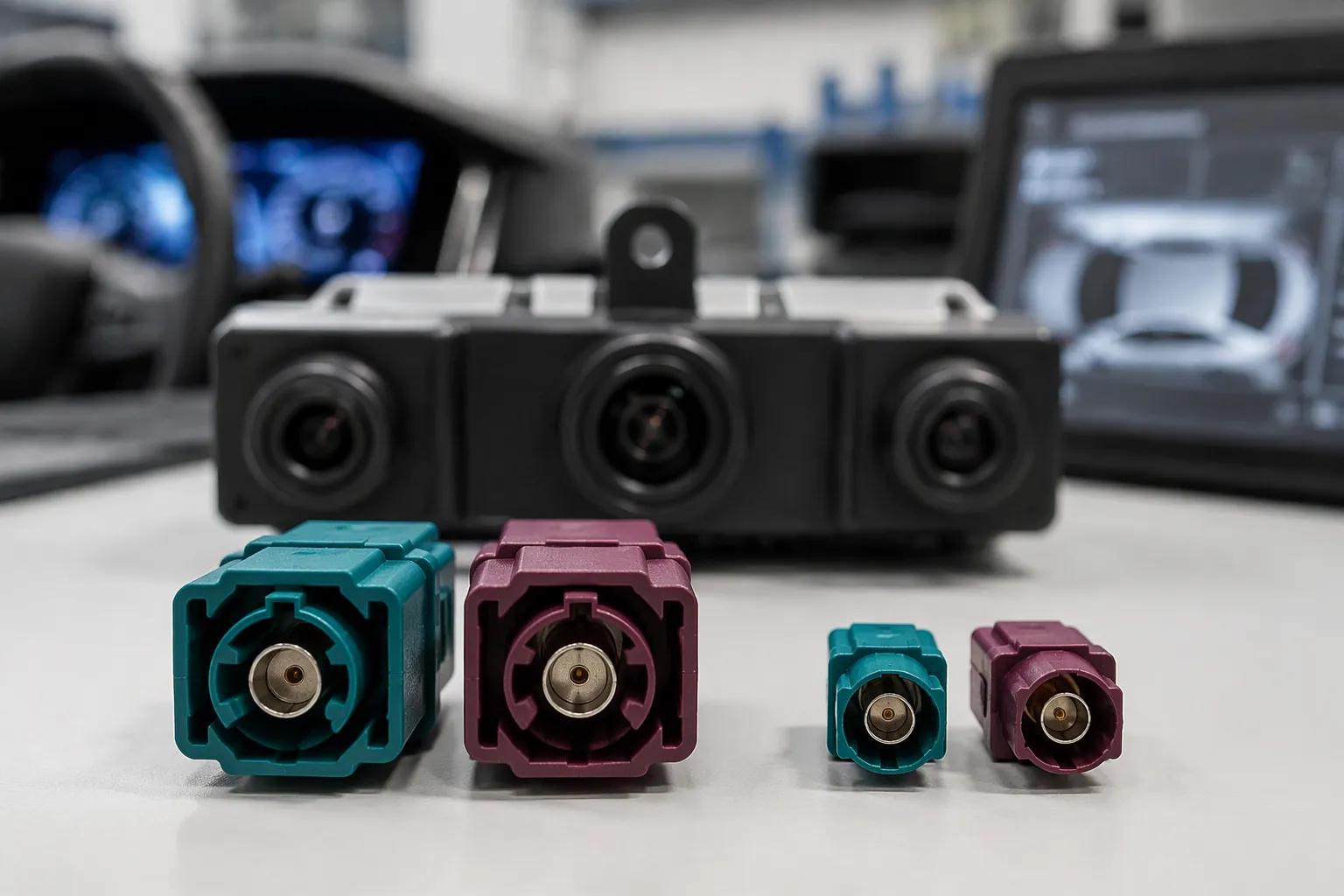
The FAKRA vs Mini FAKRA question rarely rests on size alone. Camera interface, protocol, data rate, pinout, coding, and OEM specifications drive the decision. No single connector wins every program.
In short: Mini FAKRA may save space in dense multi-camera layouts. Standard FAKRA may suit platforms already built on FAKRA interfaces and existing tooling. Interface, protocol, data rate, and OEM requirements decide the final choice.
Key Takeaways
Mini FAKRA saves space and allows more connections in tight camera layouts.
Standard FAKRA fits existing vehicle designs and is easier to service in the field.
Check the camera interface and data rate before choosing a connector family.
FAKRA and Mini FAKRA do not mate together, so confirm both ends of the link.
Match the connector coding and keying to avoid installation errors.
What Is a 360-Degree Camera System?
A 360-degree camera system combines several wide-angle cameras into one stitched view around the vehicle. Market.us describes surround-view architectures as typically deploying four wide-angle cameras. This layout removes the blind zones that a single forward-facing camera cannot cover. Drivers use the stitched image for parking, low-speed maneuvering, and full-perimeter awareness.
Surround-View Architecture Basics
Each camera in a surround-view camera system streams image data to an electronic control unit. MIPI notes that a rear backup camera can send CSI-2 data over A-PHY directly to the ECU. The ECU then pushes a real-time video stream to the dash display using DSI-2 or VESA eDP/DP over A-PHY. The same physical link can span the entire vehicle path.
Data rate shapes the link design. MIPI reports that A-PHY supports rates as high as 16 Gbps, with a roadmap to 48 Gbps and beyond. A-PHY v1.1 will double the Gear 5 downlink to 32 Gbps over star quad cables. Leopard Imaging lists Gear 1 at 2 Gbps and Gear 3 at 8 Gbps. Higher gears demand tighter impedance control and better shielding along the whole path.
Why Multi-Camera Systems Stress Connectors
A multi-camera vehicle system multiplies every connection point. Each camera adds a mated pair, a cable run, and a termination inside the ECU. One weak link can degrade the stitched image for the whole view.
The environment adds load. Kaya Vision notes that cameras mounted outdoors must withstand dust, water, chemicals, and vibration. Sturdy connectors such as FAKRA keep cables secure and hold signal integrity under vibration. Bafitoprf adds that a rear camera near the tailgate or bumper faces more exposure than a cabin camera. Connector retention and cable durability therefore matter as much as bandwidth in a multi-camera vehicle system.
How Camera Cables and Connectors Support Surround-View
Signal Path from Camera to ECU
Every surround-view camera follows the same route. The image sensor captures a frame, a serializer converts it to a high-speed serial stream, and the signal travels down a cable to the ECU. The ECU deserializes the stream, stitches the frames, and sends the result to the display. Each junction along this path adds loss and reflection.
The ADAS camera connector sits at the start of that path. It mates the camera housing to the harness and must hold impedance steady across the interface. The connector alone does not carry the signal. A complete cable assembly joins the connector, the cable, the backshell, and the termination into one tested unit. Engineers should specify the assembly, not just the connector, because a good plug on a poor termination still degrades the link.
The Role of the Automotive Camera Cable
The automotive camera cable carries both power and data through a hostile environment. Coaxial constructions suit 50 ohm links, while shielded twisted pair or shielded twisted quad suits 100 ohm differential links. The connector, cable, termination, and module impedance must all agree. A mismatch at any junction costs return loss.
Shielding protects the video stream from nearby motors, alternators, and antennas. Romtronic notes that harness bundles often include 360° braided copper shields or foil wrap around the cable cores. That shield is grounded at one end to block interference. FAKRA-based camera links commonly follow these published interface values:
Parameter | Value |
|---|---|
Impedance | 50 Ω |
Frequency range | |
VSWR | ≤ 1.30 (typical) |
Operating temperature | −40 °C to +105 °C |
Mating cycles | ≥ 25 |
Retention force | > 110 N |
Two standards govern the interface. DIN 72594-1 sets the basic dimensions, keying, and color codes. USCAR-18 adds North American performance and validation requirements. Sealed FAKRA models rated IP67 resist rain and humidity, and an IPX9K variant is available for high-pressure wash areas.
What Is a Standard FAKRA Connector?
A standard FAKRA connector is a 50 Ω RF interface built for automotive high-frequency links. LEADSIGN rates its FAKRA line from DC to 6 GHz, with data rates up to 8 Gbps and return loss of at least 18 dB. The family operates from -40 °C to +105 °C and survives at least 25 mating cycles. These figures describe the connector interface, not the full cable assembly.
Design, Coding, and Locking
The housing carries a plastic body, a center contact, and a ferrule that grips the cable shield. A primary latch holds the mated pair, and a secondary lock or CPA confirms full seating. LEADSIGN offers 13 mechanical and colored codings plus one neutral coding. Each code pairs a housing color with a rib-and-slot pattern.
Mechanical keying is the real mismating protection. Ribs and slots form a unique pattern, so only a matched pair can fully seat. A wrong key meets a physical wall. Trimming ribs or forcing a connector destroys that protection and creates a false connection. Color alone does not confirm compatibility. Two housings can share a shade and still differ in key geometry, gender, or port count. Engineers should match the exact mechanical key, the connector code, the interface gender, and the product drawing.
Typical FAKRA Camera Connector Applications
The FAKRA camera connector serves many ADAS roles. Molex lists front-view cameras, rear-view cameras, surround view cameras, blind-spot detection, and driver-monitoring systems among its automotive camera applications. TE adds lane departure warning, park assist, adaptive cruise control, and night vision cameras. A single coded family can therefore cover most camera nodes on one vehicle.
Right-angle variants help in tight spots. JAE notes that its right-angle plug can be customized to four cable exit directions for front, rear, and side camera applications. That flexibility matters when a camera sits close to a body panel. Designers should confirm the exit direction, coding, and gender against the module drawing before release. Final performance depends on the application, the cable, and the termination quality.
What Is a Mini FAKRA Connector?
A Mini FAKRA connector is a smaller, high-density variant of the FAKRA interface family. It targets modern camera and sensor links where board space and harness volume are tight. The connector keeps the familiar latch-and-key concept but shrinks the housing envelope. Engineers should treat it as its own interface family, not a trimmed standard FAKRA.
Smaller Footprint, Higher Density
The main advantage is physical. Avnet describes Mini FAKRA solutions as having a compact, high-density footprint that helps maximize space utilization. That matters when a camera module or ECU carries several ports in a small area. Molex reports up to 80% space savings over traditional FAKRA connectors. Molex also notes that the compact design reduces weight and enables more connections in a limited space.
Advantage | Detail (per Molex) |
|---|---|
Space savings | Up to 80% over traditional FAKRA |
Weight | Compact design reduces weight |
Density | More connections in limited space |
Size | Smaller than standard FAKRA |
Data rate | Up to 28 Gbps |
Frequency | Up to 20 GHz |
These figures come from Molex product literature. They describe that vendor's Mini FAKRA system, not every Mini FAKRA product on the market. Buyers should confirm the values for the exact part they plan to use.
Where Mini FAKRA Connectors Fit
Mini FAKRA suits compact camera modules and dense multi-port ECUs. Avnet lists supporting frequencies up to 9 GHz for its Mini FAKRA line. Molex rates its high-speed Mini FAKRA system up to 20 GHz and 28 Gbps. Actual performance depends on the application, the cable, and the termination.
One rule is firm. FAKRA and Mini FAKRA are not directly intermateable. A standard FAKRA plug will not seat in a Mini FAKRA jack, and the reverse also fails. Each family needs its own mating half, its own harness design, and its own coding check. Designers should confirm the interface family on both the camera and the ECU before release.
Why Connector Size Matters in Multi-Camera Architecture
Connector size shapes both the physical fit and the long-term cost of a multi-camera vehicle system. A smaller housing frees space on the module and in the harness. A larger housing leaves room for fingers, tools, and inspection. Each family trades one benefit for the other, so engineers should weigh both sides before release.
Packaging Space and Connector Density
Vehicle electronics keep compressing more function into less space. Molex notes that growing electronic content places constraints on connector size and packaging efficiency. TE expects next-generation vehicles to need more than 10 cameras, each smaller and higher in resolution. That trend pushes designers toward denser interconnect.
Molex reports that its HSAutoLink C system supports up to 24 pins in a reduced footprint.
TE cites a 75% PCB footprint reduction for its MATE-AX miniaturized coaxial system.
Wevolver warns that smaller connectors must still hold contact force, isolation, and mechanical strength.
Mini FAKRA follows this density logic. It lets several camera links enter one compact module. Standard FAKRA needs more panel area for the same port count. The tradeoff is real. Density gains demand tighter drawings, defined routing, and disciplined assembly.
Serviceability Tradeoffs
Service access shapes warranty and repair cost. A technician who can reach and replace one line quickly lowers field expense. Standard FAKRA usually wins here. Its larger housing is easier to identify, grip, and swap one cable at a time. Field technicians already know the form factor.
Mini FAKRA packs more ports into the same block. That density can complicate field access. Dense multi-port blocks save space, but they can make individual replacement less intuitive. The fakraconnectors article notes that Mini FAKRA rewards teams with stable drawings and fixture-based assembly control. Neither family is wrong. Standard FAKRA favors service simplicity, while Mini FAKRA favors port density.
FAKRA vs Mini FAKRA: Comparison Table
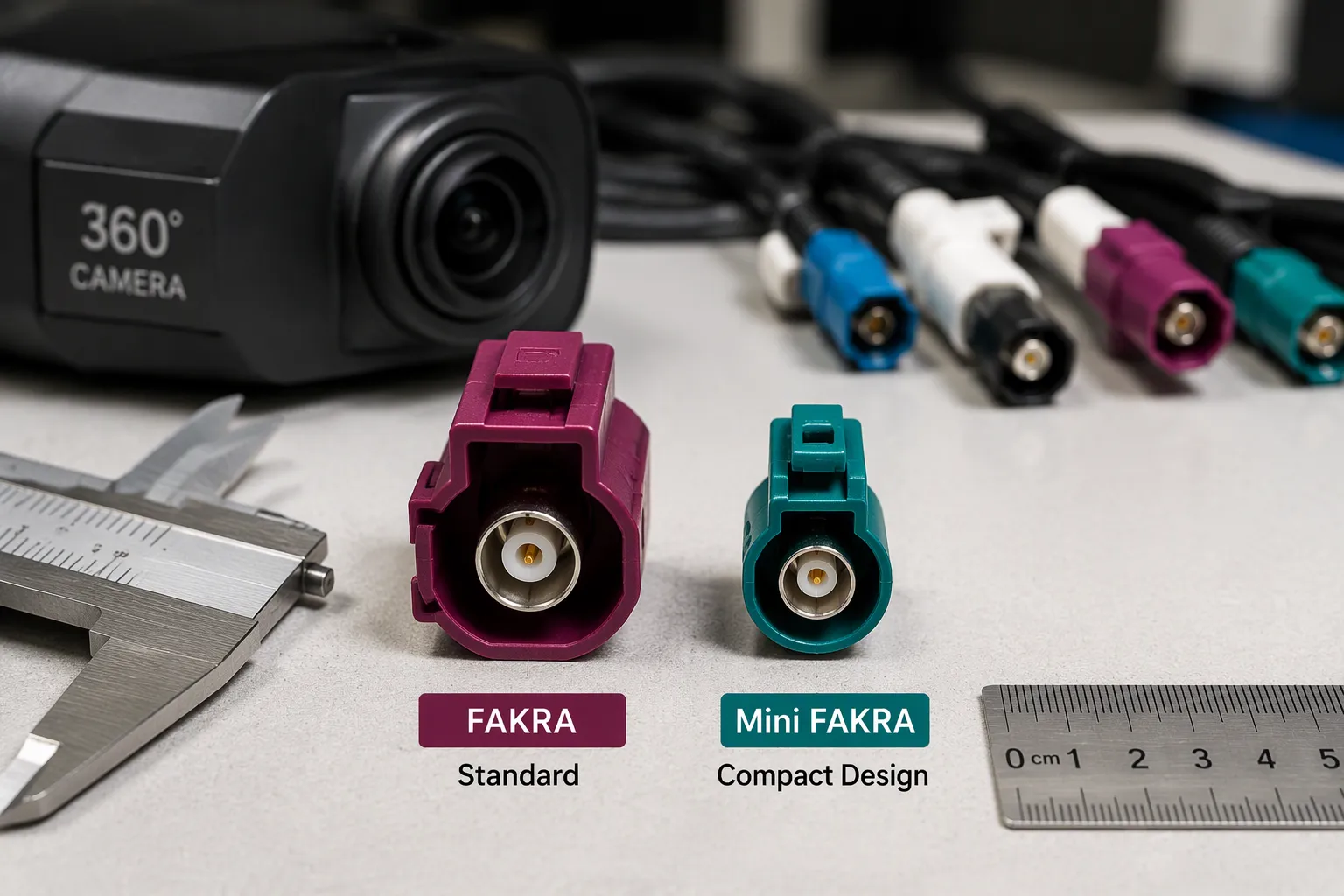
Nine criteria decide most surround-view connector choices. The table below sets standard FAKRA against Mini FAKRA on each one. Values stay qualified, because performance depends on the selected series, the cable assembly, and the OEM drawing.
Nine Selection Criteria Side by Side
Criterion | Standard FAKRA | Mini FAKRA |
|---|---|---|
Connector size | Larger housing built on the SMB interface with a protective plastic shell | Noticeably smaller housing for compact modules; Molex reports up to 80% space savings for its HFM system |
Packaging space | Moderate board area per port; one RF connection per housing | Small board area; several RF ports can share one body |
Connector density | One coaxial link per connector | Multi-port bodies, including quad versions, pack several links into one interface |
Typical camera applications | Rear-view, backup, parking, surround-view, and ADAS camera units; single-link harnesses | Dense camera and ADAS modules, around-view monitor clusters, compact multi-camera ECUs |
Coding and keying | 13 mechanical and colored codings plus one neutral coding on the LEADSIGN line; color and key pattern prevent mismating | Mechanical coding and color options, depending on the application; not intermateable with standard FAKRA |
Cable assembly requirements | Coaxial cable with crimped contacts; sealed versions for exterior use | Compact coaxial assemblies on mini-coax; termination is process-critical and best handled by a harness specialist |
Installation considerations | Easier to identify, grip, and replace one line at a time in the field | Denser blocks can complicate individual replacement; rewards fixture-based assembly control |
Platform compatibility | Fits platforms already built on FAKRA interfaces and existing harness designs | Fits modules designed for the smaller interface; requires its own mating half and coding check |
Customization requirements | Custom lengths, coding, gender, exit direction, and breakout branches | Same customization scope, plus tighter strip geometries and multi-port channel assignments |
Reading the Tradeoffs
The size row explains most of the FAKRA vs Mini FAKRA debate. Standard housings suit single feeds with room to spare. Mini housings pack several ports into one body for dense modules. Neither wins in every case.
The signal row carries equal weight. Both families present a 50 Ω coaxial, single-ended path. LEADSIGN rates its FAKRA line from DC to 6 GHz with data rates up to 8 Gbps. Molex quotes its high-speed Mini FAKRA system up to 20 GHz and 28 Gbps. Those figures apply to specific families, so engineers should confirm them for the chosen part.
Channel count usually settles the question. A four-camera surround-view system needs four video feeds. Four standard connectors take four separate ports and a wide strip of board area. One quad Mini FAKRA housing carries four coaxial ports in a single interface. That body serves the front, rear, left, and right channels with one latch.
Platform history matters just as much. A vehicle already wired for standard FAKRA needs no new tooling, no new harness drawings, and no retraining on the line. A clean-sheet module can adopt the smaller interface from the start. The decision follows the module design, not a preference for novelty.
Service access closes the loop. Standard FAKRA favors simple field replacement. Mini FAKRA favors port density. Engineers should weigh both against warranty exposure and technician workflow before release.
When Standard FAKRA May Be Suitable
Standard FAKRA may be suitable when the vehicle platform already speaks its language. The connector family has served automotive RF links for over two decades, according to 5GStore. That history gives engineers a deep base of drawings, validation data, and field experience to draw on.
Existing FAKRA Vehicle Architecture
A vehicle already wired for standard FAKRA may need no new interface work. The harness drawings, ECU ports, and camera housings all match the existing family. TE lists FAKRA connector systems for both US/APAC and European vehicle platforms, so global programs can often reuse one interface.
The FAKRA vs Mini FAKRA decision becomes simpler here. 5GStore notes that the standard covers 14 different mechanical layouts, with color coding and a push-on latch that gives audible confirmation. A designer can usually find a coding that fits the existing port without redesigning the module. Compatibility with existing cable assemblies also favors the standard family. Teams can reuse proven coax builds instead of qualifying a new interface.
Mature Platforms and Tooling
Mature camera platforms may already carry the tooling, fixtures, and crimping programs that standard FAKRA needs. MetaBee describes the termination process as precision work: the jacket, shield, and dielectric must be stripped to exact tolerances, then crimped with automated machines for high-volume runs. A platform with that equipment in place avoids a fresh capital cycle.
Available installation space also matters. Standard FAKRA housings need more panel area per port than the smaller family. A mature platform with room to spare may not gain much from shrinking the connector. Existing harness design, bend radius, and service access already suit the larger body. MetaBee adds that FAKRA connectors undergo thermal shock, vibration, and salt spray validation for OEM approval. Reusing a validated interface may reduce the test burden on a new program.
When Mini FAKRA May Be Suitable
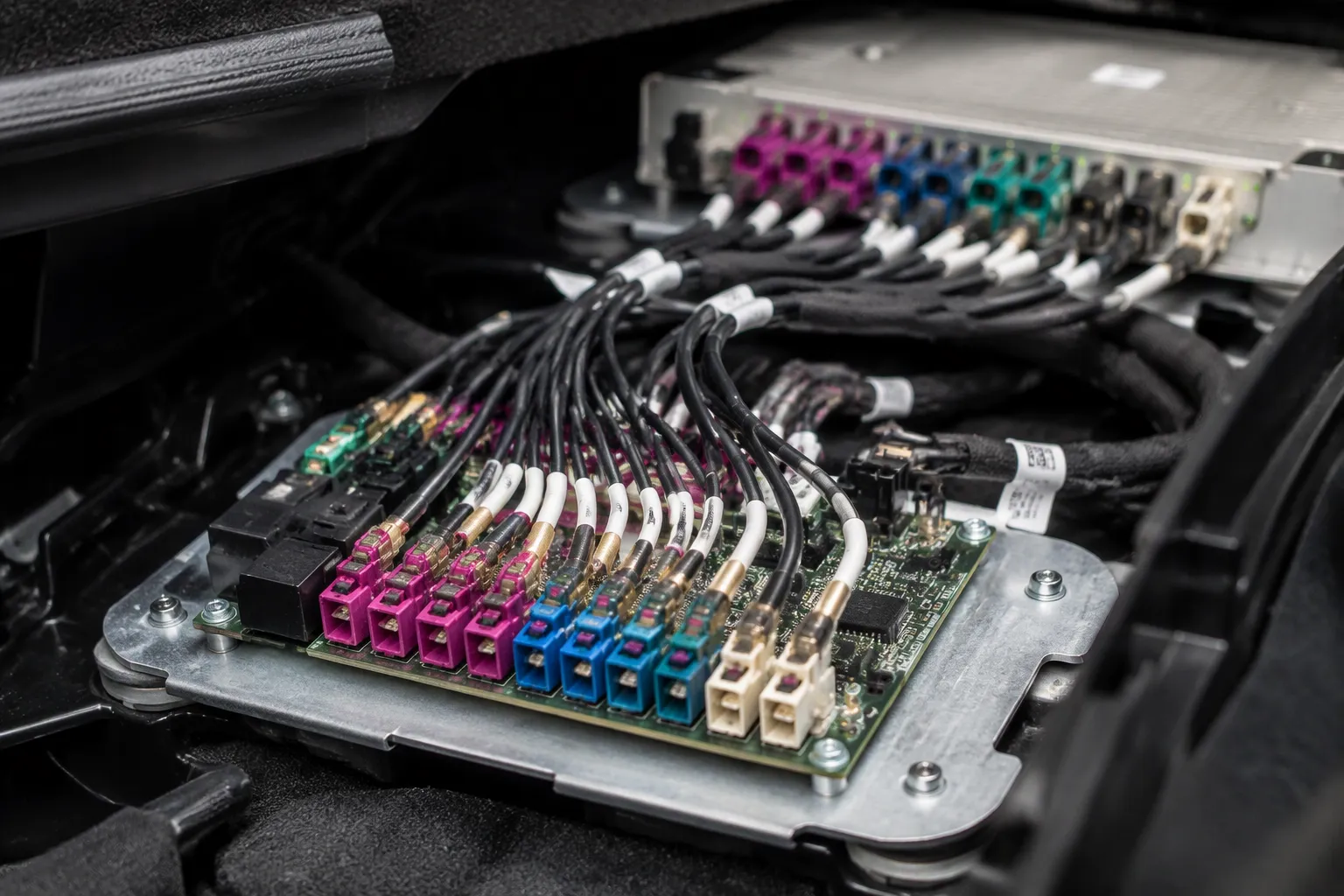
Mini FAKRA may be suitable when the camera module and the harness both run short on room. The smaller housing lets designers add ports without widening the module. That benefit grows as camera counts rise across a platform.
Compact Camera Modules and High Density
Compact camera modules often leave little board area for a full-size FAKRA shell. A Mini FAKRA connector fits that tighter envelope and still carries a coaxial link. Several ports can share one body, so a dense module keeps its channel count without spreading across the panel.
The FAKRA vs Mini FAKRA choice often follows the port count. Strategic Market Research reports that modern infotainment systems require 6+ camera feeds and 4K streaming. Mini FAKRA connectors let designers hold signal integrity without sacrificing real estate. The same source notes that modern cars deploy 8–12 cameras, plus radar and LiDAR units. Each node needs a low-loss, shielded link, and density becomes the limiting factor.
New Vehicle Electrical Architectures
New electrical architectures concentrate compute and pull many sensor links into one hub. That layout rewards a connector family built for tight, multi-port routing. LinkedIn reports that 5G and IoT integration is creating demand for RF connectors that support higher data rates and bandwidths. Mini FAKRA connectors are evolving to meet those requirements.
LinkedIn notes that connected-car technologies, including telematics, navigation, and V2X systems, are boosting demand for high-quality RF connectors.
LinkedIn adds that EVs need robust RF connectivity for battery management, charging communication, and infotainment.
LinkedIn also cites the trend toward compact vehicle designs as a driver for smaller connectors that do not compromise performance.
Strategic Market Research describes a European EV manufacturer that consolidated radar, vision, and driver-monitoring data into one hub behind the glovebox. Over 20 RF cables had to route through a tight cavity. The OEM switched to FAKRA-mini connectors with custom low-loss coax cables. Total connector volume fell by 40%, airflow improved, and EMI crosstalk dropped. Assembly time fell by 25%, and the system passed EMC testing in its first validation cycle. Mini FAKRA is not universally better, but it may fit this kind of dense, centralized layout well.
Technical Factors to Confirm Before Selecting
A connector choice only holds up when the whole link is defined first. Engineers should lock down the electrical and mechanical requirements before they compare FAKRA vs Mini FAKRA part numbers. Bafitop notes that the module interface, nominal impedance, cable structure, connector coding, shielding transition, routing, and validation method all belong in that review.
Interface, Protocol, and Data Rate
The camera interface sets the bandwidth floor. Renhotec reports that GMSL1 reaches up to 3.12 Gbps, GMSL2 up to 6 Gbps, and GMSL3 up to 12 Gbps. The same source lists standard FAKRA and HSD as typical connectors for GMSL1 and GMSL2, while GMSL3 architectures lean toward Mini FAKRA (HFM or MATE-AX). A 12 Gbps link therefore narrows the hardware list quickly.
Protocol | Max Forward Rate | Typical Connector |
|---|---|---|
GMSL1 | Up to 3.12 Gbps | Standard FAKRA, HSD |
GMSL2 | Up to 6 Gbps | Standard FAKRA, HSD |
GMSL3 | Up to 12 Gbps | Mini FAKRA (HFM / MATE-AX) |
Engineers should also confirm impedance, cable length, pinout, coding, gender, and straight versus right-angle exit. Shielding type and bend radius follow the routing plan. Final values depend on the application and the OEM drawing.
Mechanical and Environmental Checks
The housing must survive the vehicle, not just the bench. MetaBee describes thermal shock cycling between -40 °C and +105 °C, multi-axis vibration runs, and salt spray exposure for corrosion resistance. Renhotec ties these checks to USCAR-2 and ISO 20860-2 clauses for damp heat, vibration, and thermal shock.
Confirm the primary latch clicks and the CPA clip seats.
Verify the coding key matches the mating half.
Check IP67 or IPX9K sealing for exterior camera nodes.
Confirm strain relief and cable retention under vibration.
Common Connector Selection Mistakes
Size-Only Selection and Interchangeability Assumptions
A smaller housing does not guarantee a better fit. Engineers who pick a connector by size alone often overlook the interface behind it. The FAKRA vs Mini FAKRA decision starts with the camera module and the ECU port, not the panel footprint. A compact part that cannot mate with the existing jack adds cost instead of saving space.
Some teams also assume the two families interchange. They do not. A standard FAKRA plug will not seat in a Mini FAKRA jack, and the reverse fails too. Designers should confirm the interface family on both ends of the link before they compare drawings. Bafitoprf advises checking whether the cable end mates with a plug or jack on the module. That single check prevents a costly harness revision later.
Interface, Coding, and Cable Routing Errors
Interface details cause quiet failures. Bafitoprf lists several checks that catch them early. A straight connector may not clear a housing that only accepts a right-angle exit. A right-angle part can solve one layout problem and create another when its cable exit direction points toward a blocked area. Teams should add a top view sketch or clock position to the drawing for every right-angle Mini FAKRA connector.
Coding and routing deserve the same discipline. The housing color must match the channel plan used in the drawing, label file, and inspection report. A color change after sample approval creates confusion when one ADAS controller carries several similar coax ports. Cable bend radius matters too. A short cable still fails if the bend area sits too tight near the connector. A low-loss cable may not fit a module designed for a smaller outer diameter. Finally, buyers should request one test report for the finished assembly, not separate reports for loose connectors or raw cable.
Installation and Inspection Checklist
A checklist catches the errors that a bench test misses. The fakraconnectors.com guide notes that a housing which is not fully seated may pass a bench check, then turn unstable after vibration or harness movement. Two short phases — one before the mate, one after the module bolts down — cover most field failures.
Pre-Installation Verification
Verification starts at the drawing, not at the connector. The fakraconnectors.com guide advises engineers to verify the interface and coding against the module drawing. They should match the key pattern on the connector to the receptacle before attempting a mate. A wrong key meets a physical wall, and forcing it destroys the protection.
Cable preparation deserves the same care. Julie Ma notes that RG174, RG316, and RTK031 cannot be swapped, because the wrong coax breaks impedance matching. She also warns that hand pliers bring high failure risk, so teams should use the specified crimp tools. Her post adds that Code Z serves lab testing only, not mass production. Inspectors should check the shield termination and the crimp on each connector for folds or gaps.
Confirm the interface family and coding key against the module drawing.
Confirm the pinout and cut length before stripping.
Inspect the shield termination and crimp under magnification.
Check the minimum bend radius against the actual route.
Confirm the latch clicks and the housing sits flush.
Post-Installation Inspection
The second pass happens after the camera module bolts down. The fakraconnectors.com guide recommends rechecking each vehicle camera connector at that point. Technicians should confirm each camera link, each FAKRA joint, and each Mini FAKRA port once more before sign-off. They should also inspect the latch area on every connector after seating.
Strain relief closes the loop. A cable that pulls on the housing under vibration will eventually work the latch loose. Julie Ma suggests monitoring strip length, crimp height, pull force, and 50 Ω impedance during production. The fakraconnectors.com guide adds one simple record step: photograph each terminated connector and each routed cable, then keep the inspection record with the harness drawing.
Custom FAKRA and Mini FAKRA Cable Assemblies
When a Custom Camera Cable Assembly Makes Sense
A catalog connector rarely matches a real camera route on its own. Each camera node needs a defined length, a specific coding, and a termination that suits the module port. A custom camera cable assembly joins those parts into one tested unit. Engineers then validate the whole link instead of a loose set of components.
Custom builds pay off when routing is tight or channel counts are high. A rear camera may need a right-angle exit and a longer run than a front unit. A dense ECU may need several branches from one harness. A supplier can build each branch to the drawing, label it by channel, and test it before shipment. That approach reduces field errors and simplifies incoming inspection.
LEADSIGN Custom Harness Support
LEADSIGN supplies [FAKRA connectors], [Mini FAKRA connectors], HSD connectors, coaxial adapters, and antennas from its Shenzhen base. The company brings over seven years of automotive connector experience to each program. Its team also builds [automotive camera cables] and [custom cable assemblies] to customer drawings.
The company offers OEM and ODM services with short delivery times. Buyers can source connectors, cable, and finished harnesses from one supplier. That single source simplifies coding checks, test records, and change control. A buyer who needs a sealed exterior run or a multi-branch interior harness can request a quote and a technical review together.
What Buyers Should Tell LEADSIGN
A clear request shortens the quote cycle and prevents sample revisions. Buyers should send the full system picture with the first inquiry. LEADSIGN can then match the connector family, the cable, and the termination to the actual camera route.
System and Connector Details
The request should start with the camera count and the location of each camera. A four-camera surround-view layout differs from a twelve-camera ADAS layout in port count and harness branches. Buyers should name the connector family for each node, whether standard FAKRA or Mini FAKRA. They should also state the coding or key position, the cable length, and the pinout for every channel.
Signal details complete the electrical picture. Buyers should list the signal type, the shielding requirement, and the cable jacket material. They should confirm whether each connector is straight or right-angle. Branches and breakout points belong on the same drawing, because they change the harness build and the test plan. A labeled sketch of the route helps more than a text description alone.
Environmental and Testing Requirements
The environment shapes sealing, materials, and validation. Buyers should describe where each camera sits, such as a bumper, a tailgate, or a cabin. They should state the expected temperature range and any moisture or wash exposure. LEADSIGN rates its FAKRA line from -40 °C to +105 °C, so buyers can confirm whether that window covers the application.
Testing expectations should arrive with the first request. Buyers should list the samples they need and the tests they plan to run. They should also note any OEM drawing or standard the assembly must meet. A consultative review with LEADSIGN at this stage catches mismatches before tooling starts.
Mini FAKRA may offer clear packaging and density advantages in compact multi-camera systems. Standard FAKRA may suit platforms already built on FAKRA interfaces or requiring established compatibility. Neither family wins every program.
The FAKRA vs Mini FAKRA decision ultimately rests on camera interface, signal protocol, data rate, pinout, coding, cable design, environmental requirements, and OEM specifications. Engineers should confirm each factor against the module drawing before release. LEADSIGN welcomes technical questions and can prepare a quotation for standard or Mini FAKRA connectors and custom camera cable assemblies. Contact the team to review a specific surround-view layout.
FAQ
Can a standard FAKRA plug mate with a Mini FAKRA jack?
No. The two families use different housing envelopes and key geometry. A standard FAKRA plug will not seat in a Mini FAKRA jack, and the reverse also fails. Each family needs its own mating half, harness drawing, and coding check. Engineers should confirm the interface family on both the camera and the ECU before release.
Is Mini FAKRA always the better choice for a surround-view camera system?
No. Mini FAKRA may offer packaging and density gains in compact modules. Standard FAKRA may suit platforms already built on FAKRA interfaces and existing tooling. The FAKRA vs Mini FAKRA decision follows the camera interface, protocol, data rate, pinout, coding, and OEM specifications, not size alone.
How many cameras does a typical 360-degree camera system use?
Most surround-view layouts deploy four wide-angle cameras, one at the front, rear, left, and right. Some platforms add more nodes for blind-spot or driver monitoring. Each camera adds a mated pair, a cable run, and an ECU termination, so port count shapes the connector choice.
What should a buyer send LEADSIGN for a camera cable quote?
Buyers should send the camera count, camera locations, connector family, coding or key position, cable length, pinout, signal type, shielding, jacket material, and straight or right-angle exit. A labeled route sketch and any test requirements help LEADSIGN match the assembly to the application.
See Also
Discovering The Benefits Of Mini Fakra Connectors In Automotive Uses
Exploring The Perks Of Mini Fakra Connectors In Automotive Systems
Boosting Space Efficiency With Mini FAKRA Connectors In Automotive Uses
A Complete Guide To Understanding Fakra Connectors For Everyone
Discovering The Advantages Of Fakra Connectors In Automotive