FAKRA Connector Applications in Automotive Camera Systems

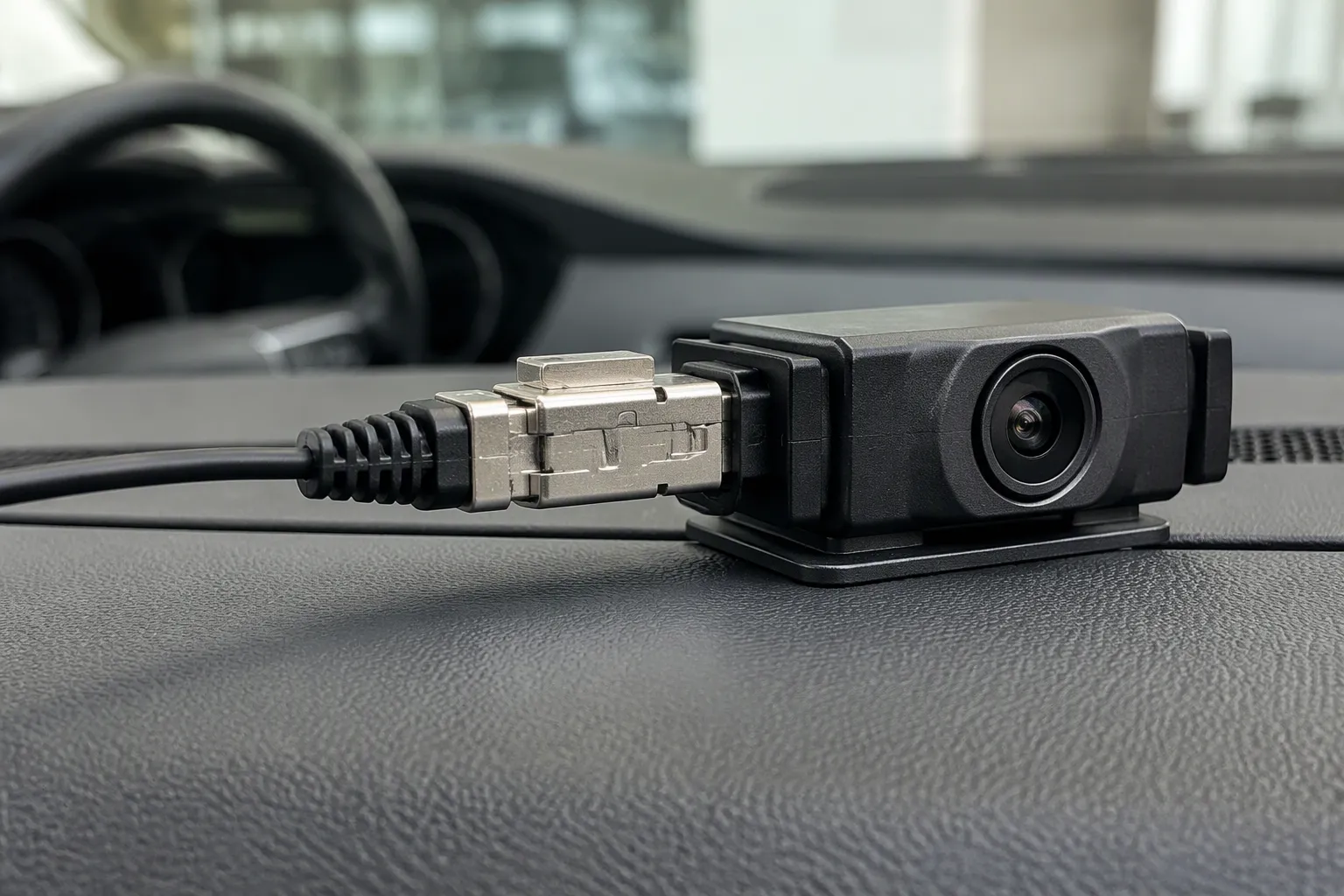
Connector choice shapes signal reliability, mechanical security, and long-term performance. FAKRA connector applications in automotive camera systems include rear-view cameras, backup cameras, parking cameras, surround-view modules, and ADAS camera units.
TL;DR: FAKRA connectors link rear-view, backup, parking, surround-view, and ADAS cameras to vehicle control units. Keyed housings and shielding protect signal quality. Compatibility depends on the camera module, platform, interface, protocol, pinout, and OEM requirements.
Key Takeaways
FAKRA connectors link rear-view, backup, parking, surround-view, and ADAS cameras to vehicle control units.
Keyed housings and shielding protect signal quality and prevent mismating.
Compatibility depends on the camera module, platform, interface, protocol, pinout, and OEM requirements.
Always confirm the connector type, coding, and cable assembly before ordering or installing.
What Is a FAKRA Connector?
Definition and Standardized Interface
FAKRA is a standardized RF connector family built for vehicle electronics. It carries antenna, GPS, camera, and infotainment signals. The housing uses a keyed, color-coded plastic shell. That keying stops one vehicle function from plugging into another.
These standardised rf connectors follow USCAR requirements. Suppliers cite USCAR-2, USCAR-17, and USCAR-18, and some hold ISO 20860-1 certification. Common color codes include A, B, C, D, E, F, and Z. A latch, a secondary lock, and a molded body define the family. Performance limits vary by design, so engineers check the datasheet for each part.
A fakra connector is one component, not a finished harness. The complete fakra cable assembly adds coaxial wire, terminals, shielding, and strain relief. Buyers who order only the plug still need a terminated fakra cable before installation. Loose housings and pre-assembled fakra cables serve different stages of a build.
Standardization also helps service and sourcing. A technician can identify a connection by color and keyway. A distributor can stock one family across several vehicle lines. Interchangeability still depends on the camera module, platform, and OEM print.
Role in Automotive Camera Systems
Camera modules sit far from the head unit or controller. A short pigtail often leaves the camera body. The main harness then carries the signal back to the host. FAKRA handles that link in many automotive applications, including rear-view and ADAS paths.
The connector alone does not define the signal. Camera type, protocol, pinout, and OEM specification set compatibility. Some platforms use FAKRA for camera video. Others route camera data over a different fakra interface or a high-speed data link. In-car displays and telematics units may share the same housing family.
Shielding continuity matters here. The shell must bond to the cable braid at both ends. A gap in that path lets noise reach the video pair. Engineers should confirm the mating half before ordering. A visual match does not prove electrical compatibility.
Why FAKRA Connectors Suit Automotive Camera Systems
A camera module rarely sits next to its host. The signal must travel from the lens housing to a central control unit, a surround-view controller, or an ADAS ECU. A fakra connector carries that link in many automotive applications. The connector family pairs a keyed housing with a coaxial interface. That combination supports both electrical and mechanical needs in one package.
Signal Reliability and Shielding
FAKRA signal reliability depends on preserving the coaxial structure across the connector transition. Center-contact position, dielectric condition, outer-conductor continuity, crimp geometry, cable deformation, and connector-to-cable impedance all shape return loss and insertion loss. A stable DC connection alone does not prove the full coaxial channel meets its frequency requirement. Shielding verification must follow the electrical topology of the connector.
Connector | Shielding Focus |
|---|---|
HSD | Conductor balance, differential impedance, crosstalk, and shield continuity |
FAKRA | Coaxial geometry, outer-conductor continuity, return loss, and insertion loss |
FAKRA connectors offer excellent emc shielding performance. During video transmission they block external electromagnetic interference, which helps keep images clear and stable. Their shielding performance also makes them a mainstream choice for in-vehicle camera systems. The connector carries high-definition video from the camera module to the host without delay or interference. Engineers who need shielded connection solutions for a camera system should confirm the mating half and the cable build together.
Mechanical Security and Locking
Road vibration tests the lock, not just the signal. During vibration testing, FAKRA assemblies shake on multi-axis tables for hours to simulate years of driving. The Connector Position Assurance (CPA) lock must stay engaged throughout. That result confirms the connector can withstand sustained automotive vibration.
The durable, rugged plastic housing helps protect FAKRA connectors from harsh operating conditions, including debris, weather, shock, and vibration.
Many FAKRA versions add a secondary lock beyond the primary audible click. These dual mechanisms resist extreme vibration and accidental disconnection. The locking design keeps a stable connection intact over thousands of miles, unlike standard RF connectors that may loosen. USCAR-17, DIN 72594-1, and ISO 20860-1 define performance expectations for the family. USCAR-18 adds strict testing for mating force, retention force, and vibration resistance. Compatibility still depends on the camera module, platform, and OEM print, so suitability varies by application.
FAKRA Connector Applications in Automotive Camera Systems
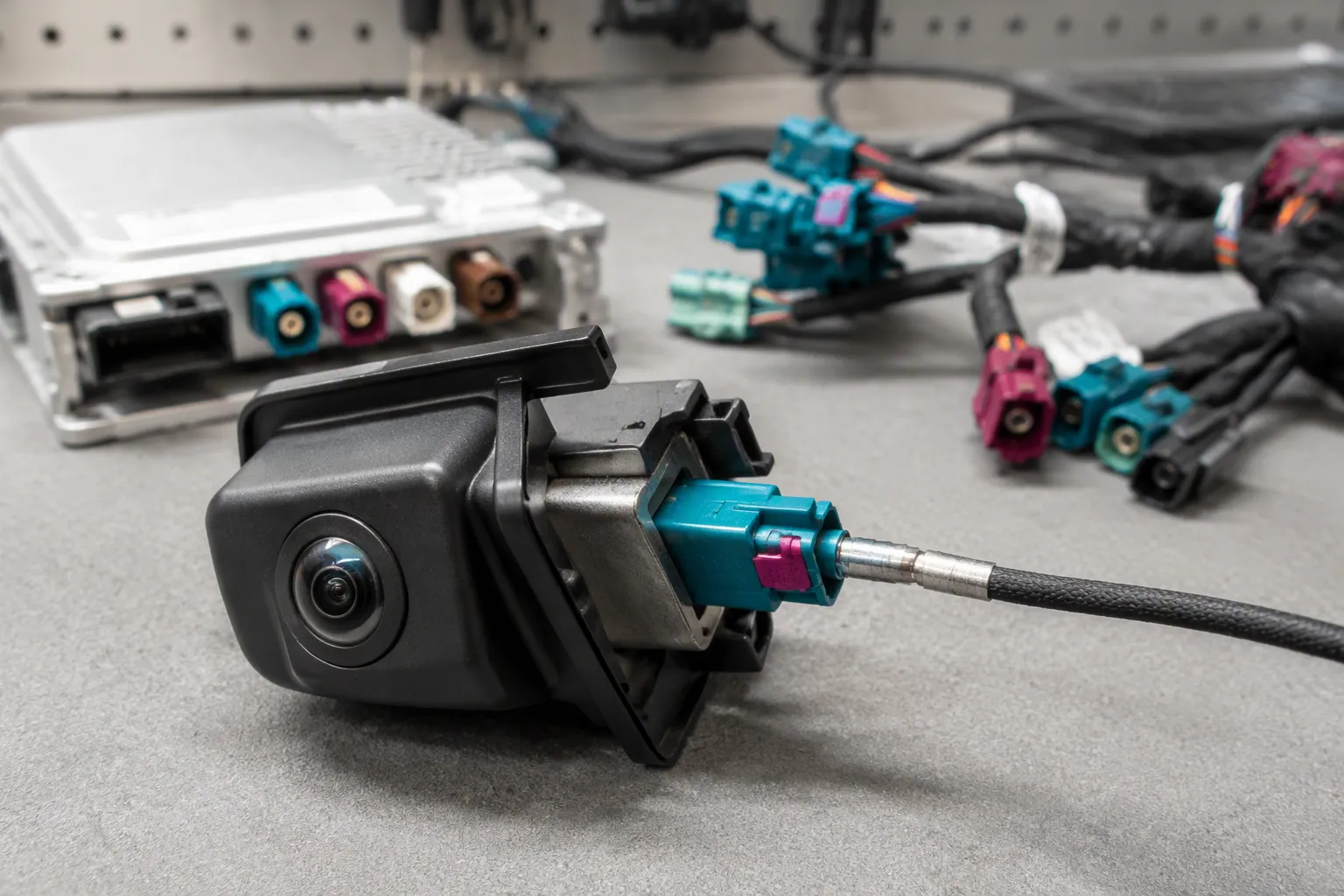
Rear-View Cameras and Backup Cameras
A rear-view camera sends its image to a display or head unit through a short pigtail and a body harness. Many vehicles terminate that link with a fakra connector at each end. The connector carries analog video signals on older platforms and high-definition video signals on newer ones. The exact interface depends on the camera module and the OEM print.
Backup cameras follow the same pattern. A reversing camera system often uses a single coaxial channel from the tailgate to the cabin. The fakra housing locks that channel against vibration and road shock. Installers should confirm the coding before mating two halves. A color match alone does not prove electrical compatibility.
Rear-view cameras also appear in mirror-display and retrofit kits. These builds often need a complete fakra cable assembly rather than a loose plug. The assembly adds the coax, terminals, and shield termination. Buyers who order only the housing still face a crimping step in the bay.
Parking, Surround-View, and ADAS Cameras
Parking and 360° surround view system designs multiply the channel count. A surround view system may route four or more camera feeds to one controller. Space and port density then become the limiting factors. Traditional FAKRA is relatively large, so compact ECUs often move to [Mini FAKRA connectors].
Front-camera-to-body harnesses may be terminated with FAKRA Type A connectors on both ends. Engineers should verify that detail against the platform drawing. An ADAS camera connector must match the serializer, deserializer, and pinout. The adas ecu side follows the same rule.
Telematics and antenna-related systems share the housing family. GPS, radio, and cellular links use the same keyed interface in many automotive applications. That shared family helps sourcing across vehicle lines.
The table below compares the three families. The values come from published series data and vary by product.
Attribute | FAKRA | Mini-FAKRA | HSD |
|---|---|---|---|
Transmission structure | Coaxial | High-speed coaxial | Shielded differential |
Typical impedance | 50 Ω | 50 Ω | 100 Ω differential |
Frequency capability | ~6 GHz (series-dependent) | up to ~20 GHz (some series) | ~2 GHz (series-dependent) |
Data capability | protocol/assembly-dependent | 20–28 Gbps (some series) | ~1.6 Gbps (traditional products) |
Camera-relevant applications | GPS, radio, cellular, V2X; traditional single camera | Cameras, ADAS, displays, radar; 360° and multi-camera ECUs | LVDS, GVIF, USB, Ethernet; differential camera/display links |
Space requirement | Relatively large | More compact than traditional FAKRA | Medium |
Mismating prevention | Color + mechanical coding | Mechanical coding | Mechanical coding |
Common cable types | RG174, RG316, automotive coax | High-frequency automotive coax | Shielded twisted-pair or star-quad |
The connector choice follows the electrical interface, not the label "camera cable." A coaxial serial link needs a 50 Ω coaxial channel. An LVDS or USB link needs a 100 Ω differential channel, which suits [HSD automotive cables]. The three families are not interchangeable.
A practical buyer checklist helps before ordering:
Confirm the camera interface and signal type.
Confirm the protocol and impedance.
Confirm coding, gender, and orientation.
Confirm cable length and routing.
Confirm shielding, jacket, and terminal requirements.
Confirm environmental and vibration needs.
Request samples and testing where the platform allows.
Buyers who need a non-standard length or branch should review [custom automotive cable assemblies]. Standard [FAKRA connectors] cover many builds, but the harness drawing decides the final part.
Meta title: FAKRA Connector Applications in Automotive Camera Systems Meta description: Explore FAKRA connector applications in automotive camera systems, from rear-view and backup cameras to parking, surround-view, and ADAS modules.
FAKRA Coding, Structure, and FAKRA Cables
Coding and Keying to Prevent Mismating
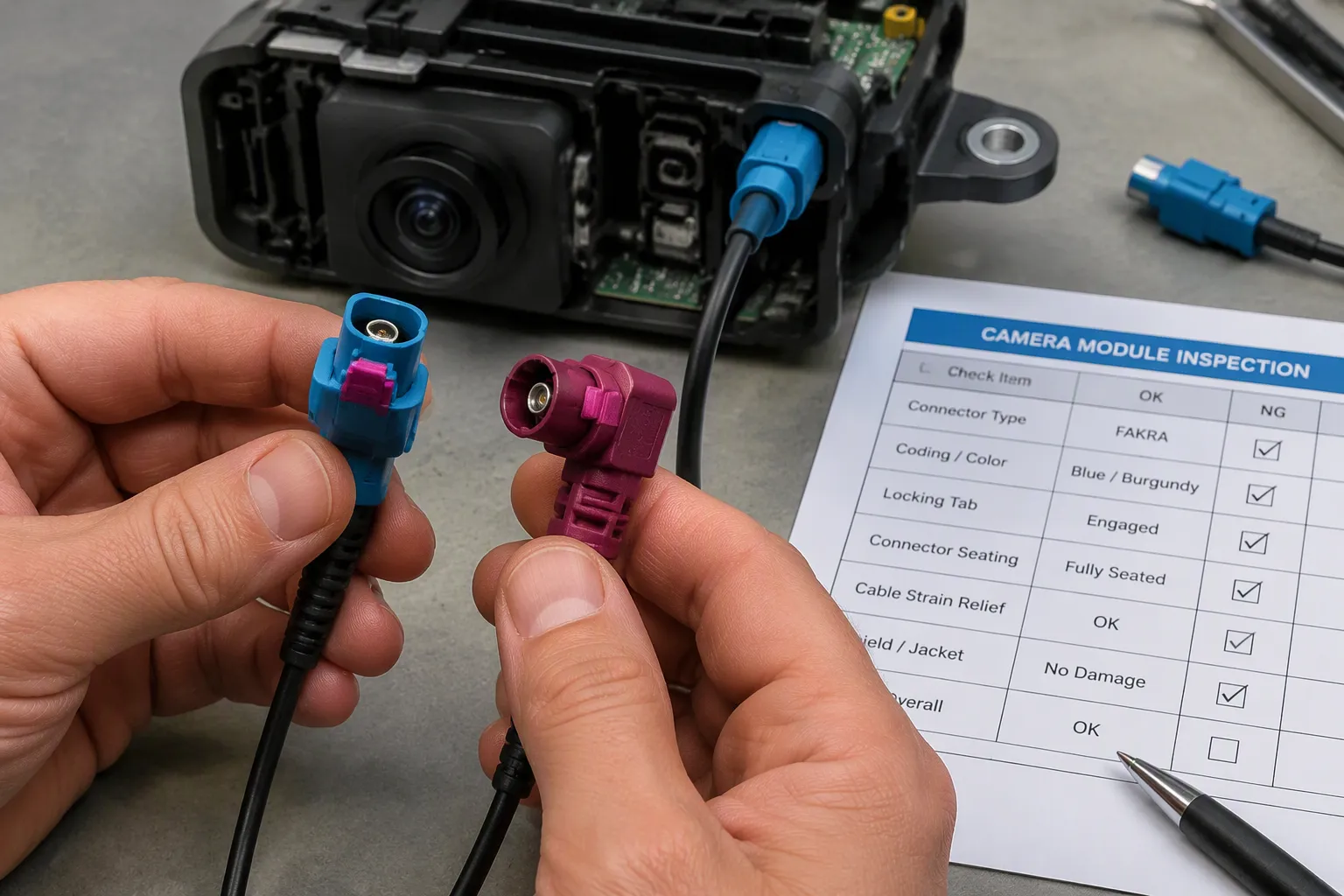
A color-coded housing and a mechanical keyway form the first defense against wrong connections. Each code position allows only one mating pair. A blue housing will not seat on a socket cut for another code. The keyway blocks the attempt before the center contact touches.
Gender adds a second layer. Male and female interfaces must pair correctly, and a forced fit damages the center contact. Orientation matters too. Straight plugs suit open runs behind a panel. Right-angle versions save depth in tight camera housings and tailgate cavities.
Cable Construction and Shielding
A fakra cable is a system, not a single part. The build combines a 50 Ω coaxial interface, a crimped terminal, a braid termination, and a molded or assembled housing. The connector, cable, termination, and module impedance must all match. A mismatch at any point degrades the channel.
Requirement | Specification |
|---|---|
Cable impedance | 50 Ω coaxial interface (DC–6 GHz, VSWR ≤ 1.30 typical) |
Shielding | Fully shielded connector with quality crimp termination |
Shield continuity | Continuous path from camera shell to ECU ground |
Installation care | Confirm bend radius and strain relief at both ends |
Shielding performance depends on a continuous path. A broken shield on long runs radiates noise instead of blocking it. Under-hood and trunk installs near EMI sources need a fully shielded connector with a quality crimp. Installers should confirm bend radius and strain relief at both ends. That care protects the shield and the center conductor.
Buyers often confuse a loose plug with a finished fakra cable assembly. The assembly adds the coax, terminals, and shield bond. Standard fakra cables cover many automotive applications. Builders who need a specific length or branch should order fakra cables to print. Code C parts, sometimes listed as fakra c cables, follow the same construction rules. Every automotive harness drawing should name the code, gender, and orientation.
Selection, Comparison, and Common Problems in Automotive Applications
Selecting a FAKRA Camera Connector
Selection starts with the camera interface, not the housing color. Engineers confirm the signal type first. Some platforms carry analog video signals over a coaxial channel. Others use a digital link with a defined protocol. The impedance must match the interface, and the cable length must suit the route.
Coding, gender, and orientation follow the electrical match. A straight plug suits an open run. A right-angle body saves depth in a tight housing. Exterior mounts demand attention to vibration, moisture, and locking. Strain relief must hold the joint under road shock.
The three families serve different electrical needs. FAKRA suits coaxial links. Mini FAKRA fits compact, high-density ECUs. HSD carries shielded differential pairs. They are not interchangeable, and each fits its own interface best.
Common Connection Problems and Installation Checklist
Most field faults trace back to assembly, not the part family. The table below lists common lock-related defects.
Defect / Cause | Description |
|---|---|
Cracked or fractured lock tabs | Stress fractures from molding or handling that reduce retention force |
Missing lock engagement features | Incomplete molding leaving locking geometry absent |
Warped or deformed lock housing | Thermal or mechanical distortion that prevents proper snap-fit engagement |
Incomplete lock deployment | Secondary lock not fully seated in the locked position |
Flash or burrs on lock surfaces | Excess material that interferes with smooth lock actuation |
Discolored or degraded plastic | Material inconsistencies indicating compromised structural integrity |
Other faults include incorrect coding, wrong gender, and incorrect pinout. Poor crimping and damaged shielding also degrade the channel. Excessive bending and incorrect routing stress the fakra cable over time.
A practical inspection sequence helps catch these issues early.
Plan the route before touching panels, and keep runs away from heat sources.
Gather tools first, including a multimeter and crimp connectors.
Confirm the positive wire with the multimeter before splicing.
Fit a waterproof connector in exposed zones and seal joints fully.
Test live video before tightening anything.
Confirm the connector seats fully and the lock engages.
Run functionality tests, including night vision clarity.
Review the full cable path one last time.
Choose a custom fakra cable assembly when the route needs a non-standard length, a branch, or a specific jacket. Buyers should provide the connector type, coding, cable length, pinout, signal type, shielding, jacket, terminals, orientation, branches, environmental needs, and sample or testing requirements. Standard fakra cables cover many automotive applications, yet the drawing decides the final part. A qualified fakra connector still needs correct termination for reliable service in automotive applications.
FAKRA connectors serve rear-view cameras, backup cameras, parking cameras, surround-view modules, and ADAS camera units. Each link carries video from the lens to a host controller. Engineers choose the fakra family for three reasons. The keyed housing blocks mismating, the shield protects signal quality, and USCAR-compliant assembly supports long service life. Compatibility still depends on the application. Camera module, platform, interface, protocol, pinout, and OEM requirements all shape the final part.
Installers and buyers should confirm those details before ordering. LEADSIGN supplies fakra connectors and custom cable assemblies for automotive camera systems. Contact the team with the drawing, and they will help match a suitable part to the build.
FAQ
Does a fakra connector work as a complete camera cable?
No. A connector is one part of the link. A finished fakra cable assembly adds coaxial wire, crimped terminals, shield termination, and strain relief. Buyers who order only the housing still face a crimping step before installation. The harness drawing should name the code, gender, and orientation.
Why do FAKRA housings use color codes and keyways?
Color codes and keyways stop one vehicle function from plugging into another. Each code position accepts only one mating pair. A forced fit damages the center contact. This keyed design supports reliable assembly across many automotive applications, including camera, antenna, and telematics links.
Can an installer swap HSD for FAKRA on a camera link?
No. The two families serve different electrical interfaces. FAKRA carries a 50 Ω coaxial channel. HSD carries a 100 Ω shielded differential pair. Each fits its own interface best. Engineers should confirm the protocol and impedance before choosing a part for automotive camera systems.
What should buyers send when requesting a custom FAKRA cable?
Buyers should provide the connector type, coding, cable length, pinout, signal type, shielding, jacket, terminals, orientation, branches, and environmental needs. Sample and testing requirements help too. Clear drawings reduce rework and support accurate quoting for automotive applications.
See Also
Why Fakra Connectors Play a Crucial Role in Automotive Industry
The Critical Role of Fakra Automotive Connectors in Today's Vehicles
Why FAKRA Z Connectors Are Essential for Automotive Applications
The Key Role of FAKRA Connectors in Automotive Use Cases
Discovering the Advantages of Fakra Automotive Connectors Today