Mini FAKRA vs Standard FAKRA for ADAS Cameras

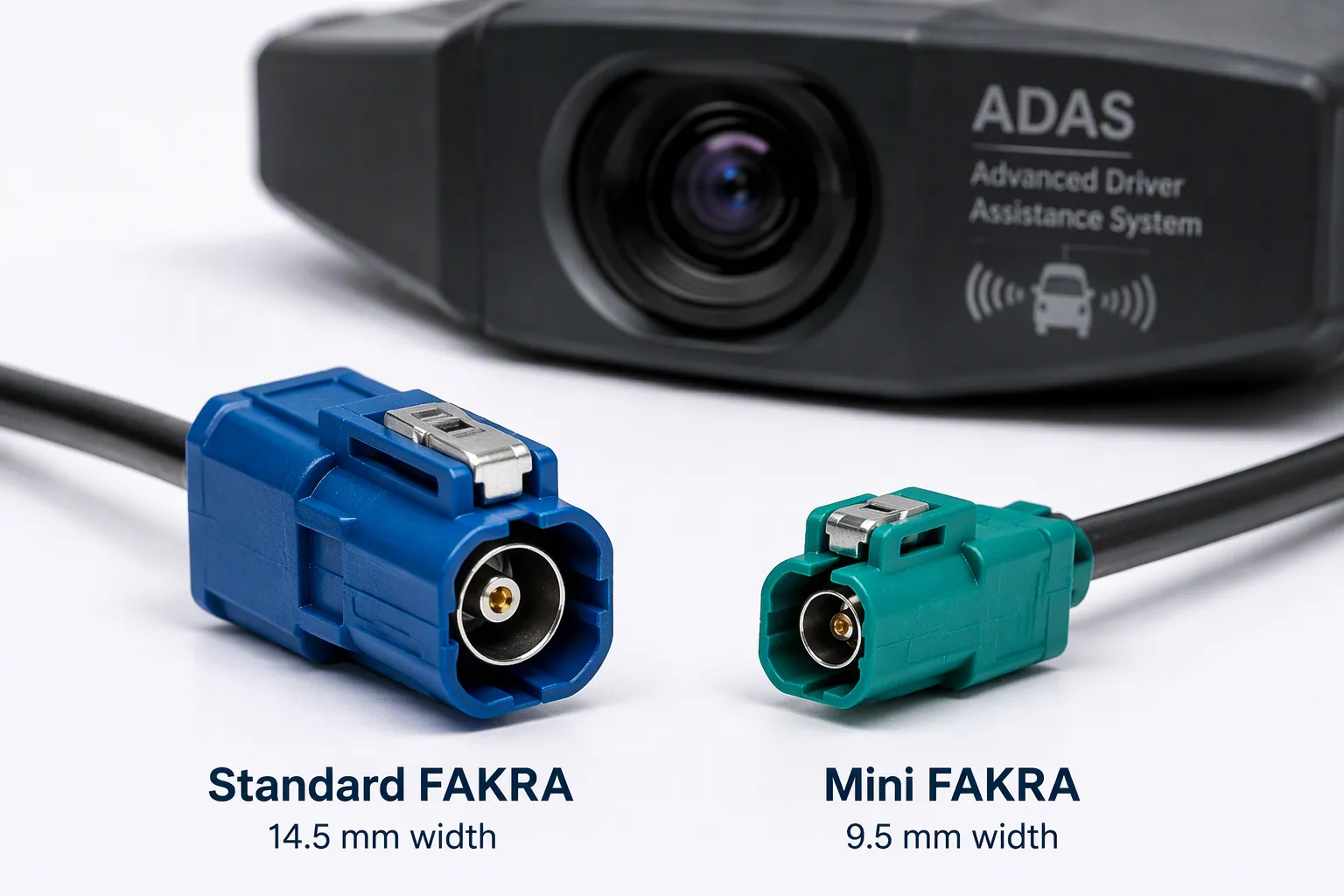
Neither connector wins universally. Standard FAKRA suits legacy, space-tolerant camera links and approved interfaces. Mini FAKRA suits space-constrained, high-density ADAS camera modules. Signal architecture, protocol, frequency, cable assembly, mechanical code, packaging, and validation decide the fit.
Standard FAKRA is a 50-ohm coaxial automotive connector with color coding and mechanical keying. Mini FAKRA, also called HFM, is a compact automotive coaxial family built for high-density layouts. HSD is a separate shielded differential family, not a FAKRA or Mini FAKRA variant.
The mini fakra vs standard fakra decision spans size, channels, coding, mating interface, cable compatibility, impedance, frequency, loss, routing, EMC, environment, cost, and customization. The mini fakra vs fakra discussion also covers protocol demands, including high-resolution camera links. Compatibility checks and a selection checklist close the guide.
Key Takeaways
Standard FAKRA fits legacy systems and modules with enough space.
Mini FAKRA saves space and suits high-density camera modules.
Always check connector codes and mating interfaces before design.
Validate the complete cable assembly in the vehicle system.
Mini FAKRA vs Standard FAKRA: Quick Comparison
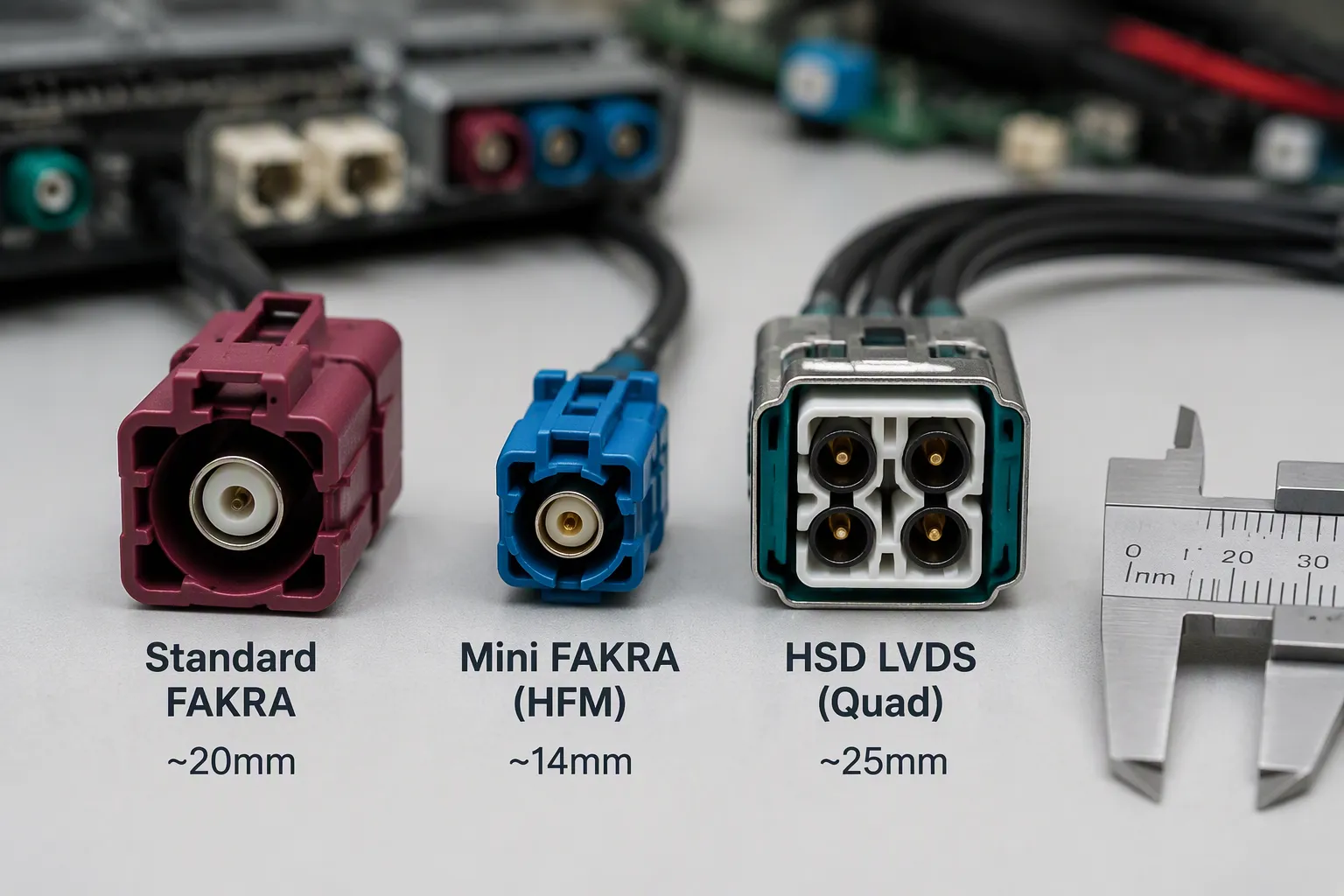
Three-Column Comparison Table
A direct comparison starts with the electrical and mechanical basics. The table below places Standard FAKRA, Mini FAKRA / HFM, and HSD LVDS side by side. Readers should treat every value as a typical class indicator, not a guaranteed limit for every part number.
Parameter | Standard FAKRA | Mini FAKRA / HFM | HSD LVDS |
|---|---|---|---|
Electrical topology | 50-ohm coaxial | 50-ohm coaxial | Shielded differential |
Nominal impedance | 50 Ω | ||
Frequency class | Commonly cited to about 6 GHz; verify exact product | Selected families claim up to 20 GHz; verify exact product | Rated for high-speed differential links; verify exact product |
Data rate | Commonly cited around 8 Gbps; verify exact product | Selected families claim up to 28 Gbps; verify exact product | Differential link rated by product; verify exact product |
Size | Baseline footprint | Selected families claim roughly 80% smaller; verify exact product | Differential quad construction |
Mating cycles | Typically ≥25 | Typically ≥25 | Typically ≥25 |
Operating temperature | Commonly -40°C to +105°C | Commonly -40°C to +105°C | Commonly -40°C to +105°C |
Sealing | IP67 available on selected families | IP67 available on selected families | IP67 available on selected families |
Coding | Color and mechanical keying | Compact coding system | Keyed differential housing |
How to Read the Table
The first lesson concerns family identity. HSD is a separate shielded differential connector family, not a FAKRA or Mini FAKRA variant. Its cable uses a shielded twisted quad structure, and its validation centers on differential impedance, time-domain reflectometry, eye diagrams, and bit error rate. Standard FAKRA and Mini FAKRA both carry a coaxial path referenced to the outer conductor, so their validation focuses on center and shield continuity, return loss, insertion loss, and time-domain reflectometry.
The second lesson concerns the headline numbers. The 20 GHz, 28 Gbps, 80% space savings, and IP67 entries describe selected product families only. They are not universal specifications. A design team must confirm the exact model and the finished cable assembly before relying on any of them. The same caution applies to camera resolution claims. A link rated for high-resolution cameras at one cable length may behave differently at another.
The third lesson concerns the mini fakra vs fakra choice itself. The mini fakra vs standard fakra decision rarely turns on one row of the table. A compact connector with a strong frequency rating still fails if its mechanical code, cable type, or mating interface does not match the ECU and camera. Engineers should read across the row, then confirm each value against the datasheet and the vehicle-level test plan.
A matching color also does not prove that two interfaces will mate. The housing color gives a visual clue, while the keying defines the coded mating geometry. Check the code letter, key position, mating side, and connector form before treating two interfaces as a match.
Standard FAKRA Connectors for ADAS Cameras
Key Specifications and Coding
Standard FAKRA connectors use a 50-ohm coaxial structure. The center pin carries the signal, and the outer ferrule provides the shield reference. This 50 ohm coaxial connector design supports stable RF transmission across the vehicle harness. A 75-ohm variant also exists for analog video links, such as legacy CVBS backup cameras.
Color coding and mechanical keying prevent mismating. Each housing color maps to a specific application, and the keyed shell blocks incorrect insertion. Connector gender varies by mounting side. The camera module often carries a jack, and the harness carries a plug. Typical frequency class reaches about 6 GHz for many standard fakra parts. Designers must verify the exact product datasheet before finalizing the link budget.
Best-Fit Applications
Standard fakra connectors fit several ADAS camera roles. The list below shows where this family remains a practical choice.
Legacy CVBS backup cameras: standard fakra carries the analog video signal from rear cameras to the head unit in a 75-ohm variant.
Radar RF connections: some short-range radar sensors use standard fakra for their RF ports.
Antenna and RF links in camera-adjacent systems: standard fakra suits radar RF, DSRC, and color-coded keying needs.
Standard fakra also fits existing RF and coaxial camera links, standard vehicle camera systems, and modules with sufficient space. Projects with an approved standard fakra interface benefit from established availability and simpler service access. Compatibility with the ECU and camera mating side deserves a check before release.
Modern high-resolution ADAS video is a different case. Links for high-resolution cameras using LVDS, APIX, FPD-Link, or GMSL typically call for HSD, not standard fakra. A high-resolution camera module may still use standard fakra for a secondary RF path. Engineers should match the connector family to the signal type, not to habit. Cameras with analog outputs remain a strong fit for this family.
Mini FAKRA and Fakra Connectors Compared
Mini FAKRA Design Intent
Mini FAKRA, also known as HFM, is a compact automotive coaxial family. Engineers often describe it as a miniaturised version of fakra. Selected families were engineered to shrink the connector footprint by roughly 80% while boosting data transmission capacity. That figure applies to specific product families, so designers should verify the exact model.
The family serves ADAS sensors, high-resolution infotainment displays, and V2X vehicle-networking antennas. One common data path runs from the cameras through the HFM connector to the around-view monitoring system. HSD connectors then relay that data onward to the host unit. Mini FAKRA acts as the transmission intermediary between sensor data and the AVM system.
Best-Fit Applications
Mini FAKRA fits systems where installation space is limited. A space-limited ECU or a compact domain controller gains room for additional components without sacrificing signal quality. Surround-view cameras with four inputs are a representative case. Radar-to-camera links, GNSS antenna feeds, and cellular modem inputs also use this family.
LEADSIGN's HFM Quad Mini FAKRA connector for 360-degree camera systems shows one multi-port configuration. Not every Mini FAKRA part is a quad connector, so engineers should confirm the port count on the datasheet.
Mini FAKRA should not be selected only because it is smaller. The engineer must confirm the camera protocol, the SerDes interface, the connector family, the mechanical code, the cable type, the finished cable length, the channel loss budget, the required frequency and data rate, the mating interface on the ECU and camera, and the complete vehicle-level test plan.
These mini fakra and fakra connectors are not automatically interchangeable. A connector that looks similar may carry a different mechanical interface, cable structure, coding system, or electrical specification. Compatibility checks belong in the design review, not in the prototype phase.
Mini FAKRA vs Fakra: RF Performance
Frequency, Impedance, and Loss
Both families present a 50 ohm impedance at the connector interface. That shared 50 ohm coaxial connector baseline lets designers compare them on the same link budget. The table below summarizes typical ratings for the exact mini fakra series and for standard fakra parts.
Specification | Mini FAKRA (typical) | Standard FAKRA (typical) |
|---|---|---|
Impedance | 50 Ω | 50 Ω |
Frequency range | DC to 20 GHz | Commonly cited to about 6 GHz |
Sealing | IP67 (optional) | Silicone grommet or O-ring, rated IP67/IP69K |
Selected Mini FAKRA families claim up to 20 GHz and 28 Gbps. Those figures apply to specific product families only. Engineers must verify the exact model and the finished cable assembly before adopting them.
Loss behavior deserves careful reading. Contact geometry preserves the specified impedance across the interface. Variations in contact position, dielectric spacing, termination quality, or conductor alignment can degrade both return loss and insertion loss at higher frequencies. High-frequency performance therefore depends on mechanical and manufacturing tolerances, not on a single fixed loss figure. For Mini FAKRA 4-in-1 RF coaxial cable assemblies, insertion loss rises as cable length grows. The target protocol, cable model, signal spectrum, and receiver link margin all shape the outcome. A performance comparison for high-resolution cameras should use the finished assembly, not the bare connector.
Shielding, EMC, and Environment
The outer ferrule and housing form the shield path on both families. A continuous shield reference keeps emissions low and protects the camera signal from nearby RF sources. Termination quality at the ferrule and the PCB ground plane drives much of the EMC result. A loose ferrule or a poor ground connection raises radiated emissions and invites interference.
Environmental ratings vary by product family. Standard fakra parts use silicone grommet or O-ring sealing and reach IP67 or IP69K on rated models. Mini FAKRA offers IP67 as an option. Designers should confirm the sealing level on the chosen part number. Temperature and vibration requirements also belong in the validation plan. Both families commonly operate from -40°C to +105°C, and both must survive harness vibration in the installed vehicle.
Space, Channels, and Harness Routing
Footprint and Multi-Channel Density
Connector size drives the packaging plan for every ADAS module. Standard FAKRA uses a baseline footprint, and each channel needs its own interface. Mini FAKRA shrinks the port geometry and allows multi-port blocks. Selected mini fakra families claim roughly 80% space savings, and that figure applies to specific product families only. Designers should verify the exact model before they size the housing.
Channel count shapes the layout. A dual-position design such as the MATE-AX Mini FAKRA system routes two coaxial channels through one interface. The TE 2306868-9 housing carries two positions, a Z code, and a 180-degree cable exit. This architecture replaces two independent FAKRA interfaces with one compact housing. Controller-side density rises as a result.
Multi-port blocks suit high-channel-count systems. Mini-FAKRA becomes advantageous when four or more RF links must fit into a compact module. Surround-view camera clusters, telematics units, and multi-band antenna modules all benefit. Single, dual, and quad configurations exist where available, and engineers should confirm the port count on the datasheet.
Cable Length and Bend Considerations
Coaxial cable compatibility sets the routing envelope. Both families accept 50-ohm coaxial cable, and the chosen cable jacket and diameter must match the connector termination. A mismatched cable raises loss and weakens the shield path.
Cable length affects the link budget. Insertion loss rises as the run grows, so long harness routes need margin in the design. Bend radius matters as well. Tight bends stress the dielectric and the shield, and crushed cable degrades return loss. Harness clips should hold the cable without compression. Routing near heat sources or sharp edges invites damage, and service loops should respect the minimum bend radius. A high-resolution camera link and a high-resolution cameras surround-view system both depend on a clean, uncrushed cable path.
Cost, Availability, and Customization
Unit Cost vs System Cost
A connector price tag tells only part of the story. The total system cost includes the cable assembly, tooling, and service access. A compact mini fakra interface may carry a higher unit price than a baseline part, yet it can reduce housing size and simplify the module layout. Standard fakra connectors often win on unit price and shelf availability, which matters for high-volume programs with mature designs.
Serviceability shapes the long-term cost. A connector that a technician can reach and replace quickly lowers warranty and repair expense. Dense multi-port blocks save space, but they can complicate field access. Buyers should weigh purchase price against assembly effort, tooling investment, and service access across the vehicle life.
OEM and ODM Options
Customization starts with a simple review. A supplier can begin with a sample, clear connector photos, or a description of the equipment and required quantity. An accurate quotation then needs drawings and a BOM, connector and mating part numbers, pinout, wire length and gauge, branch layout, quantity, and required tests. Materials, inspection scope, and delivery are confirmed per project.
LEADSIGN supplies standard fakra connectors and cable assemblies, mini fakra and HFM solutions, and single, dual, and quad configurations where available. The company supports camera and ADAS connector applications, custom cable assemblies, and application-specific connector and cable matching. Common customization dimensions include:
Customization Dimension | Available Options |
|---|---|
Connector orientation | Straight, right angle |
Coding | A–Z codes (14 key codes) |
Housing configurations | Single, double, triple, quad; panel connectors |
Cable types | RG174, RG316, RG58, RG178, 1.13 mm, 1.37 mm, Dacar 535/462/647 |
Cable length | Customizable, typically 0.5 m to 15 m |
Interface conversion | FAKRA to SMA, SMB, MCX, MMCX, TNC, HSD, H-MTD, Mini-FAKRA, MATE-AX |
OEM and ODM projects also cover cable length customization, connector configuration, channel mapping, and cable assembly requirements for automotive development, testing, and wholesale manufacturing. Small batch orders are possible, with no MOQ on stock items.
Selection Checklist for ADAS Cameras
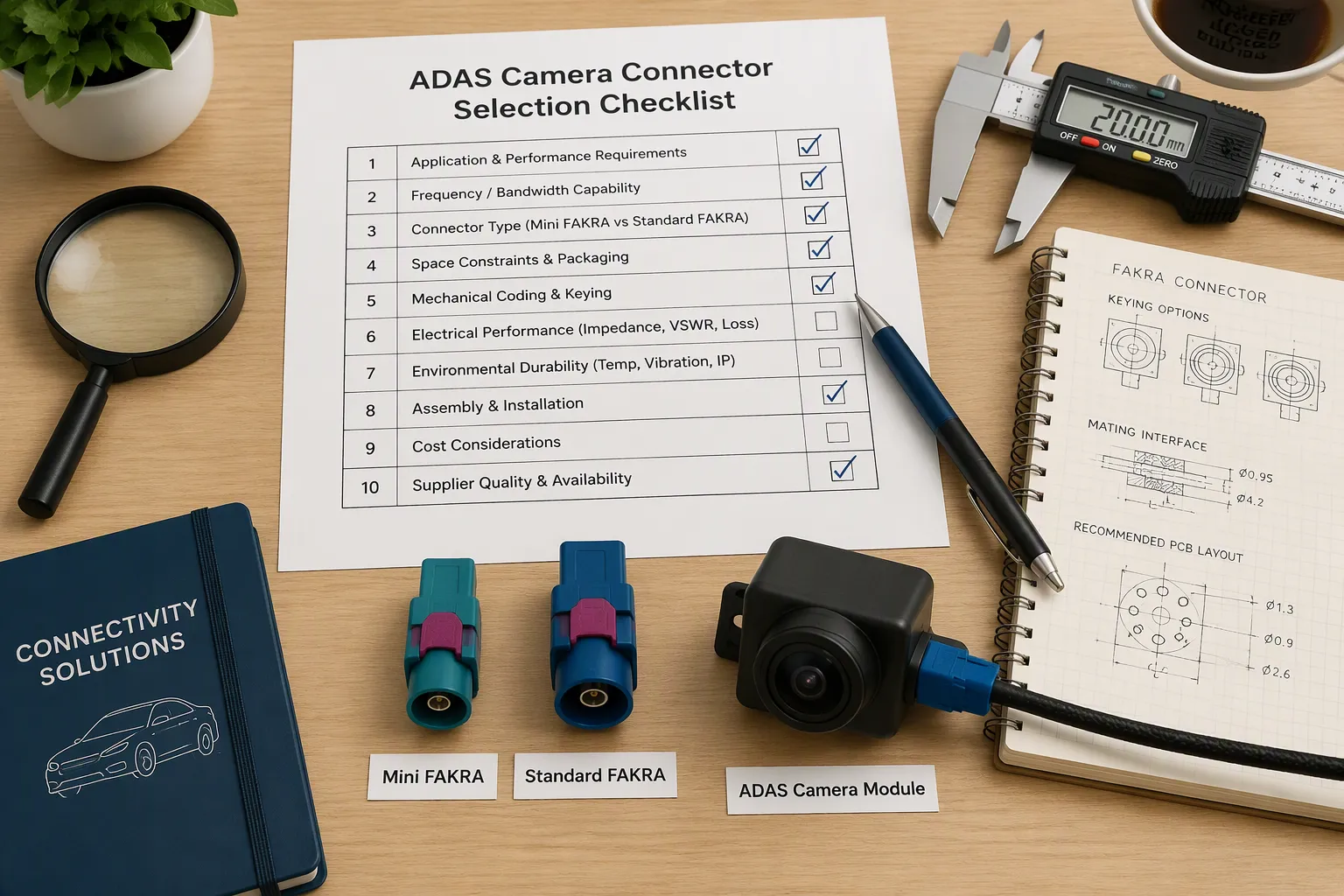
Ten-Step Checklist
A structured review prevents costly redesigns later. The following sequence walks engineers from signal definition to vehicle-level validation, and each step builds on the one before it. Skipping a step often surfaces later as a field failure or a harness rework.
Identify the camera signal architecture. Record the vehicle, model year, module, port, and expected function before any part number enters the discussion.
Confirm coaxial or differential transmission. Count the RF channels and their frequency ranges, then note whether the link carries a single-ended coaxial signal or a shielded differential pair.
Confirm the connector family and mating side. Decide whether the link needs standard FAKRA, Mini FAKRA, HSD, or another automotive data connector, and compare the interface on both the ECU and the module.
Confirm the connector code and color. Match the letter code against the drawing; housing color alone does not prove that two interfaces will mate.
Confirm single, dual, or quad configuration. Count the independent channels and avoid confusing a multi-port breakout with a signal splitter.
Confirm cable construction and length. Specify the 50-ohm cable type, run length, and any Power over Coax conditions.
Confirm frequency, impedance, and loss requirements. Check insertion loss, return loss, and shielding against the target protocol and the channel loss budget.
Confirm straight or right-angle orientation. Verify gender, cable exit direction, and sealed or unsealed construction.
Confirm operating temperature and vibration requirements. Review routing space, bend radius, moisture exposure, and service access across the vehicle life.
Validate the completed assembly in the installed vehicle system. Compare dimensions and part numbers, then test continuity and channel performance where appropriate.
Matching Connector to Camera Type
The mini fakra vs standard fakra decision follows the platform, not the resolution alone. Standard FAKRA remains the right call for retrofits, for platforms where harness compatibility with existing FAKRA-terminated cable assemblies matters, and for lower channel counts such as single antenna feeds. Mini fakra fits high-channel-count modules such as ADAS domain controllers and sensor hubs where board space is at a premium. New platforms without legacy harness constraints also benefit from a single multi-way connector instead of several discrete ports. A retrofit that swaps a compact part for a baseline port forces new tooling and new harness drawings.
A high-resolution module does not automatically require Mini fakra. The standard family can also carry automotive SerDes protocols, so bandwidth, density, and platform design drive the choice rather than an analog-versus-digital label. Surround-view systems with several cameras converging at one space-limited ECU are a strong candidate for a compact multi-port part. The same logic applies to radar and other adas sensors that share a dense module housing.
These two families are not automatically interchangeable. A connector that looks similar may carry a different mechanical interface, cable structure, coding system, or electrical specification. Engineers should confirm the mating interface on both the ECU and the module, then verify the exact part number before release. Compatibility checks belong in the design review, not in the prototype phase. A quick dimensional check against the drawing catches most mismatches before a prototype build.
Troubleshooting Fakra and Mini Fakra Links
Video and Channel Faults
A flickering image or a missing channel usually points to the signal path, not the display. Technicians should start at the connector and work backward. A loose ferrule or a damaged center pin breaks the shield reference and causes flicker. Excessive cable loss shows up as a weak or dropped channel, especially on long runs. Poor shielding or grounding lets nearby RF sources interfere with the video signal. An incorrect camera protocol also produces a blank or garbled channel, because the serializer and deserializer cannot negotiate the link.
Intermittent video during vibration deserves a focused check. The fault often hides in a partially seated connector or a cable that flexes against a sharp edge. A gentle wiggle test at the harness can reveal the weak point, though results vary by installation. Engineers should confirm the protocol setting, the cable type, and the loss budget before replacing parts. The same diagnostic logic applies to both fakra and mini fakra links, since each family relies on a continuous coaxial path.
Mechanical and Interface Faults
A wrong connector code blocks mating even when the housing looks correct. The keying geometry defines the match, and color alone proves nothing. Incomplete locking allows the plug to back out under vibration, which produces the intermittent faults described above. Cable bend or compression damage crushes the dielectric and raises return loss. Technicians should inspect the run for tight bends, crushed sections, and clip pressure.
ECU and camera interface incompatibility remains a common root cause. A compact mini fakra port may not accept a standard fakra plug, and the reverse is also true. Engineers should compare part numbers and drawings on both sides before assuming a match. A dimensional check against the drawing catches most mismatches early. Careful inspection and a documented validation step prevent repeat failures in the field.
The mini fakra vs standard fakra decision follows the platform. Standard fakra fits legacy compatibility, approved interfaces, sufficient module space, and mature service access. Mini fakra fits board-space limits, camera miniaturization, multi-camera density, and tight harness routing, provided the exact product and finished cable assembly are validated.
Both families meet ADAS reliability expectations when engineers specify them correctly. HSD remains a separate differential family. The fakra vs mini fakra comparison also shows that the two coaxial families are not automatically interchangeable.
A practical framework guides the final choice:
Signal architecture
Connector family
Code and color
Cable and length
Loss budget
Vehicle-level validation
FAQ
Can a mini fakra plug mate with a standard FAKRA jack?
No. The two families use different housing geometry and keying. A similar look does not guarantee a match. Engineers should compare part numbers and drawings on both sides before assembly.
When does a mini fakra connector make sense for an ADAS camera module?
A mini fakra part fits when module space is tight and channel count is high. Surround-view clusters and domain controllers are typical cases. The design team must still confirm protocol, cable type, loss budget, and the mating interface on both ends.
Does a high-resolution camera always need a mini fakra link?
No. Resolution alone does not decide the connector family. Standard FAKRA can carry automotive SerDes links too. Bandwidth, channel density, and platform packaging drive the choice, so engineers should verify the exact product and finished cable assembly.
Why does connector color not prove compatibility?
Color gives a visual clue only. The keying geometry defines the coded mate. Two housings can share a color and still differ in key position or interface. Technicians should check the code letter against the drawing.
Where does HSD fit compared with these coaxial families?
HSD is a separate shielded differential family. It is not a FAKRA or mini fakra variant. Camera links that use a differential pair call for HSD validation, such as differential impedance and eye diagram checks, rather than coaxial loss checks alone.
See Also
Why Quad Mini Fakra Connectors Matter So Much in Automotive
Discovering the Key Benefits of Mini Fakra Connectors in Cars
Exploring the Major Benefits of Mini Fakra Connectors in Vehicles
Revealing the Benefits of High-Speed FAKRA-Mini HFM for Self-Driving Cars
Understanding the Benefits of Mini FAKRA Connectors in Today's Vehicles