What Is a Mini FAKRA Quad Connector and How Does It Support 360-Degree Camera Systems

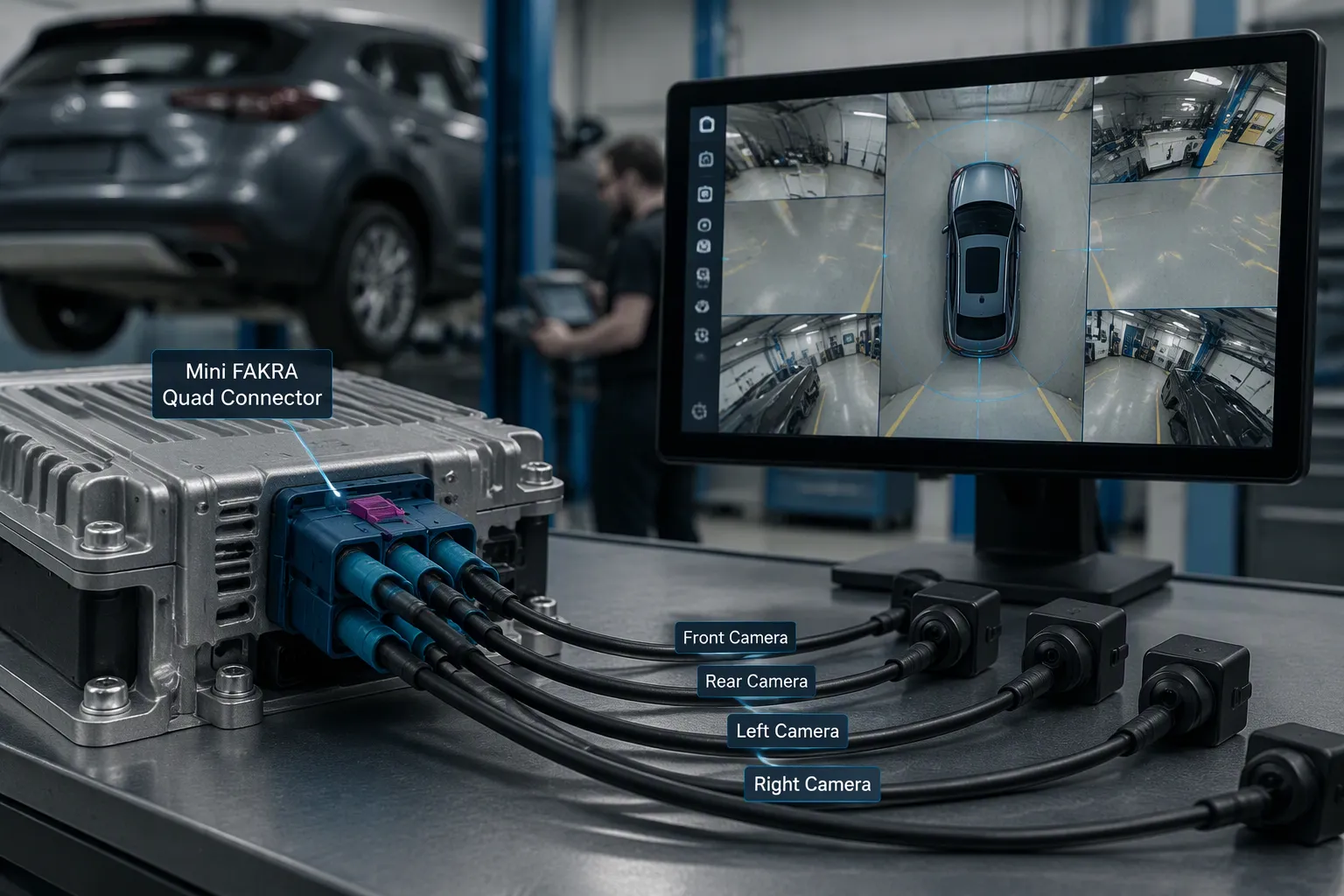
A Mini FAKRA Quad Connector is a compact, four-port automotive coaxial connector. It routes multiple camera signals through one interface in 360-degree camera systems. Each port carries one video channel, so a single housing can serve several cameras around the vehicle.
LEADSIGN's HFM Quad Mini FAKRA connector, model LDS-HFM-204ZM, is a representative example. It uses a quad right-angle plug configuration for automotive surround-view applications. Engineers should confirm exact specifications for this part number with LEADSIGN.
This article examines design and features, support for camera systems, comparison with alternatives, selection factors, and troubleshooting. Readers gain practical guidance for connector choice and validation.
Key Takeaways
A Mini FAKRA Quad Connector routes four camera signals through one compact housing for 360-degree views.
Its small size saves up to 80% board space and simplifies wiring in dense automotive modules.
High-speed versions support data rates up to 28 Gbps for clear, real-time video from multiple cameras.
Always confirm the connector matches your camera protocol, cable, and ECU interface before installation.
LEADSIGN offers customizable Mini FAKRA and HFM solutions with expert support for your project.
Mini FAKRA Connector Design and Features
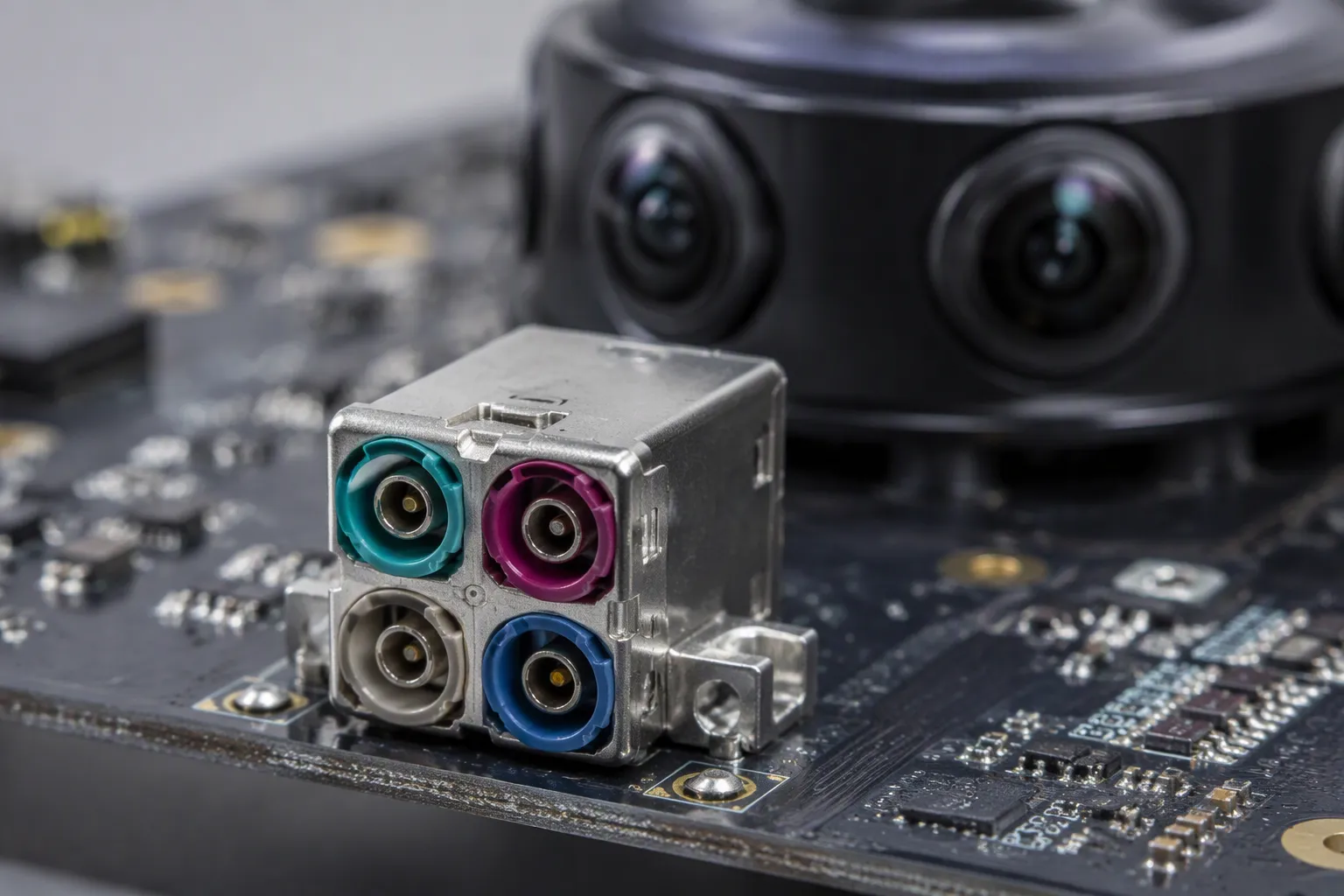
Compact Quad-Port Architecture
A Mini FAKRA connector is a miniaturized version of the traditional FAKRA connector. The smaller body delivers meaningful space savings and higher port density. Published figures show the scale of the gain. Molex cites up to 80% space savings for its High-Speed FAKRA-Mini (HFM) system, and TE reports a 75% maximum space reduction versus standard FAKRA connectors.
Connector System | Manufacturer | Claimed Space Savings vs. Standard FAKRA |
|---|---|---|
High-Speed FAKRA-Mini (HFM) | Molex | Up to 80% |
Mini FAKRA Connector System | TE | 75% maximum reduction |
The quad layout takes this density further. One housing carries four coaxial ports, so a single interface serves four camera channels. Designers can consolidate multiple camera connections instead of stacking four separate interfaces on a crowded board. LEADSIGN's fakra mini hfm quad portfolio follows this principle. The product family emphasizes a compact space-saving design, multi-port and modular configurations, and use in automotive camera, ADAS, infotainment, GPS, and high-bandwidth applications. These space-saving connectors suit dense modules where every millimeter of board area counts.
Specifications vary by family and configuration. Typical automotive Mini FAKRA systems use 50-ohm coaxial transmission. Selected HFM configurations support frequencies up to 20 GHz and data rates up to 28 Gbps. Other families may reach 20 Gbps, and one published quad example lists 50 Ω impedance with a DC to 6 GHz range. Engineers should treat these limits as product-specific, not universal.
Coding, Locking, and Shielding
Mechanical coding prevents mismating. Each port carries a keyed housing and a color code, so installers can identify channels at a glance. Primary and secondary locking hold the plug in place under vibration. Shielding surrounds the center contact and controls signal integrity along the path.
These features matter in automotive interconnect technology, where a loose or crossed channel disrupts the surround view. Coding and color identification simplify harness assembly and service replacement. Shielding supports electromagnetic compatibility near motors and power electronics.
Industry standards anchor the design. ISO 20860-1 and -2, along with SAE/USCAR 18, govern FAKRA-family connectors. A newer specification addresses the miniature class directly.
USCAR refers to the new connector as a "mini-coaxial connector," and the upcoming specification USCAR-49 will define industry-standard testing specifically for miniature coaxial connectors.
This standard targets surround-view camera and driver assistance use. Buyers should confirm compliance for the exact part number. A mini-fakra housing alone does not guarantee performance. The camera protocol, cable, code, and ECU interface must all match. LEADSIGN supplies Mini FAKRA and HFM solutions for these automotive applications and supports project-specific validation.
Supporting 360-Degree Camera Systems
High-Bandwidth Automotive Connectivity
A 360° surround view system places cameras at the front, rear, left side, and right side of the vehicle. Each camera sends video signals to a central unit. That unit stitches the frames into one overhead image for the driver. Some designs use 4-6 cameras to close blind spots near the bumpers.
High-bandwidth automotive connectivity carries these streams. Raw video demands steady throughput and low latency. A mini fakra connector helps here. Selected HFM configurations support DC to 20 GHz and data rates up to 28 Gbps, and suppliers specify them for ADAS and surround view camera applications. Standard FAKRA tops out lower.
Connector Type | Max Data Rate |
|---|---|
Standard FAKRA | Up to 8 Gbps |
Mini FAKRA (HFM) | Up to 28 Gbps |
These figures apply to selected product families, not every part. Buyers should confirm the rating for the exact model. Higher headroom matters as sensors move to sharper resolution. A gmsl2 camera cable and a gmsl fakra 1-to-4 m-f cable both rely on this class of interconnect for high-speed data transmission. The same link carries high-definition video signals across the harness.
Multi-Camera Routing and Packaging
A quad housing consolidates four camera connections into one interface. This improves packaging density inside a camera ECU or domain controller. It also reduces the space needed compared with four separate conventional FAKRA interfaces. Harness routing becomes simpler, because one connector body replaces a row of single ports. Dense ADAS architectures benefit most.
Several requirements shape the design. Cable length from each camera to the ECU sets the loss budget. Longer runs need lower-loss fakra cable. Connector coding and color identify each channel, which prevents crossed feeds during assembly. Shielding and EMC control keep noise away from high-definition video signals. Mechanical retention must survive vibration at the bumper and mirror mounts. Tight packaging near the ECU limits bend radius. Service and replacement favor keyed, color-coded ports. The surround view controller then handles image stitching and display.
A quad housing does not guarantee compatibility with every 360 degree surround view cameras setup. The camera protocol, coaxial cable, connector code, ECU interface, and system validation must all match. Engineers should treat the connector as one link in a chain. A mini fakra connector that fits mechanically may still fail if the protocol differs. Testing the finished assembly in the vehicle remains essential for any automotive camera systems project.
Comparing FAKRA and HSD Connector Options
Mini FAKRA vs. Standard FAKRA
Both families share the same coaxial transmission principle. The difference lies in scale and density. A standard fakra connector builds on the SMB interface with a protective plastic shell and carries one RF connection per housing. A mini-fakra part uses a much smaller contact structure and packs several RF ports into one compact module.
Attribute | Standard FAKRA | Mini FAKRA |
|---|---|---|
Housing Size | Larger, built on the SMB interface with a protective plastic shell | Noticeably smaller, tailored for compact vehicle electronic modules |
Interface Structure | Single coaxial connection within a keyed automotive housing | High-density modular interface allowing several RF connections in one housing |
Connection Density | One RF connection per connector housing | Multiple RF ports integrated into a single compact connector module |
Standard FAKRA remains a sound choice for single-link runs and legacy harness designs. Mini FAKRA fits modules that need many channels in limited board area. A quad fakra housing serves four camera feeds through one interface. Frequency, impedance, and data-rate limits stay product-specific, so engineers should check each part number.
HSD and Generic Camera Connectors
HSD connectors carry differential signals for LVDS, USB, and Ethernet links. They suit displays, infotainment buses, and sensor networks that use paired conductors. Mini FAKRA and HFM parts serve selected high-speed coaxial camera and RF architectures instead. Generic camera connectors may lack controlled impedance, coding, locking, or environmental performance, so they fit best in low-demand or protected locations.
Option | Ports per Housing | Typical Fit |
|---|---|---|
Single Mini FAKRA | One | Single camera or RF link in tight spaces |
Dual Mini FAKRA | Two | Paired camera runs near a compact ECU |
Quad Mini FAKRA | Four | Surround-view clusters and dense ADAS modules |
Standard FAKRA | One | Established single-link harnesses |
HSD | Differential pairs | LVDS, USB, and Ethernet connections |
Each option has a proper place. The system architecture, not the connector alone, decides the match.
Selection Factors and Practical Checklist
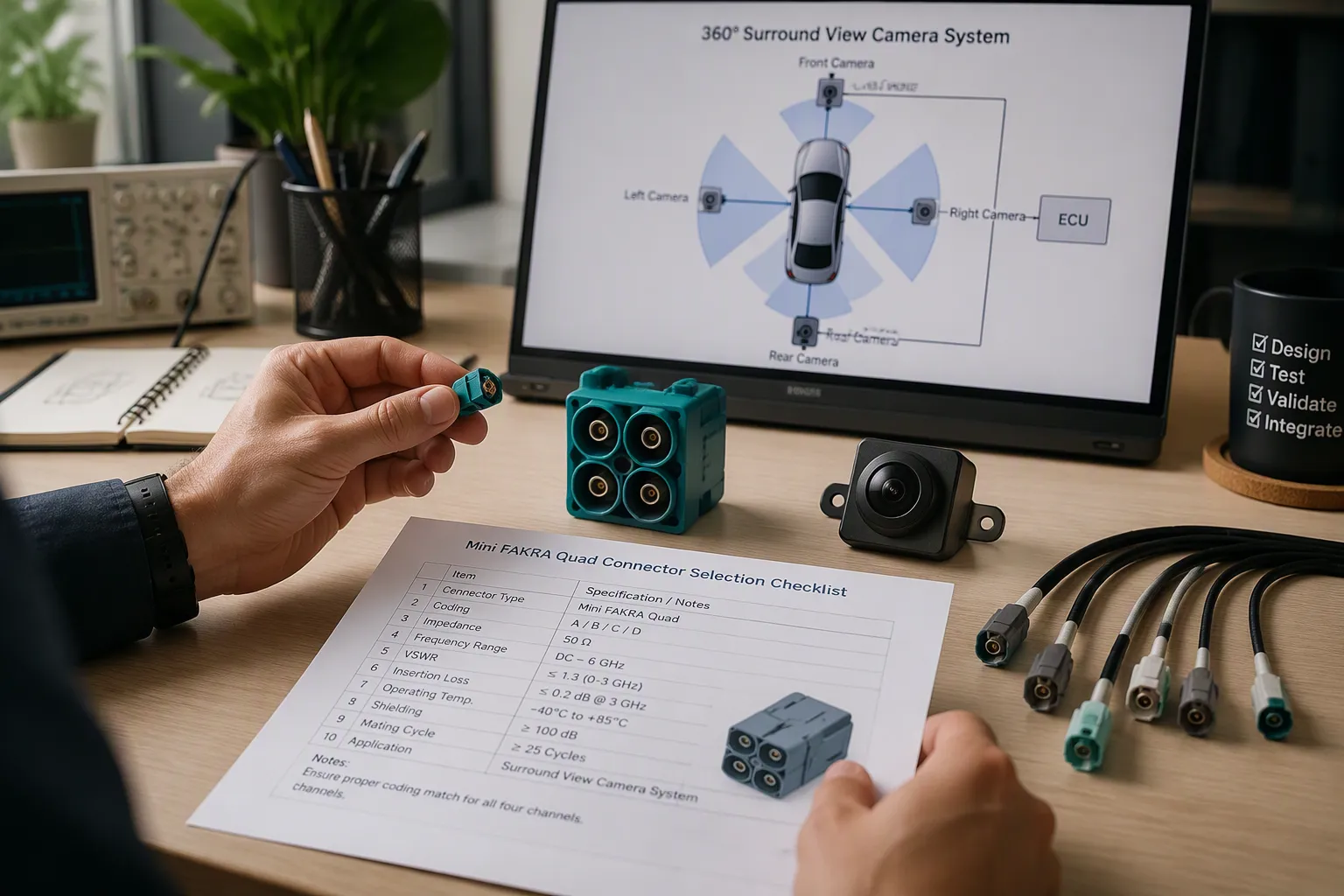
Key Selection Factors
Engineers weigh several factors before choosing a mini fakra connector for a surround-view design. The quad-port configuration and camera channel count come first. A four-camera system needs four ports, and the port arrangement must match the ECU layout. The connector family matters too. Mini FAKRA and HFM parts serve different high-speed roles, so the approved mating interface must be confirmed. Connector code and color prevent crossed channels. Plug or jack interface, straight or right-angle orientation, and PCB footprint all shape the board design.
Electrical and mechanical requirements follow. Coaxial cable compatibility, impedance, frequency range, and data-rate or protocol needs must align with the camera module. Insertion loss and return loss set the signal budget. Cable routing and bend radius affect the harness. Temperature, vibration, moisture, and contamination demands shape the housing choice. Locking and retention keep the link stable. OEM and ODM customization may be needed for a specific project.
The evidence table below shows how the two main topologies differ.
Selection Criterion | HSD | Mini FAKRA / FAKRA |
|---|---|---|
Electrical topology | Shielded differential path | Coaxial path referenced to outer conductor |
Nominal impedance | Commonly 100 ohm | Commonly 50 ohm |
Camera use | When module specifies compatible differential interface | When module specifies compatible coaxial/SerDes interface |
The connector is selected from the module interface and cable topology. A camera port defined for a 100 ohm differential path points toward HSD or another compatible differential system. A camera port designed for a coaxial SerDes path may use FAKRA or another compatible automotive coaxial interface. HSD and FAKRA are not interchangeable.
Prototype Testing and Validation
A practical checklist guides the prototype phase. Engineers confirm the camera signal architecture first. They confirm whether the system uses coaxial or differential transmission. They verify the approved Mini FAKRA/HFM mating interface. They check the quad-port housing and port arrangement. Connector code and color get a final review. Cable type and finished length are fixed. Frequency, impedance, insertion loss, and return loss requirements are confirmed. Right-angle orientation and PCB layout are checked against the board. Temperature, vibration, and sealing requirements are reviewed. The finished fakra cable assembly is then validated in the installed vehicle system.
Validation methods differ by topology. Coaxial paths rely on center and shield continuity, return loss, insertion loss, and TDR. Differential paths use differential impedance, TDR, eye diagram, and BER. Mini FAKRA variants such as HFM reach up to 20 GHz and 28 Gbps, which supports dense multi-port headers on congested ADAS ECUs. HSD suits links that need strong EMI/EMC resilience. Specifications should be confirmed for the exact part number and cable assembly with LEADSIGN. Engineers should not transfer specifications from one product page to every Mini FAKRA product.
Troubleshooting and LEADSIGN Support
Common Installation Issues
Most faults in a surround-view harness trace back to assembly, not the connector design. A missing camera channel often points to a crimp problem. Over-crimping the ferrule crushes the inner dielectric and shifts the 50 Ohm impedance, which weakens the video signals. Poor shielding or grounding produces the same symptom. A technician who forces a Code A plug into a Code C jack by breaking the plastic ribs destroys the housing and creates an incorrect mating interface.
Intermittent video during vibration usually means the secondary lock (TPA) is not fully engaged. The colored lock must sit flush with the housing. A loose plug can also come from a forgotten ferrule, an uneven crush from household pliers, or a cable mismatch such as an RG174-designed connector on an RTK031 cable. Each error degrades the fakra cable assembly and undermines a stable connection. Wrong connector codes cause incorrect channel mapping, and moisture or contamination at an open port invites corrosion. An incompatible camera protocol will fail regardless of mechanical fit, so engineers should verify the ECU interface before installation.
LEADSIGN Connector Solutions
LEADSIGN supplies Mini FAKRA and HFM connector solutions for automotive camera and ADAS applications. The portfolio includes quad and multi-port configurations, straight and angled shapes, and coding options that match specific wiring systems. Customers can request OEM and ODM customization, cable and connector matching, and application-specific automotive wiring solutions.
The company maintains an in-house design team and a strict quality management department in Shenzhen, China. More than 15 years of expertise supports projects from concept to production. Sample support may be available according to the product page. Engineers can contact LEADSIGN for connector identification and project requirements, then confirm final specifications for the exact part number.
The Mini FAKRA Quad connector enables 360-degree camera systems through compact quad-port design, high-bandwidth capability, and reliable locking and shielding. One housing routes four video channels, so dense ADAS modules save board space and simplify harness routing.
Future articles could explore growing camera counts, higher-resolution sensors, zonal architectures, and evolving automotive connectivity standards. Each trend raises new questions about signal integrity and packaging.
LEADSIGN supplies HFM and multi-port connector solutions with OEM and ODM customization and technical support. Engineers can confirm specifications for their exact part number and cable assembly. As surround-view designs advance, the right connector keeps every video channel clear and stable.
FAQ
What does a quad Mini FAKRA connector do in a surround-view system?
It routes four camera channels through one compact housing. Each port carries one video signal from a front, rear, or side camera to the central processing unit. One interface replaces four separate connections, so the ECU saves board space and the harness stays simpler.
How does a quad housing differ from four single connectors?
A quad housing consolidates four ports into one body. This raises packaging density near the camera ECU and reduces the space needed versus separate conventional fakra interfaces. Coding and color still identify each channel, so installers keep the feeds in the correct order.
Does a quad connector fit every 360-degree camera system?
No. A quad housing does not guarantee compatibility. The camera protocol, coaxial cable, connector code, ECU interface, and system validation must all match. Engineers should confirm the mating interface and signal architecture before they select a part.
Which specifications should engineers confirm before ordering?
Engineers should confirm impedance, frequency range, insertion loss, return loss, and data-rate needs for the exact part number. They should also check port arrangement, right-angle orientation, and PCB footprint. LEADSIGN can confirm final specifications for the chosen model and cable assembly.
What causes a missing or intermittent camera channel?
A missing channel often points to a crimp fault or poor shielding. Intermittent video during vibration usually means the secondary lock is not fully seated. A wrong connector code causes crossed channels. Technicians should verify the lock, the cable, and the code before they replace parts.
See Also
Why Quad Mini Fakra Connectors Matter So Much in Cars
How Mini FAKRA Connectors Maximize Space Efficiency in Automotive Uses
Discovering the Key Benefits of Mini Fakra Connectors in Cars
Revealing the Main Benefits of Mini Fakra Connectors in Vehicles
New Progress in Mini FAKRA Connectors for High-Speed Data Transfer