Custom FAKRA Cable Assemblies: What Buyers Must Specify

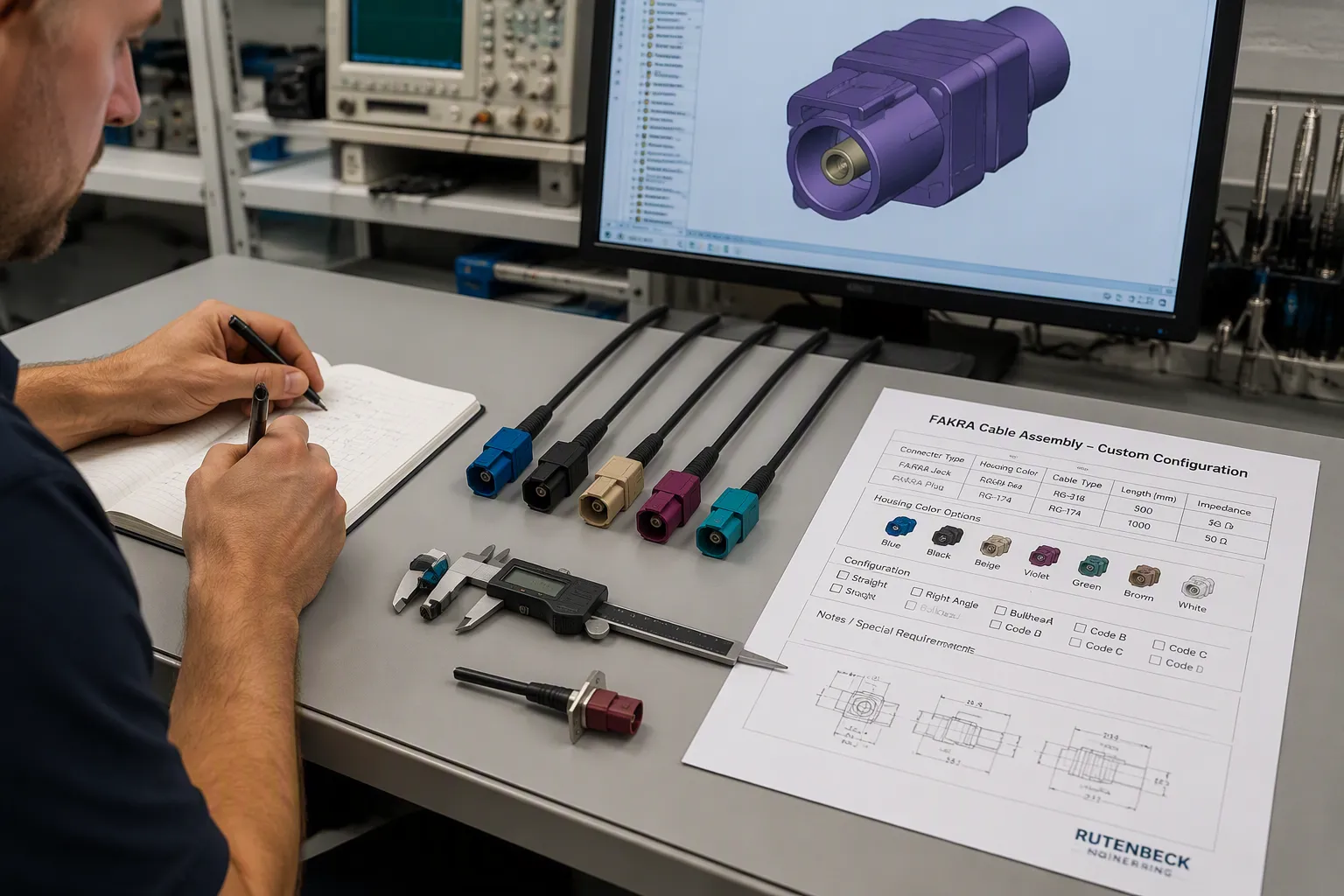
A buyer emails you a photo and asks for a FAKRA cable price. You still need the coding, gender, length, cable type, and application before you can quote. This delay happens often with a custom FAKRA cable assembly request.
To get an accurate quote, you must confirm connector coding, gender, orientation, cable type, length, impedance, shielding, application, operating environment, quantity, and drawings or samples. Clear specifications reduce mismatching, quotation delays, sample revisions, and installation problems.
TL;DR: Specify connector coding, gender, orientation, cable type, length, impedance, shielding, application, environment, quantity, and drawings or samples. Complete details prevent mismatching, delays, and rework.
Key Takeaways
Specify the FAKRA code, gender, and orientation to prevent mismating.
Choose the correct cable type, length, and shielding for your application.
Provide drawings, samples, or part numbers to speed up the quote.
Confirm impedance, testing needs, and order quantity before you buy.
Why Custom FAKRA Cable Assembly Specs Matter
Mismatching, Delay, and Rework Risks
An incomplete specification for your custom fakra cable assembly creates real financial risk. A major European automaker reported that mismatched fakra coax cables delayed their ADAS integration by 15%. That delay cost $500,000 in overtime expenses. A U.S. truck manufacturer experienced a 40% drop in warranty claims after switching to enhanced FAKRA RG174 assemblies. Those claims originated from cable failures caused by unclear specifications. An Asian EV supplier faced a 10,000-unit recall when untested fakra coax cables failed in humid environments. Each failure traces back to missing details on the original purchase order.
Your supplier cannot guess the coding, cable type, or shielding requirements. A clear, written specification for your cable assembly reduces these risks. You avoid costly rework, scrap, and production delays. A complete specification also helps your supplier select the correct materials and verification tests for your application.
FAKRA vs. HSD and Other Coax Systems
FAKRA is a 50-ohm automotive RF connector system. Do not confuse it with HSD connectors, which use 100-ohm differential signaling. These two systems serve different applications. FAKRA transmits signals through a coaxial path referenced to the outer conductor. HSD uses a shielded differential path with twisted quad cable. FAKRA handles GPS, AM/FM, cellular, and basic telematics. HSD handles high-speed data for cameras and displays.
Think of a fakra connector as an SMB connector in heavy-duty automotive armor. A strong plastic latch prevents vibration from pulling it apart. Fourteen keyways prevent cross-wiring. The metal core stays shielded from physical impacts. Standard fakra supports frequencies up to 6 GHz. Mini-fakra (HFM) supports up to 20 GHz for 4K cameras, LiDAR, and autonomous ECUs. However, standard fakra remains the correct choice for GPS, AM/FM, and basic telematics.
Your application determines the correct connector and cable assembly for your automotive wire harness. Confirm the system impedance before ordering. FAKRA requires 50 ohms. HSD requires 100 ohms. Matching the wrong system causes signal loss and system failure. Know your application before you specify the connector and cable. Your supplier can guide your selection based on your signal requirements and operating environment.
FAKRA Connector Coding, Color, Gender, and Orientation
Coding and Color Confirmation
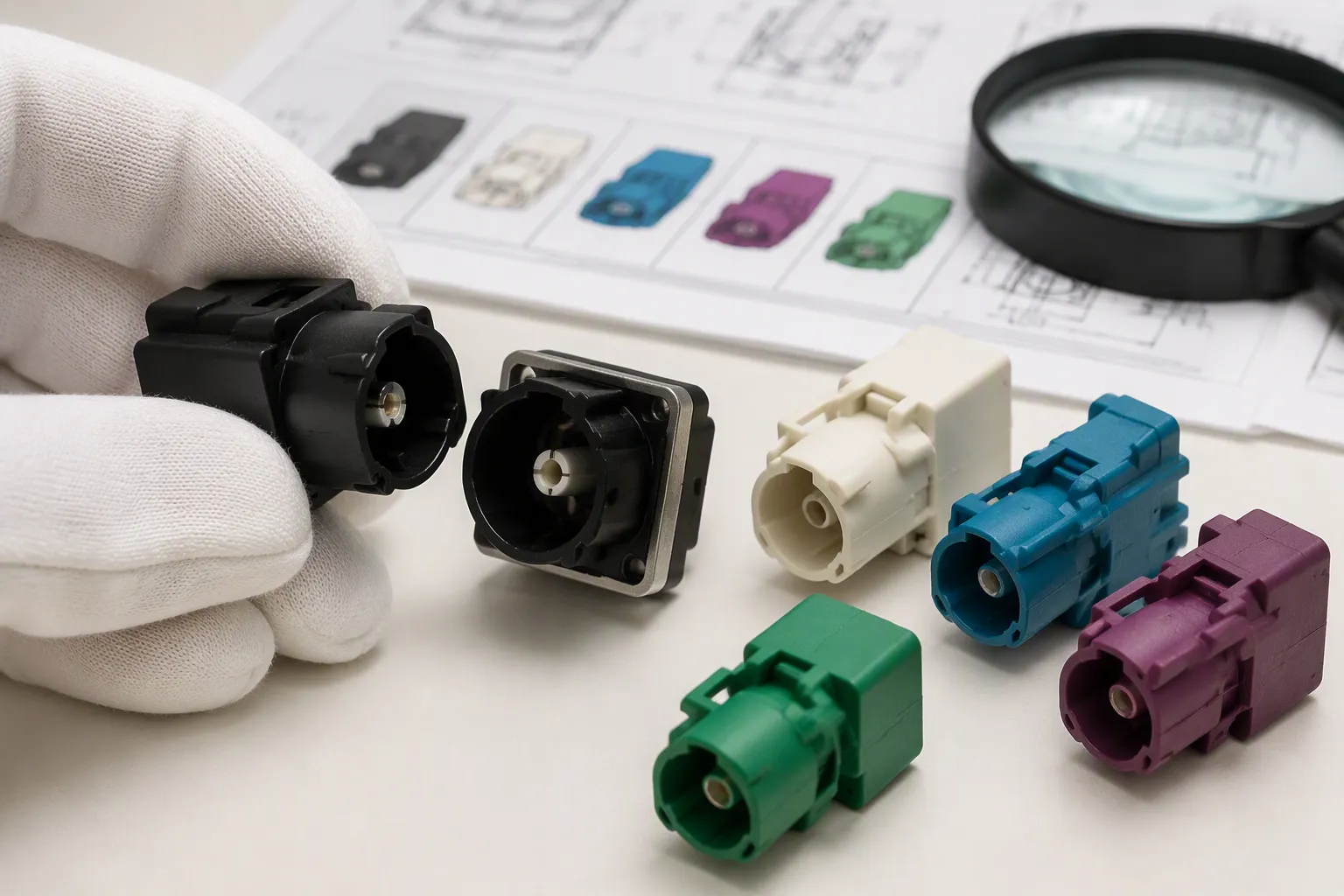
Per DIN 72594-1, the FAKRA plastic housing uses specific internal ribs and external slots. Each keying variant physically fits only into a matching receptacle of the same keying type. These mechanical ribs block any incorrect connection from being inserted. Every unique mechanical keyway also receives a standardized color following the RAL color standard. This ensures exact color matching across global factories so assembly workers can visually verify that a connector and its receptacle share the same code before mating.
Color serves only as an identification aid, not as the sole selection criterion. Mechanical coding and interface gender determine whether two components can mate correctly. Two connectors with similar colors may still have different mechanical keys. A universal code may fit more interfaces than a dedicated production code. The code letter and keying profile on a manufacturer drawing take priority over housing color for procurement and engineering confirmation. FAKRA connectors must match the physical keying of the mating connector. If a color chart and a customer drawing disagree, the drawing and the physical keying check determine which part to use.
You can produce a custom FAKRA cable assembly in any FAKRA code, color, and gender. Standard FAKRA interfaces are available with multiple mechanical and color codings plus a neutral coding option. Code Z is the neutral option and provides more mating flexibility than a fixed coded housing. However, automotive OEMs frown upon using universal Code Z in final production.
FAKRA Code | Color | Common Automotive Application |
|---|---|---|
Code A | Jet Black | AM/FM Radio |
Code B | Cream White | Phantom Radio Supply |
Code C | Signal Blue | GPS / GNSS / Telematics |
Code D | Bordeaux Violet | Cellular / GSM |
Code E | Leaf Green | TV Type 1 |
Code H | Heather Violet | GPS / Telematics |
Code Z | Water Blue | Universal (Mates with all codes) |
Standard code reference: DIN 72594-1 / USCAR-18
FAKRA Connector Gender and Mating
Custom FAKRA cable assemblies can use straight or right-angle orientation. Connector direction must match vehicle space wiring and installation layout. Standard options include straight and right-angle plugs and jacks. Right-angle connectors allow easier connections in tight spaces.
When choosing a connector, one key factor is the required orientation. This affects how the assembly fits the installation. Buyers must provide information about the mating connector: connector type at end A and end B, plug or jack interface, mechanical code, housing color, orientation, and cable compatibility. A clear measurement reference for cable length prevents misunderstandings during production.
FAKRA is an SMB connector internally, but the keying on the outer shell makes it distinct. The metal core stays shielded from physical impacts. Standard fakra supports frequencies up to 6 GHz. Mini-fakra supports up to 20 GHz for 4K cameras, LiDAR, and autonomous ECUs. The mini-fakra connector design enables advanced vehicle systems. Many RF applications now use mini fakra connections. A mini fakra connector delivers reliable performance in tight spaces. Engineers prefer mini fakra for space-constrained installations. This mini connector offers improved signal integrity. Proper connector selection and cable assembly customization ensure reliable system performance.
For more details, visit the FAKRA cable connector category at fakraconnectors.com.
Cable Type, Length, Shielding, and Impedance
Cable Type, Jacket, and Bend Radius
The cable you choose for your fakra cable assembly directly affects signal integrity and physical routing. Common options include RG174, RG316, and custom low-loss constructions. Each type uses a different dielectric material, so the attenuation profile and flexibility vary. Your jacket material matters too. PVC jackets work for general interior use. TPE or PE jackets handle higher temperatures in engine compartments. Your standard fakra or mini fakra connector must match the cable diameter.
You must also specify the minimum bend radius. Tight bending of coaxial cable can deform its internal geometry. In flexible coax, the braid may bunch on the inside of the bend or open on the outside. A single hand bend can create a permanent local geometry change in semi-rigid coax. In micro-coax, a small bend can shift the conductor before any visual damage appears. Damage may not show in a simple continuity test because continuity only proves the conductor and shield are connected, not that the cable still behaves as a controlled-impedance path. Standard practice sets the bend radius at 8 times the cable outer diameter during installation. For mini-fakra applications, you must ensure the installed cable can actually obey the bend specification.
Length, Shielding, and Impedance
Cable length affects signal attenuation. Longer runs need lower-loss cable types. Your supplier can help you select the right cable for your fakra assembly based on the frequency and distance. Shielding protects your signal against electromagnetic interference. The shield can use braided copper, aluminum foil, or a combination of both. Copper offers high conductivity for blocking interference. Each type has specific trade-offs:
Shield Type | Coverage | Flexibility |
|---|---|---|
Braided copper | 85–95% | Flexible |
Aluminum foil | 100% | Limited flexibility |
Combination braid-foil | Balanced coverage | Balanced flex performance |
You must confirm the impedance requirement. FAKRA is a 50-ohm system. Mini fakra cable assemblies maintain return loss above 18 dB across their operating range. For validation, you can request TDR impedance testing. This test shows where the discontinuity occurs: connector launch, shield fold, bend zone, or cable body. Testing is especially important for short mini assemblies where continuity alone is insufficient.
The shield is the outer layer of the cable that provides protection against external electromagnetic interference. The shield can be made of braided copper, aluminum foil, or a combination of both. Copper is the most commonly used material for the shield due to its high conductivity and effectiveness in blocking electromagnetic interference.
Custom cable assemblies should be confirmed by application, mating connector, drawing, sample, or original part number. This ensures the correct cable type, connector selection, shielding, and impedance for your system.
Automotive Cable Assembly Applications and Documentation
GPS, AM/FM, LTE/5G, Telematics, and Infotainment
Your custom fakra cable assembly serves many vehicle systems. GPS and GNSS antennas rely on these cables for accurate positioning. AM/FM radio, LTE/5G cellular, and V2X antennas all connect through fakra interfaces. Telematics units use them for real-time data transmission. Infotainment systems depend on stable connections for satellite radio and digital audio. Camera systems for rear-view, front-view, and surround-view applications also use these cables to link to the head unit or ADAS computer.
The automotive application determines your cable requirements. A GPS antenna cable needs low signal loss over its length. An infotainment connection may prioritize high-speed data transfer. Safety and security systems, including camera and radar connections, represent the fastest-growing segment. This growth comes from ADAS mandates in many markets. You should provide your vehicle or device information, mating connector details, and operating environment when requesting a quote.
Typical automotive operating temperature ranges from -40°C to +105°C. Final performance depends on your specific product and assembly. A standard fakra connector works well for most interior applications. An automotive connector near the engine bay may need a different jacket material. Share your temperature requirements with your supplier.
Drawings, Samples, Photos, and Part Numbers
Clear documentation speeds up your quotation and reduces errors. Send drawings that show connector code, orientation, and cable length. A sample photo helps your supplier verify the mating interface. An original part number confirms the exact configuration you need. These items improve quote accuracy more than a written description alone.
Your supplier needs specific details to confirm the custom assembly. Provide the connector code or mating reference. Include the cable type if you know it. State your target length and route constraints. Share your forecast quantity and validation stage. Packaging photos and test requirements also help. A BOM and sealing expectations complete the picture.
For antenna connections, a fakra antenna adapter may suit your application. You can review options at fakraconnectors.com. Send drawings, samples, photos, or part numbers to confirm your custom assembly before production.
Custom FAKRA Cable Assembly Checklist, Quantity, and Testing
RFQ Checklist and Specification Table
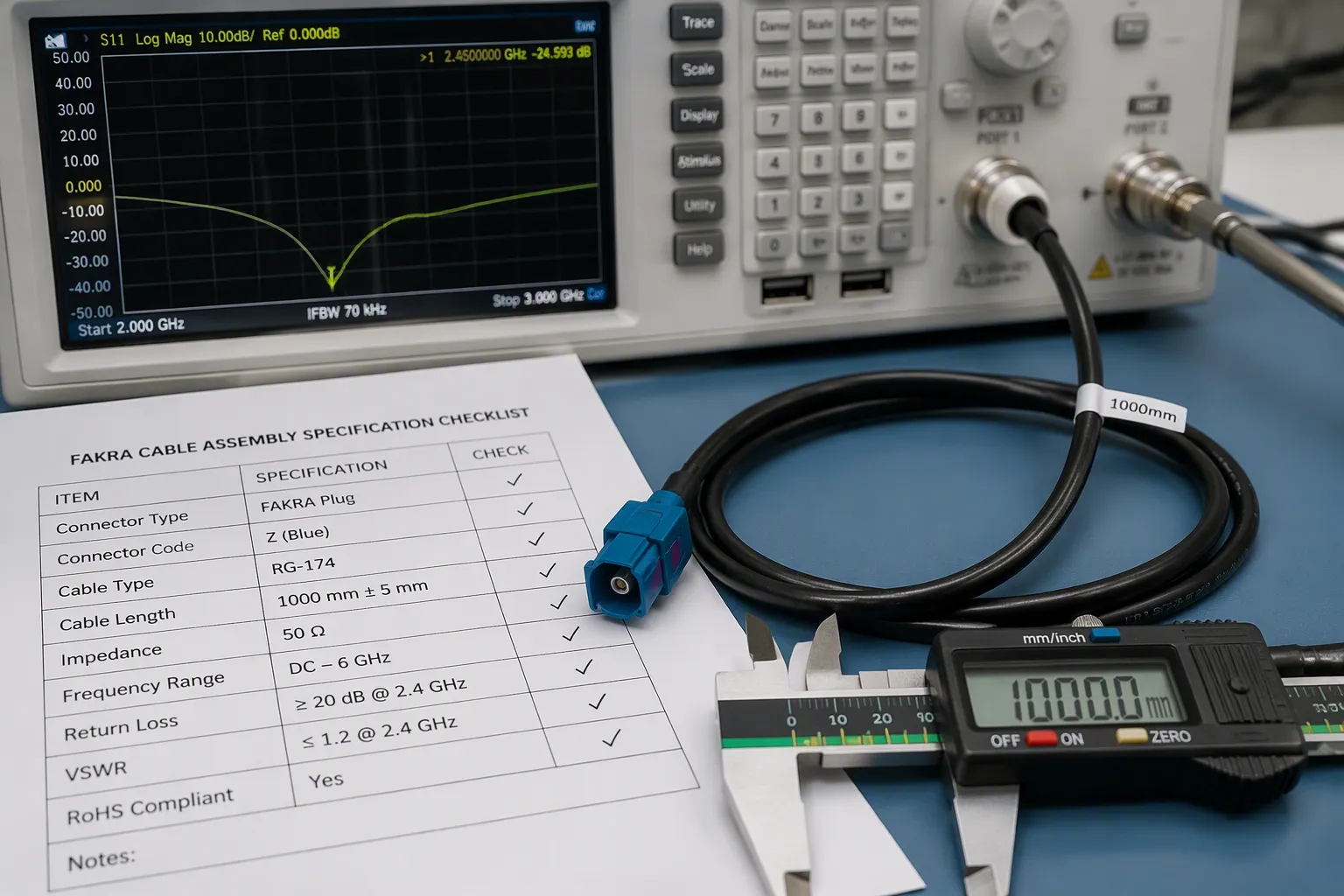
An incomplete RFQ creates repeated quotation revisions. Missing key codes, undefined cable exits, and test requirements added only after samples are built are common omissions. You can avoid these delays by providing a complete specification table upfront.
Specification Item | What to Confirm | Why It Matters | Example |
|---|---|---|---|
Connector Code and Color | FAKRA code letter and housing color | Mechanical keying prevents mismating between systems | Code C, signal blue for GPS |
Connector Gender | Plug or jack interface | Ensures correct mating with the system connector | Male plug for the antenna end |
Orientation | Straight or right-angle | Fits the routing space and installation panel clearance | Right-angle for tight spaces |
Cable Type | RG designation or low-loss construction | Affects signal attenuation and flexibility for the route | RG174 or custom low-loss |
Cable Length | Finished length plus tolerance | Prevents tension or excess slack in the automotive wire harness | 500 mm ±5 mm |
Impedance | 50 ohm or 75 ohm requirement | FAKRA systems require 50 ohm for RF performance | 50 ohm |
Shielding | Braided copper, aluminum foil, or combination | Protects the signal against EMI from nearby equipment | Braided copper with 90% coverage |
Application | Specific use case such as GPS or cellular | Determines frequency range and cable requirements | GNSS antenna link at 1.5 GHz |
Mating Connector | Connector type at both ends | Ensures the assembly mates with the existing system | FAKRA jack Code D to Code C |
Quantity | Sample quantity and annual forecast | Affects production planning, material procurement, and cost | 100 samples, 5000 annually |
Testing | VSWR, return loss, insertion loss, continuity | Validates the assembly performs to specification | Return loss greater than 18 dB up to 6 GHz |
Drawing or Sample | Drawing number, photo, or original part number | Eliminates all ambiguity about the required configuration | Customer drawing Rev B |
Quantity, Packaging, Lead Time, and Testing
You must confirm your order details before your supplier provides a quotation. Quantity affects both unit cost and lead time. Specify the sample quantity and the annual forecast separately. Your supplier uses this information for material planning and production scheduling.
Packaging requirements vary by the automotive application. Some assemblies need individual bags or reels for automated insertion. Others require ESD-safe packaging or trays for sensitive automotive wire harness installations. Define your packaging preference clearly in your RFQ.
Testing requirements must appear in your initial RFQ. Common tests include VSWR, return loss, insertion loss, and continuity. For impedance-critical applications, request TDR testing. For demanding environments, confirm temperature cycling or vibration testing. Adding test requirements after sample production causes rework and delays.
Your buyer checklist for the RFQ should include every item below:
Connector code and color
Connector gender (plug or jack)
Straight or right-angle orientation
Cable type, including mini-fakra options if needed
Cable length and tolerance
Impedance (50 ohm for FAKRA)
Shielding requirement
Application (GPS, LTE/5G, ADAS, or infotainment)
Mating connector at both ends
Vehicle or device information
Quantity (sample and production)
Drawing, sample photo, or part number
Packaging requirement
Testing requirement (VSWR, return loss, and so on)
Provide the application, both interfaces, a pin-to-pin requirement, lengths or mechanical dimensions, expected quantity, and the desired inspection or test evidence. Flag unknown items for engineering review rather than leaving them implied.
Most RFQ revisions happen because buyers omit items like the FAKRA code, connector gender, frequency band, or test reports. Others leave cable exits undefined. You can avoid these delays by providing a complete specification upfront.
A mini-fakra cable assembly requires special attention to routing space and bend radius. This mini-fakra connector enables dense packaging in modern vehicles. A mini fakra solution fits tight automotive wire harness spaces where a standard fakra connector cannot. You must confirm the minimum bend radius for any mini fakra cable assembly. This mini fakra system also supports higher frequencies for ADAS applications. The mini-fakra platform continues to gain adoption in new vehicle models. Select between this mini connector and a standard fakra assembly based on your routing constraints.
Your custom cable assembly order moves faster when you provide every item on this checklist. A complete specification prevents the mismatching, delays, and rework that stem from incomplete RFQs.
Confirm connector coding, gender, orientation, cable type, length, impedance, shielding, application, environment, quantity, and drawings before you order. A complete, written specification prevents mismatching, quotation delays, sample revisions, and installation problems. Verify each parameter with your supplier before releasing a purchase order. This step protects your automotive project from costly rework and production downtime. Send your drawings, samples, photos, part numbers, or application requirements to LEADSIGN for a custom fakra cable assembly quotation. Our team reviews your fakra cable details and responds with accurate pricing for your assembly. Visit our contact page to start your request today. Clear communication saves time and money for every project.
FAQ
What information do you need to quote a custom FAKRA cable assembly?
Provide the FAKRA code, gender, orientation, cable type, length, shielding, and application. A mini-fakra assembly requires bend radius details. A mini fakra cable needs routing space confirmation. Include your drawing or sample photo.
When should you choose a mini fakra connector for ADAS use?
Select a mini fakra connector for tight spaces. Use a mini fakra cable for ADAS cameras. A mini-fakra assembly also supports radar connections. Standard FAKRA works for GPS and cellular up to 6 GHz.
Does coding color matter for a FAKRA cable?
Yes. Color identifies the keying variant for a FAKRA cable. A mini-fakra connector uses the same coding system. The mechanical keying determines actual compatibility with your automotive connector.
How does a mini-fakra cable assembly differ from a standard assembly?
A mini-fakra cable supports frequencies up to 20 GHz. A standard FAKRA cable handles up to 6 GHz. Use a mini connector when space is tight and data rates are high. A mini-fakra assembly suits ADAS applications.
See Also
A Complete Guide To Understanding Fakra Cables Clearly
Why FAKRA Coaxial Cables Matter In Automotive Applications Today
Harnessing The Full Potential Of FAKRA Coaxial Cable Connectors
Why FAKRA Industry Standard Connectors Are Essential For Systems
A Thorough Guide To Comprehending Fakra Connectors Effectively