FAKRA vs Mini FAKRA vs HSD: automotive camera connector comparison

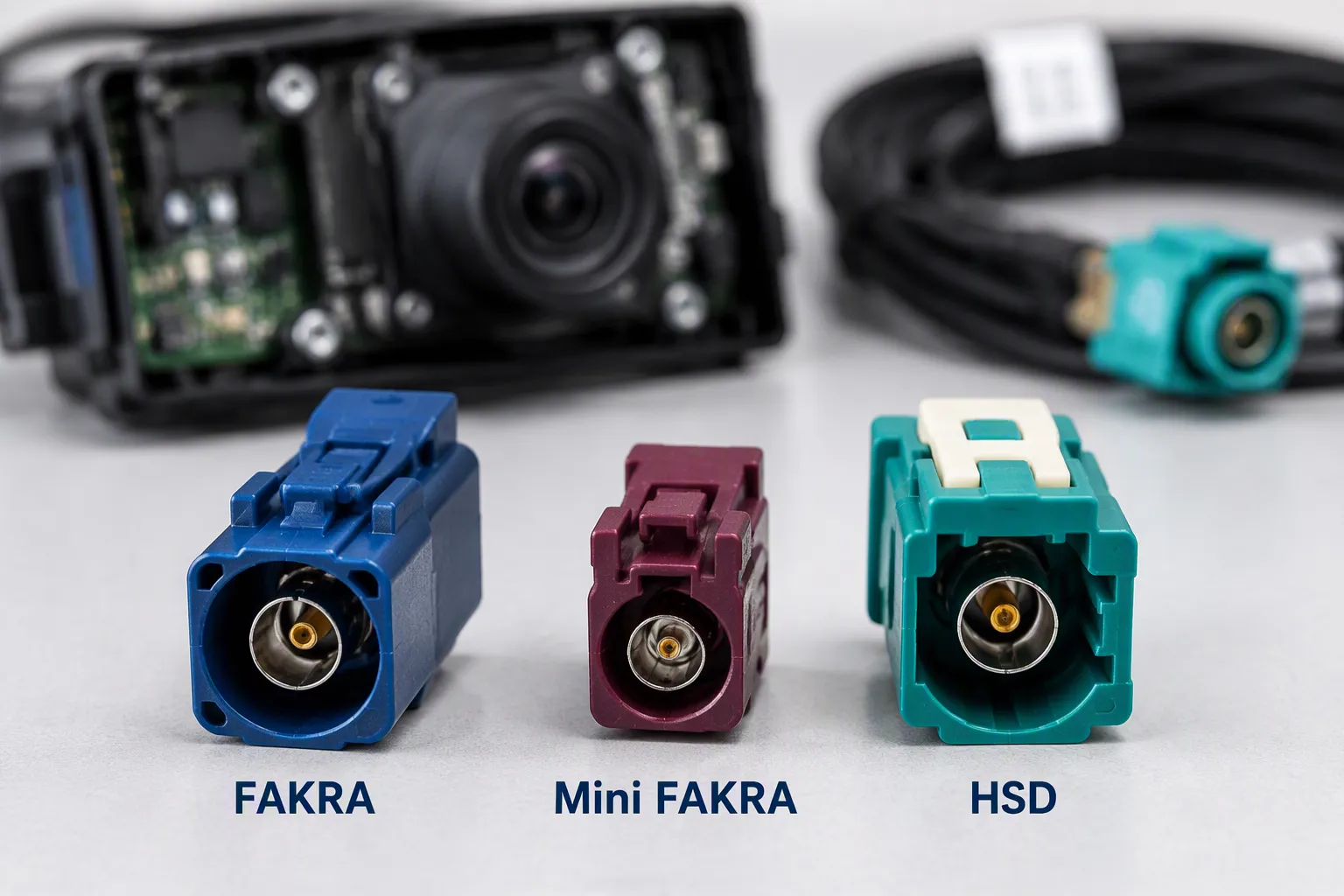
FAKRA is the standard 50 Ω coaxial RF connector for antennas and camera links. Mini FAKRA is its smaller 50 Ω coaxial variant for high-density camera and ADAS connections. HSD is the differential-data connector for USB, Ethernet, and LVDS links.
TL;DR: FAKRA and Mini FAKRA handle coaxial RF camera links. HSD handles differential data such as USB, Ethernet, and LVDS. The right choice depends on the camera module, interface, protocol, and OEM requirements.
This post provides a spec table, per-connector deep dives, a selection workflow, and a buyer checklist for FAKRA vs Mini FAKRA and HSD decisions.
Key Takeaways
FAKRA and Mini FAKRA connectors carry single-ended coaxial signals for camera and antenna links.
HSD connectors carry differential data pairs for USB, Ethernet, and LVDS links.
Mini FAKRA saves space and suits multi-camera systems with high port density.
Match the connector to the camera interface and protocol to avoid signal problems.
Check coding, pinout, and environmental sealing before finalizing your connector choice.
What an Automotive Camera System Includes
An automotive camera system is more than a lens and a housing. It combines a camera module, a cable, and a connector into one signal path. Each part must match the others. A mismatch at any point can degrade image quality or block communication between the camera and the ECU.
Camera Module, Cable, and Connector Roles
The camera module captures light and converts it into an electrical signal. Inside the module, a board-to-board connector links the image sensor board to the processing board. A backshell housing and an I/O bullet carry the signal out of the module. The cable then transports that signal to the vehicle harness. The connector at each end terminates the cable and mates with the module or the ECU.
A connector family is not a complete cable assembly. A family defines the interface geometry, impedance, and coding. A complete assembly adds the cable, the backshell, the seals, and the terminated contacts. Buyers who order by family name alone may receive a part that does not fit their harness.
Camera module assembly requires adhesives with good adhesion, flexibility, and substrate compatibility. These adhesives are applied at interfaces such as lens barrel to housing and housing to PCB. Key considerations include fast cure, low-temperature cure, and an operating range of -40 to 130°C.
Why Signal Type Drives the Choice
The camera interface decides the connector type. A coaxial link carries a single-ended RF signal. A differential link carries paired signals for USB, Ethernet, or LVDS. FAKRA and mini fakra serve the coaxial case. HSD serves the differential case. The two are not interchangeable.
Several factors shape the final choice. These include the camera module, vehicle platform, interface, protocol, pinout, and OEM requirements. Cable length and shielding needs also matter, depending on the application. A backup camera on a compact hatchback may need a short, sealed run. A surround-view system on a larger platform may need multiple shielded runs with tight bend radii. The connector must survive the same vibration, moisture, and temperature profile as the rest of the automotive harness.
FAKRA Connectors for Camera Links
FAKRA connectors are the standard 50 Ω coaxial interface for high-frequency automotive links. They carry RF signals from DC up to 6 GHz and support data rates up to 25 Gbps. Return loss stays at or above 18 dB. These traits make them a common choice for coaxial camera links, antenna feeds, and telematics modules.
Typical Automotive Applications
A backup camera, a surround-view module, and a GPS antenna all rely on a stable RF path. FAKRA handles each of these roles. The same family serves infotainment, Bluetooth and WLAN, keyless entry, and RF remote control systems. Waterproof versions are available for exposed locations such as the rear bumper or the exterior mirror.
Cable routing deserves early attention. FAKRA assemblies come in straight and right-angle forms, so the housing can follow tight body lines. Engineers should confirm the bend radius of the chosen cable before finalizing the harness path. Standard fakra connectors are not waterproof by default. Sealed versions are needed wherever moisture can reach the mating interface.
Category | LEADSIGN FAKRA Specification |
|---|---|
Impedance | 50 Ω |
Frequency range | DC up to 6 GHz |
Data rate | Up to 25 Gbps |
Return loss | ≥ 18 dB |
Temperature range | −40 °C to +105 °C |
Mating cycles | ≥ 25 |
Compliance | RoHS, WEEE, ELV |
Coding, Locking, and Routing
Mismating is a real risk in a dense harness. FAKRA solves it with mechanical keying. LEADSIGN offers 13 mechanical and colored codings plus one neutral coding. The physical key decides whether two housings can mate. Color is a visual aid only. It does not confirm compatibility on its own.
The locking system adds a second layer of security:
A push-on mechanism built into the plastic housing
An audible click that confirms full engagement
Primary and secondary locks that hold the connection under vibration
These features matter for any video link that runs through a moving tailgate or a vibrating chassis. Installers should verify the code letter, the keying profile, and the lock engagement before routing the cable. A quick check at this stage prevents a costly rework later.
Mini FAKRA vs FAKRA: Size and Density
Space is the main practical difference in the fakra vs mini fakra debate. Standard FAKRA uses a larger housing built on the SMB interface with a protective plastic shell. Mini FAKRA uses a much smaller housing for compact vehicle electronic modules. Both carry a 50 Ω coaxial signal. They differ in how much room that signal needs.
Compact Camera and Multi-Camera Use
A surround-view system needs four video feeds. Four standard fakra connectors take four separate ports and a wide strip of board area. A single quad Mini FAKRA housing carries four coaxial ports in one interface. That one body serves the front, rear, left, and right channels. Mini FAKRA also works as a transmission intermediary between sensor data and the AVM (around-view monitor) system.
Vendor-published figures put the space saving at up to 80% for Molex HFM and 75% maximum for TE, compared with standard FAKRA. Selected HFM configurations reach DC to 20 GHz and data rates up to 28 Gbps. These numbers apply to specific families, so engineers should confirm them for the chosen part. The mini fakra vs fakra choice is not a straight upgrade. A backup camera with one feed may not need the extra density.
Packaging and Mismating Prevention
Dense packaging raises the risk of crossed feeds. Color coding and keying stop that error at the mating step. An amber plug will not fit a blue socket, so a GPS antenna cannot land on a camera input.
Color | Application |
|---|---|
Amber | GPS antenna |
Blue | Camera video (CVBS, AHD) |
White | SDARS (satellite radio) |
Bordeaux | AM/FM radio |
Violet | Bluetooth / 5G telematics |
Green | USB / infotainment |
Retention matters as much as keying. A secondary lock or CPA (connector position assurance) keeps the connection tight under automotive vibration. Terminal position assurance (TPA) snaps into place after proper mating. Push-on mating gives an audible click. Low engagement forces ease installation in tight spaces. These features make mini fakra systems a compact alternative for dense layouts, not a replacement for every FAKRA use case.
HSD vs FAKRA Connectors for Data
The hsd vs fakra connectors question starts with signal type. HSD carries differential data pairs. FAKRA carries a single-ended coaxial RF signal. Engineers cannot swap one for the other, even when the housings look similar in size.
High-Speed Video and Data Links
An HSD connector moves paired signals for USB, LVDS, Ethernet, and similar protocols. TE Connectivity lists support for SerDes, GMSL1, FPD-Link III/IV, APIX2, USB 2.0, LVDS, Ethernet, IEEE 1394, GVIF, and MOST. Published figures for that family reach up to 6 Gbps and 6 GHz. The HSL variant tops out at 1 Gbps.
"The term HSD describes an interface family, not one fixed bandwidth value... A data rate stated for one connector series cannot automatically be applied to every HSD connector or cable assembly."
That caution matters for high-speed camera links. The system defines the protocol and rate. The connector, cable, and full channel must then support them. A coaxial GMSL link and an automotive ethernet over hsd link use different signal paths. Each needs its own matching hardware.
Shielding and Signal Integrity
The vehicle harness is an electrically noisy place. HSD answers that with layered shielding. The outer contact forms a first shield around the inner terminals. A 360-degree die-cast metal shield adds high EMI and EMC immunity. A shielded twisted quad holds two differential pairs inside one continuous shield. This layout limits crosstalk between pairs.
FAKRA relies on its own coaxial shield instead. The braid and outer contact protect a single RF line. That design suits camera video, antenna feeds, and other RF links. It does not carry paired data the way HSD does.
Compatibility with the camera and display system decides the match. LVDS cameras and display modules expect a differential path. Many coaxial cameras expect a 50 Ω RF path. The fakra hsd split follows that rule. A designer should confirm the interface on both ends before choosing a connector.
FAKRA vs Mini FAKRA vs HSD Table
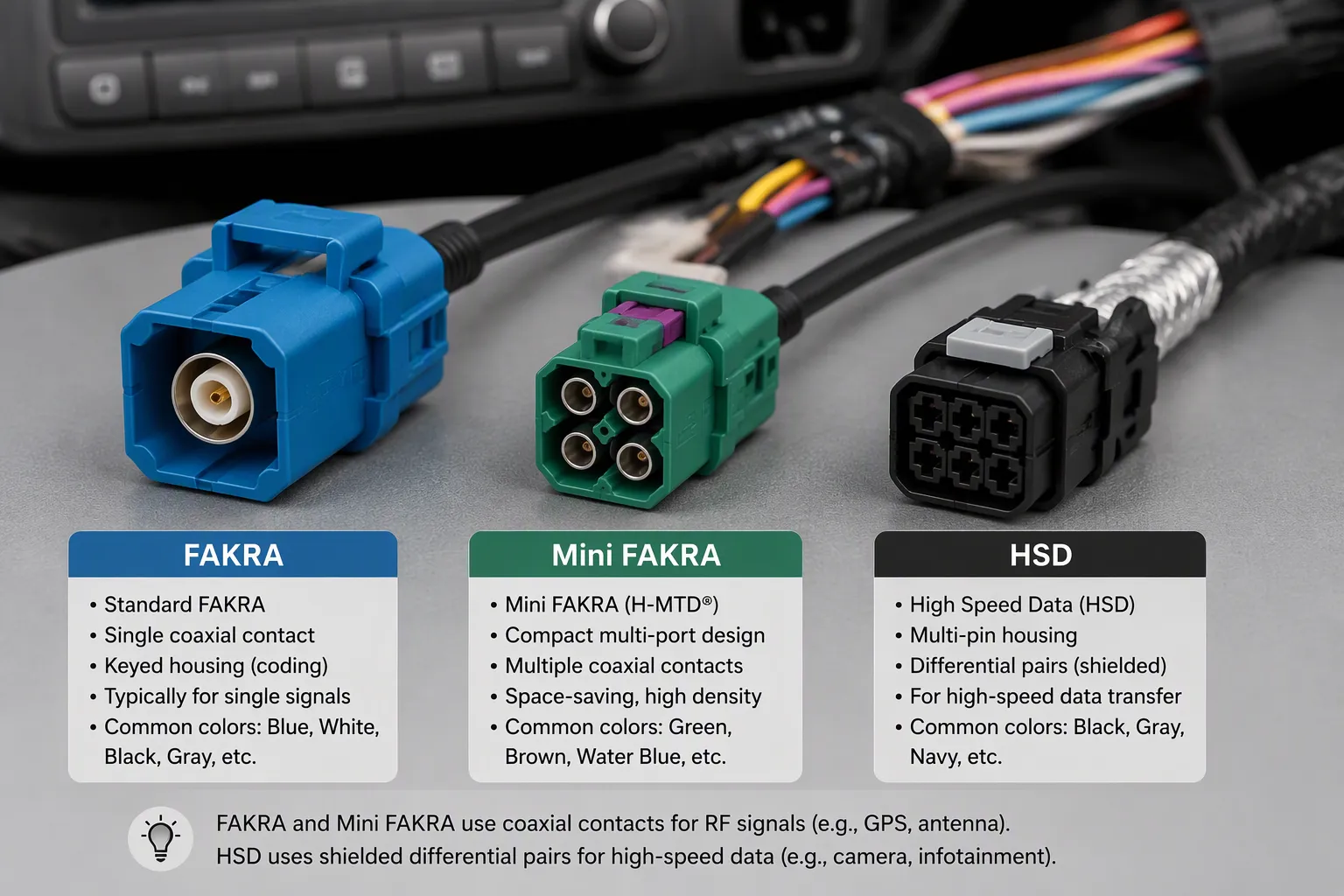
Comparison Criteria
A fair comparison needs the same criteria applied to every family. This table uses seven: connector size, typical application, signal environment, packaging requirements, coding options, cable assembly considerations, and best-fit use cases. Each row describes the family as a whole. A specific part may differ, depending on the application.
Criterion | FAKRA | Mini FAKRA | HSD |
|---|---|---|---|
Connector size | Standard housing, larger footprint | Compact housing, high density | Compact multi-pin housing |
Typical application | Antenna, camera, telematics, RF links | USB, Ethernet, LVDS camera and display links | |
Signal environment | Coaxial, single-ended, 50 Ω | ||
Packaging requirements | Moderate board area per port | Small board area, multi-port bodies | Small board area, paired channels |
Coding options | 13 mechanical and colored codings plus one neutral coding | Color and keying options, depending on the application | Keying options, depending on the application |
Cable assembly considerations | Coaxial cable, crimped contacts, sealed versions for exterior use | Compact coaxial assemblies for tight layouts | Shielded twisted quad assemblies for high-speed data |
Best-fit use cases | Single RF camera or antenna feed | Multi-camera surround-view and compact modules | High-speed video and data between camera, ECU, and display |
How to Read the Results
The signal environment row carries the most weight. FAKRA and Mini FAKRA both use a coaxial, single-ended path. HSD uses a differential path over a shielded twisted quad. That split decides which family can serve a given camera interface. The fakra hsd difference is not a matter of size or price. It is a matter of signal type.
The size row explains the fakra vs mini fakra trade-off. Standard fakra housings suit single feeds with room to spare. Mini fakra housings pack several ports into one body for dense modules. Neither is better in every case. The mini fakra vs fakra decision follows the channel count and the available board area.
Cable assembly deserves a close look. A mismatched connector can deform the cable dielectric and break the 50-ohm impedance. Common coaxial cables such as RG174, RG316, RTK031, and LMR100 fall in the 2.5–3.2 mm outer diameter range. Right-angle bodies save space behind a dashboard, but they are harder to crimp. Exterior locations call for sealed connectors with internal O-rings. Installers should also confirm the coding before production. A universal Code Z defeats the anti-mismating function.
Read the table as a starting filter, not a final answer. The correct choice depends on the camera module, vehicle platform, interface, protocol, pinout, and OEM requirements. Engineers should confirm each cell against the chosen part and the full cable assembly. A connector family alone does not define the finished harness.
HSD vs FAKRA: Selection Guide
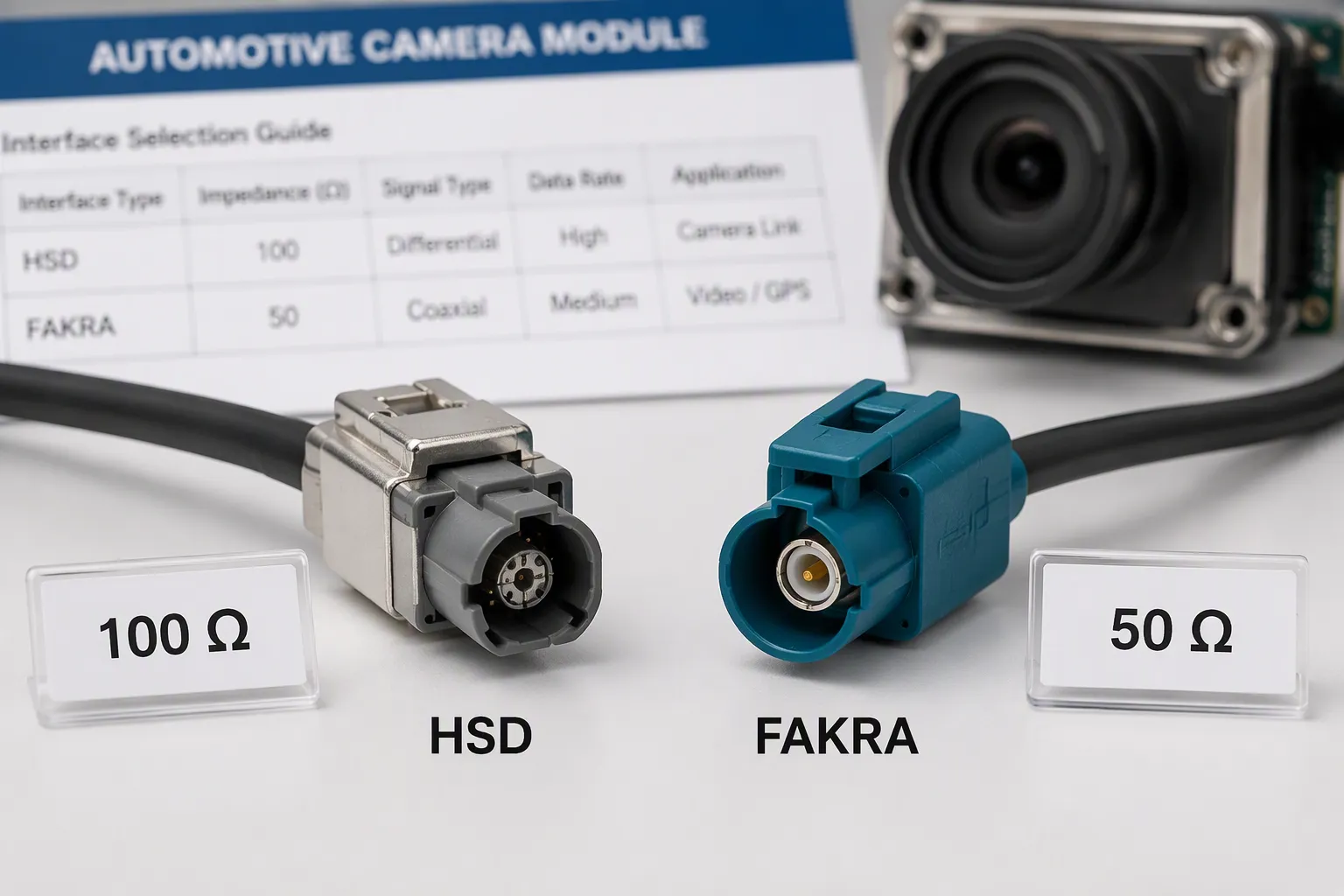
The selection process starts at the camera interface, not at the connector catalog. A designer reads the module datasheet first. That document names the port type, the protocol, and the impedance. Every later decision follows from those three facts.
Interface, Protocol, and Data Rate
The camera interface sets the electrical topology. A coaxial SerDes port expects a single-ended 50 Ω path. A differential port expects a paired 100 Ω path. The hsd vs fakra question answers itself at this step. A 100 Ω differential module points to an HSD connector. A coaxial module points to FAKRA or Mini FAKRA.
Connector Family | Nominal Impedance | Electrical Topology | Selection Implication |
|---|---|---|---|
HSD | Commonly 100 Ω | Shielded differential path | Must match a 100 Ω differential module interface |
FAKRA | Commonly 50 Ω | Coaxial path referenced to outer conductor | Must match a 50 Ω coaxial module interface |
Impedance matching must hold across the connector, cable, termination, and module. A mismatch raises loss and weakens shielding. The video protocol and data rate come next. The full channel must support the target rate, not just the bare connector. Cable length shapes the link budget too. Insertion loss rises as the run grows, so long harness routes need extra design margin. Tight bends stress the dielectric and shield. A crushed cable degrades return loss. The finished assembly deserves evaluation against the protocol, cable model, and receiver margin.
Space, Environment, and OEM Requirements
Installation space decides between standard and compact housings. The fakra vs mini fakra trade-off follows channel count and board area. A single backup camera feed may fit a standard housing. A dense multi-camera module often needs the smaller body. The mini fakra vs fakra choice is a packaging decision, not a performance upgrade. Both families present 50 Ω at the interface, so impedance alone cannot separate them. Designers compare frequency capability and sealing instead.
The environment sets the sealing and material requirements. Moisture, mud, and washdown call for IP67 or higher protection. Extreme temperatures demand materials that tolerate thermal expansion and contraction. Vibration calls for resistant locking, secondary locks, and wedge locks. Dust and debris need sealed bodies with gaskets.
Requirement | FAKRA Specification |
|---|---|
Operating temperature | |
Vibration and mechanical shock | USCAR-2 Paragraph 5.4.6 / ISO 20860-2 Clause 9.1 |
Damp heat cycling | USCAR-2 Paragraph 5.6.2 / ISO 20860-2 Clause 9.3 |
Thermal shock | USCAR-2 Paragraph 5.6.1 / ISO 20860-2 Clause 9.2 |
Waterproofing | Select models IP67; IPX9K variant for high-pressure wash |
Coding protects the harness during assembly. Installers should confirm the key position before production. The fakra hsd split means the two families never share a mating interface. No adapter turns a coaxial port into a differential one. OEM and system integrator requirements close the loop. These documents may fix the coding, the test standard, and the approved cable list. Engineers should treat them as binding constraints. The final choice depends on the module, platform, interface, protocol, pinout, and OEM requirements. No single family fits every automotive camera design.
Common Selection Mistakes
Most selection errors start with a reasonable assumption. A designer sees two similar housings and assumes they match. That shortcut causes rework, scrap, and delayed builds. The list below covers the errors that appear most often in automotive camera harness projects.
Appearance and Pinout Errors
The first mistake treats the three families as interchangeable. HSD is a 100-ohm differential system. FAKRA and Mini FAKRA are 50-ohm coaxial systems. Similar applications do not make them swap-compatible. A designer who orders an HSD part for a coaxial port will receive an assembly that cannot mate or carry the signal.
Color is another common trap. Color only identifies an application. Mechanical coding, interface gender, and internal terminal configuration decide compatibility. Two plugs with similar colors may still carry different keys. Buyers should confirm the code letter and the keying profile on the drawing.
Pinout errors follow close behind. Identical-looking HSD housings can be wired differently. An order placed without a pinout carries a real risk of an unusable assembly. The same caution applies to any multi-conductor cable.
Cable and Routing Errors
Cable construction deserves equal care. A catalog data rate describes a defined product family under stated conditions. It does not rate the finished harness. Cable type, length, termination, mating interface, and routing all shape real channel performance. A small coaxial cable may route easily, yet it can show higher loss at the required frequency. Engineers should check attenuation across the full assembly length.
Length measurement causes quiet failures. Length can run between connector tips, housing reference planes, or cable-exit points. Each choice produces a different finished part. The drawing must show where measurement begins and ends.
Right-angle orientation needs the same check. Right-angle connectors can exit in different directions. A cable may mate correctly and still strike a module housing, bracket, or dashboard structure. A drawing or sample confirms the fit before production. Routing and bend radius belong in the same review. A tight bend can stress the dielectric and shield, so the harness path should respect the cable's rated radius.
Custom LEADSIGN Camera Cable Assemblies
A standard catalog part rarely matches every harness route. A custom assembly closes the gap between the camera module and the vehicle harness. LEADSIGN supplies FAKRA connectors, Mini FAKRA connectors, HSD cables, LVDS cables, USB cables, coaxial cables, and custom automotive cable assemblies. This range covers both coaxial and differential camera links.
When a Custom Assembly Fits
A custom assembly fits when the harness route demands more than a catalog length. A surround-view module may need four branches from one breakout point. A rear camera may need a right-angle exit that clears a tailgate hinge. A shielded fakra hsd and lvds cable run may need a specific jacket material for the engine bay.
A custom build also fits when the pinout or coding is fixed by the OEM. The supplier then terminates the exact key position and cable type the drawing calls for. Engineers should confirm the interface on both ends before ordering. A coaxial port and a differential port never share one assembly.
What LEADSIGN Provides
LEADSIGN offers OEM and ODM services for camera and sensor harness projects. An experienced design team reviews the drawing, the pinout, and the routing path. Strict quality management covers incoming materials, crimping, and final inspection. Efficient production personnel keep delivery times short.
The product range covers the full signal path. FAKRA and mini fakra connectors serve coaxial links. HSD cables and hsd connector options serve differential links. LVDS, USB, and coaxial cables complete the assembly. Buyers can request samples before a production run. A sample confirms fit, coding, and bend radius on the real vehicle structure.
Buyer Checklist for LEADSIGN
A clear request shortens the quotation cycle. Buyers who supply complete details receive an accurate assembly on the first attempt. Vague requests invite guesswork, and guesswork invites rework.
Connector and Cable Details
The connector family comes first. A buyer states whether the link needs a fakra connector, a mini fakra variant, or an hsd assembly. The code letter and housing color follow. Mechanical keying prevents mismating between systems, so the code must match the mating port exactly. Buyers also confirm the gender, plug or jack, and the orientation, straight or right-angle.
Cable details complete the picture. The table below lists the items that remove ambiguity from a request.
Specification Item | What Buyers Must Confirm |
|---|---|
Connector code and color | Code letter and housing color |
Gender and orientation | Plug or jack; straight or right-angle |
Cable type and length | RG designation or low-loss construction; finished length plus tolerance |
Impedance | 50 ohm for fakra, 100 ohm for hsd |
Shielding | Braided copper, aluminum foil, or a combination |
Pinout and mating connector | Terminal assignment and the connector type at both ends |
Drawing or sample | Drawing number, photo, or original part number |
A backup camera harness may need only one coaxial run. A multi-camera module may need several branches from one breakout point. The drawing should show every branch and exit direction. Buyers should also state sample quantity and annual forecast, so production planning stays realistic.
Environmental and Testing Needs
The vehicle location sets the environmental profile. Buyers should state the operating temperature range, moisture exposure, vibration, abrasion resistance, minimum bend radius, and routing space. Flex points and strain relief matter for truck and commercial wiring. Sealing deserves its own line. A waterproof connector version with a stated IP rating protects exposed joints, and the rating should cover the full assembly, not just the connector.
Build shielding and connector sealing into the design early. Late changes cost time and money during validation.
Shielding structure belongs in the request too. Buyers should name the shield type, the 360° shield grounding method, and any CISPR 25 Class 5 emission and immunity targets. Electrical testing rounds out the checklist. VSWR, return loss, insertion loss, and continuity validate the finished assembly. Buyers should also name the applicable ISO, SAE, or DIN EN standard. A controlled drawing, bill of materials, pinout, and test plan turn these details into a repeatable build. The fakra hsd split means the request must also state the signal type, so the supplier selects the correct coaxial or twisted quad construction for the video link.
Installation and Inspection Checklist
A final inspection catches most mating and routing faults before the vehicle leaves the line. The checks below take only a few minutes per camera link. They apply to any coaxial or differential camera harness, including every fakra assembly.
Mating and Coding Checks
Confirm the code letter and keying profile against the mating port. Color alone does not prove compatibility. Push each plug in until the audible click confirms full engagement. Then tug the body gently to verify the primary lock holds. Where a secondary lock or connector position assurance clip exists, seat it fully.
Inspect the terminal position assurance device after mating. It should snap into place without force. A loose clip signals an incomplete connection. Installers who want to learn how to crimp a fakra connector correctly should practice on scrap cable first. A poor crimp deforms the dielectric and shifts impedance. Check the contact sits flush in the housing before the plug goes anywhere near the module.
Routing and Environmental Checks
Route every cable along its planned path and respect the rated bend radius. A tight bend stresses the shield and raises return loss. Add strain relief at flex points such as tailgate hinges and door grommets. Tie the harness away from sharp edges and heat sources.
Seal all exposed joints on waterproof versions. Confirm the O-ring sits clean and undamaged before mating. Verify the connector temperature rating covers the mounting location. Standard fakra parts run from −40 °C to +105 °C, so engine-bay routes need a check against that window. Look for moisture traps where water can pool against the housing. A dry, sealed joint at installation prevents corrosion months later.
One rule settles most designs. Coaxial RF links point to fakra or Mini fakra parts. Differential data links point to hsd parts. The final choice still depends on the camera module, vehicle platform, interface, protocol, pinout, and OEM requirements.
No connector family wins everywhere. Each one fits a specific application well. Engineers can use the comparison table, the selection guide, and the buyer checklist as a practical reference for the next automotive system design. A complete request with pinout and coding details shortens the quotation cycle. For a quotation or a technical consultation, readers can contact LEADSIGN at info@leadsignauto.com or visit https://www.fakraconnectors.com.
FAQ
What is the main difference between FAKRA, Mini FAKRA, and HSD?
FAKRA and Mini FAKRA both carry a single-ended 50 Ω coaxial signal. They differ mainly in housing size. HSD carries differential data pairs for USB, Ethernet, and LVDS links. Signal type separates the families, not appearance.
Can an engineer use an HSD connector in place of a fakra connector?
No. The two families serve different electrical paths. A fakra port expects a 50 Ω coaxial link. An HSD port expects a differential pair. No adapter converts one into the other, so each port needs its matching connector family.
Which connector suits a multi-camera surround-view module?
A dense module often needs several coaxial feeds in limited board space. Mini FAKRA packs multiple ports into one compact body. A single backup camera may fit a standard fakra housing instead. Channel count and available space decide the fit.
What details should a buyer send with a camera cable request?
A complete request names the connector family, code letter, gender, orientation, cable type, length, pinout, impedance, and shielding. It also states the operating environment and any test standard. Clear details reduce rework and shorten the quotation cycle.
See Also
Discovering The Benefits Of Mini Fakra Connectors For Automotive Uses
Exploring The Benefits Of Mini Fakra Connectors Within Automotive Systems
Benefits Of High-Speed FAKRA-Mini Connectors For The Automotive Sector
Revealing The Benefits Of Mini FAKRA Connectors In Today's Vehicles
Why Fakra Connectors Matter So Much In The Automotive Industry