FAKRA vs. HSD vs. Mini-FAKRA: How to Choose the Right Connector for Your Automotive Application

Introduction
Choosing the wrong automotive connector can cause much more than a mechanical fit problem.
Unstable GPS reception, interrupted camera images, display flickering and failed EMC tests can all result from an incorrectly selected connector or cable assembly. FAKRA, HSD and Mini-FAKRA are widely used in automotive electronics, but they are designed for different signal types, impedance structures, bandwidth requirements and installation conditions.
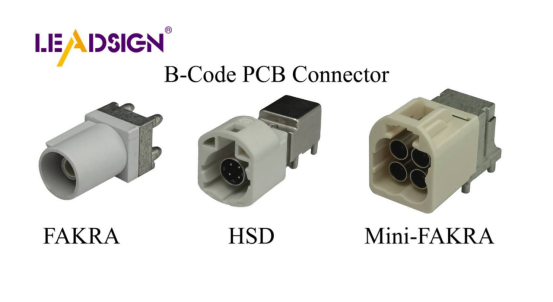
A FAKRA connector is commonly used for automotive RF and coaxial signals. An HSD connector is designed primarily for differential data transmission such as LVDS, GVIF and USB. A Mini-FAKRA connector supports compact, high-bandwidth connections for cameras, ADAS systems and automotive computing modules.
This article compares FAKRA, HSD and Mini-FAKRA connectors using practical technical parameters and application examples. It is intended to help automotive wire harness manufacturers, connector distributors, GPS/GNSS antenna manufacturers, infotainment and display manufacturers, automotive electronic module suppliers, and aftermarket accessory companies select the right automotive connectors for their projects.
1. What Is the Main Difference Between FAKRA, HSD and Mini-FAKRA?
The primary difference is the signal transmission structure.
FAKRA and Mini-FAKRA generally use a 50-ohm coaxial structure. HSD normally uses a 100-ohm differential structure for balanced digital data transmission.
Comparison | FAKRA | HSD | Mini-FAKRA |
Transmission structure | Coaxial | Shielded differential | High-speed coaxial |
Typical impedance | 50 ohms | 100 ohms differential | 50 ohms |
Typical frequency capability | Up to approximately 6 GHz, depending on series | Up to approximately 2 GHz, depending on series | Some series support up to 20 GHz |
Typical data capability | Depends on protocol and assembly | Some traditional products support approximately 1.6 Gbps | Some series support 20–28 Gbps |
Common applications | GPS, radio, cellular and V2X | LVDS, GVIF, USB and Ethernet | Cameras, ADAS, displays and radar |
Coupling method | Push-on locking | Push-on locking | Push-on locking |
Mismating prevention | Color and mechanical coding | Mechanical coding | Mechanical coding |
Space requirement | Relatively large | Medium | More compact than traditional FAKRA |
Common cable types | RG174, RG316 and automotive coaxial cable | Shielded twisted-pair or star-quad cable | High-frequency automotive coaxial cable |
The frequency and data-rate values in this table represent typical or maximum ratings published for selected product families. They are not universal ratings for every connector.
The performance of a finished FAKRA cable assembly, HSD cable assembly or Mini-FAKRA cable assembly also depends on the terminal, cable type, cable length, termination process and mating device interface.
2. When Should You Choose a FAKRA Connector?
FAKRA is well suited to established automotive RF applications.
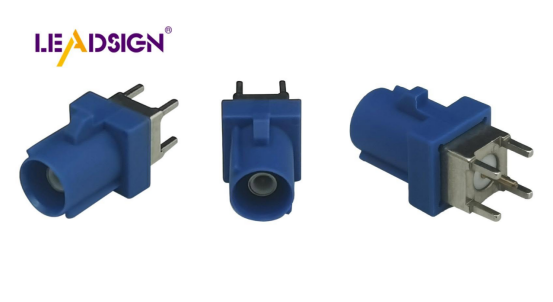
The FAKRA interface is based on an SMB-type RF connection combined with an automotive plastic housing, locking mechanism, color identification and mechanical keying. It normally has an impedance of 50 ohms and is commonly found in GPS, GNSS, AM/FM radio, satellite radio, 4G/5G, Wi-Fi, Bluetooth, V2X and telematics systems.
Typical FAKRA applications
GPS and GNSS automotive antennas
AM/FM and DAB radio antennas
4G and 5G cellular communication modules
Telematics control units and T-Boxes
Vehicle-to-everything communication modules
Selected backup-camera and video connections
OEM head-unit and aftermarket radio adapters
For a GPS/GNSS antenna manufacturer, FAKRA is often a practical and mature choice. Its color and mechanical coding help production workers distinguish GPS, radio and cellular antenna channels during vehicle assembly.
For automotive aftermarket companies, products such as a FAKRA adapter, GPS antenna cable and GPS antenna extension cable also address clear replacement and retrofit requirements. Common configurations include FAKRA-to-SMA, FAKRA-to-DIN, FAKRA-to-MCX and other customized RF interfaces.
Main advantages of FAKRA
The main advantages of FAKRA are its mature automotive application base, broad configuration range and easy identification.
Its mechanical keying and color coding reduce the risk of connecting one antenna channel to the wrong module port. Straight, right-angle, cable-mount and PCB-mount configurations are widely available, allowing an automotive wire harness manufacturer to create many different FAKRA cable assemblies.
FAKRA connectors are also familiar to vehicle manufacturers, antenna suppliers, telematics companies and aftermarket installers. This makes them suitable for projects that require established components and straightforward field identification.
Limitations of FAKRA
The main limitations of traditional FAKRA are connector size and port density.
When a module requires many camera, antenna or high-speed data channels, multiple traditional FAKRA ports can occupy substantial PCB and enclosure space. Mini-FAKRA may be a better option for compact domain controllers, multi-camera ECUs and other high-density automotive modules.
Before purchasing a FAKRA cable assembly, confirm:
The required mechanical code
The FAKRA housing color
Whether each interface is a plug or jack
Straight or right-angle configuration
The actual right-angle cable-exit direction
50-ohm cable compatibility
Cable attenuation at the required frequency
Cable length and tolerance
Whether a sealed interface is required
Color should be used as an identification aid rather than the only selection criterion. Mechanical coding and interface gender determine whether the two components can mate correctly.
3. When Should You Choose an HSD Connector?
HSD is suitable for differential digital data transmission inside the vehicle.
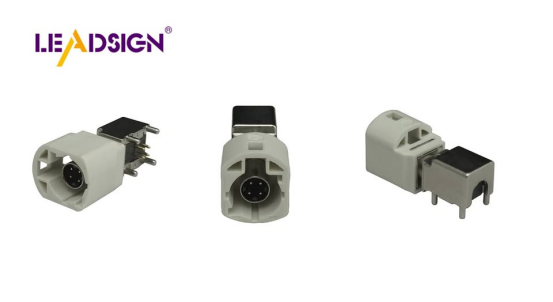
An HSD connector normally uses a 100-ohm differential design with shielding and mechanical keying. It can support applications based on LVDS, GVIF, USB, IEEE 1394 and selected Ethernet-related systems.
HSD connections are commonly found in infotainment systems, displays, digital instrument clusters, cameras, consumer ports and automotive electronic modules.
Typical HSD applications
Center-information displays
Digital instrument clusters
Automotive infotainment head units
Rear-seat entertainment systems
LVDS cameras
Vehicle USB ports
Digital video connections
Selected automotive Ethernet applications
Multimedia and electronic control modules
For a head-unit or display manufacturer, an HSD cable assembly provides a shielded interface for differential data transmission. Certain HSD configurations may also include additional power contacts, depending on the connector design and system requirements.
Main advantages of HSD
The primary advantage of HSD is its ability to maintain a balanced differential channel.
Unlike a 50-ohm coaxial FAKRA interface, HSD is generally designed around a 100-ohm differential transmission path. Its shielded structure helps control external interference, while mechanical coding reduces the risk of mixing display, camera, USB and other data connections.
Published specifications for certain HSD product families show frequency ranges from DC to approximately 2 GHz. Some traditional HSD assemblies support data rates around 1.6 Gbps. The applicable rating must always be confirmed for the particular connector, cable and protocol.
Limitations of HSD
HSD is not a direct substitute for a FAKRA coaxial connector.
Both connector types can appear in automotive camera systems, but the underlying signal structures may be completely different. A camera using a coaxial serializer/deserializer link normally requires a 50-ohm coaxial channel. A camera or display using LVDS or another differential interface may use HSD.
Before ordering an HSD cable assembly, confirm:
The complete pin assignment
The required differential impedance
HSD mechanical coding and color
Straight or right-angle orientation
Cable construction and shielding
The communication protocol
Required data rate
Finished cable length
Whether additional power contacts are needed
An identical HSD housing does not guarantee an identical pinout. An incorrect pin assignment can prevent communication and, in some cases, damage the connected equipment.
4. When Should You Choose Mini-FAKRA?
Mini-FAKRA is intended for applications requiring high bandwidth and high port density.
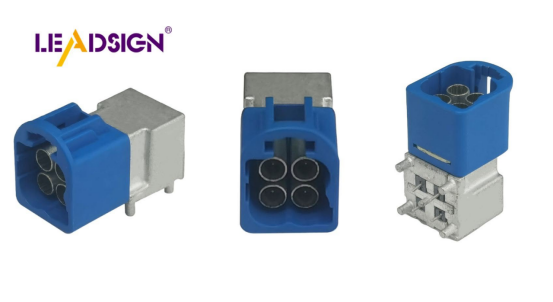
A Mini FAKRA connector, sometimes identified as HFM or another brand-specific miniature automotive coaxial system, retains a coaxial transmission structure while reducing interface size. This makes it suitable for automotive electronic modules that must accommodate multiple high-speed channels within limited space.
Selected Mini-FAKRA or HFM product families support frequencies up to 20 GHz and data rates from 20 to 28 Gbps. Ratings vary between manufacturers and connector series, so buyers must verify the exact part number and finished cable assembly.
Typical Mini-FAKRA applications
360-degree surround-view cameras
Front-view and rear-view cameras
ADAS sensor connections
Automated-driving domain controllers
High-resolution automotive displays
Radar and high-speed data modules
Multi-antenna systems
GMSL and FPD-Link connections
Central computing platforms
For an automotive electronic module manufacturer, a Mini FAKRA cable assembly can provide more high-speed ports in a smaller enclosure. Single, dual and quad configurations can support camera aggregation and multi-channel controllers while reducing the PCB space required for individual interfaces.
Main advantages of Mini-FAKRA
The central value of Mini-FAKRA is the combination of compact size and high bandwidth.
Some miniature automotive coaxial systems require substantially less installation space than traditional FAKRA. A control module can therefore accommodate more camera or data channels without a proportional increase in enclosure size.
This is particularly valuable for:
ADAS control units
Smart cockpit controllers
Multi-camera ECUs
Automated-driving computers
High-resolution display systems
Centralized vehicle architectures
Mini-FAKRA can also reduce cable-interface density at the module and support multi-port housings. These features help automotive engineers manage a growing number of sensors and video channels.
Limitations of Mini-FAKRA
Mini-FAKRA is more sensitive to cable and termination quality at higher frequencies.
As operating frequency increases, small changes in the termination geometry become more important. Cable construction, stripping dimensions, center-contact position, shield crimping and bend radius can all affect insertion loss and return loss.
Before purchasing a Mini FAKRA cable assembly, ask the supplier to confirm:
The connector family and compatible mating interface
Single, dual or quad-port configuration
Mechanical coding
Target frequency or data rate
Coaxial cable type
Finished cable length
Insertion-loss requirements
Return-loss requirements
GMSL, FPD-Link or other protocol requirements
Prototype test method
Production inspection method
A compact connector should not be selected only because it saves space. The full channel must support the required protocol at the intended cable length.
5. Which Connector Is Best for GPS, Cameras and Displays?
The communication protocol is more important than the device name.
There is no single universal automotive camera connector. Different camera systems can use FAKRA, HSD or Mini-FAKRA, depending on whether the camera outputs a coaxial serial signal or a differential digital signal.
Customer application | Connector to consider first | Main reason |
GPS/GNSS antenna | FAKRA | Mature 50-ohm automotive RF interface |
AM/FM radio antenna | FAKRA | Suitable for established automotive RF connections |
4G/5G or T-Box | FAKRA or Mini-FAKRA | Depends on frequency, space and port count |
Traditional single camera | FAKRA or HSD | Depends on coaxial or differential signal architecture |
360-degree camera system | Mini-FAKRA | Supports multiple high-speed channels in limited space |
ADAS domain controller | Mini-FAKRA | Suitable for high-density coaxial data connections |
LVDS center display | HSD | 100-ohm differential structure is appropriate for LVDS |
Automotive USB port | HSD | Supports shielded differential data transmission |
Aftermarket GPS adapter | FAKRA-to-SMA or another RF interface | Connects an OEM antenna to an aftermarket device |
A GPS antenna connector will often use FAKRA, but the interfaces at both ends still need to be confirmed. Some antennas and modules use SMA, MCX or other small RF connectors, creating a need for a custom FAKRA adapter cable.
An LVDS connector application will more commonly require an HSD-type differential connection. The buyer should provide the device pinout, cable length and orientation rather than selecting the assembly from housing color alone.
Camera application example
A surround-view system can contain four or more cameras connected to an image-processing ECU. Traditional FAKRA may work when enclosure space is available and the protocol is compatible.
Mini-FAKRA becomes attractive when the ECU needs multiple compact high-speed coaxial ports. Dual-port or quad-port housings can simplify module packaging and cable identification.
An HSD cable may be appropriate when the camera or display interface uses a 100-ohm differential architecture. The connector decision therefore follows the electrical interface rather than the general label “camera cable.”
GPS/GNSS application example
A roof-mounted GPS/GNSS antenna may be connected to a navigation unit or telematics module using a FAKRA cable assembly.
The buyer should confirm the required FAKRA code, cable length, cable attenuation and connector orientation. A longer cable route may require a lower-loss coaxial cable to preserve sufficient signal margin.
Display application example
An automotive display connected by LVDS will normally require controlled 100-ohm differential impedance.
An HSD cable assembly may be suitable, provided that its pinout, cable construction and bandwidth match the display and head unit. Selecting a cable only because the HSD housings mate mechanically does not confirm electrical compatibility.
6. What Should Automotive Wire Harness Manufacturers and Distributors Check?
Automotive wire harness manufacturers should focus on production compatibility and batch consistency.
A terminal must match the conductor size, cable diameter, dielectric structure and crimping process. A terminal may physically fit into the housing while remaining unsuitable for the selected cable.
An automotive wire harness manufacturer should confirm:
Terminal-to-cable compatibility
Applicable conductor and cable dimensions
Crimp-height requirements
Cable stripping dimensions
Terminal retention requirements
Secondary-lock structure
Cable-side and PCB-side mating compatibility
Availability of loose components or finished assemblies
Packaging requirements
Required inspection and test reports
Connector distributors should focus on product coverage and customization options.
FAKRA products include multiple colors, mechanical codes, straight connectors and right-angle configurations. HSD and Mini-FAKRA also include different coding options, port arrangements and orientations.
An automotive connector supplier with broad product coverage can help a distributor respond to more customer inquiries without sourcing each variation from a different factory.
Distributors should also determine whether the supplier can provide:
Low-volume samples
Batch production
Mixed connector configurations
Custom labeling and packaging
Customer-specific part numbers
FAKRA adapters
Customized cable lengths
Drawing confirmation before production
Ongoing supply for repeat orders
7. What Information Should Be Included in an RFQ?
A complete RFQ reduces incorrect samples and unnecessary communication.
When requesting a FAKRA cable assembly, HSD cable assembly or Mini FAKRA cable assembly, provide the following information whenever possible:
Application, such as GPS, camera, display or T-Box
Connector type at end A
Connector type at end B
Plug or jack interface
Mechanical code and housing color
Straight or right-angle configuration
Right-angle cable-exit direction
Cable type and impedance
Finished cable length and tolerance
Operating frequency or data rate
Complete HSD pinout
Required clips, labels, sleeves or tape
Prototype quantity
Estimated annual volume
Electrical and environmental test requirements
RoHS or other compliance requirements
Target delivery date
If the connector part number is unknown, the buyer can send clear front and side photographs of the device interface, an original cable sample, vehicle information and relevant dimensions.
An experienced supplier can help narrow down the possible interface, but the final connector selection should be confirmed against the customer’s device.
Suggested RFQ table
RFQ item | Information to provide |
Application | GPS, camera, display, telematics, USB or Ethernet |
End A | Connector series, interface, code and orientation |
End B | Connector series, interface, code and orientation |
Cable | Type, impedance, diameter and jacket |
Length | Measurement reference and tolerance |
Performance | Frequency, data rate, insertion loss and return loss |
Pinout | Required for HSD and other multi-contact products |
Protection | Sleeve, tape, clip, grommet or conduit |
Compliance | RoHS and customer-specific requirements |
Quantity | Sample quantity and estimated annual volume |
Delivery | Prototype and production schedule |
Detailed information allows the supplier to recommend an appropriate custom cable assembly instead of quoting a visually similar but electrically unsuitable product.
8. Common Connector Selection Mistakes
Selecting by housing appearance alone is the most common mistake.
Mistake 1: Treating HSD as a coaxial connector
HSD is normally a 100-ohm differential connection system. FAKRA and Mini-FAKRA are generally 50-ohm coaxial systems. Similar applications do not make these transmission structures interchangeable.
Mistake 2: Selecting FAKRA only by color
Color helps identify a FAKRA connector, but mechanical code, interface gender and internal terminal configuration determine whether it is compatible.
Two connectors with similar colors may still have different mechanical keys. A universal code may also fit more interfaces than a dedicated production code.
Mistake 3: Treating the maximum data rate as the finished harness rating
A catalog value of 20 or 28 Gbps usually refers to a defined product family under specified conditions.
Cable type, cable length, connector termination, mating interface and routing can all affect actual channel performance. Buyers should provide a target protocol or test requirement rather than relying only on the connector’s maximum headline value.
Mistake 4: Ignoring right-angle orientation
Right-angle connectors can have different cable-exit directions. A cable may mate correctly but still interfere with a module housing, bracket or dashboard structure.
A drawing or physical sample should be used to confirm orientation before production.
Mistake 5: Ordering an HSD cable without a pinout
Identical-looking HSD housings can be wired differently. Missing pinout information creates a substantial risk of receiving an unusable assembly.
Mistake 6: Specifying cable length without a measurement reference
Length can be measured between connector tips, housing reference planes or cable-exit points. Different methods produce different finished assemblies.
The drawing should show exactly where the measurement begins and ends.
Mistake 7: Choosing the smallest cable without checking attenuation
A smaller coaxial cable may be easier to route, but it can also have higher loss. The cable should be evaluated at the required frequency and total assembly length.
9. How Do You Evaluate a Connector and Cable Assembly Supplier?
The right supplier should be able to confirm both mechanical and electrical requirements.
A supplier that quotes only from a photograph may overlook connector coding, impedance, cable compatibility or pin assignment. A capable supplier will normally ask about the application, mating interface, cable, length, protocol and required testing before production.
Buyers should evaluate the supplier’s ability to provide:
Accurate connector identification
Technical drawing confirmation
Prototype and low-volume support
Cable and connector customization
OEM and ODM services
Consistent crimping and assembly
Continuity and short-circuit testing
Required high-frequency testing
Batch traceability
Custom labels and packaging
Stable production lead times
Engineering support after sample testing
For distributors, broad product availability and rapid response are particularly important. For module and antenna manufacturers, technical confirmation and repeatable production quality carry more weight.
For aftermarket suppliers, vehicle compatibility information, custom packaging and flexible minimum order quantities can improve market response and reduce returns.
Conclusion: Select the Connector According to the Signal and Application
FAKRA, HSD and Mini-FAKRA solve different automotive connectivity requirements.
FAKRA should be considered first for established 50-ohm RF applications such as GPS, AM/FM radio, cellular communication and V2X. HSD is generally more suitable for 100-ohm differential links such as LVDS, GVIF and USB. Mini-FAKRA is an important option for multi-camera systems, ADAS modules and other applications requiring high-speed coaxial connections in limited space.
The final selection should also consider cable length, protocol, operating frequency, data rate, mechanical coding, cable-exit direction, installation space and validation requirements. Ordering from a connector name or product image alone can lead to repeated sampling, installation conflicts and project delays.
LEADSIGN AUTOMOTIVE has more than seven years of experience in automotive connectors and cable assemblies. We supply FAKRA, Mini-FAKRA, HSD and related automotive wiring harness products to wire harness factories, connector distributors, GPS/GNSS antenna manufacturers, infotainment and display manufacturers, automotive electronic module suppliers, and aftermarket accessory companies.
Our OEM and ODM services support customized connector combinations, cable types, cable lengths, mechanical codes, right-angle orientations, HSD pin assignments, labels and protective components. We can provide a custom cable assembly based on a drawing, original sample or device-interface photograph.
RoHS-compliant product options are available for prototype development, low-volume validation and production orders.
To request a recommendation or quotation, send us the application, connector photographs or part numbers, cable length, sample quantity and estimated order volume. These details will help us identify the appropriate FAKRA cable assembly, HSD cable assembly or Mini-FAKRA cable assembly for your project.