HSD vs FAKRA Connectors: Which One Does Your Automotive System Really Need? (2026 B2B Guide)

Intro: Speed vs Signal Integrity – The Connector Choice That Affects Your Entire Electrical Architecture
Modern vehicles rely on two distinct types of high‑frequency connectors: HSD (High‑Speed Data) and FAKRA (Fachkreis Automobil). They look similar but serve completely different purposes. Choosing the wrong one can result in flickering backup cameras, lost GPS signals, or non‑functional USB‑C ports – all costly callbacks.
In this guide, you will learn:
The fundamental differences between HSD and FAKRA (design, signal type, speed)
Where each connector excels (infotainment/ADAS vs. GPS/radio/antenna)
How to choose based on bandwidth, environment, and vehicle application
2026 trends that affect connector selection (4K cameras, 5G, Ethernet)
Why LEADSIGN offers pre‑terminated solutions for both families
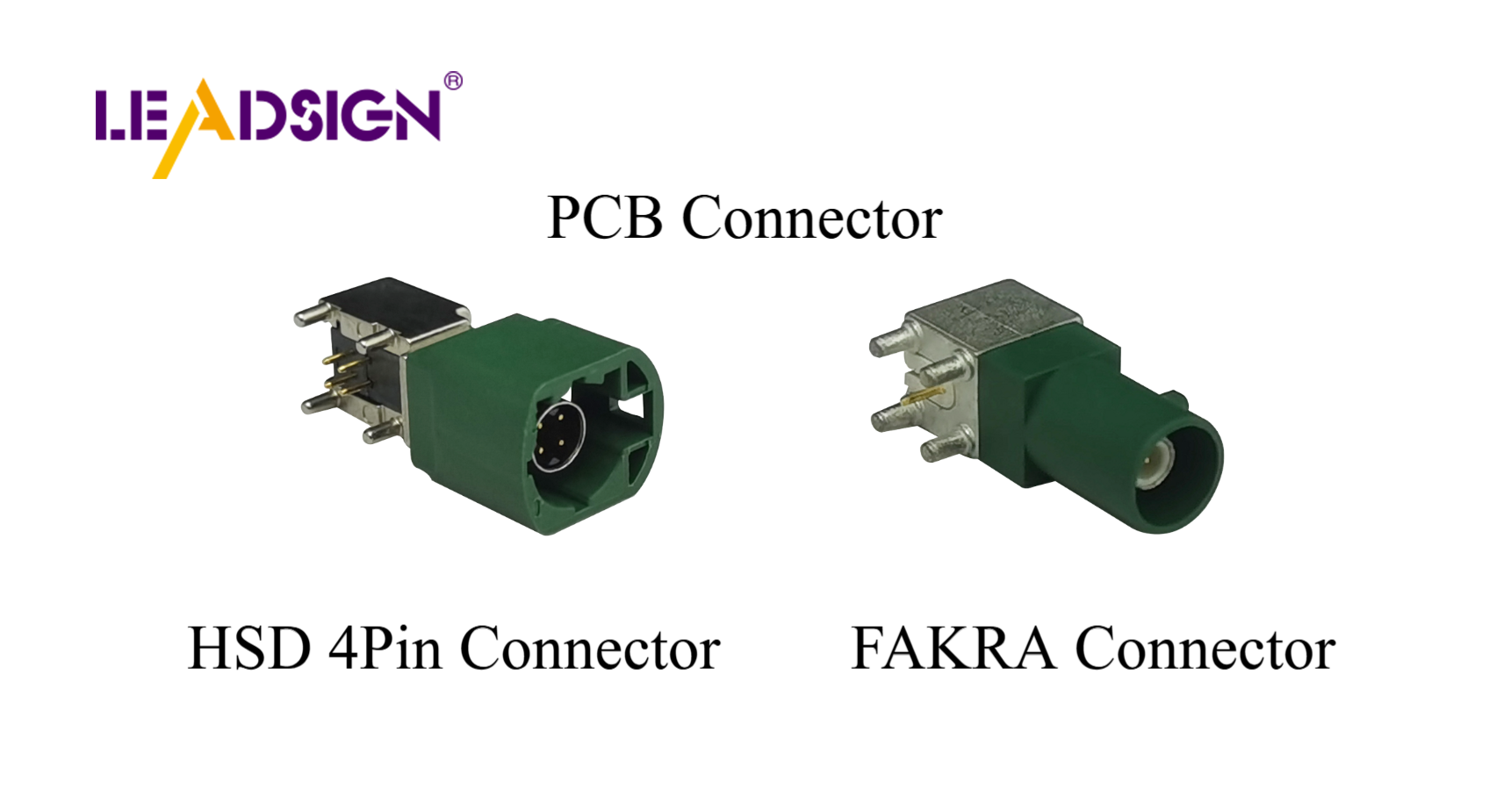
1. Quick Comparison: HSD vs FAKRA
Feature | HSD Connector | FAKRA Connector |
|---|---|---|
Primary signal type | High‑speed data (differential) | RF / antenna (coaxial) |
Impedance | 100Ω | 50Ω |
Max frequency | Up to 6 GHz | Up to 6 GHz (standard), 20 GHz (Mini) |
Data rate | Up to 5 Gbps (USB 3.0), 1 Gbps (Ethernet) | Up to 8 Gbps (AHD video) |
Typical applications | USB‑C, CarPlay, LVDS, Ethernet (ADAS) | GPS, SDARS, 4G/5G antenna, backup camera (AHD/CVBS) |
Size | Compact, space‑saving | Standard or Mini (80% smaller) |
Locking mechanism | Secondary lock / CPA | Secondary lock + colour coding |
Shielding | Double shielding (foil + braid) | Double shielding (foil + braid) |
Cost | Moderate to high | Low to moderate |
Common use case | Infotainment, ADAS, telematics gateway | GPS antenna, radio antenna, reverse camera (coax) |
Key takeaway: HSD is for differential data (USB, Ethernet, LVDS). FAKRA is for coaxial RF signals (antenna, video). They are not interchangeable.
2. Design & Construction – Why They Look Different
🔹 HSD Connector
4‑pin or 6‑pin layout – two differential pairs + optional shielding.
Twisted‑pair quad construction inside the cable – cancels common‑mode noise.
Small footprint – fits tight spaces behind radios, displays, and ECUs.
Secondary lock – prevents vibration loosening.
Crimp termination – requires specialized tool or pre‑terminated cable.
🔹 FAKRA Connector
Coaxial (centre pin + shield) – single channel, 50Ω impedance.
Colour‑coded plastic housing (14 colours) – prevents mismating (blue = camera, amber = GPS, violet = 5G).
Larger than HSD (standard) but Mini FAKRA is 80% smaller.
Secondary lock + audible click – reliable in high‑vibration environments.
Available as PCB mount, in‑line, or pre‑terminated cable.
Pro tip: If you see a blue or amber plastic connector, it’s FAKRA – do not try to plug an HSD connector into it.
3. Performance – Speed vs. Signal Integrity
Parameter | HSD | FAKRA | Winner |
|---|---|---|---|
Max data rate | 5 Gbps (USB 3.0) / 1 Gbps (Ethernet) | 8 Gbps (AHD video) | HSD (for USB/Ethernet) |
Frequency range | DC – 6 GHz | DC – 6 GHz (standard), 20 GHz (Mini) | FAKRA (Mini for 4K) |
Signal type | Differential (twisted pair) | Single‑ended (coaxial) | Application dependent |
EMI immunity | Excellent (common‑mode rejection) | Very good (shielded coax) | Both good |
Cable length (max) | 10‑15m (depends on speed) | 15‑20m (low‑loss coax) | FAKRA for longer runs |
Real‑world example: A 1080p AHD backup camera works perfectly with FAKRA blue (50Ω coax) up to 10‑15 metres. A 4K camera (6+ GHz) needs Mini FAKRA. USB‑C CarPlay (5 Gbps) requires HSD USB‑C.
4. Applications – Where to Use Each
✅ HSD Connectors are best for:
USB‑C (CarPlay / Android Auto) – requires 100Ω impedance and locking mechanism.
LVDS displays (high‑resolution screens) – differential signalling.
Automotive Ethernet (100BASE‑T1, 1000BASE‑T1) – ADAS, telematics, diagnostics.
Camera raw video (LVDS) – not common in aftermarket, but used in factory 360° systems.
✅ FAKRA Connectors are best for:
GPS / GNSS antenna – FAKRA amber, 50Ω.
SDARS (satellite radio) – FAKRA white.
4G/5G telematics antenna – FAKRA violet (standard) or Mini FAKRA.
Backup camera (AHD / CVBS / HD‑TVI) – FAKRA blue, 50Ω coax.
AM/FM radio antenna – FAKRA bordeaux.
🔹 Shared systems (both HSD and FAKRA)
Infotainment head unit – may use FAKRA for GPS and radio, and HSD for USB‑C and Ethernet.
Telematics box – FAKRA for antenna, HSD for Ethernet to gateway.
5. 2026 Trends – Why You Need Both in Your Inventory
Trend | Connector requirement |
|---|---|
4K backup cameras on trucks & vans | Mini FAKRA (20 GHz) – standard FAKRA’s 6 GHz may be borderline for long runs. |
5G telematics (C‑V2X) | Mini FAKRA violet – low‑loss coax, double‑shielded. |
Wireless CarPlay / Android Auto | Still requires wired USB‑C for charging and diagnostics – HSD USB‑C. |
ADAS (radar, lidar) | Automotive Ethernet over HSD (100Ω). |
Software‑defined vehicles | Ethernet backbone – HSD connectors. |
Legacy system retrofits | FAKRA remains standard for GPS and camera video. |
What this means for your shop: You cannot stock only one type. Keep FAKRA (blue, amber, violet) for antennas and cameras, and HSD (USB‑C, Ethernet) for data.
6. Advantages & Limitations – Quick Summary
🔹 HSD Advantages
High speed (up to 5 Gbps)
Compact size
Excellent EMI rejection (differential signalling)
Supports multiple protocols (USB, Ethernet, LVDS)
🔹 HSD Limitations
Only for data – cannot carry RF signals (GPS, radio)
More expensive than basic connectors
Requires proper crimp tool or pre‑terminated cables
🔹 FAKRA Advantages
Colour‑coded – prevents mismating
Rugged, weather‑sealed options (IP67)
Supports long cable runs (15‑20m with low‑loss coax)
Standard for automotive antennas and video
🔹 FAKRA Limitations
Standard size is bulkier (Mini FAKRA solves this)
Lower data rate than HSD for USB/Ethernet
Not suitable for differential signalling
7. How to Choose – Decision Flowchart
Question | Answer | Recommendation |
|---|---|---|
What signal do you need to transmit? | GPS, radio, 4G/5G antenna, analog/AHD video | → FAKRA (choose colour accordingly) |
USB‑C, Ethernet (CarPlay, ADAS), LVDS display | → HSD (USB‑C or Ethernet type) | |
Do you need long cable (>10m)? | Yes, for camera on truck/bus | → FAKRA (low‑loss coax) or Mini FAKRA |
No, short distance | → Either, but HSD is fine for short runs | |
Is space extremely tight? | Yes (behind thin radio) | → Mini FAKRA or HSD (both small) |
No | → Standard FAKRA or HSD |
8. Why LEADSIGN – Your Single Source for Both HSD and FAKRA
LEADSIGN specialises in pre‑terminated HSD and FAKRA cables for automotive aftermarket and fleets. No field crimping – just plug and play.
What LEADSIGN offers:
✅ FAKRA (standard & Mini) – all 14 colours, 50Ω, up to 20 GHz, IP67 optional
✅ HSD (USB‑C, Ethernet, LVDS) – 100Ω, locking, up to 5 Gbps
✅ Pre‑terminated cables – custom lengths 0.3m – 20m, no tooling required
✅ Low‑loss, double‑shielded coax – for long runs and EV environments
✅ Bulk pricing – for shops, fleets, and distributors
For your business: Whether you need a FAKRA blue cable for a backup camera or an HSD USB‑C for CarPlay, LEADSIGN delivers a ready‑to‑install solution – reducing labour and eliminating callbacks.
Final Recommendations
If you need… | Use this | Source from LEADSIGN |
|---|---|---|
GPS antenna extension | FAKRA amber | Pre‑terminated, custom length |
1080p backup camera | FAKRA blue | Pre‑terminated, standard or low‑loss |
4K backup camera | Mini FAKRA blue | Low‑loss, up to 20 GHz |
5G telematics antenna | Mini FAKRA violet | Double‑shielded, low‑loss |
USB‑C CarPlay (wired) | HSD USB‑C | Locking, 5 Gbps, custom length |
ADAS Ethernet | HSD (100Ω) | Pre‑terminated, matched impedance |
Remember: HSD and FAKRA are not interchangeable. Use the right tool for the right signal.
Ready to stock both HSD and FAKRA cables?
See Also
Unveiling The Advantages Of Fakra Connectors In Cars
Why Fakra Connectors Matter In The Auto Sector
Significance Of Fakra Connectors In Today's Vehicles