How to Choose the Right Automotive FAKRA Cable Assembly

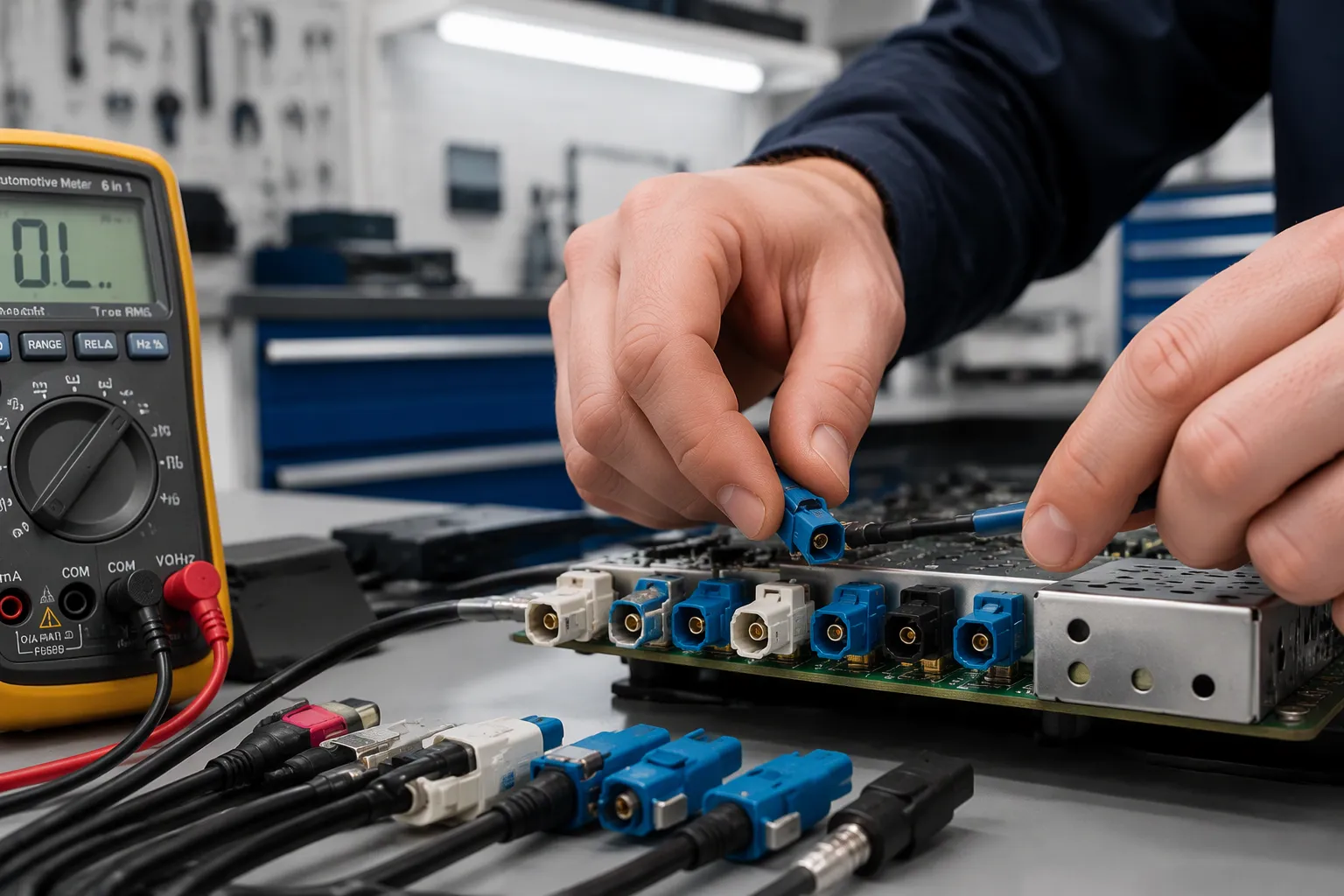
You avoid this by matching four items to the application: keying, coax type, impedance, and connector interface. Check each against the device drawing before you order. Confirm the code letter, the plug or jack side, the 50 ohm rating, and the cable group.
TL;DR: Choose an automotive fakra cable assembly by matching keying, coax type, impedance, and connector interface to the device. Confirm the code letter, gender, 50 ohm rating, and cable group on the drawing.
Key Takeaways
Match the connector keying to your device port. Check the code letter on the drawing.
Choose the right coax cable for your run length. Short runs use thin cables; long runs need low-loss types.
Keep the impedance at 50 ohms from end to end. Confirm the VSWR rating on the drawing.
Adapt the connector interface with pigtails if needed. Check gender, orientation, and coding.
Always confirm the full part number and drawing before you order. This prevents mating problems.
What Is an Automotive FAKRA Cable Assembly?
An automotive fakra cable assembly is a coaxial cable terminated with one or more FAKRA connectors. It carries radio-frequency signals between an antenna, ECU, radio module, navigation unit, telematics box, or camera system. You can think of it as a short, protected signal highway inside the vehicle.
Coax, Connectors, and Signal Path
The cable forms the signal path. A center conductor carries the RF energy, a dielectric insulates it, and a shield blocks outside interference. The fakra connector at each end terminates that path and locks it to the device.
This matters because the assembly sits inside a harsh electrical environment. Motors, screens, and power lines all radiate noise. A well-built fakra cable assembly keeps the wanted signal clean along the whole route.
A typical example is a mini-fakra cable assembly that combines a multi-channel connector with several coded fakra ends. One harness then feeds several systems at once. The 50-ohm rf coaxial connector standard keeps every link matched.
Core Fakra Specifications
The fakra connector family follows a shared set of ratings. These figures come from published FAKRA technical data, including Metabee's specification summary. Use them as a starting reference, then confirm against your device drawing.
Parameter | Standard Specification | Note |
|---|---|---|
Impedance | 50 Ω | Standard RF impedance |
Frequency Range | DC to 6.0 GHz | Supports 5G and ADAS sensors |
VSWR | ≤ 1.30 (Typical) | Ensures low signal reflection |
Operating Temp. | -40°C to +105°C | High-temp plastics available |
Mating Cycles | ≥ 25 Cycles | Optimized for factory assembly |
Retention Force | > 110 N | Prevents accidental pull-outs |
LEADSIGN FAKRA products add up to 8 Gbps data rates, return loss of ≥ 18 dB, 13 mechanical and colored codings plus 1 neutral coding, and RoHS, WEEE, and ELV compliance. A primary latch gives an audible click at full mating. Many designs add a CPA clip as a secondary lock against vibration.
Electrical performance depends on the cable you select, the connector, the length, and the assembly design. Treat the table as a baseline, not a guarantee for every build.
FAKRA Color Codes and Keying
A fakra connector will only mate with its correct partner. The plastic housing carries internal ribs and external slots. These features form the keying system, and they decide which two parts can join. Color sits on top of that function as a visual aid.
Keying Is Functional, Color Is Visual
The mechanical key does the real work. A Code A plug only fits a Code A jack. The ribs physically block any other pairing. This is why the fakra family works as a keyed, color-coded connector system: the key prevents wrong connections, and the color helps you find the right one fast.
How It Prevents Mismating | |
|---|---|
Mechanical keys (internal ribs and external slots) | Only a matched pair can fully seat; the ribs block incorrect connections |
Keying variants (A, B, C, D) | Fixed key positions ensure each connector meets only its intended counterpart |
Color codes | A quick identification aid, not a compatibility guarantee |
Product drawing confirmation | Confirms the key, interface, and part number before mating |
Self-aligning keying | Makes the correct mate obvious and reduces operator error |
Orientation fixtures and alignment pins | Hold parts in position and allow only one correct fit |
Forcing a mismatched pair defeats the design. Breaking the ribs on a Code A plug to fit a Code C jack destroys the housing and creates a wrong interface. The DIN 72594-1 standard applies a Poka-Yoke approach for this reason.
Color remains useful. Bafitop notes that black connectors serve AM/FM radios, while violet ones serve remote systems. The standard fakra system includes 13 mechanically keyed and color-coded variants plus one neutral Z coding, giving 14 options in total. Still, treat fakra color codes as a guide, not proof.
FAKRA is an automotive RF connector system that combines a coaxial interface with mechanically keyed, color-coded housings. Color supports identification; the exact coding and approved part drawing determine mating. A blue, black or water-blue housing is not by itself proof of the vehicle function or electrical rating. — Sigmarf
Confirming Coding Against the System Spec
Never order from a color name alone. "Blue fakra" is not a part number. Confirm the code letter, the interface, and the drawing together. The fakra color codes and keying must both match the device port.
Check these points before you release the order:
The connector's gender and polarity: a male plug carries a center pin, a female jack carries a socket. The center contact decides the mating pair, not the housing shape.
Orientation: straight versus right-angle, matched to the module port and routing path.
Single-ended versus multi-connector harness requirements.
Housing, primary lock, and secondary lock features for mechanical retention under vibration.
A drawing, sample photo, or manufacturer part number removes the guesswork. Two connectors may share a color but differ in gender or orientation. Confirm the full part number, not just the shade.
Step-by-Step Selection Flow
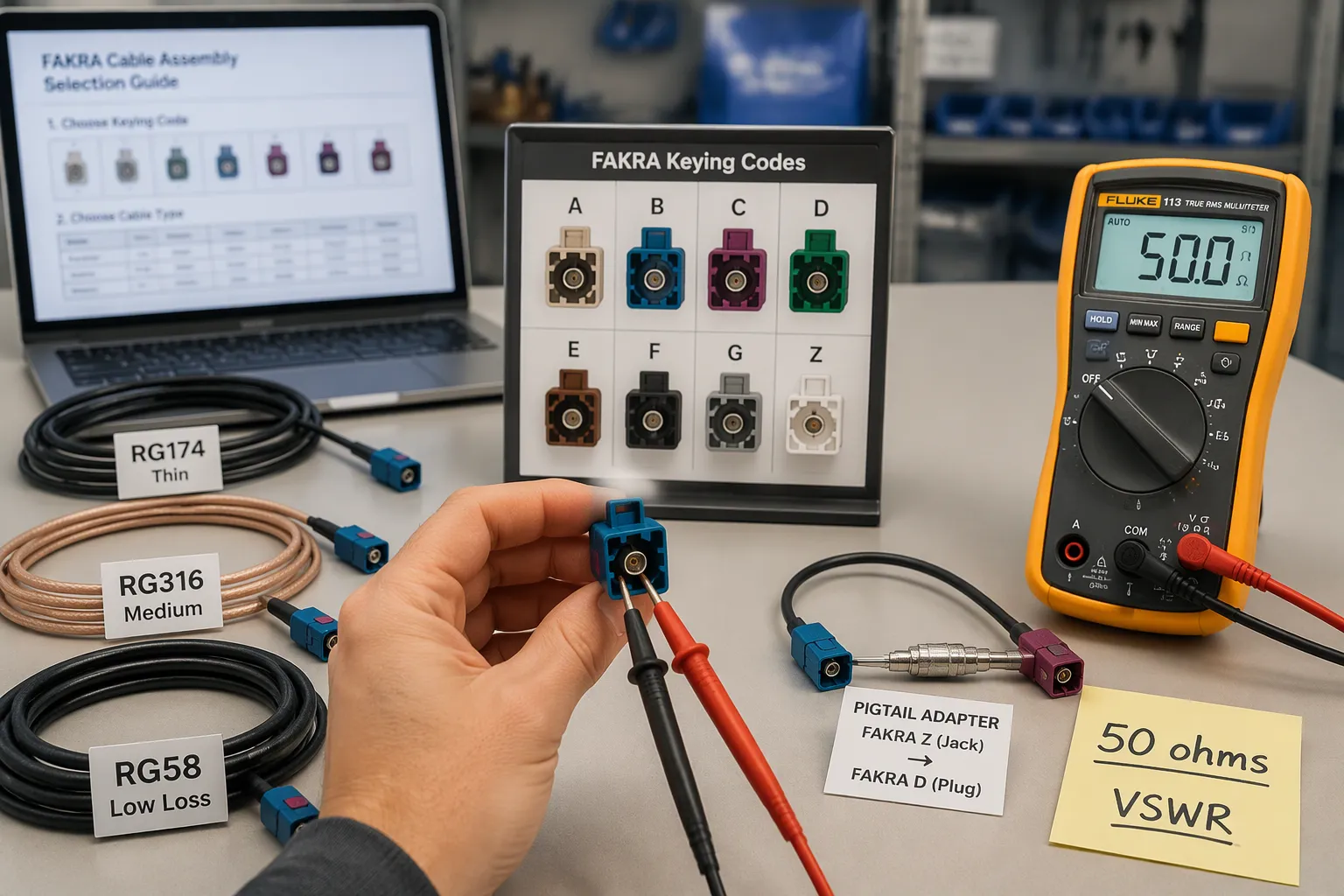
Work through four steps in order. Each step narrows the choice until one part number remains. Skipping a step is how wrong orders happen.
Match keying to the device. Confirm the code letter on the port drawing. Metabee's selection guide gives a clear example: GPS navigation must use Code C (Blue). If you are in R&D and the keying is still open, Code Z (Water Blue) is a universal code that mates with any mechanical key from A to N.
Match coax to run length. Short, space-limited runs suit thin cables. Longer antenna feeds need low-loss types.
Confirm impedance and vswr. Keep the path 50 ohms end to end. A stable vswr means little signal reflects back to the source.
Adapt the interface with pigtails. A pigtail converts one connector style to another at the device end. This solves a mismatched port without redesigning the harness.
Match Keying, Coax, and Impedance and VSWR
Keying comes first because it is binary. The part fits or it does not. Bafitop notes that mechanical keying controls whether two housings can enter the mating position. Color only helps you identify the part during assembly. A similar shade from another family proves nothing.
Cable choice follows the route. The table below summarizes common options from PCM Cable's selection guidance.
Cable Type | Impedance | Frequency Range | Best Fit |
|---|---|---|---|
RG174 | 50 ohms | Up to ~1 GHz | Short runs in tight spaces |
RG316 | 50 ohms | Up to ~3 GHz | Better shielding and heat tolerance |
Low-loss (RG58, LMR-100) | — | — | Long runs and high-data-rate systems |
Then confirm impedance and vswr together. A fakra connector rated at 50 ohms only performs if the cable matches. Keep the assembly 50-ohm throughout. A mixed build raises vswr and wastes signal. Check the crimp ferrule inner diameter against the cable outer diameter before you commit.
Measure the actual routing path for length. Add slack for service movement. Avoid excess cable and sharp bends. Decide whether you need a fixed length or a custom length.
Adapt the Interface with Pigtails
A pigtail is the flexible answer to a stubborn port. One end carries the fakra connector your module expects. The other end carries the mating interface. This keeps the main harness standard and localizes the adaptation.
Orientation deserves its own check. A straight connector may not clear a housing that only accepts a right-angle exit. A right-angle part can solve one layout problem and create another when its cable exit points toward a blocked area. Add a top view sketch or clock position to the drawing for every right-angle part.
Factor | Straight | Right-Angle |
|---|---|---|
Installation space | Needs axial room behind the port | Saves depth, exits sideways |
Routing | Cable runs straight back | Cable turns along the panel |
Bending direction | Bend starts away from the shell | Bend starts close to the shell |
Access | Easy to pull straight off | Harder to grip in tight spots |
Mechanical strain | Pull acts along the axis | Side loads stress the joint |
Clearance | Poor near brackets and panels | Good where depth is limited |
A short cable still fails if the bend area sits too tight near the connector. Check the minimum bend radius against the actual route.
Confirm the full interface before ordering: impedance, length, pinout, coding, gender, and exit direction. A 4-pin fakra connector is not always for cameras; some carry power plus signal. Match the shell shape, not just the pin count. For multi-channel routes, a mini fakra cable assembly or mini-fakra cable assembly bundles several coded ends into one harness. That approach suits camera clusters and antenna arrays. A custom fakra cable assembly lets you mix a straight end with a right-angle end on the same run. This is common when one module sits deep behind the dash and the other sits on a bracket. The same logic applies to any automotive fakra cable assembly built for a specific vehicle program.
FAKRA Connector vs. SMA, U.FL, and N-Type
Each connector family solves a different problem. Compare them on frequency, coupling, and environment before you pick one.
Performance and Application Fit
A fakra connector tops out around 6 GHz, according to Soarcable. That range covers GPS, cellular sub-6, and vehicle-to-everything links. SMA reaches 18 GHz in typical builds and 26.5 GHz in precision versions. Choose SMA when your signal sits above 6 GHz or when you need repeatable lab measurements.
Coupling separates the two designs. SMA threads on with a metal nut and holds up to 500 mating cycles. Fakra uses a plastic housing with a push-on latch and a click you can hear. That latch resists vibration far better than a hand-tightened nut, which is why automotive programs specify it.
U.FL sits at the small end. It suits compact module ports where space is scarce. A pigtail lets you run from a U.FL module to a larger antenna connector on the enclosure, per Bafitop. This keeps pulling forces off the tiny port.
Feature | FAKRA | SMA | U.FL |
|---|---|---|---|
Impedance | 50 Ω | 50 Ω | 50 Ω |
Max frequency | About 6 GHz | 18 GHz typical | Compact module use |
Coupling | Keyed push-lock | Threaded nut | Snap-on |
Vibration resistance | High | Moderate | Low |
Best fit | Vehicle RF links | Test and microwave | Module pigtails |
Compliance and Cost
Automotive buyers answer to standards. Fakra meets USCAR-17 and ISO 20860-1 and survives thermal cycling from −40 °C to +105 °C, Soarcable reports. SMA carries no automotive vibration mandate by default. U.FL targets internal module connections, not sealed vehicle ports.
Cost follows volume and purpose. Fakra pricing drops with bulk orders for vehicle programs, per Fakraconnectors. SMA costs more when you need high-frequency grades. U.FL stays inexpensive for short internal runs.
Match the part to the job. Use fakra for keyed, sealed, vibration-heavy vehicle links. Use SMA for high-frequency benches. Use U.FL inside compact modules with a pigtail adapter.
Where LEADSIGN FAKRA Assemblies Fit Best
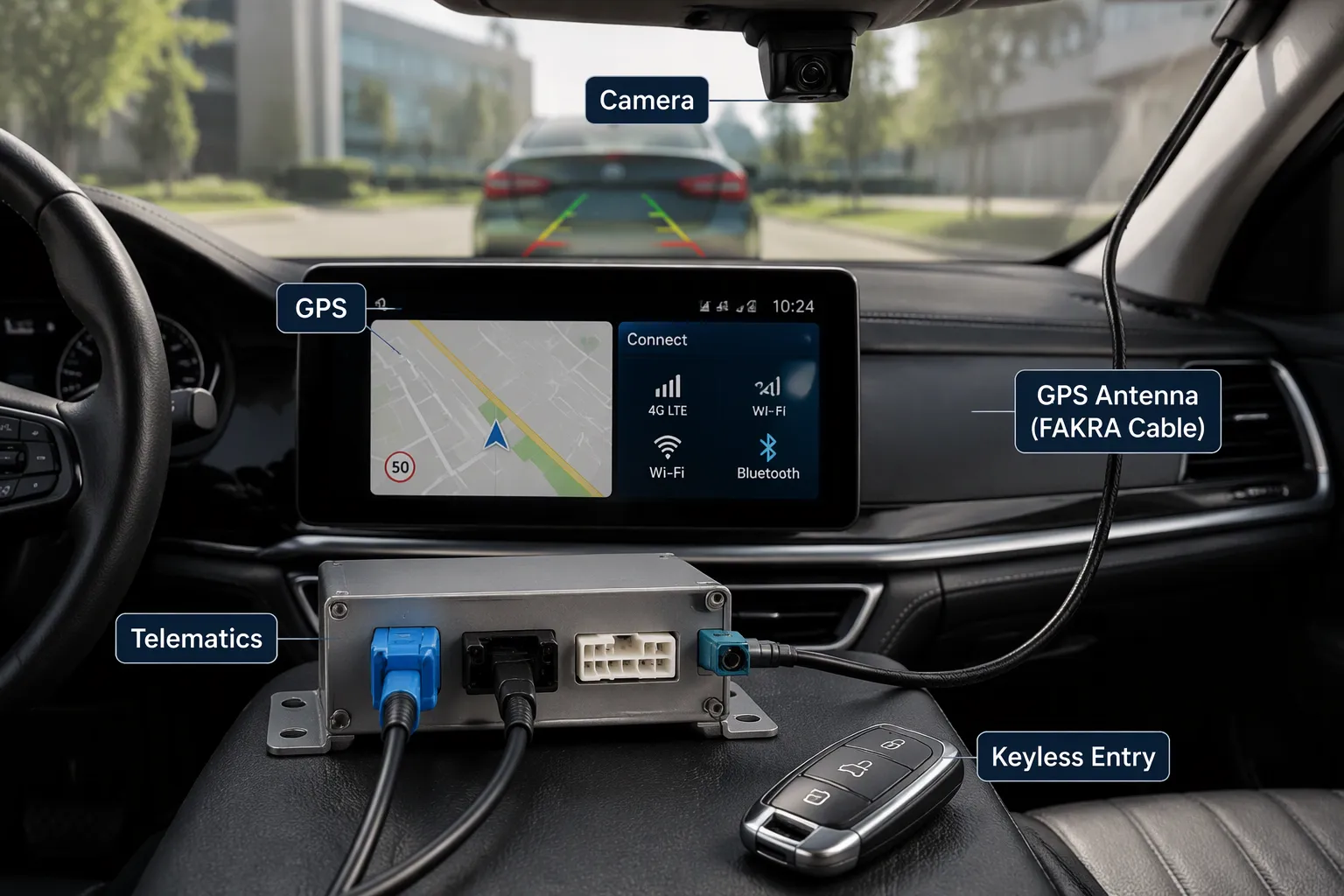
LEADSIGN builds fakra cable assemblies for the RF links that keep a vehicle connected. The right assembly depends on the port, the route, and the program volume. Match all three before you request a quote.
Typical Automotive Applications
Vehicle programs use fakra connections across several signal paths. 5G Store lists telematics, GPS navigation, entertainment systems, Bluetooth, cellular connectivity, keyless entry, radio antennas, and driver assist technologies among the common uses. Each path carries its own frequency and loss budget.
Camera and sensor links form another group. TE Connectivity names rear-view, surround-view, front-view, and interior cameras as typical high-frequency connections. Connected-vehicle modules add TCU, 4G/5G, V2X, Wi-Fi, and GPS/GNSS links. A fakra antenna line often serves the roof antenna, while in-vehicle antenna lines feed the radio and telematics units.
The table below maps common systems to their typical connector family.
System | Typical Link | Connector Family |
|---|---|---|
GPS/GNSS navigation | Antenna to receiver | Standard fakra, Code C |
AM/FM and satellite radio | Antenna to head unit | Standard fakra |
Telematics and cellular/LTE | Module to antenna | Standard fakra |
Camera and ADAS | Camera to ECU | |
Keyless entry | Receiver to module | Standard fakra |
Standard fakra covers DC up to 6 GHz, Metabee reports. Mini-FAKRA reaches up to 20 GHz for data-rich links. Choose the family that matches your device port, not the other way around.
Standard vs. Custom Assemblies
A standard fakra cable assembly fits a common combination. You know the length, the routing is fixed, and you reorder the same part. This suits repeat production and simple antenna runs.
A custom assembly fits when the standard part cannot. Special lengths, mixed ends, straight-to-right-angle builds, special coding, tight spaces, multi-branch harnesses, and prototype runs all call for a custom design. A mini fakra cable assembly with four coded ends is a good example. So is a mini-fakra cable assembly built for a camera cluster in a low-volume program.
Send a complete checklist with your request. The table below follows the buyer's guide from fakraconnectors.
Item | What to Confirm |
|---|---|
Application | GPS, LTE/5G, ADAS, or infotainment |
Connector code and color | Code letter and housing color |
Gender | Plug or jack at each end |
Orientation | Straight or right-angle |
Cable type | RG designation or low-loss build |
Length | Finished length plus tolerance |
Shielding | Braid, foil, or combination |
Environment | Temperature, sealing, vibration |
Drawing or sample | Revision number or photo |
Quantity | Sample and annual forecast |
Soarcable adds a useful supplier check. Ask whether the supplier will review the controlled drawing and pin-to-pin table before production. Confirm which connector and cable references apply, and which alternatives need your approval.
For related options, review the LEADSIGN fakra connectors, fakra cable assemblies, fakra extension cables, and fakra coaxial cables. Custom fakra cable assemblies cover mixed ends and special lengths. HSD cable assemblies and automotive camera cable solutions serve high-speed data links. These pages help you compare families before you specify an automotive fakra cable assembly for automotive and in-vehicle antenna systems.
You now have a four-part checklist for any automotive fakra cable assembly: keying, coax type, impedance, and connector interface. Treat keying as the functional selector. Color is only a visual aid on a keyed, color-coded housing. Let coax choice follow your run length and loss budget.
Before you order, confirm impedance and vswr on the drawing. Check the interface adaptation at each end. Request a sample or a controlled drawing for every fakra part. These steps catch most mating and signal problems early.
Need help with a fakra cable assembly? Contact LEADSIGN for product information, technical consultation, or a custom quotation.
FAQ
How do I know which fakra coding my assembly needs?
Check the code letter on the device port drawing, not the housing color. A Code A plug only mates with a Code A jack. If your R&D keying is still open, a neutral Z coding mates with any mechanical key. Confirm the full part number before you order.
Can I use one fakra cable assembly for every vehicle system?
No. Each system sets its own electrical interface, frequency range, and loss budget. A gps/gnss antenna feed differs from a camera link or a telematics run. Match the connector family, cable type, and coding to the actual device. A single universal assembly does not exist.
How do I pick the right cable length?
Measure the real routing path first. Add slack for installation and service movement. Avoid excess cable and sharp bends near the connector. Decide whether you need a fixed length or a custom length. A longer run adds attenuation, so check your loss budget.
What should I confirm about impedance and vswr before ordering?
Keep the path 50 Ω from end to end. A mixed build raises vswr and wastes signal. Ask for the vswr figure on the drawing, and confirm the cable and connector match. Electrical performance depends on the cable, connector, length, and assembly design.
When should I choose a custom assembly instead of a standard one?
Choose a custom build for special lengths, mixed ends, straight-to-right-angle runs, special coding, tight spaces, or multi-branch harnesses. A mini-fakra cable assembly with several coded ends is a good example. A mini fakra cable assembly for a camera cluster also fits this case. Standard parts suit common, repeat orders.
See Also
Why FAKRA Coaxial Cables Play a Critical Role in Automotive Applications
Understanding the Vital Role of Fakra Connectors in the Automotive Industry
How Fakra Automotive Connectors Drive Performance and Reliability in Modern Vehicles
A Closer Look at the Key Benefits of Fakra Automotive Connectors
Why FAKRA Connectors Are Essential for Automotive Applications Today