What Is a FAKRA to SMA Cable for Vehicle Telematics Systems

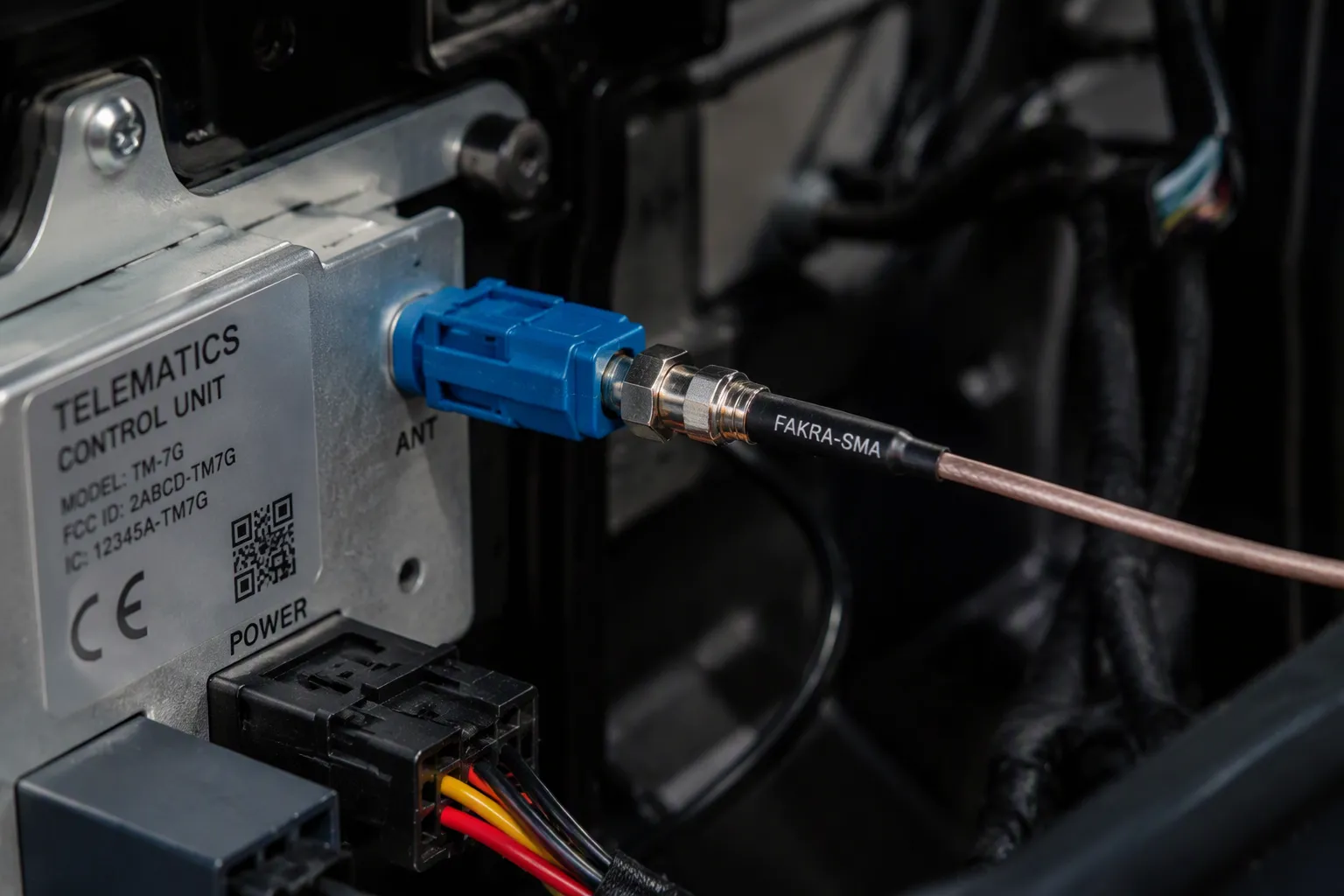
A fleet telematics integrator prepares to connect a T-Box to a GPS/LTE antenna. The T-Box uses a FAKRA port. The antenna uses an SMA connector. The two sides do not mate directly. The integrator needs a FAKRA to SMA cable, which is a hybrid RF assembly with a FAKRA connector on one end and an SMA connector on the other.
Before ordering, the buyer must confirm several details. Which FAKRA coding and gender does the T-Box require? Does the antenna use standard SMA or RP-SMA? What cable length and impedance does the installation need? These questions determine whether the cable will fit and perform correctly in the vehicle.
Key Takeaways
A FAKRA to SMA cable connects a FAKRA port to an SMA port in vehicles.
Check FAKRA coding, gender, and orientation before you buy.
Confirm SMA gender and whether it is standard or RP-SMA.
Choose the right cable length and type to keep signals strong.
Avoid common mistakes like mixing up SMA and RP-SMA.
What Is a FAKRA to SMA Cable?
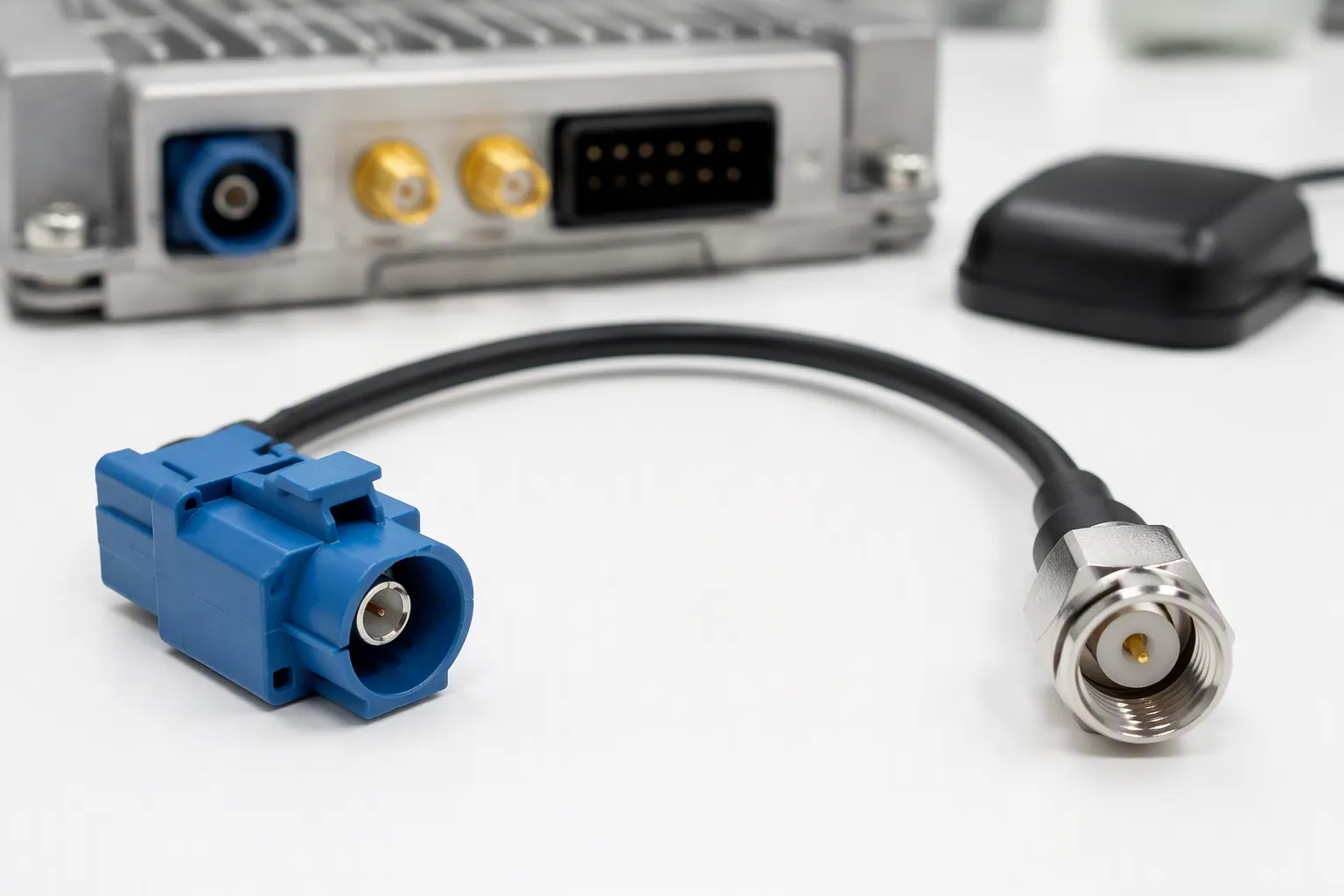
TL;DR: A FAKRA to SMA cable joins a 50-ohm automotive FAKRA connector to a standard SMA connector. Buyers must confirm FAKRA coding, gender, and orientation, plus SMA gender and whether the SMA side is standard or RP-SMA, before ordering.
Definition and Basic Function
A FAKRA to SMA cable is a hybrid RF assembly. One end carries a FAKRA connector. The other end carries an SMA connector. This design bridges two different RF interface standards inside a vehicle.
FAKRA is a 50-ohm automotive RF connector system. It uses a keyed, color-coded housing. The locking mechanism provides a clear engagement feel. A release latch must be pressed to disconnect the plug. These features help the connector survive vibration and keep the RF path stable. FAKRA connectors typically operate up to 6 GHz, which covers GPS, LTE, Wi-Fi, and V2X antenna signals.
SMA connectors serve a different role. Manufacturers use SMA in RF modules, GPS/GNSS receivers, LTE/5G antennas, telematics devices, and test equipment. SMA connectors typically handle frequencies up to 18 GHz. That range suits RF/microwave work beyond typical automotive needs.
A FAKRA to SMA cable carries a 50-ohm characteristic impedance on both ends. This match keeps signal integrity consistent for GPS, LTE, Wi-Fi, and telematics modules. The assembly may use coax options such as RG174A/U, RG316/U, or LMR-100A. Each cable type affects loss and attenuation differently.
Buyers must not confuse FAKRA 50-ohm RF connectors with HSD 100-ohm differential connectors. The two serve different purposes.
Feature | FAKRA 50-ohm RF | HSD 100-ohm Differential |
|---|---|---|
Primary signal | Coaxial RF/antenna | High-speed differential data |
Impedance | 50 ohms | 100 ohms |
Typical use | GPS/GNSS, 4G/5G antenna | USB-C/CarPlay, LVDS displays, Automotive Ethernet |
Design basis | Center pin plus shield | 4/6-pin layout with differential pairs |
Where It Fits in a Telematics Build
Telematics systems depend on reliable antenna connections. A T-Box may use a FAKRA port for its GPS/GNSS input. An aftermarket LTE antenna may use an SMA connector. These two interfaces do not mate directly. A FAKRA to SMA cable solves this mismatch.
The same need appears in test setups. An engineer may connect a FAKRA-equipped telematics module to SMA test equipment. The hybrid cable provides a keyed, vibration-resistant interface between the automotive FAKRA port and the standard SMA port.
Fleet tracking companies often mix OEM and aftermarket hardware. A vehicle may arrive with a factory FAKRA antenna cable. The installed tracking device may accept only SMA. The adapter cable bridges this gap without replacing the factory antenna.
Emergency call systems, diagnostics ports, and multi-band antenna systems also rely on these assemblies. Each application requires the correct FAKRA code, gender, and SMA polarity. A wrong combination will not mate or will damage the center contact.
Why Telematics Systems Use FAKRA to SMA Cables
Telematics Functions and Signal Types
Vehicle telematics systems handle several functions at once. These functions include GPS/GNSS positioning, LTE/5G cellular communication, emergency call, fleet tracking, diagnostics, and antenna connectivity. Each function relies on a specific signal type and frequency band.
GPS/GNSS positioning uses satellite signals. The L1 band at 1575.42 MHz carries the primary civilian signal with Coarse/Acquisition code. The L2 band at 1227.60 MHz supports military P(Y) code and the modern L2C civilian signal. The L5 band at 1176.45 MHz provides a newer safety-of-life civilian signal for enhanced accuracy and interference rejection. Some vehicle GPS and GNSS receivers use multiple frequency bands to improve positioning accuracy.
LTE/5G communication uses cellular bands for data exchange. A Telematics Control Unit manages wireless communication with external networks. These networks include 4G/5G cellular, Wi-Fi, and vehicle cloud data exchange. FAKRA connectors serve as automotive RF interfaces for these signals. They provide RF shielding and stable performance for high-data-rate antenna modules.
A FAKRA to SMA cable becomes necessary when a telematics module uses a FAKRA port and the antenna or test device uses an SMA port. The cable bridges the two interface types without replacing existing hardware.
Telematics Application Table
The table below maps common telematics functions to their signal types and the details buyers must confirm.
Telematics Function | Signal Type | Possible FAKRA to SMA Use | What Buyers Should Confirm |
|---|---|---|---|
GPS/GNSS positioning | Satellite RF (L1, L2, L5 bands) | Connect FAKRA Code C or H antenna to SMA GPS receiver | FAKRA code, SMA gender, cable loss at 1575.42 MHz |
LTE/5G communication | Cellular RF | Link FAKRA Code D antenna to SMA LTE module | FAKRA code, frequency range, cable type |
Emergency call | Cellular RF plus GPS | Bridge FAKRA telematics port to SMA test device | FAKRA gender, SMA polarity, shielding |
Fleet tracking | GPS plus cellular RF | Adapt factory FAKRA cable to aftermarket SMA tracker | FAKRA orientation, cable length, routing path |
Test equipment connection | RF test signal | Connect FAKRA module to SMA test instrument | Impedance match, connector torque, adapter quantity |
T-Box antenna connection | Multi-band RF | Join T-Box FAKRA port to SMA antenna | FAKRA coding, SMA standard or RP-SMA, cable length |
FAKRA coding and color help identify the correct signal path. Code C in Signal Blue typically serves GPS and navigation. Code D in Bordeaux Purple handles cellular and telematics. Code K in Curry supports SDARS and satellite radio. Buyers can explore FAKRA antenna adapter options at FAKRA antenna adapter to match their specific telematics build.
FAKRA Side: Coding, Color, and Gender
Coding, Color, and Orientation
FAKRA connectors use a keyed housing and a color code to guide mating. Each code matches a specific signal type. Code C in Signal Blue typically carries GPS and navigation. Code D in Bordeaux Purple handles cellular and telematics. Code K in Curry supports satellite radio. The keyway prevents a plug from entering the wrong jack. The color gives installers a fast visual check during assembly.
Code | Color | Common Telematics Signal |
|---|---|---|
C | Signal Blue | GPS/GNSS navigation |
D | Bordeaux Purple | Cellular, LTE/5G telematics |
K | Curry | SDARS, satellite radio |
Z | Neutral (Water Blue) | Universal variant |
FAKRA connectors are color-coded to prevent mismating. They also provide vibration-proof, waterproof RF transmission up to 6 GHz. This range covers GPS, LTE, Wi-Fi, and V2X antenna signals. The locking latch holds the connection under vehicle vibration. A seal around the interface keeps moisture out of the RF path.
Coding and color reduce mismating risk. They do not guarantee the correct part. Buyers should confirm the final selection by drawing, sample, photo, or part number. Two connectors may share a color but differ in gender or orientation. A visual match alone is not enough.
The FAKRA Z connector is a universal variant. It can mate with any other FAKRA connector. This makes Z useful for test setups and mixed builds. Buyers who need a specific signal path should still match the code to the application. Review FAKRA coaxial cable options for compatible assemblies.
Gender and Mating Confirmation
FAKRA gender follows the housing and the center contact. A male FAKRA plug carries a center pin. A female FAKRA jack carries a center socket. The housing shape alone can mislead a buyer. The center contact decides the mating pair.
Orientation adds another variable. FAKRA connectors come in straight and right-angle versions. A right-angle plug saves space behind a tight dashboard panel. A straight plug suits a direct run to an antenna. Buyers should confirm orientation against the module port and the routing path.
The safest confirmation method uses a drawing, a sample photo, or the manufacturer part number. A device model number also helps. These references remove guesswork before the order ships. Buyers who skip this step risk a cable that will not seat or lock.
SMA Side: Male, Female, and RP-SMA
Standard SMA vs RP-SMA
The SMA side of a FAKRA to SMA cable requires careful polarity confirmation. Standard SMA and RP-SMA share the same threaded interface. Their center contacts differ. Standard SMA uses a center pin in the male plug and a socket in the female jack. RP-SMA reverses this arrangement. The male RP-SMA carries a socket, and the female RP-SMA carries a pin.
Standard SMA uses a standard center-contact arrangement (plug has a male pin), whereas RP-SMA uses a reverse-polarity center contact (plug has a female socket). The two standards are not physically interoperable.
This reversal creates a serious risk. The outer threads of standard SMA and RP-SMA match. A user can thread them together by mistake. The center contacts then fail to connect or crush each other. A pin-to-pin collision can damage both connectors permanently.
Connector Type | Outer Threads | Center Contact |
|---|---|---|
Standard SMA Male | Inside threads | Center Pin |
Standard SMA Female | Outside threads | Center Receptacle |
RP-SMA Male | Inside threads | Center Receptacle |
RP-SMA Female | Outside threads | Center Pin |
SMA connectors appear in RF modules, GPS/GNSS receivers, LTE/5G antennas, telematics devices, and test equipment. Each device may use standard SMA or RP-SMA. Buyers must state the polarity clearly on every order. Review FAKRA cable connector options for compatible assemblies.
Confirming Gender by Center Contact
Gender identification starts with the threaded body. A connector with inside threads is male. A connector with outside threads is female. This rule applies to both standard SMA and RP-SMA. The thread type alone does not reveal the polarity.
The center contact confirms the polarity. A center pin indicates standard SMA male or RP-SMA female. A center socket indicates standard SMA female or RP-SMA male. A buyer who checks only the pin will misidentify the connector half the time.
A connector cannot be identified from the center pin alone because both an SMA male and an RP-SMA female have a center pin. Use the threaded body to identify the connector gender, then check the center contact to determine whether it is standard SMA or RP-SMA.
This two-step check prevents ordering errors. First, identify the gender by the threaded body. Second, identify the polarity by the center contact. A photo, drawing, or part number removes remaining doubt before the order ships.
Buyer Checklist for FAKRA to SMA Cables
Cable Length, Shielding, and RF Performance
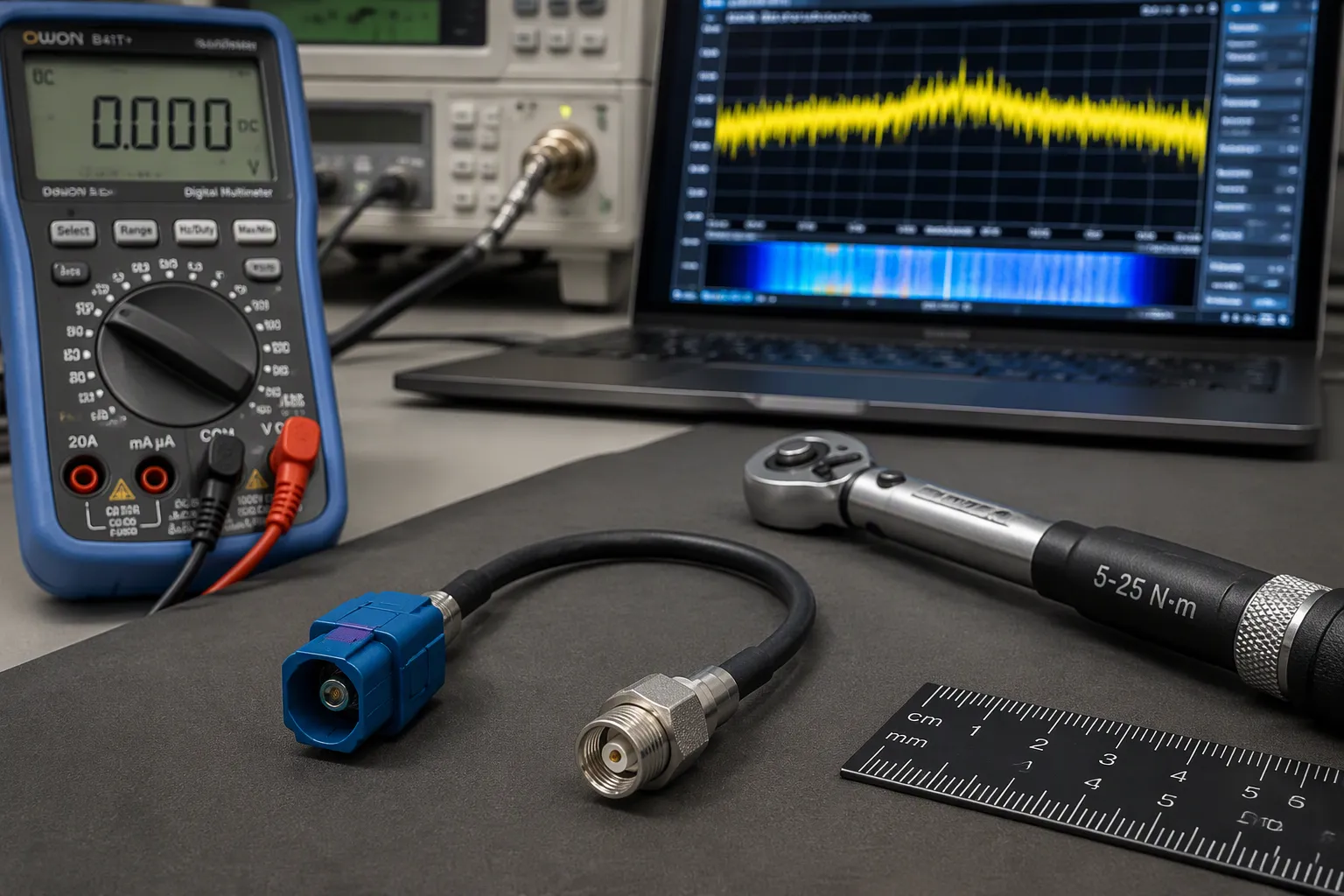
Cable length, cable type, shielding, connector termination, routing, and adapter quantity all affect RF signal performance. A longer cable adds more attenuation. A thin coax cable loses more signal than a thicker low-loss alternative. Poor shielding lets interference into the RF path. A weak crimp or solder joint creates an impedance discontinuity. Each extra adapter adds insertion loss and another mechanical failure point.
Buyers should minimize cable length wherever installation geometry permits. In receive-critical systems, mounting a low-noise amplifier close to the antenna before the cable run helps preserve signal strength. A single adapter cable works better than stacked mechanical adapters. Sealing all outdoor connections prevents moisture ingress, which causes galvanic corrosion and gradual insertion loss increase.
Impedance consistency matters. RF communications use 50 ohms. Broadcast and CATV use 75 ohms. A mismatch creates reflections that increase VSWR. Buyers should also verify bend radius, connector torque, and shielding effectiveness. The SMA interface requires checks for center contact alignment, connector threads, plating condition, foreign particles, mechanical damage, and proper mating torque.
Ordering Checklist and Common Mistakes
A complete order specification prevents costly errors. Buyers should provide the following details before requesting a quote.
FAKRA code/color
FAKRA gender
FAKRA orientation
Standard SMA or RP-SMA
Cable type
Cable length
Impedance
Shielding requirement
GPS/GNSS or LTE/5G application
Device or module model
Antenna location
Routing path
Drawing, sample photo, or part number
Quantity
Testing requirement
Three common mistakes cause most ordering problems. First, buyers confuse standard SMA with RP-SMA. The threads match, but the center contacts differ. Second, buyers confuse FAKRA 50-ohm RF connectors with HSD 100-ohm differential connectors. These serve different purposes and do not mate. Third, buyers assume universal compatibility without verifying the device model or mating connector. A FAKRA to SMA cable must match the specific FAKRA code, gender, and SMA polarity of the target hardware.
Buyers should also distinguish a FAKRA to SMA cable from a FAKRA antenna adapter. An adapter directly joins the FAKRA and SMA interfaces without a cable. A cable assembly contains a coax segment between the two connectors. The adapter eliminates coax cable loss and offers more durability because no wire can break or vibrate loose. The cable assembly provides routing flexibility and length options. Each serves a different installation need.
Attribute | FAKRA-to-SMA Adapter | FAKRA-to-SMA Cable (Pigtail) |
|---|---|---|
Cable run | None — integrated inter-series adapter | Contains a thin coax cable |
Connection method | Directly connects FAKRA and SMA interfaces | Connects via a cable segment between interfaces |
Signal loss | Eliminates coax cable loss | Thin coax wire can sap signal |
Durability | More reliable; no wire to break or vibrate loose | Wire can break when routed or vibrate loose on the road |
For a quote, buyers should send the connector code or mating reference, cable type if known, target length, vehicle application, route constraints, forecast quantity, and validation stage. Drawings, packaging photos, and test requirements shorten review time and reduce quoting assumptions. Contact the team at LEADSIGN with project details for FAKRA to SMA cable and custom FAKRA cable assembly support.
A FAKRA to SMA cable solves a common mismatch in vehicle telematics. The assembly is needed when a T-Box, GPS/GNSS antenna, LTE/5G antenna, or test device uses different RF interfaces on each side. Before ordering, buyers must confirm FAKRA coding, SMA gender, cable length, cable type, impedance, shielding, frequency range, routing path, and application. These details prevent mating errors and signal problems.
The hybrid cable acts as a practical bridge between automotive FAKRA ports and standard SMA RF equipment. It connects factory hardware to aftermarket devices without replacing existing components. For project support, contact LEADSIGN with drawings, samples, connector photos, device models, antenna requirements, or telematics details.
FAQ
When does a telematics build require a FAKRA to SMA cable?
A telematics build requires this cable when a module uses a FAKRA port and the antenna or test device uses an SMA port. The cable bridges the mismatch. Buyers must confirm the FAKRA code and SMA polarity before ordering.
Can a single FAKRA to SMA cable carry both GPS and LTE signals?
A cable provides one RF path. GPS and LTE use different frequency bands and separate FAKRA ports on most modules. Installers use one cable for GPS and another for LTE. Each cable must match the module's FAKRA code for that port.
How does a buyer confirm SMA male or female on the cable?
Check the threaded outer body first. An SMA male plug has inside threads and a center pin. An SMA female jack has outside threads and a center socket. The center contact identifies whether it is standard SMA or RP-SMA, since RP-SMA reverses that contact.
Does a longer cable reduce telematics signal quality?
Yes. A longer cable adds attenuation, which weakens GPS and LTE signals. Short cable runs preserve signal strength. Installers choose low-loss cable types for longer routes. They also verify the routing path, because routing can affect RF signal performance.
See Also
Why Fakra To SMA Connectors Matter In RF Applications
How FAKRA Coaxial Cable Benefits Automotive Applications Today
A Complete Guide To Understanding Fakra To SMA Connectors
Improving Automotive Data Transmission Using FAKRA PCB Connectors
How Fakra GPS Connectors Improve Automotive Navigation Systems