How to Specify a Custom Mini FAKRA Camera Cable Assembly

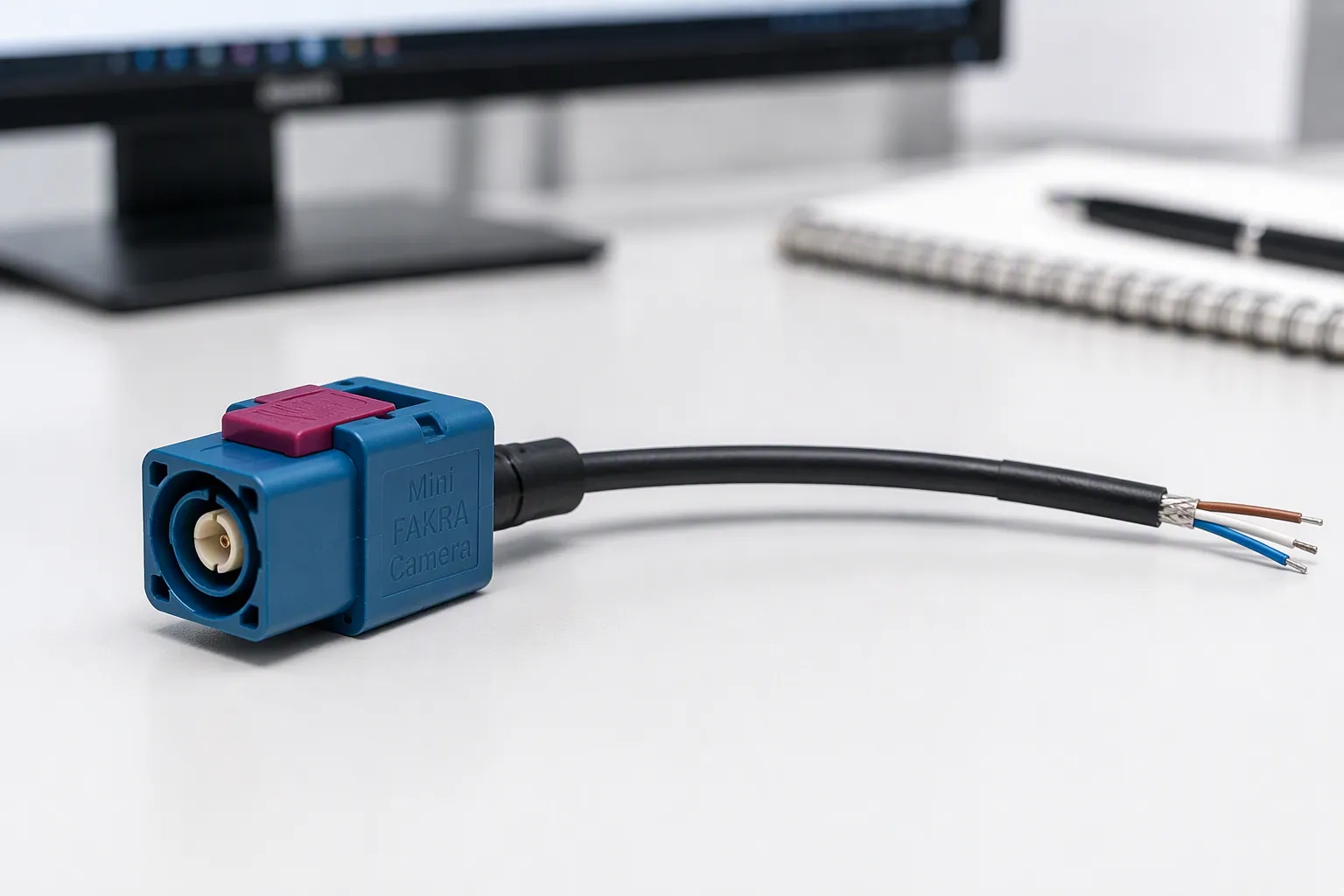
A complete custom mini fakra cable assembly specification covers the connector family and code, plug or jack interface and gender, straight or right-angle connector orientation, single, dual, or quad configuration, coax type and outer diameter, finished cable length and tolerance, impedance, frequency or camera protocol, insertion-loss and return-loss targets, shielding, bend radius, cable exit direction, accessories, environmental requirements, reference samples or drawings, quantities, and inspection tests.
An incomplete spec carries real cost. Incorrect mating, wrong coding or color, wrong cable length, excessive loss, poor ECU fit, intermittent video, sample revisions, production delays, and installation rework all trace back to missing details.
This post follows the order of a real design review, so engineers can turn it into an RFQ checklist. Mini FAKRA, also called HFM, is the compact automotive coaxial connector family used for high-frequency camera links. A reliable mini fakra cable starts with a documented specification for every mini fakra connector and cable assembly.
Key Takeaways
Define the camera signal path and protocol first to guide cable selection.
Choose the correct Mini FAKRA connector code, color, and gender for each end.
Specify the coaxial cable type, finished length with tolerance, and shielding.
Verify electrical performance with insertion loss and return loss tests.
Prepare complete documentation and samples to speed up quoting and reduce revisions.
Define the ADAS Signal Path and Camera Protocol
Camera-to-ECU Link and Data Rate
The signal path decision comes first. The engineer identifies the imaging module, the ECU or domain controller, and the serializer/deserializer pair. Then the spec states the operating frequency or data-rate range and the impedance requirement, typically 50 ohm impedance for coaxial video links. GMSL2 links support a maximum data rate of 6 Gbps per link. In practice, GMSL2 typically supports data rates ranging from 1 Gbps to several Gbps, depending on hardware, cable quality, and system configuration. These figures guide the cable choice for adas coax signal paths.
Mini FAKRA/HFM coaxial cable assemblies, standard FAKRA coaxial cable assemblies, and HSD differential or LVDS cable assemblies serve different signal architectures. Mini FAKRA and HSD are not automatically interchangeable. The final choice depends on signal architecture, protocol, impedance, cable construction, connector code, and vehicle module interface. A 50 ohm coaxial cable suits single-ended links. HSD suits differential links. Engineers should confirm GMSL2 and similar protocols against the exact part numbers, not assume them. Each protocol shapes adas coax signal paths differently.
Custom GMSL2 FAKRA Cable Assemblies and Protocol Fit
Protocol fit shapes the cable assembly. GMSL2 is rated to 15 meters at 6 Gbps over standard automotive coaxial cable. FPD-Link III is rated to 15 meters at 4.16 Gbps. Cable and connector quality matter more than the rated distance in practice. Both protocols support Power over Coax. GMSL2 supports coax, STP, or SPP cable types. These details belong in the spec for custom gmsl2 fakra cable assemblies.
Mini FAKRA connectors serve ADAS imaging systems, front, rear, and side-view sensors, 360-degree surround view camera link systems, domain controllers, autonomous-driving modules, high-density ECUs, and displays or infotainment where a Mini FAKRA coaxial interface is specified. A surround view camera link and other adas coax signal paths benefit from the compact interface. Selected mini-fakra product families support frequencies up to 20 GHz, a claim to verify against the exact part number. The spec should list each application and its protocol so the supplier can match the custom gmsl2 assemblies. An adas cable assembly also needs the automotive coax connections documented for each end. Documenting adas coax signal paths early prevents rework.
Choose Mini FAKRA Connectors and Keying
Connector Code, Color, and Gender
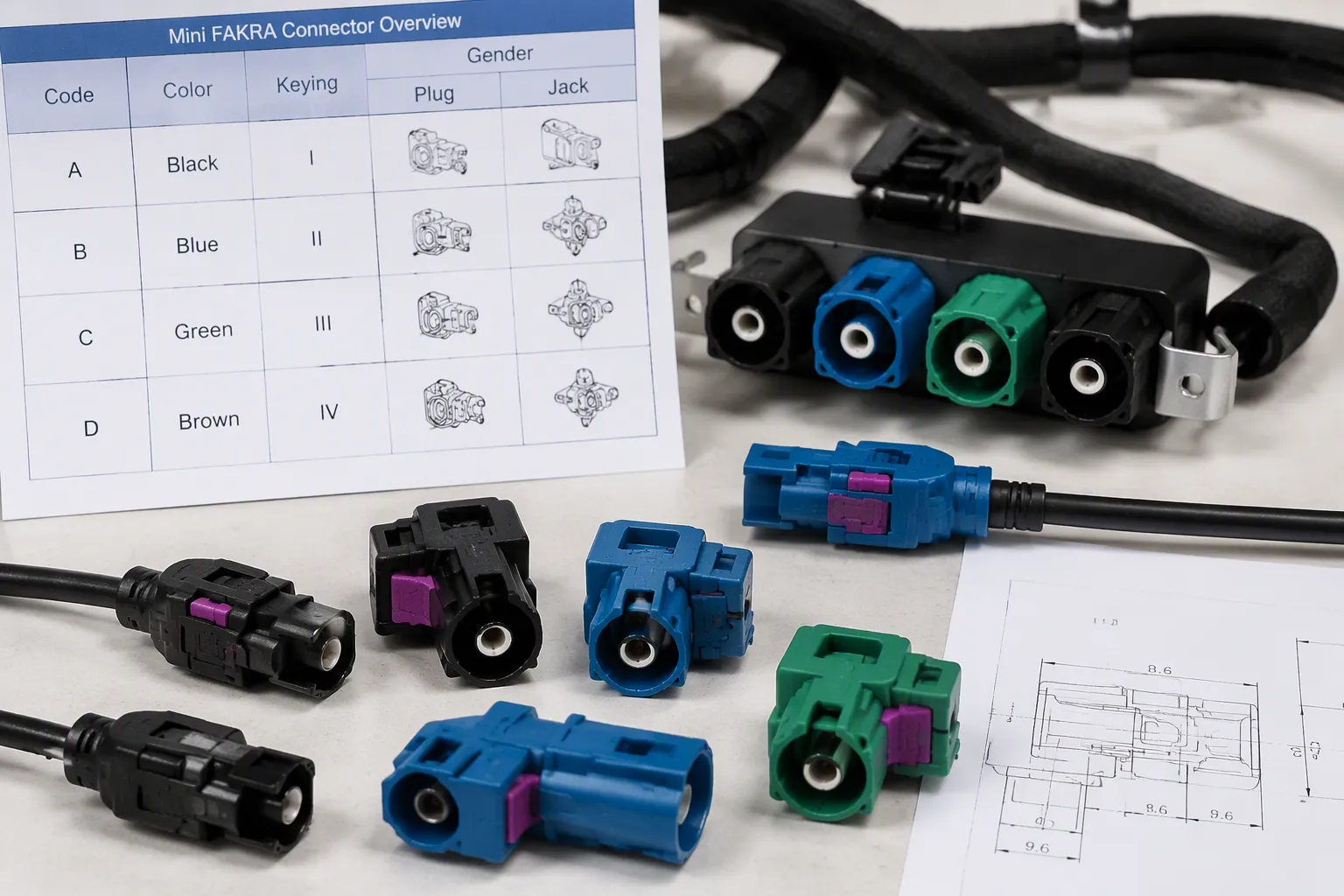
The connector family choice comes next. Engineers select Mini FAKRA or HFM, then record the connector code and housing color for each end. The spec must state the plug or jack interface and the connector gender at the camera side and the ECU side separately. A mismatched gender or code stops the harness from mating at all.
Mechanical coding and primary/secondary locking appear as features of selected product families, not universal claims. The reader should verify the exact part number with the supplier before release. This step protects connector type & compatibility across the vehicle build.
The table below turns these decisions into an RFQ format.
Specification item | What the buyer should provide | Why it matters | Example |
|---|---|---|---|
Connector family | Mini FAKRA or HFM | Sets the mating interface | HFM |
Connector code and color | Code letter and housing color per end | Prevents wrong-keyed mating | Code A, black |
Interface and gender | Plug or jack, male or female, per end | Stops non-mating pairs | Jack at ECU |
Orientation | Straight or right angle | Controls cable exit path | Right angle at ECU |
Configuration | Single, dual, or quad | Matches port count | Quad |
Cable type and length | Coax type, finished cable length, tolerance | Controls loss and fit | 50 ohm, 300 mm |
Orientation, Configuration, and Locking
Single, dual, and quad Mini FAKRA configurations support camera aggregation and multi-channel controllers while reducing PCB space versus individual interfaces. Dual-port or quad-port housings simplify module packaging and cable identification when an ECU needs multiple compact high-speed coaxial ports. Buyers should confirm the port configuration along with mating interface, mechanical coding, target frequency or data rate, cable type, and protocol requirements.
Cable-side orientation offers straight exit or right-angle exit. This choice determines the cable exit path and the distance before the first cable bend. PCB-header orientation offers vertical or right-angle mounting, which affects PCB footprint, module wall position, latch access, and shield cover clearance. A right angle mini fakra connector suits a space-limited ECU. Straight and right angle mini fakra connectors both belong in the spec, stated per end.
Five example configurations show how these choices combine. A single Mini FAKRA camera cable links one sensor to one ECU port. A dual-port Mini FAKRA camera assembly feeds two channels into one housing. A quad Mini FAKRA assembly serves a 360-degree surround-view system. A right angle connector at the ECU solves a tight module wall. A custom Mini FAKRA cable for an ADAS camera documents every item above before quoting.
The assembly design & configuration section of the drawing should repeat these choices. Clear documentation of the mini fakra cable and its mating hardware reduces sample revisions later.
Specify Mini FAKRA Cable Type and Cable Length
Coax Type, Outer Diameter, and Shielding
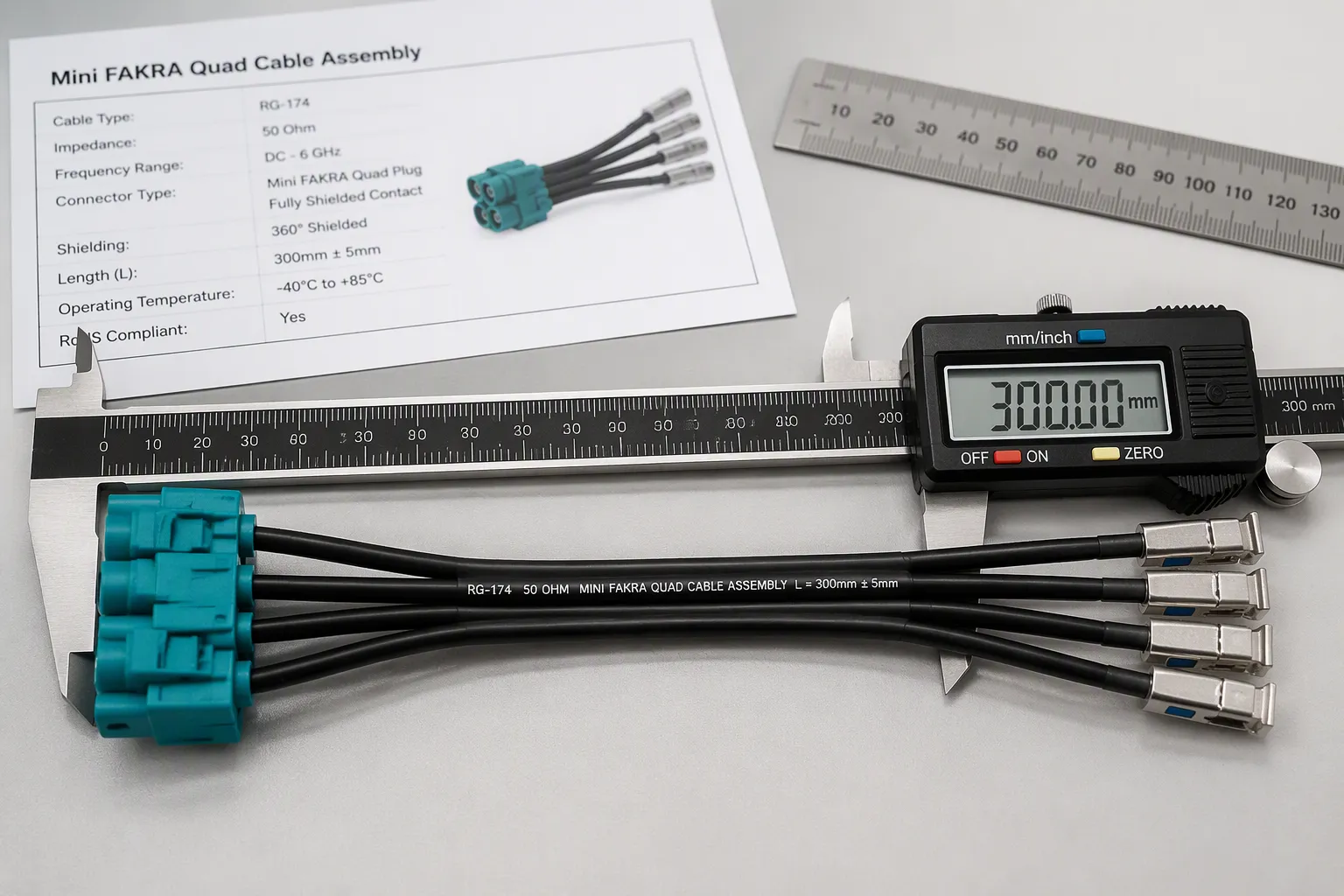
The cable choice follows the connector choice. The spec states the coaxial cable type, its outer diameter, and the shielding construction. Mini FAKRA assemblies are often built on flexible single-shielded 50-ohm cable types. Buyers should confirm the cable type against the target assembly rather than assume it. A quad Mini FAKRA assembly, for example, may use 50Ω LEONI DACAR 302-4 automotive coaxial cable on each branch, which provides independent shielding per channel together with impedance control.
Shielding construction deserves its own line in the RFQ. Fully shielded coaxial cable contacts provide optimal signal integrity and electromagnetic interference suppression. A 360° fully-diecast shielded-header core optimizes EMI/EMC performance at the PCB header interface. Buyers should also record the minimum bend radius, the cable exit direction, and any clips, labels, sleeves, or strain relief.
Shielding effectiveness reflects the cable's ability to limit electromagnetic interference. Because bend radius, cable length, and shield termination all interact, a poorly terminated shield can degrade EMC performance; therefore the connector, cable, crimp, adapter, PCB transition, and mating interface must be treated as a single transmission channel.
A low loss coaxial cable helps preserve margin on longer runs. The spec should name the cable family and let the supplier confirm the match.
Finished Cable Length and Tolerance
Buyers should provide finished cable length, not only approximate routing length. Routing length ignores connector bodies, bend allowances, and service loops. The finished cable assembly measurement runs from mating face to mating face. Every cable length on the drawing needs a stated tolerance, because an untoleranced cable length invites a rejected lot.
Cable length drives insertion loss directly. A longer cable length adds loss at the operating frequency. The spec should pair each cable length with the loss budget for that run. A right angle connector at the ECU end also changes the effective cable length before the first bend, so the drawing should show the exit path.
USCAR-49 compliance is a specification to confirm for the selected assembly, not a universal claim. Buyers should ask the supplier to confirm USCAR-49 against the exact mini fakra connector and cable combination. The same rule applies to every mini-fakra assembly: verify, then release.
The drawing package should repeat the cable type, outer diameter, shielding, minimum bend radius, cable exit direction, accessories, and each cable length with tolerance. Clear documentation of the mini fakra cable and its automotive coax connections reduces sample revisions. A well-specified mini fakra cable also shortens the quote cycle, because the supplier can match mini fakra connectors and cable in one pass. Engineers who document the cable assembly this way get a finished cable assembly that fits the first time.
Verify Electrical and Environmental Performance
Insertion Loss, Return Loss, and VSWR
Electrical verification goes beyond a simple continuity check. A continuity test confirms that a conductor carries current from one end to the other. It cannot prove that a mini-fakra cable assembly will carry a high-frequency camera signal without degradation. The spec should therefore define an insertion loss limit at the operating frequency, a return loss or VSWR target, and an impedance verification method. These measurements confirm that the coaxial cable and connector interface work as one transmission channel.
The validation plan should list each test and its acceptance criterion. A complete list covers visual inspection, continuity, shield continuity, connector retention, pull-force inspection, impedance, insertion loss, return loss or VSWR, vibration, temperature, and vehicle-level camera image validation. Each test addresses a different failure mode, so the spec should not rely on any single check.
Sealing, Temperature, and Vibration
Environmental requirements depend on where the camera sits. A camera near an exterior opening, lamp area, bumper area, or wet zone needs a sealed connector, a suitable IP rating, a stable backshell, and strain relief. Cabin or mirror cameras may instead prioritize retention, cable bend space, and compact connector size. The spec should state the operating temperature range, vibration resistance level, cable jacket material, and connector retention requirement. Where a waterproof or IP-rated design is needed, the buyer should describe it as a specification for a selected assembly and verify it with LEADSIGN.
Vibration resistance for FAKRA and HSD automotive connectors follows ISO 16750-3 or an equivalent standard. Mini FAKRA is a variant within the FAKRA connector family, so this requirement applies to Mini FAKRA cable assemblies as well. USCAR-2 Class 4 covers vibration up to 20 G over a frequency range of 10–2000 Hz. The Mini FAKRA connector standard itself is defined in ISO 20860, which does not specify a dedicated vibration test beyond these general automotive connector requirements. Buyers should cite the standard by name and confirm the test level against the exact assembly.
Prepare Documentation, Samples, and RFQ Quantities
Drawings, Samples, and Part Numbers
A complete documentation package removes guesswork from the quote. Buyers should supply a customer drawing, a connector mating drawing, and a cable routing drawing. An original sample, connector photographs, and the ECU and camera part numbers add certainty. A pinout or interface description, quantity forecast, testing requirements, and packaging and labeling requirements complete the package.
Providing drawings, photos, samples, or the original part number whenever possible reduces sample revisions and production delays. A custom mini fakra cable assembly quote moves faster when the supplier sees the actual mating hardware. Buyers who send only a verbal description often face repeated sample rounds. A custom gmsl camera cable manufacturer can match mini fakra connectors and cable in one pass when the documentation is complete.
Quantities, Testing, and Packaging
The RFQ should separate prototype quantity from production quantity. Each volume carries different tooling and inspection needs. Buyers should list the required inspection and validation tests for each stage. Packaging and labeling requirements belong in the same document.
Labels must identify channels while keeping connector codes and latches visible and unobstructed. Inspection and packaging should follow the agreed drawing, including protection for contacts and for bend-sensitive cable exits. Channel identification and branch lengths must remain clear where bundles split toward individual cameras or sensors. Recognized color codes and pinout configurations should be followed, since the color-coded system (Gray, White, Blue, Green, Black, Red) helps identify pin assignments and reduces installation errors. Comprehensive traceability and documentation should span from raw material selection through final packaging to simplify procurement audits.
LEADSIGN supplies Mini FAKRA and HFM connector solutions, custom camera cable assemblies, single, dual, and quad configurations where available, custom cable lengths, and straight and right angle connector options. The company offers OEM and ODM support, sample development, connector and cable matching, and application-specific automotive wiring solutions. Buyers should confirm each item with LEADSIGN before release.
A reusable RFQ checklist follows the same sequence as the design review:
Signal path and protocol, including gmsl2 confirmation.
Connector family, code, color, gender, connector orientation, and configuration.
Coax type and finished cable length with tolerance.
Electrical and environmental targets.
Documentation, quantities, and tests.
A complete, documented specification makes a custom mini fakra cable reliable. Buyers should confirm every item against the exact part number and the finished cable assembly with the supplier. This step keeps the cable assembly matched to the ADAS camera system.
Engineers should confirm each checklist item with LEADSIGN before release. Clear documentation of mini fakra connectors, the mini fakra cable, and adas coax signal paths prevents rework. The assembly then fits the first time.
FAQ
Can a buyer substitute HSD for Mini FAKRA on the same camera link?
No. Mini FAKRA carries a single-ended 50 ohm coaxial signal. HSD carries a differential signal. The camera architecture, protocol, impedance, and module interface decide the choice. Buyers should confirm the connector family against the exact camera and ECU part numbers before release.
Does a continuity test prove the cable will pass video?
No. Continuity only shows that a conductor carries current end to end. It says nothing about high-frequency behavior. The specification should add insertion loss, return loss or VSWR, and impedance verification at the operating frequency.
Which length should the drawing state?
The drawing should state finished cable length, measured from mating face to mating face. Routing length alone ignores connector bodies and bend allowances. Each length needs a stated tolerance, because an untoleranced length invites a rejected lot.
What documents speed up a quote?
Buyers should send a customer drawing, connector mating drawing, cable routing drawing, original sample, connector photographs, and the ECU and camera part numbers. A pinout description, quantity forecast, test list, and packaging requirements complete the package. Complete documents reduce sample revisions.
How does a buyer confirm protocol fit?
The buyer should name the serializer/deserializer pair and the data-rate range, then confirm both against the exact part numbers. GMSL2 is rated to 15 meters at 6 Gbps, and FPD-Link III to 15 meters at 4.16 Gbps. Cable and connector quality still govern real performance.
See Also
Why Quad Mini Fakra Connectors Matter So Much in Cars
Harnessing the Full Potential of FAKRA Coaxial Cable Connectors
Discovering the Capabilities of High-Speed FAKRA-Mini Connectors Today
Exploring the Benefits of Mini Fakra Connectors in Automotive Use
Realizing the Potential of High-Speed FAKRA-Mini Connectors in Automotive