Choosing the Appropriate Vehicle Cable for Your Automotive Needs – Professional B2B Guide (2026)

Intro: One Wrong Cable Can Overheat, Drop Voltage, or Cause a Fire
Selecting the correct vehicle cable is not just about making a connection – it directly affects safety, performance, and long‑term reliability. An undersized cable can overheat, melt insulation, and cause a short circuit. An oversized cable may be unnecessarily heavy and expensive. Understanding basic electrical principles (voltage, amperage, wire gauge) and matching the cable to your vehicle’s needs is essential for any repair shop, fleet manager, or custom builder.
In this guide, you will learn:
Basic electrical concepts: voltage, voltage drop, amperage, and wire gauge
How to select the right wire thickness based on load, length, and environment
Step‑by‑step examples for common automotive circuits
Why proper cable selection prevents failures and improves safety
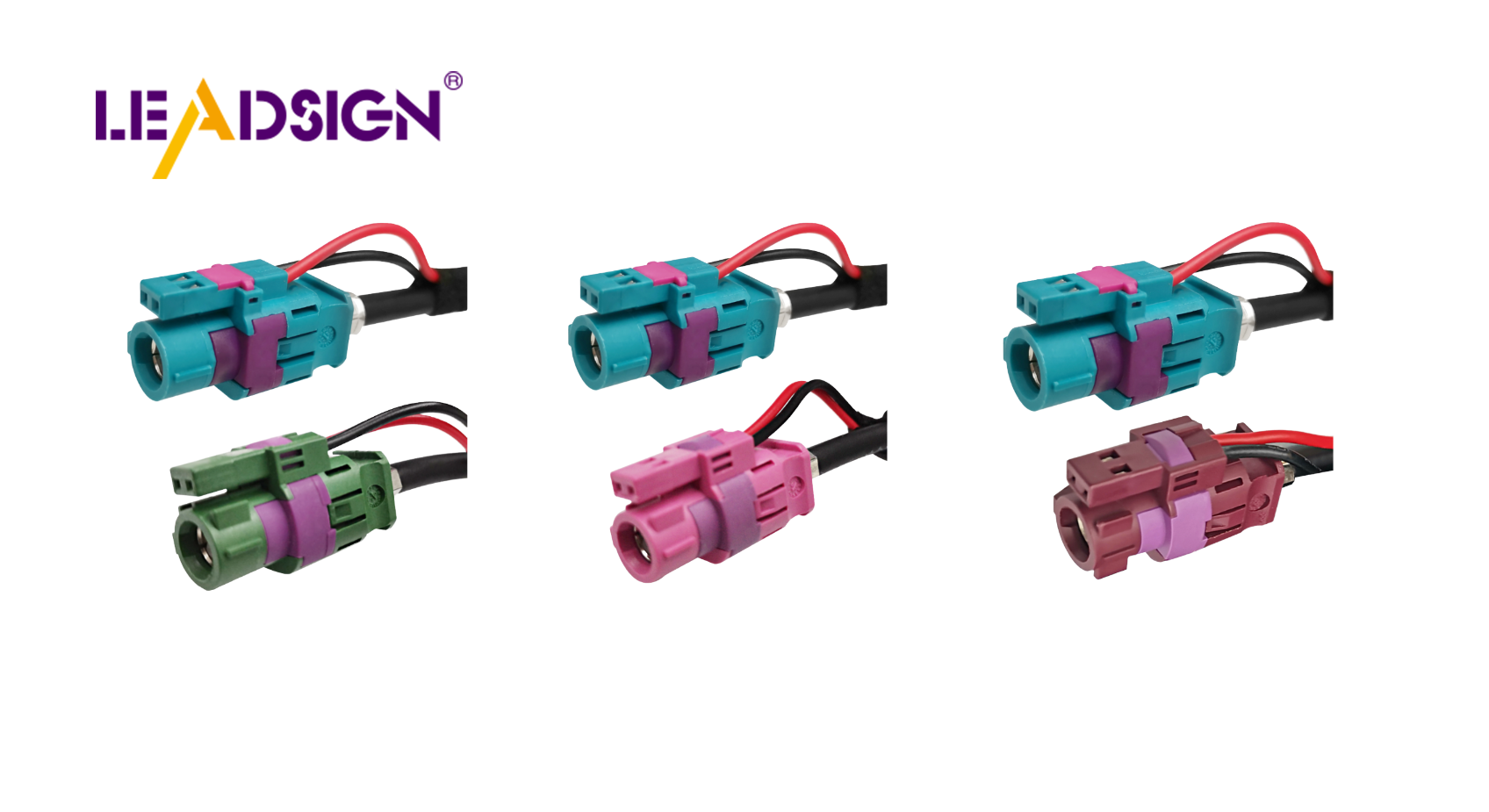
The role of specialised cables (FAKRA, HSD) for high‑speed data
1. Understanding Basic Electrical Concepts for Automotive Cables
🔹 Voltage and Voltage Drop
Voltage is the electrical pressure that pushes current through a wire. In vehicles, the nominal voltage is 12V (or 24V for trucks, 400V/800V for EVs).
Voltage drop occurs when voltage decreases along the length of a wire due to resistance. Excessive voltage drop (typically >3‑5%) can cause dim lights, slow sensors, or ECU malfunctions.
Rule of thumb: For critical circuits (ECU, fuel pump, headlights), keep voltage drop below 0.2V at rated current.
🔹 Amperage (Current) and Wire Ampacity
Amperage is the amount of electrical current flowing through a wire.
Each wire size has a maximum ampacity (safe current‑carrying capacity). Exceeding it causes overheating, insulation melting, and fire risk.
Example: A 18 AWG wire may handle 10A in chassis wiring, while 10 AWG can handle 55A.
🔹 Wire Gauge (AWG)
AWG (American Wire Gauge): Smaller numbers = thicker wire = lower resistance = can carry more current.
Common automotive gauges: 22‑20 AWG (sensors, low‑current signals), 18‑16 AWG (lights, relays), 14‑12 AWG (power distribution, fans), 10‑8 AWG (alternator, starter, winch).
2. How to Select the Right Wire Thickness – Factors to Consider
Factor | What to evaluate | Why it matters |
|---|---|---|
Current (amperage) | Circuit load (e.g., 10A for a light, 50A for a winch) | Determines minimum wire gauge to prevent overheating. |
Wire length | Distance from battery/fuse to load (one‑way or round trip) | Longer wires need thicker gauge to reduce voltage drop. |
Temperature | Engine bay (up to 125°C) vs. interior (up to 80°C) | High‑temperature insulation (XLPE, GXL) required for engine bay. |
Voltage drop allowed | 2‑3% for most circuits; 5% for non‑critical | Ensures device receives adequate voltage. |
Insulation type | PVC (interior), XLPE (engine bay), silicone (high flex) | Prevents melting, cracking, and short circuits. |
Pro tip: Use an online wire gauge calculator or a standard chart – but always derate for high‑temperature locations.
3. Step‑by‑Step Wire Selection Process
Step 1: Determine the circuit load (amperage)
Read the device specification (e.g., headlight 15A, fuel pump 10A).
If unknown, use a clamp meter.
Step 2: Measure the one‑way wire length (from battery or fuse box to device).
For long runs (e.g., rear winch on a truck), consider voltage drop more carefully.
Step 3: Choose a target voltage drop.
For critical circuits (ECU, ABS, camera): 2% max.
For general lighting: 3‑5% may be acceptable.
Step 4: Use a wire gauge chart or formula.
Example: For a 10A load over 5 metres, 18 AWG may be too thin – use 16 AWG.
Step 5: Select insulation type based on location.
Engine bay: XLPE (SXL, GXL) or high‑temp TXL.
Interior: PVC (GPT) is fine.
Underbody / exterior: Use cross‑linked or additional loom tubing.
4. Common Automotive Circuits – Wire Size Examples
Circuit | Typical current | One‑way length | Recommended gauge | Insulation |
|---|---|---|---|---|
Interior light | 2A | 3m | 22 AWG | PVC |
Radio (accessory) | 10A | 4m | 18 AWG | PVC or TXL |
Headlight (one side) | 15A | 3m | 16 AWG | SXL (engine bay) |
Electric fan | 20A | 2m | 14 AWG | GXL (high temp) |
Fuel pump | 10A | 5m | 16 AWG | SXL |
Battery to starter (short) | 150A | 1m | 4 AWG | Battery cable (fine strand) |
Winch (50 ft away) | 200A | 15m | 2/0 AWG | Fine strand (welding cable) |
Important: For long winch runs, overesize significantly – voltage drop under high current can reduce performance.
5. Special Considerations for High‑Speed Data Cables
Not all vehicle cables carry power – some carry sensitive high‑speed signals (camera video, GPS, USB‑C, Ethernet). These require specified impedance and shielding, not just correct gauge.
Signal type | Cable type | Impedance | Key requirement |
|---|---|---|---|
Backup camera (1080p) | Coaxial (e.g., RG‑174, low‑loss) | 50Ω | Double shielding, low attenuation |
GPS antenna | Coaxial | 50Ω | Low loss, stable phase |
4K camera | Low‑loss coax (Mini FAKRA) | 50Ω | Very low attenuation, 20 GHz |
USB‑C CarPlay | Twisted pair (HSD) | 100Ω | Differential, shielded |
Automotive Ethernet | Twisted pair (HSD) | 100Ω | Shielding, CAT rating |
Rule: Do not use primary power wire for data signals – impedance mismatch will cause corruption. Use pre‑terminated FAKRA or HSD cables from LEADSIGN.
6. Environmental Factors – Heat, Moisture, and Abrasion
Condition | Recommended cable feature |
|---|---|
Engine bay (high heat) | XLPE or silicone insulation; rated -40°C to +125°C |
Underbody (water, salt) | Sealed connectors, adhesive‑lined heat‑shrink |
High vibration (engine, suspension) | Fine‑stranded copper (not solid), secure strain relief |
Chemical exposure (oil, coolant) | Chemical‑resistant jacket (e.g., cross‑linked polyethylene) |
Pro tip: When routing cable, add split loom tubing for abrasion protection and keep away from exhaust, sharp edges, and moving parts.
7. Why LEADSIGN for Data Cables – Pre‑Terminated, No Guesswork
For power cables, you can measure, cut, and crimp your own – as long as you calculate gauge correctly. However, for data cables (FAKRA, HSD), field termination is difficult and error‑prone. LEADSIGN provides pre‑terminated cables in custom lengths, with the correct impedance and shielding already built in.
What LEADSIGN offers:
✅ FAKRA (standard & Mini) – all 14 colours, 50Ω, up to 20 GHz, IP67 optional
✅ HSD (USB‑C, Ethernet, LVDS) – 100Ω, locking, up to 5 Gbps
✅ Pre‑terminated cables – any length 0.3m – 20m, no crimping
✅ Low‑loss, double‑shielded coax – for long runs and EV environments
✅ Bulk pricing – for shops, fleets, and distributors
For your business: When you need a camera extension cable, GPS antenna lead, or USB‑C upgrade, order a LEADSIGN pre‑terminated cable – correct length, correct impedance, ready to install.
Final Recommendations – Cable Selection Checklist
Step | Action |
|---|---|
1 | Determine device current (amps) and voltage. |
2 | Measure one‑way wire length. |
3 | Choose target voltage drop (2‑3% for critical, 5% for non‑critical). |
4 | Select wire gauge from a standard chart. |
5 | Choose insulation (PVC for interior, XLPE for engine bay). |
6 | For data (camera, GPS, USB), use pre‑terminated FAKRA/HSD cables. |
7 | For exterior/underbody, add loom and use sealed connectors. |
Remember: A correctly selected cable is invisible – it just works. An incorrect cable will cause intermittent problems, heat, or failure. Take the time to calculate correctly.
Ready to simplify your data cable selection with pre‑terminated solutions?
See Also
Maximizing Vehicle Data Flow: Innovative Connectors and Cables
Boosting Data Flow: The Role of Fast Automotive Connectors
Why Fakra Connectors Are Essential in Today's Cars