FAKRA Connector vs SMA Connector for GPS Antennas: What Is the Difference?

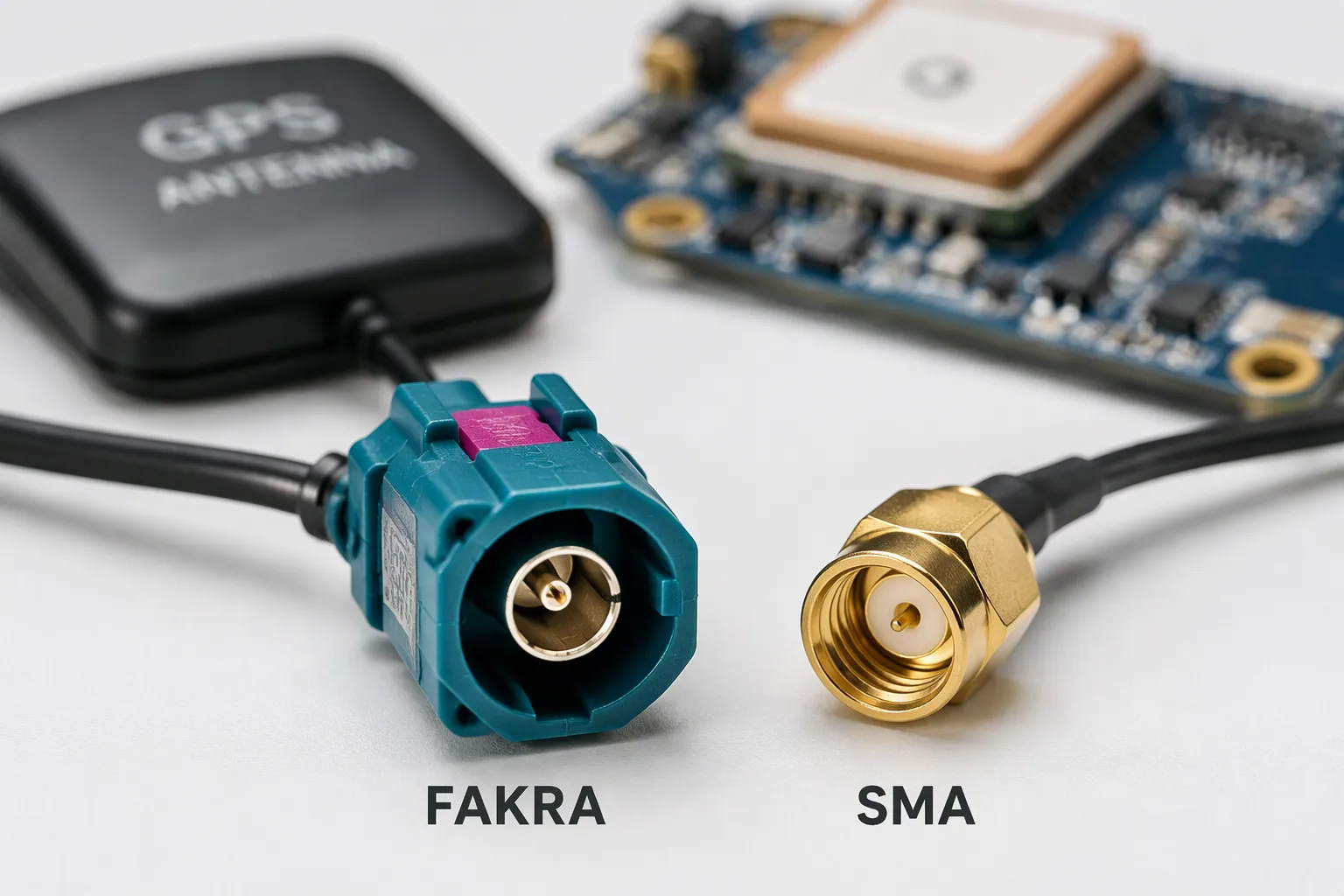
An installer holds a GPS antenna with a FAKRA connector. The navigation module in the dash uses an SMA jack. The two parts will not mate, and forcing them risks damage to both sides.
Connector choice affects more than fit. Mating interface, gender, polarity, coding, impedance, and cable routing all shape whether a GPS antenna system works reliably in service.
The core difference in the FAKRA connector vs SMA connector comparison is simple. FAKRA is a plastic-housed, keyed, coded connector built for automotive integration. SMA is a threaded metal connector common in general RF, module, and test applications. A GNSS installation may call for either one.
In Short: The right choice depends on the actual GPS antenna, navigation module, vehicle wiring, and installation environment. A FAKRA-to-SMA cable or adapter may be needed when interfaces differ.
Key Takeaways
FAKRA connectors use plastic housings with keys and codes for safe automotive use.
SMA connectors use threaded metal bodies for test gear and modules.
Choose FAKRA for factory vehicle wiring and SMA for bench or aftermarket devices.
Use a FAKRA-to-SMA adapter or cable when the two connector types do not match.
Always check gender, polarity, and 50-ohm impedance before you order.
What Are FAKRA and SMA Connectors?
Both connector families carry radio-frequency signals on coaxial cable. Each one solves a different problem. FAKRA targets the vehicle harness. SMA targets the bench, the module, and the antenna port.
FAKRA Connector Basics
A fakra connector uses a plastic housing around a small coaxial contact. The housing snaps into place with a positive detent instead of threads. This push-to-lock design mates quickly and resists vibration. Letter-coded housings from A to Z carry a specific color and a unique mechanical key. Ribs and slots block a Code A plug from entering a Code H receptacle. GPS (Code A, violet) is a common assignment. The design follows ISO 20860 and USCAR requirements, with DIN 72594-1 defining the housing geometry. Most parts are specified at 50 ohms and up to about 6 GHz. Thin flexible coax such as RG-174, RG-316, or 1.13 mm micro-coax suits short in-vehicle runs. Automotive gnss receivers often use this housing. The connector body stays small, so it fits behind trim panels and inside tight harness bundles. Crimping or soldering terminates the cable, and the housing then clicks onto the connector body.
SMA Connector Basics
A sma connector uses a metal body and a threaded coupling nut. The thread holds the interface tight under vibration, and a torque wrench set to 5 in-lbs gives a repeatable mate. Standard parts run from DC to 18 GHz at 50 ohms. The family appears on test equipment, RF modules, development boards, and many external antenna ports. Cable-mount versions need crimping tools, and PCB versions come in edge-mount, end-launch, and surface-mount styles. The contacts wear with use, and typical life reaches about 500 mating cycles. A gps/gnss module on a prototype board often carries this interface. Right-angle versions help in crowded enclosures.
Neither family is universal. The antenna, the module, and the harness decide the fit.
FAKRA Connector vs SMA Connector: Key Differences
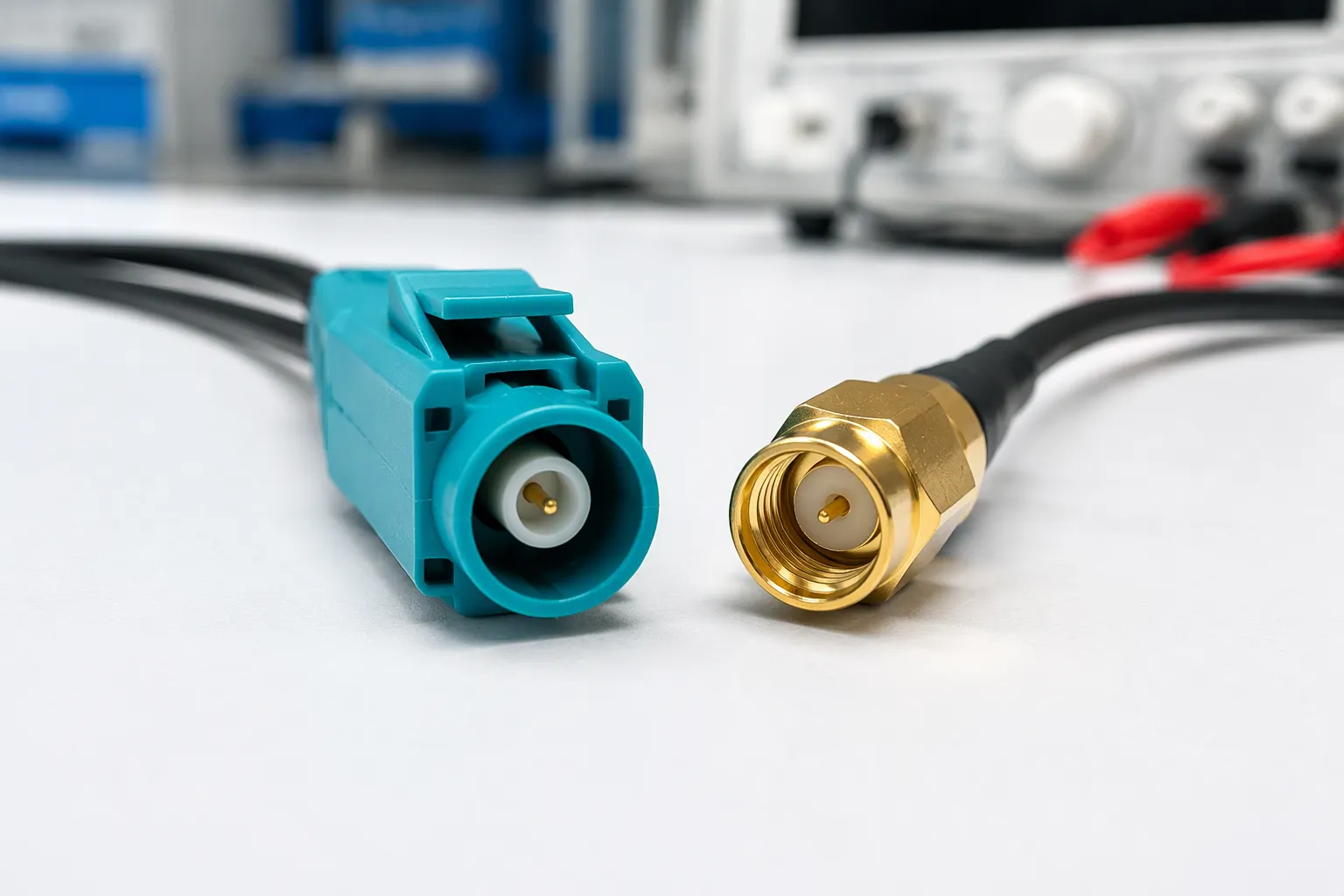
The fakra connector vs sma connector comparison comes down to how each part handles retention, identification, and mating. The table below sets the two families side by side.
Feature | FAKRA | SMA | Selection consideration |
|---|---|---|---|
Connector structure | 50-ohm SMB-style contact inside a plastic housing | Metal body with a threaded coupling nut | Match the housing to the space and the harness |
Locking method | Snap-on with a positive detent, plus a primary and secondary lock | Threaded coupling, typically torqued to 5 in-lbs | Vibration and service access drive the choice |
Coding and keying | Letter codes A to Z with matching housing colors | None; the thread mates with any matching series | Coding prevents wrong-line mating in a vehicle |
Mating interface | Code-specific plug and jack pair | Standard or reverse polarity thread | Confirm the interface, not the color alone |
Connector gender | Plug carries the center pin; jack carries the sleeve | Plug and jack in standard or reverse polarity | Gender must match at both ends |
Installation environment | Vehicle harness, trim panels, sealed body areas | Benches, modules, test racks, antenna ports | Match the part to moisture, dust, and vibration |
Packaging | Bulk or harness-integrated assemblies | Individual parts and cable assemblies | Plan for service spares |
Cable assembly options | Broad range of automotive coax assemblies | Wide range of lab and module assemblies | Cable type must suit the run |
Service and replacement | Housing releases with a tab; coded re-mating | Unscrew and re-torque | Repeated service favors quick-release designs |
Typical GPS antenna use | Factory navigation and telematics runs | Modules, prototypes, and external antenna ports | Confirm the actual antenna and module ports |
Structure, Locking, and Coding
Traditional RF connectors such as SMA rely on documentation and installer experience to keep signal paths separate. FAKRA adds a coded plastic housing that guides correct pairing and locks the connector in place. The internal RF contact stays a standard 50-ohm coaxial interface. The outer housing handles identification, keying, and retention.
A fakra connector combines that contact with color identification, mechanical keying, and secondary locking. The keying is mechanical first. Color is a visual aid that mirrors it. A Code A plug only mates with a Code A jack. Code Z is neutral and mates with any type, which suits lab and prototype work. The secondary lock reduces partial disengagement during repeated assembly.
The sma connector takes the opposite approach. A thread locking mechanism holds the interface tight, and a torque wrench gives a repeatable mate. Nothing on the body prevents a wrong connection. The installer reads the drawing and checks the port.
Mating Interface and Gender
Gender works differently across the two families. A FAKRA plug carries the center pin and usually sits on the cable side. The jack carries the sleeve and usually sits on the device. A plug with code A (violet) mates only with a jack that shares the same key and color. Mismatched keys will not physically connect.
SMA follows a simpler rule. Standard polarity puts the pin in the plug and the socket in the jack. Reverse polarity swaps the contact arrangement. Buyers should confirm the actual mating interface instead of relying on informal terms such as "male cable."
FAKRA connectors commonly serve automotive wiring systems where coding, locking, and vehicle integration matter. SMA connectors serve RF equipment, modules, test gear, and some antenna assemblies. Neither family wins everywhere. The gps or gnss port, the harness, and the service plan decide the fit.
When to Choose FAKRA for GPS Antennas
Automotive and OEM Integration
FAKRA earns its place when the installation follows a vehicle harness. Factory wiring, OEM-style antenna connections, navigation modules, and telematics units all rely on controlled mating. Code A (violet) covers GPS runs. It also serves aftermarket head units and legacy vehicle upgrades. Code B (blue) covers FM radio, and Code H (orange) covers camera inputs. Their distinct uses do not make them interchangeable. The coded housing also speeds assembly on a busy line.
An installer should treat the housing code as a routing rule, not a suggestion. A GPS antenna connection that lands on the wrong code will not seat. The automotive harness drawing therefore drives the choice. This is why an automotive GPS antenna project starts with that document. A mismatched pair wastes installation time and risks a damaged contact. LEADSIGN FAKRA connectors give designers a coded option for these runs.
Coded and Locked Connections
Coding and locking protect signal integrity in a moving vehicle. Fourteen mechanical and color codes plus one neutral code block wrong mating. The primary latch clicks into place with an audible sound. An optional secondary lock adds retention for mission-critical systems. The housing resists shock and vibration. The center contact rotates through 360 degrees, so the cable does not twist during service. A partial mate can pass a visual check and still fail in service.
These features matter in automotive electronics, where a loose connection can drop a GNSS fix. A neutral Code Z part suits lab work, not a production harness. Buyers who need fakra c blue connectors should confirm the code against the module drawing. The automotive fakra port on the device side must match the cable side. For vehicle GPS and other gps antennas, this discipline keeps the link stable. A quick photo of both ends settles most questions before an order ships.
When to Choose SMA for GPS Antennas
RF Modules and Test Equipment
SMA suits the bench and the module. The 1/4-36 threaded coupling gives a stable, vibration-resistant connection. That is why SMA became the default interface for RF test equipment, antennas, GPS modules, and wireless infrastructure. A lab that swaps antennas between a signal generator and a spectrum analyzer needs one repeatable interface. The threaded sma connector delivers it.
Common uses in RF modules and development work include:
GNSS receivers that need a stable antenna connection for precise timing and location data
Portable navigation devices, where compact size keeps a robust link in motion
Test and measurement gear such as oscilloscopes, signal generators, and analyzers
Wireless communication systems, including routers and modems
Aerospace and defense equipment for radar, navigation, and communication
A development board for a gps receiver often carries an sma port on the edge. Engineers can attach a patch antenna, a simulator feed, or a cable to a chamber. The same port serves prototype and production test. SMA also appears on antenna modules for cellular and IoT hardware, software-defined radio, and industrial telemetry. Suitability still depends on the actual antenna and equipment interface. A threaded port on the module does not guarantee that a given gps antenna will match it.
Aftermarket and External Antenna Connections
SMA is popular in handheld GPS units, drones, and some marine electronics. These devices need a compact, threaded interface that holds under motion. An external antenna connection on an aftermarket router follows the same logic. The installer screws the cable on, tightens it, and the link stays put.
One caution applies here. SMA and FAKRA are physically and electrically different, and they are not interchangeable. An installer cannot substitute one for the other at the same port. When a device carries an SMA female input and the vehicle harness ends in a coded FAKRA plug, a dedicated adapter bridges the two. That adapter lets the installer choose from the wide array of gps antennas with SMA male connectors already fitted. It works with active and passive antennas on OEM and aftermarket systems. The same part can feed an external GPS aerial on a 4G or 5G router. Buyers should confirm both ends before they order.
When a FAKRA to SMA Adapter Is Needed
Common Interface Transition Scenarios
An interface transition becomes necessary when the two ends of a GPS antenna connection belong to different connector families. A common case is a gps antenna with a FAKRA plug that must reach a navigation module with an SMA jack. The reverse also happens: a module with a FAKRA port must connect to test equipment that offers only an SMA port. Aftermarket devices add another case, where a new radio must join a factory antenna cable already terminated in a coded FAKRA housing. Vehicle installations often need a transition when the harness and the head unit come from different suppliers. Prototype systems create the same problem when the antenna and the development board use different families.
A fakra to sma adapter solves these cases by joining the two interfaces in one compact part. One popular version is an SMA female to Signal Blue FAKRA C adapter. It lets an installer choose from the wide array of gps antennas that ship with SMA male connectors already fitted. The same part works with active and passive antennas on OEM and aftermarket systems. It can also feed an external GPS aerial on a 4G or 5G router. FAKRA connectors follow ISO 20860-1/2 standards, and their color and mechanical coding keep the RF link stable in harsh automotive environments.
Adapter vs Cable Assembly
A short adapter suits a tight space behind the dash. A fakra to sma cable assembly suits a longer run or a service loop. The table below lists the factors that decide the choice.
Factor | Guidance |
|---|---|
SMA gender and polarity | Choose the fakra to sma adapter by the SMA gender and polarity (SMA vs RP-SMA) needed on the device side. |
Impedance | Keep the coax 50-ohm throughout. |
Cable length and loss | FAKRA terminates thin cable. Short in-dash jumpers typically use RG-174 or 1.13 mm micro-coax. RG-316 is a common step up for a slightly longer or lower-loss run. |
Destination connector | Choose by the destination connector's gender and polarity, not just its family. |
A fakra to sma adapter must match gender, polarity, mating interface, impedance, cable type, frequency needs, installation space, and environmental conditions.
A cable assembly often wins when the run passes near heat, vibration, or moving panels. A custom fakra to sma cable assemblies option lets the buyer set length, jacket, and right-angle ends. Thin coax loses signal quickly at GPS and cellular frequencies. A longer route may call for adapting out to a lower-loss cable instead of stacking adapters. Buyers should confirm the gps/gnss antenna port, the sma port on the module, and the gnss receiver input before ordering. A proper gps antenna connection also needs a clean route and strain relief. For longer vehicle runs, a dedicated GPS and GNSS Antenna Cable keeps loss under control. A fakra to sma cable also simplifies service, because one part replaces a stack of adapters.
Impedance, Gender, and Polarity Checks
50-Ohm Impedance Matching
Impedance matching keeps a GPS antenna system electrically sound. The antenna interface, the coaxial cable, and the navigation module interface should all share the same nominal impedance. Most automotive RF systems use 50-ohm interfaces, but the actual requirement must be confirmed for the specific system. A 75-ohm adapter in a 50-ohm system causes signal reflections. The connector may fit mechanically and still fail electrically, degrading GPS lock and LTE connections.
Parameter | Specification |
|---|---|
Nominal impedance (FAKRA) | 50 ohm |
Impedance tolerance | 50 ±2 ohm across the full frequency range |
VSWR per FAKRA standard under USCAR | 1.6 max, equivalent to -13 dB return loss, over 3-6 GHz |
Return loss of better connectors | ≥ 18 dB (reflects less than 2% of signal power) |
FAKRA frequency ceiling | Up to 6 GHz |
A -13 dB return loss means about 5% of signal power reflects back. Mismatch effects worsen at higher frequencies. A GPS signal at 1.575 GHz is more sensitive to mismatch than an AM broadcast at 600 kHz. Buyers should check the product page for "impedance: 50 ohm" and never assume a FAKRA connector is 50 ohms. The frequency rating must also match the highest-band device. An adapter rated only for audio bands will weaken a GPS or LTE link.
Plug, Jack, and Polarity
Gender describes the connector body and contact arrangement, not the cable. An SMA male connector has a rotating nut with an internal thread and a 0.9 mm center pin projecting from the dielectric. The SMA female has a non-rotating external thread and a center socket flush with the dielectric. The threads retain the pair, and electrical contact comes from the sliding conductors next to the dielectric.
Reverse-polarity SMA swaps the center contact. The RP-SMA plug carries a socket, and the RP-SMA jack carries a pin. The thread is identical, so an RP-SMA plug screws smoothly onto a standard SMA jack and feels seated. The two center contacts never touch, and the feed goes dead. Normal SMA connectors are incompatible with RP-SMA connectors. Buyers should confirm the actual mating interface on the antenna side and the module side instead of relying on informal terms such as "male cable" or "female cable." A photo of both ends settles the sma gender question before an order ships.
Cable Length, Routing, and Installation
Cable Length and Signal Quality
Cable length affects loss, but it is not the only factor. Loss rises with frequency and with every foot of cable. A thin coax run loses more signal than a thicker low-loss cable of the same length. Connector quality matters too. Poor terminations cause internal reflections and add loss at each joint. The practical rule is simple: keep the run as short as the routing allows, and use fewer connectors rather than more.
Installers should measure the complete path before ordering. Run a tape along the actual route, not a straight line between endpoints. Add a service loop at the module so the cable can be disconnected without tension. Avoid sharp bends and confirm the cable bend radius. AC 43.13-1B guidance calls for a bend radius of no less than 6 times the outside diameter of the coax. Route away from power cables and other interference sources, and never crush the cable behind dashboards or panels.
Automotive Installation Considerations
A vehicle environment stresses every part of the gps antenna connection. Vibration works connectors loose, and temperature swings expand and contract the housing. Moisture and dust attack unprotected joints. A positive lock and good strain relief protect the link. Installers should leave space behind the dash for service access and place the antenna where it sees the sky.
The antenna location and the navigation module location shape the route. A roof-mounted antenna needs a path through a door seal or a dedicated grommet. Keep parallel runs of coax separated from EMI sources, because coupling grows with run length. Confirm the cable type, the connector lock, and the bend radius against the vehicle drawing before installation.
Standard vs Custom FAKRA Cable Assemblies
When a Standard Cable Fits
A standard fakra to sma cable suits a known job. The antenna port, the module port, and the cable length all match an existing catalog part. Common GPS and GNSS installations often fall into this group. The route follows a familiar path behind the dash, and the installer repeats the same build across many vehicles. A standard part shortens lead time and keeps spare stock simple.
A standard assembly also fits when the connector combination is fixed. One end carries a fakra code c plug, and the other end carries an SMA plug. The buyer confirms gender, polarity, and impedance against the drawing. A catalog fakra to sma adapter may cover a short in-dash transition. Repeated installation work favors this approach, because the same part number serves every unit.
When a Custom Assembly Helps
A custom build earns its cost when the standard part cannot meet the drawing. A special cable length, a different connector gender, or a right-angle end may be required. Limited space behind a panel can rule out a straight plug. A special fakra code, a custom jacket, or a prototype build also points to a custom part. OEM and aftermarket integration projects often need this flexibility.
A drawing-controlled build prevents expensive late rework in several cases:
Non-standard length tolerance
Controlled breakout geometry
Mixed connector families
Shielding detail
Verified RF limits at specific bands such as 2.4 GHz, 5.9 GHz, or higher
A quality fakra coaxial cable and a made-to-order Custom FAKRA Cable Assembly give the designer control over these details. The fakra c blue housing, for example, may need a specific key and color to match the vehicle harness. Buyers should send the antenna model, the module port, and a photo of both ends. That package lets the supplier confirm the fakra to sma cable assemblies against the real interface before production.
GPS Antenna Connector Selection Checklist
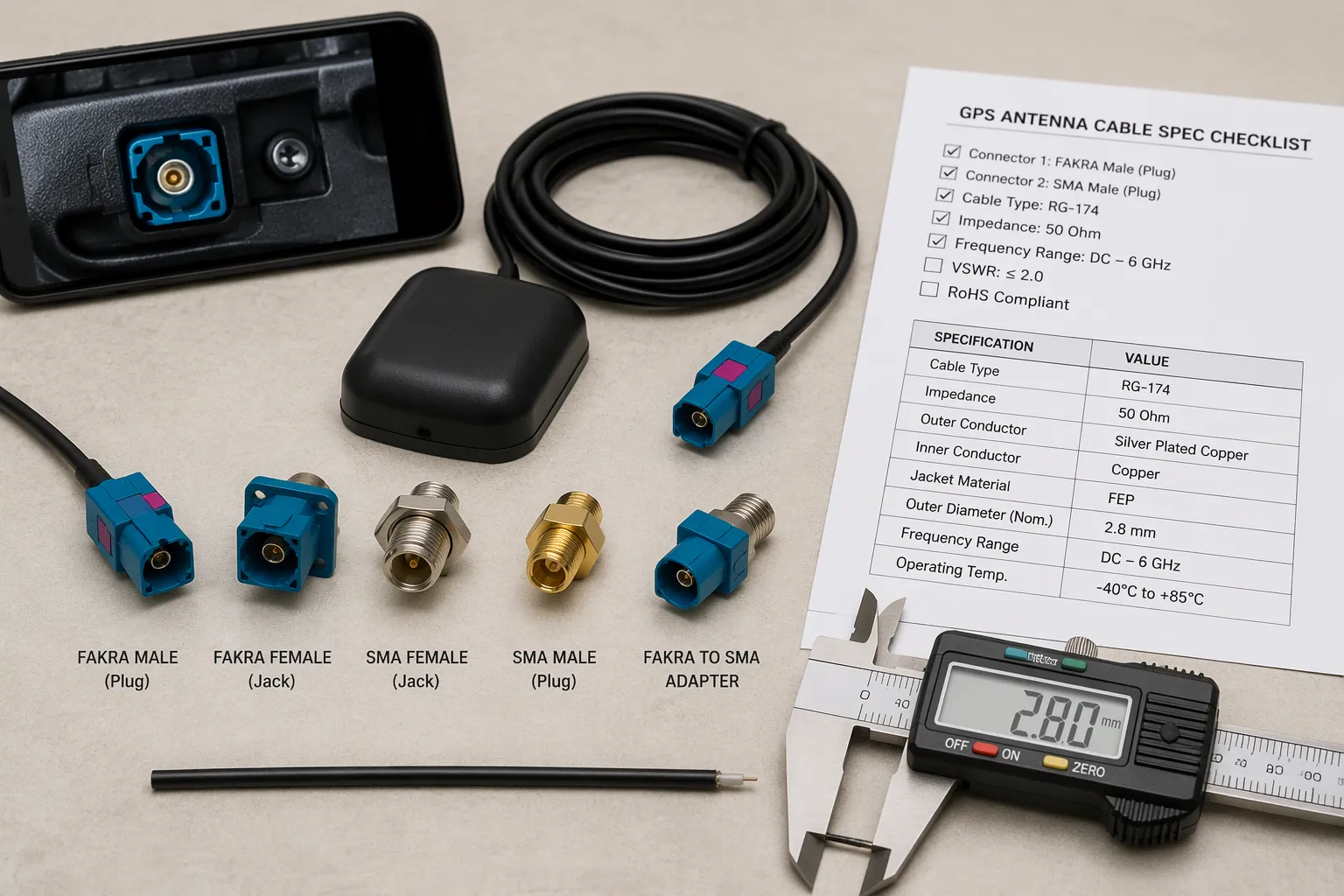
What to Confirm Before Ordering
A complete specification list prevents most ordering errors. The buyer should confirm each item against the actual hardware, not against a catalog photo. The table below covers the points that matter most for a gps antenna connection.
Specification | Why it matters | What the buyer should confirm |
|---|---|---|
GPS or GNSS application | The receiver sets the signal plan | List the constellations and bands the receiver needs |
Antenna interface | A wrong port blocks mating | Record the connector family, gender, and mating side |
Navigation module interface | The module side must match the cable | Photograph the sma port or coded jack on the device |
FAKRA or SMA connector | The two families do not interchange | Confirm the family on both ends before ordering |
Connector gender | A plug will not seat in a plug | Check the body and contact arrangement on each side |
Polarity | Reverse polarity mates but carries no signal | Confirm standard sma vs. rp-sma on the device |
Coding and keying | A wrong code will not snap in | Verify the fakra code c or other letter against the drawing |
Impedance | A mismatch causes reflections | Confirm the 50-ohm requirement for the whole chain |
Cable type | The connector must fit the cable group | Match the part to the coax outside diameter and crimp style |
Cable length | A short cable cannot reach the module | Measure the full routing path plus a service loop |
Straight or right-angle design | Space behind panels is limited | Check the exit direction against the installation space |
Adapter requirement | Extra joints add loss | Decide whether a fakra to sma adapter is needed |
Shielding | Noise can degrade the receive chain | Confirm the shield coverage the route requires |
Environmental conditions | Interior parts are not sealed | State moisture, dust, and temperature exposure |
Required quantity | Volume affects lead time | Give the build quantity and forecast |
Samples | A trial fit catches errors early | Request samples before production |
Technical drawings | The drawing controls the build | Approve the drawing before release |
Delivery requirements | Schedule drives the order | State the delivery region and project date |
Common Selection Mistakes
Several mistakes repeat across gps antennas projects. A connector with the correct color can still be wrong when its keying or cable group does not match the assembly. Buyers should treat the mechanical key as authoritative, because some suppliers use different colors for the same letter code. A fakra c blue housing, for example, must still carry the right key and fit the chosen coax.
Cable group errors cause fit problems. FAKRA parts pair with coax families such as RG 174, RG 316, and RG 178, and each group has its own diameter and crimp requirement. Not every fakra connector is waterproof either, so an interior part should not serve a sealed body area. On the threaded side, buyers confuse sma gender and ignore polarity, and an RP-SMA plug will screw onto a standard jack yet never connect. Other common errors include choosing by appearance, using unnecessary adapters, ignoring cable routing, and ordering without photos or drawings. A gps/gnss cable built for one band does not suit every RF path, so the drawing must confirm the gnss signal plan before release.
How LEADSIGN Supports GPS Antenna Projects
LEADSIGN supplies automotive FAKRA and SMA cable assemblies for navigation, telematics, and vehicle electronics programs. The product range covers FAKRA connectors, FAKRA coaxial cables, FAKRA cable assemblies, FAKRA-to-SMA adapters, FAKRA extension cables, HSD connectors, HSD cable assemblies, Mini FAKRA connectors, and customized automotive cable assemblies. A project team can source the full signal path from one supplier and keep the interface consistent from the antenna to the module.
Connector Matching and Custom Assemblies
Connector matching starts with the real hardware. LEADSIGN reviews the antenna port and the module port together, then confirms the connector family, the mating side, and the cable group before quoting. A customer who needs a fakra connector for a coded harness run can match the housing code to the vehicle drawing. A customer who needs a fakra to sma adapter can bridge a factory cable and an aftermarket device in one compact part.
Custom work covers the details a catalog part cannot. Engineers set cable length, jacket type, right-angle exits, and coding to fit the route behind a dashboard. The team also builds gps and gnss antennas cables for prototype and production builds. Each assembly follows the approved drawing, so the sma gender and the keying stay correct across every lot.
Samples, Drawings, and Quotations
A clear input package speeds every quotation. Customers should send the gps antenna model or a connector photo, the navigation module interface, connector gender, FAKRA coding, SMA polarity, cable length, installation environment, and required quantity. Sample or drawing requirements belong in the same message. Photos of both mating ends remove most ambiguity about the interface.
LEADSIGN then returns a drawing for approval before production. The drawing shows the connector, the cable, the length, and the keying. Buyers can review the fakra and sma details against the vehicle harness and the gnss receiver input. Approved samples let the installer test the fit before a full order. Teams ready to start can browse the FAKRA Connector range and Request a Quote with their project details.
The fakra connector vs sma connector decision follows the installation. FAKRA brings coded housings, positive locking, and vehicle integration. SMA brings threaded flexibility for modules, test gear, and prototypes. Factory or OEM wiring points to FAKRA. Bench work, aftermarket devices, and development boards point to SMA. When the interfaces differ, a FAKRA-to-SMA cable or adapter bridges the gap.
Final compatibility still rests on the real hardware. Installers should check the gps antenna, the navigation module, the connector gender, the cable, the polarity, and the technical drawing before ordering. A gps or gnss link fails on small mismatches.
Teams can contact LEADSIGN for technical support, samples, custom cables, and quotations on any antenna connection.
FAQ
Can a FAKRA plug mate directly with an SMA jack?
No. The two families use different mating interfaces, so they will not connect. An installer needs a FAKRA-to-SMA adapter or cable assembly. The antenna side and the module side must match in gender, polarity, and 50-ohm impedance.
Does connector color prove compatibility?
No. Color is a visual aid that mirrors the mechanical key. A Code A plug only mates with a Code A jack. Buyers should confirm the keying and the drawing, not the color alone, before ordering a gps antenna cable.
How does an installer confirm gender and polarity?
They should photograph both mating ends. An RP-SMA plug screws onto a standard SMA jack but carries no signal. Informal terms such as "male cable" mislead. The gps antenna port and the module port both need a direct check.
When does a cable assembly beat a short adapter?
A cable assembly suits longer runs, service loops, and routes near heat or vibration. A short adapter fits tight space behind a dash. Either part must keep the gps antenna link at 50 ohms and match both interfaces.
Why does impedance matter in a GNSS installation?
Most automotive RF systems use 50-ohm interfaces, but the actual requirement must be confirmed. A mismatch causes reflections and can degrade the gps fix. Buyers should verify the gnss receiver input and the gps antenna port against the drawing.
See Also
Why Fakra to SMA Connectors Matter in RF Applications
The Critical Role of GPS Antennas with Fakra Connectors
A Complete Guide to Understanding Fakra to SMA Connectors