HSD LVDS Cable Selection for BMW EVO and Automotive Displays

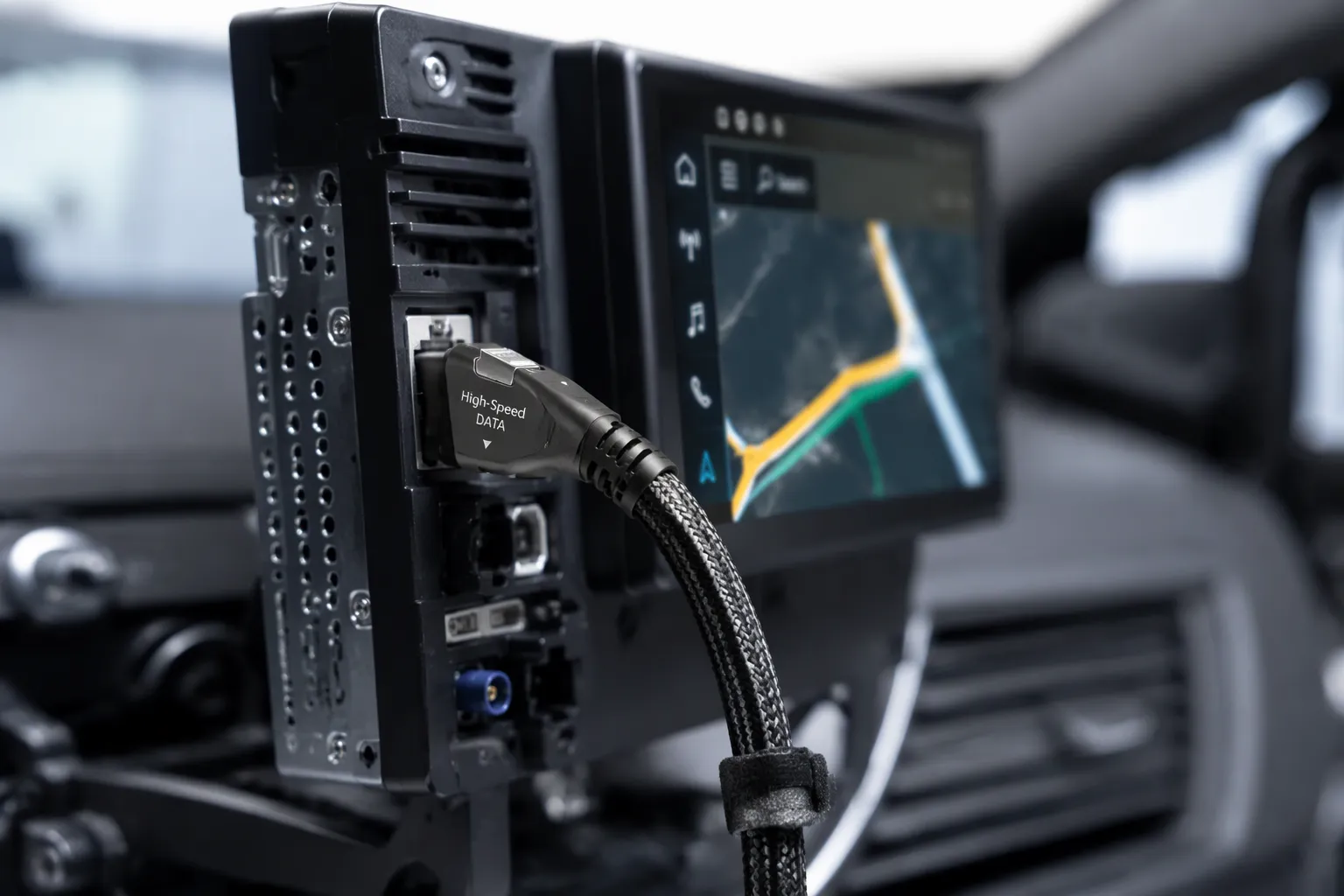
The right BMW EVO LVDS cable matches the head unit's connector type, gender, coding, and pin assignment, holds 100 Ω differential impedance, fits the measured routing length, and is properly shielded. BMW EVO units commonly use a 6-pin HSD connector, yet compatibility must be confirmed per vehicle.
Apply one rule: confirm connector and pinout first, then length, then shielding.
This post covers definitions, BMW EVO fitment, a step-by-step selection guide, OEM versus aftermarket versus generic options, installation, and troubleshooting.
In : Match the connector type, gender, coding, and pinout to the specific head unit and display. Measure the real routing path before choosing length. Confirm 100 Ω differential impedance and full shielding before ordering.
Key Takeaways
Confirm the connector type, gender, coding, and pinout for your specific BMW EVO head unit and display before you order.
Measure the actual cable route in the car to choose the right length and avoid fit problems.
Check that the cable has 100 Ω differential impedance and full shielding to keep the video signal clean.
Take clear photos of both connectors and send them with your order to prevent mistakes.
Test a sample cable before you buy in bulk to catch any pinout or length errors early.
What Is an HSD LVDS Cable?
An HSD LVDS cable is a shielded high-speed data interconnect built to carry low-voltage differential signaling between automotive electronics modules. HSD stands for High-Speed Data. The connector system uses primary and secondary locks, a crimp connection, high cable retention force, and high coding efficiency. These features keep the link seated under vibration and prevent misconnections during installation. LEADSIGN supplies HSD connectors and HSD cable assemblies for these applications.
HSD Connectors and LVDS Signaling
LVDS transmits video as low-voltage differential pairs. One pair carries the signal, and the receiver reads the voltage difference between the two conductors. Cable construction, pair arrangement, impedance, shielding, termination, and connector quality all influence display signal integrity. A cable built for 100 Ω differential impedance keeps reflections low along the run. Poor pair arrangement or weak shielding lets noise couple into the video link.
The HSD connector alone does not guarantee a clean signal. The crimp termination must suit the cable, and the connector housing must hold the pair geometry stable. A loose crimp or a damaged latch changes the electrical path and can produce flicker or a dropped image.
Why Automotive Displays Use Shielded Differential Links
Automotive displays operate in a harsh electrical environment. LVDS resists electromagnetic interference well, because the differential pair cancels common-mode noise. LVDS also offers durable, low-power operation compared with HDMI links in the same cabin environment. These traits make shielded differential links the practical choice for head unit to display video.
HSD is a versatile interconnect family. Beyond LVDS, the same system supports USB, Ethernet, IEEE 1394, and GVIF. One connector platform can therefore serve several high-speed data functions inside the vehicle. Installers should still confirm the specific cable's pinout and electrical rating for each application.
What Is BMW EVO and Where Is the LVDS Cable Used?
BMW EVO is a generation of BMW head units, not a single universal part. Each EVO variant carries its own connector layout and display pairing. The LVDS cable carries video from the head unit to the central information display (CID). Installers also use these cables in head-up display (HUD) retrofits and specialty extension setups.
NBT EVO Head Units and CID Displays
The NBT EVO head unit sits in the dashboard and drives the CID monitor through a dedicated video link. That link is the BMW EVO LVDS cable. It carries the differential video signal from the head unit output to the display input. A correct cable preserves image quality across the full run.
The cable must match both ends of the link. The head unit connector and the display connector each carry their own gender, coding, and pin assignment. A cable that seats on one end may still fail on the other. Installers should verify both connectors before ordering.
HUD and Display Retrofit Applications
HUD retrofits add a projection display above the instrument cluster. These projects often need a longer or differently routed LVDS link than the factory CID cable provides. Specialty extension cables serve this need. Some 7 Series screen upgrades also use an LVDS coupler to join cable segments behind the dashboard.
Retrofit work raises the compatibility stakes. The added display must accept the head unit's signal format and pinout. The extension path must hold impedance and shielding across every joint. A coupler adds another connection point, so each joint must lock fully and stay protected from strain.
One caution applies throughout. No single cable fits every BMW vehicle, EVO head unit, or display. Compatibility depends on model, year, head unit generation, display type, connector configuration, pin assignment, length, and installation. Installers should confirm each factor against the actual vehicle before purchase.
Why the Correct Cable Matters
Signal Integrity and Display Performance
A mismatched cable breaks the video link in predictable ways. The display may show no signal at all, flicker at random intervals, or carry visible interference across the image. These symptoms often trace back to impedance mismatch, weak shielding, or a pinout error rather than a failed head unit. Installers who replace the head unit first may spend far more than a correct cable would have cost.
Correct shielding and impedance protect the video link across the full run. The differential pair needs a stable 100 Ω path from the head unit output to the display input. Shielding keeps outside noise from coupling into that pair. A cable built to these requirements delivers a clean image and holds it under vibration and temperature change.
Fit, Retention, and Installation Safety
Mechanical factors decide whether the link survives daily driving. The HSD connector uses primary and secondary locks, and both must engage fully. High cable retention force keeps the plug seated when the dashboard flexes. A loose latch or a partially seated plug can interrupt the signal intermittently, which makes diagnosis difficult.
Bend radius and routing protect the cable over its service life. A tight bend stresses the shield and can shift the pair geometry inside the jacket. Crushing the cable behind the dashboard causes the same damage, often without any visible mark on the jacket. Installers should route the cable along a clear path, secure it away from sharp edges and moving parts, and leave slack for service access. A cable that passes a bench test can still fail in the vehicle if the installation pinches or kinks it.
How to Identify the Correct BMW EVO LVDS Cable
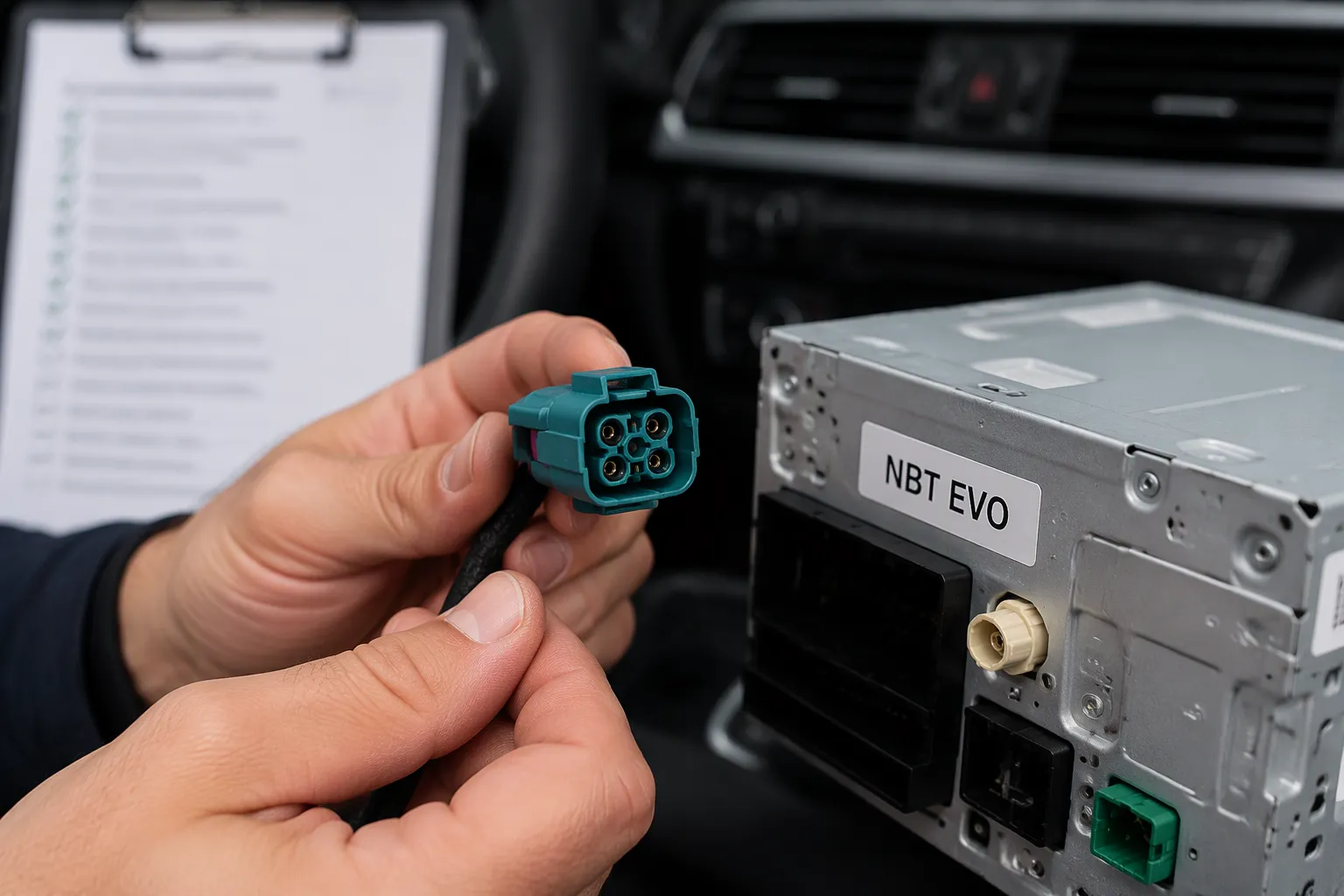
Identification starts with the vehicle, not the catalog. Installers should collect the facts below before they compare any product listing. Each row changes the answer.
Information to confirm | Why it matters | Example of required information |
|---|---|---|
BMW model | Connector layout varies by platform | 3 Series, 5 Series, X5 |
Production year | Mid-cycle changes alter the head unit | 2017 |
Head unit generation | Sets the connector family | NBT EVO |
EVO version, if known | Variants differ in pinout | EVO ID5 or ID6 |
Factory display type | Defines the display-side connector | 10.25-inch CID |
Replacement display type | Aftermarket units may differ | Android screen, 8.8-inch |
Connector type | Wrong family will not seat | 6-pin HSD |
Connector gender | Male and female ends are not interchangeable | Female housing, male housing |
Connector coding | Keying prevents misconnection | Coding A |
Pin assignment | Signal and power pins must align | Pin 1 to pin 1 |
Cable length | Must fit the real route | 1.5 m |
Cable routing | Path sets bend and clearance needs | Behind glovebox, under dash |
Straight or right-angle design | Space behind the display decides | Right-angle at display end |
Required quantity | Affects pricing and lead time | 50 pieces |
Sample requirement | Verifies fit before bulk order | One sample first |
Model, Year, and Head Unit Information
The model and production year narrow the field fast. A cable listed for one BMW platform may not serve another, even when both use EVO head units. Installers should record the VIN and confirm the head unit generation from the vehicle itself. Photos of the original cable add a second check.
Connector Shape, Gender, Coding, and Pinout
Connector families follow the head unit generation. A 6-pin HSD connector is standard for BMW NBT and EVO units. A 4-pin HSD connector serves CIC units. A 10-pin rectangular connector serves CCC units. These patterns give a useful starting point, not a final answer.
An HSD connector alone does not confirm compatibility. The head unit, display, pinout, connector configuration, and electrical requirements must all match. Two cables can look identical and still differ inside. Gender, coding, and pin position decide whether the link works.
Voltage rating deserves a direct check. Some cables are rated 9V and others 12V. Installers should confirm the infotainment system voltage before they order. A mismatched rating puts the display link at risk.
A practical workflow helps here. Photograph both connectors, note the pin count, and trace each pin against the factory wiring. Then compare that record with the supplier's drawing. This step catches most errors before money changes hands. A verified BMW EVO LVDS cable order starts with this evidence, not with a model name alone.
Cable Length and Dashboard Routing
Length decides whether the cable reaches the display without strain. Common BMW NBT EVO lengths are 0.8 m, 1 m, 1.5 m, and 2 m. Some assemblies use Dacar 535 4-core construction. A catalog length is only a starting point. The vehicle decides the final answer, and a cable that arrives short forces a reroute or a return.
Measuring the Real Routing Path
Installers should run a measuring tape along the actual path, not a straight line between the two connectors. The path includes space behind the display and behind the head unit. Both areas hide brackets, ducts, and harness bundles that push the cable aside. A recorded measurement with photos of the route gives the supplier a reliable basis for the order.
A service loop belongs in the measurement. Extra length lets a technician pull the display forward without disconnecting the link. Excessive slack creates its own problems. Loose cable can rattle, rub against trim, or catch on moving parts.
Three rules protect the cable during routing. Keep pulling force off the connector, because the crimp and latch carry the load. Avoid sharp bends that stress the shield and shift the pair geometry. Prevent crushing behind the dashboard, since a pinched jacket can damage the link without leaving a visible mark.
Straight vs. Right-Angle Connector Options
Connector orientation matters most in tight dash spaces. A straight plug extends along the cable axis. It needs clear room behind the display or head unit for the bend that follows. A right-angle plug turns the cable immediately, which saves depth in shallow cavities.
Installers should check clearance at both ends before choosing. A right-angle design at the display end often fits a slim CID housing. A straight design may suit the head unit side, where space runs deeper. Mixing orientations on one BMW EVO LVDS cable is common, and suppliers can build that configuration to order.
Shielding and Signal Integrity
Differential Pairs and Impedance
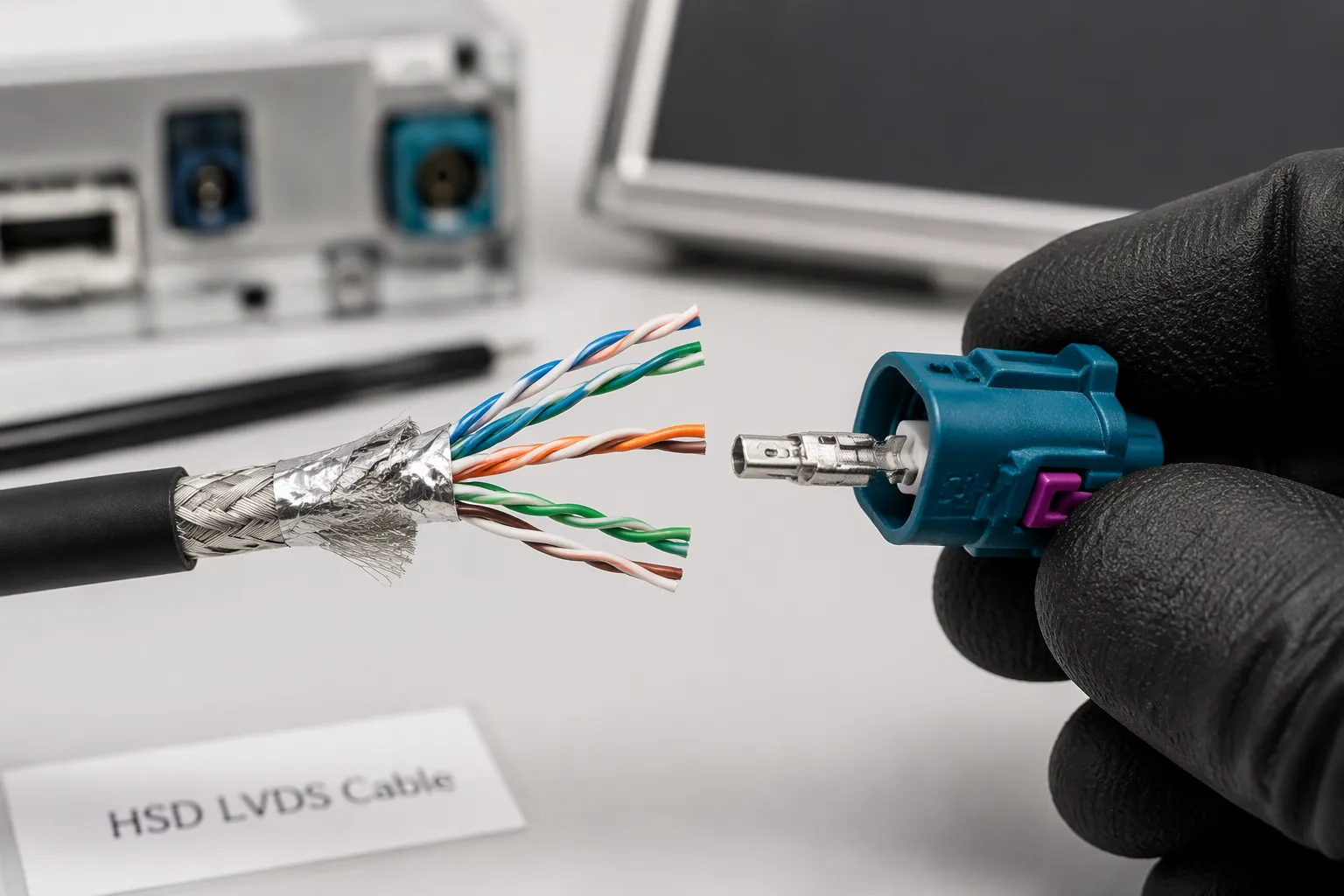
Shielding, pair arrangement, and impedance work together to protect the LVDS link. The differential pair carries the video signal as a voltage difference between two conductors. The receiver reads that difference and ignores noise common to both wires. This arrangement gives LVDS strong immunity to electromagnetic interference. A cable that keeps the pair geometry stable preserves that immunity along the full run.
Impedance sets how the signal travels through the cable. An LVDS link expects a 100 Ω differential path from the head unit output to the display input. A cable built to that target keeps reflections low. Pair arrangement inside the jacket supports the target impedance. Loose or uneven spacing between conductors shifts the impedance and disturbs the signal. Installers should confirm the cable's rated differential impedance before ordering.
Shielding adds a second layer of protection. The shield blocks outside noise from coupling into the pair. It also contains the signal's own emissions. A damaged or incomplete shield weakens both functions. Sharp bends and crushed sections can compromise the shield without any visible mark on the jacket.
Termination and Connector Quality
Termination quality decides whether the cable performs as designed. The HSD connector uses a crimp connection to join the cable conductors to the contacts. A clean crimp holds the electrical path stable. A loose crimp adds resistance and can interrupt the signal under vibration. Installers should treat every crimp joint as a critical part of the link.
Connector quality affects the link in mechanical ways as well. The HSD housing uses primary and secondary locks, and both must engage fully. High cable retention force keeps the plug seated when the dashboard flexes. A partially seated plug or a damaged latch can cause intermittent flicker that is hard to trace. Installers should inspect each connector for bent contacts and cracked housings before installation.
The connector must also match the cable. A housing that does not hold the pair geometry stable changes the electrical path. Coding and keying prevent misconnections, and they protect the link from reversed or offset pin contact. A quality connector, correctly terminated, keeps the LVDS link clean from end to end.
Standard BMW EVO LVDS Cable vs. Custom Assembly
When a Standard Cable Fits
A standard cable suits the common case. Many BMW EVO retrofits use a factory-style 6-pin HSD link at a catalog length of 0.8 m, 1 m, 1.5 m, or 2 m. When the measured route falls within one of those lengths and both connectors match the head unit and display, a standard assembly saves time and money. The installer orders a known part, fits it, and moves on.
Standard cables also carry predictable quality. A supplier builds them in volume against a fixed drawing, so each unit matches the last. That consistency helps distributors who stock parts for repeat installations. The buyer gets a documented configuration without a custom engineering cycle.
Standard cables fit best when the vehicle stays close to factory layout. A CID replacement in the original housing often needs nothing more. The same holds for a HUD retrofit that follows the factory route. In these cases, the standard option is the practical first choice.
When to Request a Custom Harness
Custom assemblies serve projects that standard parts cannot cover. A longer route behind a modified dashboard may exceed the catalog lengths. A right-angle plug at one end and a straight plug at the other may solve a clearance problem. An aftermarket display with a different connector gender or coding may need a matched harness. These cases call for a built-to-drawing assembly.
LEADSIGN supplies HSD connectors, HSD LVDS cables, HSD cable assemblies, FAKRA and Mini FAKRA solutions. The team supports connector matching, cable length, connector configuration, custom cable assemblies, samples, technical drawings, and quotation requests. An installer can send photos of both connectors and the measured route, then receive a drawing for review before production.
A sample order de-risks the custom path. The installer tests fit and signal on one unit before committing to a bulk run. That step catches pinout errors and length mistakes while the cost stays low. A verified BMW EVO LVDS cable drawing then becomes the reference for every later order.
Installation and Procurement Checklist
Installer Verification Steps
A careful installer verifies the cable before the dashboard goes back together. First, confirm the connector seats fully at both ends and both locks engage. Second, trace each pin against the factory wiring record. Third, check the voltage rating against the infotainment system. Fourth, inspect the route for sharp bends, crushing points, and pulling force on the connector. A bench test alone does not prove the link will survive the vehicle.
Common selection mistakes deserve a direct review at this stage. Buyers who choose by BMW model only, ignore the production year, or confuse EVO head unit generations often order the wrong part. Others assume all BMW displays use the same cable, or match connector appearance while ignoring pinout. Wrong length, confused gender, and ignored coding or keying cause the same result. Bending or crushing the cable during installation, skipping sample testing before bulk orders, and failing to provide photos of both connectors round out the list. Each mistake is avoidable with a short verification pass.
Information to Send with a Quotation Request
A complete request shortens the quotation cycle and reduces returns. Suppliers can match a BMW EVO LVDS cable accurately when the buyer supplies the full picture. Send the following with every inquiry:
Vehicle model and production year
Head unit information, including generation and EVO version if known
Display information, factory and replacement
Photos of the original cable
Photos of both connectors
Required cable length and routing notes
Required quantity
Installation purpose
Destination country
Technical drawing or sample, if available
Photos carry more weight than descriptions. A clear image of each connector shows gender, coding, and pin count at a glance. A photo of the original cable reveals the jacket type and any markings. The destination country affects shipping and documentation, so include it early. A sample or drawing lets the supplier confirm the build before production begins.
Troubleshooting and Maintenance
Diagnosing No-Signal, Flicker, and Interference
A display that shows no signal, flickers, or carries visible interference usually points to the cable link before the head unit. The technician should start at the connectors. Both ends must seat fully, and the primary and secondary locks must engage. A partially seated plug can pass a bench test and still fail once the dashboard flexes. Reseating each connector and confirming the latch click takes a minute and rules out the most common fault.
The next check follows the cable route. A sharp bend or a crushed section can damage the shield without leaving a mark on the jacket. The technician should trace the full run behind the display and the head unit, then look for pinch points near brackets, ducts, and trim. A cable that passes a continuity test can still drop the video link when the pair geometry shifts inside a kinked jacket.
Pinout and voltage rating close out the diagnosis. The technician should trace each pin against the factory wiring record and confirm the cable rating matches the infotainment system voltage, since some cables are rated 9V and others 12V. A pinout error or a mismatched rating produces the same symptoms as a failed head unit, so both checks belong early in the process.
Inspection and Replacement Guidance
Routine inspection extends the life of any BMW EVO LVDS cable. The technician should check connector seating at every service visit, inspect the jacket for cracks or flat spots, and confirm the cable stays clear of moving parts. Loose slack invites rattles and rubbing. A secured route with a modest service loop protects the link without adding strain.
Replacement makes sense when inspection finds a damaged shield, a bent contact, or a cracked housing. The buyer should order a sample first and test fit and signal on one unit before committing to a bulk run. That step catches pinout errors and length mistakes while the cost stays low. A verified sample then becomes the reference for every later order.
Selection follows a fixed order. Confirm the connector and pinout first, measure the routing length second, and verify shielding and impedance third. That sequence prevents most ordering errors.
Each option has a place. OEM suits buyers who need guaranteed fit. Quality aftermarket suits cost-effective retrofits with verified specifications. Generic suits budget or non-critical runs where the buyer confirms every spec. A verified BMW EVO LVDS cable order starts with photos of both connectors.
Contact LEADSIGN at info@leadsignauto.com for cable information, connector matching, samples, custom lengths, drawings, and quotations. Visit https://www.fakraconnectors.com for details.
Meta title: 55–60 characters. Meta description: 150–160 characters.
FAQ
Does a 6-pin HSD connector guarantee fit on a BMW EVO head unit?
No. A 6-pin HSD connector is standard for BMW NBT and EVO units, yet the connector alone proves nothing. Gender, coding, and pin assignment must also match the display. Installers should photograph both connectors and trace each pin before ordering.
Which cable length should an installer order for a BMW EVO retrofit?
The installer measures the real routing path, including space behind the display and the head unit. Common NBT EVO lengths are 0.8 m, 1 m, 1.5 m, and 2 m. A service loop helps, yet excessive slack invites rattles and rubbing.
Why does 100 Ω differential impedance matter for an LVDS display link?
LVDS carries video as a voltage difference between two conductors. A 100 Ω differential path keeps reflections low from head unit to display. Pair arrangement inside the jacket supports that target. Loose or uneven conductor spacing shifts impedance and disturbs the signal.
Can one cable serve a CID replacement and a HUD retrofit?
Not automatically. The CID link and the HUD link may differ in length, connector orientation, and pinout. A right-angle plug often fits a slim display housing, while a straight plug suits deeper space. Each project needs its own verification.
What causes flicker after a BMW EVO LVDS cable install?
Flicker usually traces to a partially seated plug, a damaged latch, or a pinched cable behind the dashboard. The technician should reseat both connectors, confirm the locks engage, and inspect the route for sharp bends or crushing points.
See Also
Improving Connection Performance Using HSD LVDS Cables
Why LVDS/GVIF Cables Matter in Vehicle Information Systems
Key Benefits of LVDS Transmission Lines in Automotive Uses
Benefits of HSD Connectors in Automotive Infotainment Systems
Examining the Benefits of HSD Connectors in Automotive Cameras