How to Choose a FAKRA to FAKRA Cable for GPS Antennas

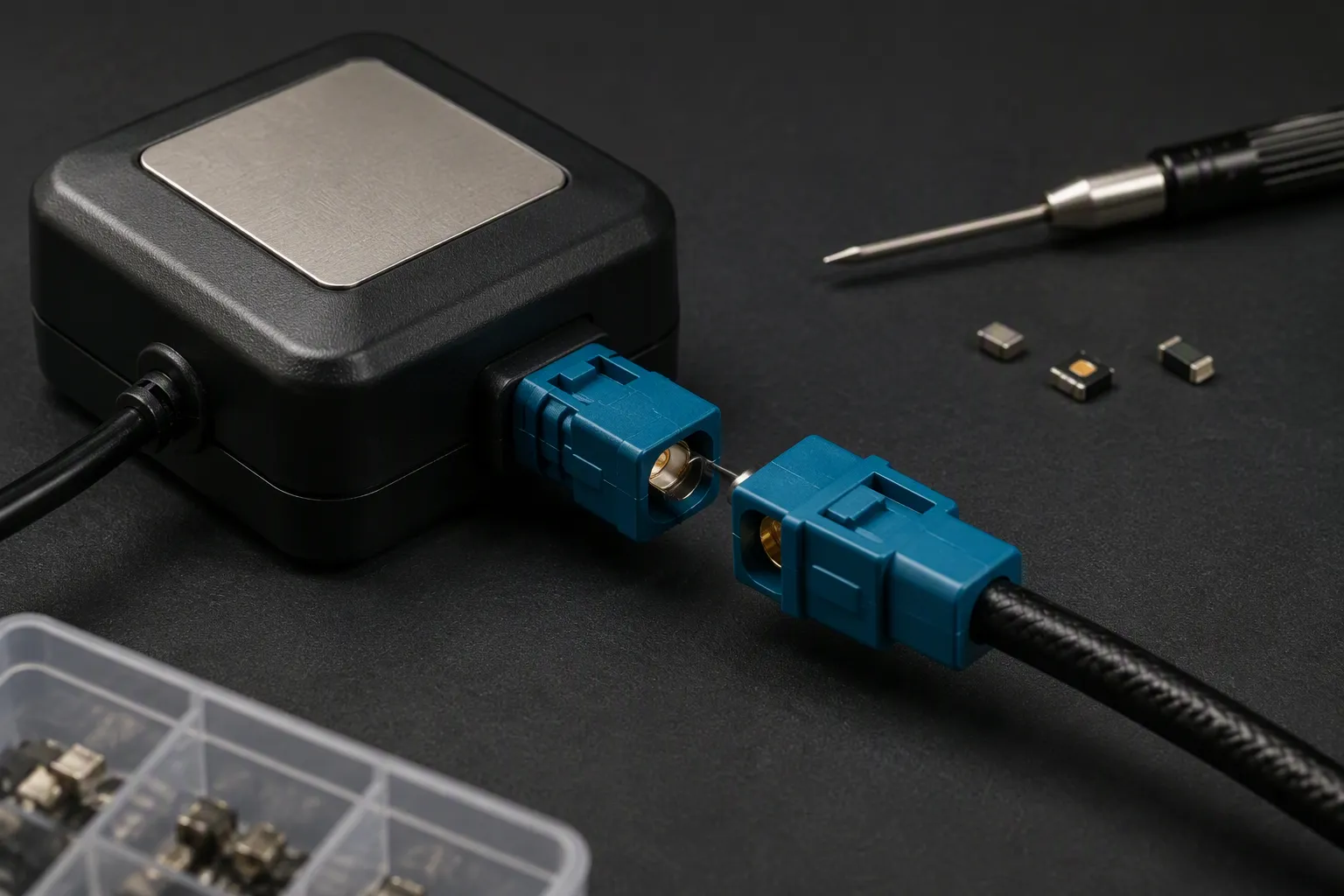
To choose the right FAKRA cable for a GPS antenna, focus on three factors: impedance, connector type, and build quality.
These assemblies look nearly identical at first glance. Yet small differences in color coding, keying, and shielding can make or break your signal. A mismatched plug will not seat properly. Poor shielding lets noise drown out weak satellite data.
This guide walks through each factor one by one. You will learn how to match parts, avoid signal loss, and pick the right shielding. A final checklist at the end makes your choice simple, clear, and fast.
Key Takeaways
Match the FAKRA connector color and keying to your GPS antenna and receiver. GPS uses Signal Blue with Code C keying.
Ensure your cable has 50-ohm impedance. A 75-ohm cable causes signal loss and poor GPS performance.
Choose the shortest cable that reaches from antenna to receiver. Every extra foot weakens the signal.
Select a cable with proper shielding. Dual-shielded works for most cars. Tri-shielded offers extra protection in noisy environments.
Consider your installation environment. For outdoor or marine use, choose a waterproof cable with an IP67 rating.
Understanding FAKRA Connectors
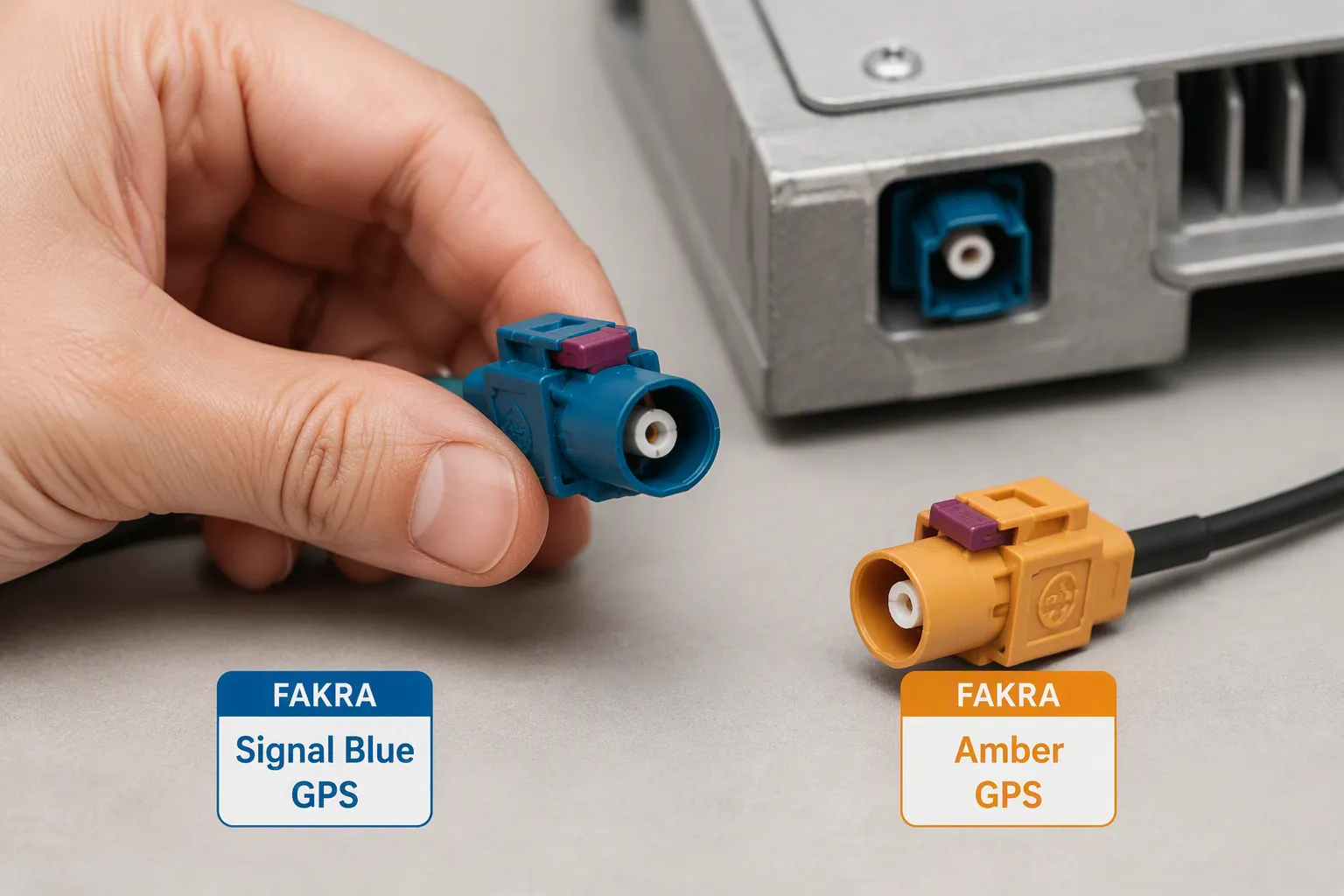
FAKRA connectors serve as the standard interface for high-frequency automotive applications, including GPS navigation, satellite radio, and cellular telematics. These connectors combine a standard RF interface with plastic housings that provide mechanical keying and color coding. The system prevents you from plugging a GPS connector into a radio port or mixing up antenna feeds during assembly. Understanding the coding scheme and the physical design helps you select the correct FAKRA cable the first time. The FAKRA connector standard defines 14 unique color-coded keying options. Each code pairs a specific plastic housing color with a distinct mechanical key shape. This dual system ensures that only matching plugs and jacks can mate. When you hold a FAKRA connector in your hand, the color immediately tells you its intended application. The mechanical key provides a secondary safeguard. If the shapes do not match, the plug will not enter the jack at all.
Color Codes and Keying
For GPS applications, the standard designates a Signal Blue connector with Code C keying. This connector operates within the 1.2 to 1.6 GHz frequency range, covering GPS, navigation, and GNSS signals. Some automotive systems also use an Amber-coded FAKRA connector for GPS, depending on the manufacturer's specification. The mechanical keying on the plastic housing prevents any other code from entering a GPS port. This physical barrier eliminates the risk of connecting the wrong antenna to your receiver.
Other colors serve different applications. Violet connectors handle 4G telematics antennas, not GPS. Different FAKRA connector types cover radio, television, and Bluetooth functions. The 14-code system keeps every signal path separate. You cannot force a connector into a mismatched port. The connector also features a primary and secondary locking system. The primary lock engages when you push the plug fully into the jack. A secondary lock then slides over the connection to secure it against vibration and accidental pull-out. This dual-lock design meets the demanding requirements of automotive environments where constant motion and temperature swings can loosen standard connectors.
Gender and Connection Points
Every FAKRA connection involves a male plug and a female jack. The male plug has a center pin that inserts into the female's receptacle. The outer shell of the male connector slides over the female housing. This gender pairing works with the color coding to create a foolproof assembly process. Connection points fall into three main categories. Cable connectors attach directly to a FAKRA cable. PCB connectors solder onto a circuit board. Panel connectors mount through a chassis or dashboard. Selecting the right connection point depends on your specific installation layout. When you order a FAKRA to FAKRA cable, confirm the gender at both ends. Most GPS antenna cables come with a female jack on one end to connect to the antenna and a male plug on the other end to connect to the receiver.
The FAKRA connector standard also specifies performance benchmarks. Each connector must withstand a minimum of 25 mating cycles before any degradation occurs. The operating temperature range spans from -40°C to +105°C, covering extreme cold and under-hood heat. LEADSIGN's FAKRA connectors meet these standards with high reliability and durability. The company also offers waterproof versions for exterior or marine installations where moisture exposure is a concern. These connectors use sealed housings and gaskets to keep water out while maintaining signal integrity. Whether you need a standard cable for a dashboard installation or a ruggedized version for an exterior antenna, the FAKRA connector platform provides the flexibility and dependability that modern vehicles demand.
Impedance and the FAKRA Cable
Impedance defines how much resistance a cable offers to the alternating current of a radio signal. Every part of your GPS signal path must share the same impedance value. A mismatch creates reflections, and reflections weaken the signal that reaches your receiver. This section explains why 50 ohms is the correct value and what happens when you use the wrong cable.
The 50-Ohm Standard
GPS antennas require a 50-ohm impedance for proper signal transmission. This value comes from the fakra connector standard, which specifies 50 ohms for all automotive RF interfaces. Your antenna, your fakra cable, and your receiver must all match this number. When they do, the signal flows smoothly from the antenna to the receiver with minimal reflection.
A 50-ohm system also supports the frequency range that GPS uses. LEADSIGN's fakra connectors and cables are designed with 50-ohm impedance and a frequency range of DC up to 6 GHz. This range covers GPS signals and many other automotive applications. The fakra connector on each end maintains this impedance through the mating interface. A well-designed connector keeps the impedance stable across the entire connection.
You can think of impedance like a pipe diameter. Water flows best when the pipe stays the same size from start to finish. A sudden change in diameter creates turbulence and reduces flow. The same principle applies to your fakra cable. A consistent 50-ohm path delivers the strongest possible signal to your GPS receiver.
Risks of 75-Ohm Cables
A 75-ohm cable is common for television and video applications. These cables look similar to 50-ohm fakra cables, and the connectors may even appear identical. However, using a 75-ohm cable in a 50-ohm GPS system causes signal loss and poor GPS performance. The impedance mismatch creates reflections that travel back toward the antenna instead of reaching the receiver.
The loss from a perfect 50/75 ohm impedance mismatch is approximately 0.2 dB. When the mismatch corresponds to a 1.5:1 SWR, the calculated loss is 0.18 dB. These numbers may sound small, but GPS signals are already weak when they reach your antenna. Every fraction of a decibel matters.
Dropping this into a known 50 Ohm antenna system, with a matched 75 Ohm transmitter will result in an additonal 0.18 dB loss (1.5:1 SWR).
That extra loss compounds with other losses in your system. Cable length, connector quality, and shielding all add their own attenuation. A 75-ohm cable adds unnecessary loss on top of these factors. The result is a GPS signal that may drop out in urban canyons, under tree cover, or in bad weather.
You should always verify the impedance before you buy. Check the product specifications for a 50-ohm rating. Look for a fakra cable that explicitly states 50-ohm impedance. LEADSIGN's fakra connectors and cables meet this requirement, and they also offer waterproof versions for outdoor installations. Choosing the right impedance protects your signal and ensures the reliability you expect from your GPS system.
Cable Length and Signal Loss
Your FAKRA cable length directly controls how much signal reaches your GPS receiver. Every foot of cable reduces signal strength. This reduction, called attenuation, builds up quickly. A longer assembly always delivers a weaker signal than a shorter one of the same type.
The Trade-Off: Length vs. Attenuation
Signal loss increases with length. A common coaxial type, RG-174, loses 12.9 dB per 100 feet at 1.5 GHz. This frequency covers the satellite signals your receiver needs. A 10-foot cable loses about 1.29 dB. A 50-foot cable loses about 6.45 dB. These numbers matter. Signals arrive at your antenna extremely weak. Every dB of loss reduces the margin your receiver needs to lock onto satellites and maintain accuracy. You cannot ignore attenuation. A 3-foot cable delivers a much stronger signal than a 30-foot cable of the same type. The FAKRA connector on each end adds a small fixed loss. The cable itself dominates the total. Think of it like drinking water through a short straw versus a very long straw. The long straw requires more effort for less water.
Choosing the Shortest Feasible Length
You should choose the shortest cable that still reaches from your antenna to your receiver. Measure the actual distance. Add a small loop for service access and no more. A 3-foot assembly is better than a 6-foot assembly if both can reach. A 6-foot assembly is better than a 12-foot assembly. Every extra foot adds unnecessary loss. If a longer run is unavoidable, a higher-quality assembly with better shielding may help. Better assemblies use thicker center conductors, lower-loss dielectrics, and denser shielding braids. These features reduce attenuation per foot. However, the shortest cable of a standard type still outperforms a long premium assembly in most cases. Your best choice is the shortest feasible assembly. For exterior installations, consider using a waterproof cable. Outdoor antennas often require a longer run to reach the receiver inside the vehicle. The assembly protects the signal path from moisture while keeping the length as short as practical. The combination of short length and weather protection gives you the most reliable GPS signal.
Shielding and Construction Quality
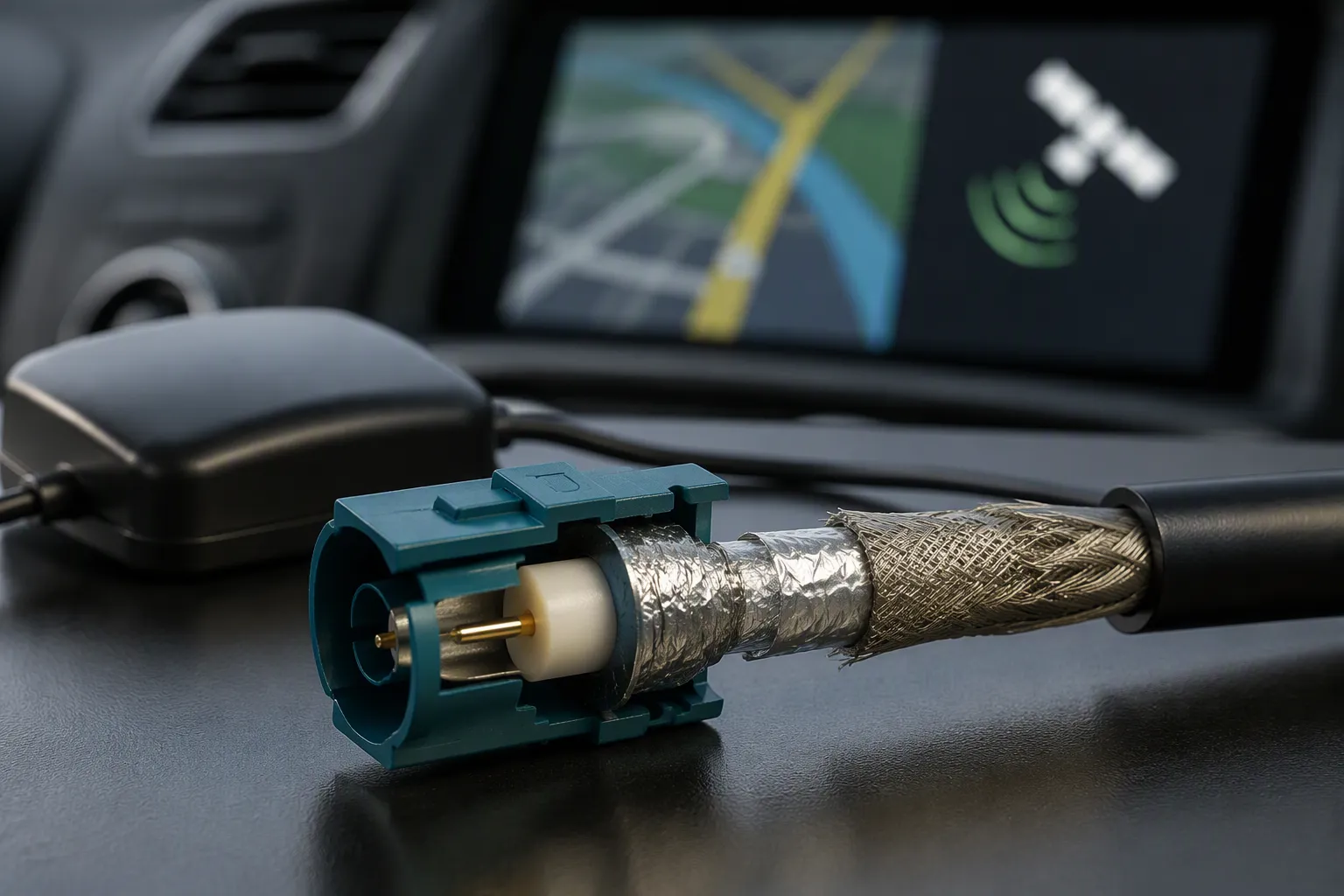
A GPS signal arriving from orbit is incredibly weak. Once it hits your antenna, it travels through the cable to the receiver. Along the way, electromagnetic interference (EMI) from other electronics can corrupt that signal. Shielding acts like a protective wall around the inner conductor, keeping noise out and the satellite data clean inside.
Why Shielding is Critical for GPS
Every modern vehicle is a noisy electrical environment. The cable runs near many components that emit interference. These sources can disrupt the faint GPS signal if the cable lacks proper shielding. Below is a breakdown of the main EMI sources inside and outside a car.
Category | Sources of Electromagnetic Interference |
|---|---|
Internal | Ignition systems, electric motors, power converters, in-vehicle communication networks, wireless devices such as smartphones and GPS systems |
External | Nearby high-voltage power lines, radio and television transmitters, other vehicles |
A poorly shielded cable acts like an antenna itself, picking up this noise and mixing it with your GPS signal. The result is a lower signal-to-noise ratio, slower satellite lock times, or even complete signal loss. For a GPS navigation system that must stay accurate in city traffic or under tree cover, shielding is not optional. You need a cable that keeps the internal conductor isolated from the surrounding electrical chaos.
Dual vs. Tri-Shielded Cables
Coaxial cables come with different levels of shielding. The most common types for GPS applications are dual-shielded and tri-shielded. A dual-shielded cable has a layer of foil wrapped around the dielectric and a braided wire mesh over the foil. This combination already provides good protection against everyday EMI. A tri-shielded cable adds an extra foil layer, often placed between two braids, for even better rejection of interference.
Tri-shielded cables offer a higher shielding effectiveness, typically improving signal integrity in high-interference environments. If your antenna is mounted on the roof and the cable passes near the engine bay or an infotainment unit, tri-shielding gives you more margin. The extra layer also helps when you need a longer cable run, though the shortest feasible length is still the best practice.
LEADSIGN's FAKRA cable assemblies are built with durable materials and precision engineering to withstand vibration, temperature extremes, and electromagnetic interference. They use high-quality coaxial cable with robust shielding, and the connector interfaces maintain that shielding through the entire path. For installations exposed to weather or moisture, LEADSIGN also offers waterproof versions that combine the same shielding with sealed housings. This ensures your cable stays reliable whether it runs inside the dashboard or outside under the chassis.
Choosing the right cable shielding depends on your vehicle's noise environment and the cable route. For most passenger cars, a dual-shielded cable works well. For heavy commercial vehicles, EVs with high-voltage inverters, or any installation near powerful transmitters, a tri-shielded cable provides extra protection. In every case, make sure the cable you select is rated for 50 ohms and uses FAKRA connectors on both ends. This cable choice directly affects your GPS signal quality and the antennas overall performance.
A well-shielded cable prevents interference from leaking into the signal path. It protects the investment you made in your GPS system and keeps navigation accurate mile after mile. When you pair a high-quality cable with minimal length and correct impedance, you get the most reliable connection possible for your GPS antenna.
LEADSIGN FAKRA Solutions and Checklist
LEADSIGN AUTOMOTIVE ELECTRONICS CO., LTD brings over seven years of experience to the automotive connector industry. The company specializes in high-performance cable assemblies for demanding applications. Their product line includes fakra connector types and custom harness solutions built to strict quality standards. The engineering team supports custom designs for unique installation needs. You get reliable products that meet global certification requirements.
Automotive vs. Stationary Use
Your installation environment determines which cable you need. Automotive and marine applications expose cables to vibration, temperature swings, and moisture. Stationary installations face fewer physical stresses but may still require weather resistance for outdoor setups.
LEADSIGN builds its cable assemblies to handle both scenarios. The operating temperature range spans from -40°C to +105°C. This range covers cold winter starts and hot under-hood conditions. Each FAKRA connector types withstand at least 25 mating cycles without performance loss. For outdoor or marine use, choose a waterproof version. The sealed option carries an IP67 rating. This rating means the cable resists dust and temporary submersion.
Specification | Value |
|---|---|
Operating Temperature Range | -40°C to +105°C |
IP Rating | IP67 (sealed option) |
The fakra connector standard also covers a rugged blue connector with 50-ohm impedance and IP67 protection. This connector works well for harsh environments such as truck reverse cameras or exterior GPS antenna mounts. You get strong cables that maintain signal integrity even near noisy vehicle electronics.
Your choice between automotive and stationary use also affects cable routing. A vehicle cable passes near engine components and power converters. Stationary cables may run through walls or conduit. In both cases, a high-quality cable delivers consistent performance. The reliability of your connection depends on proper shielding and build quality.
Your Pre-Purchase Checklist
Use this checklist to select the right cable for your GPS antenna.
Match antenna and receiver connectors. Verify the color code and keying on both ends. The FAKRA connector provides a secure fit that prevents mismatches. GPS applications typically use a Signal Blue connector with Code C keying.
Verify 50-ohm impedance. Your entire signal path must use 50-ohm components. A 75-ohm cable causes signal loss and poor GPS performance.
Select the shortest feasible length. Every foot of cable adds attenuation. Measure the distance and add only a small service loop. The shortest cable delivers the strongest signal.
Choose appropriate shielding. A dual-shielded cable works for most passenger cars. A tri-shielded cable provides extra protection in high-interference environments.
LEADSIGN also offers OEM and ODM services. Their team can design custom harness solutions for your specific requirements. Whether you need a standard cable assembly or a custom length, they provide short delivery times and consistent quality. A well-chosen cable protects your GPS antenna and ensures accurate navigation mile after mile.
You now know the three pillars of a reliable FAKRA cable: impedance, connector type, and build quality. The best cable matches your antenna and receiver exactly, stays as short as possible, and uses high-quality shielding. These choices protect your signal from loss and interference.
By following this guide, you can confidently select a cable that ensures your gps antenna delivers the reliable performance you need. For high-quality FAKRA solutions, consider LEADSIGN's proven products.
FAQ
What color FAKRA connector does a GPS antenna use?
GPS applications typically use a Signal Blue connector with Code C keying. This code covers the 1.2 to 1.6 GHz range where GPS and GNSS signals live. The mechanical key prevents any other code from entering a GPS port, so you cannot mix up your connections.
Can I use a 75-ohm cable with my GPS antenna?
No. Your antenna, cable, and receiver must all share the same 50-ohm impedance. A 75-ohm cable creates reflections that weaken the signal before it reaches your receiver. Always check the product specifications for a 50-ohm rating before you buy.
How long can my FAKRA to FAKRA cable be?
Choose the shortest cable that still reaches from your antenna to your receiver. Every foot adds attenuation, and GPS signals arrive very weak. Measure the real distance, add a small service loop, and stop there. A longer run only costs you signal strength.
Do I need a waterproof FAKRA cable?
It depends on where you mount the antenna. Exterior, marine, and under-chassis installations face moisture, so a sealed version with an IP67 rating protects the signal path. A dashboard or interior run usually does fine with a standard assembly.
How many times can I plug and unplug a FAKRA connector?
LEADSIGN's FAKRA connectors handle at least 25 mating cycles without performance loss. That count covers normal installation, service, and troubleshooting. If you expect frequent reconnections, plan your routing so you rarely need to separate the pair.
See Also
Why GPS Antennas with Fakra Connectors Are Crucial for Reliable Signal
Understanding the Vital Role of GPS Fakra Antennas in Navigation Systems
Why Using a Fakra Antenna Adapter Matters for Your Setup
How to Improve Your Vehicle Navigation Using Fakra GPS Antennas
A Complete Guide to Understanding Fakra Cables and Their Uses