Essential Tips for Choosing Terminal Connectors – Professional B2B Guide (2026)

Intro: The Right Terminal Connector Prevents Failure, Improves Reliability, and Simplifies Maintenance
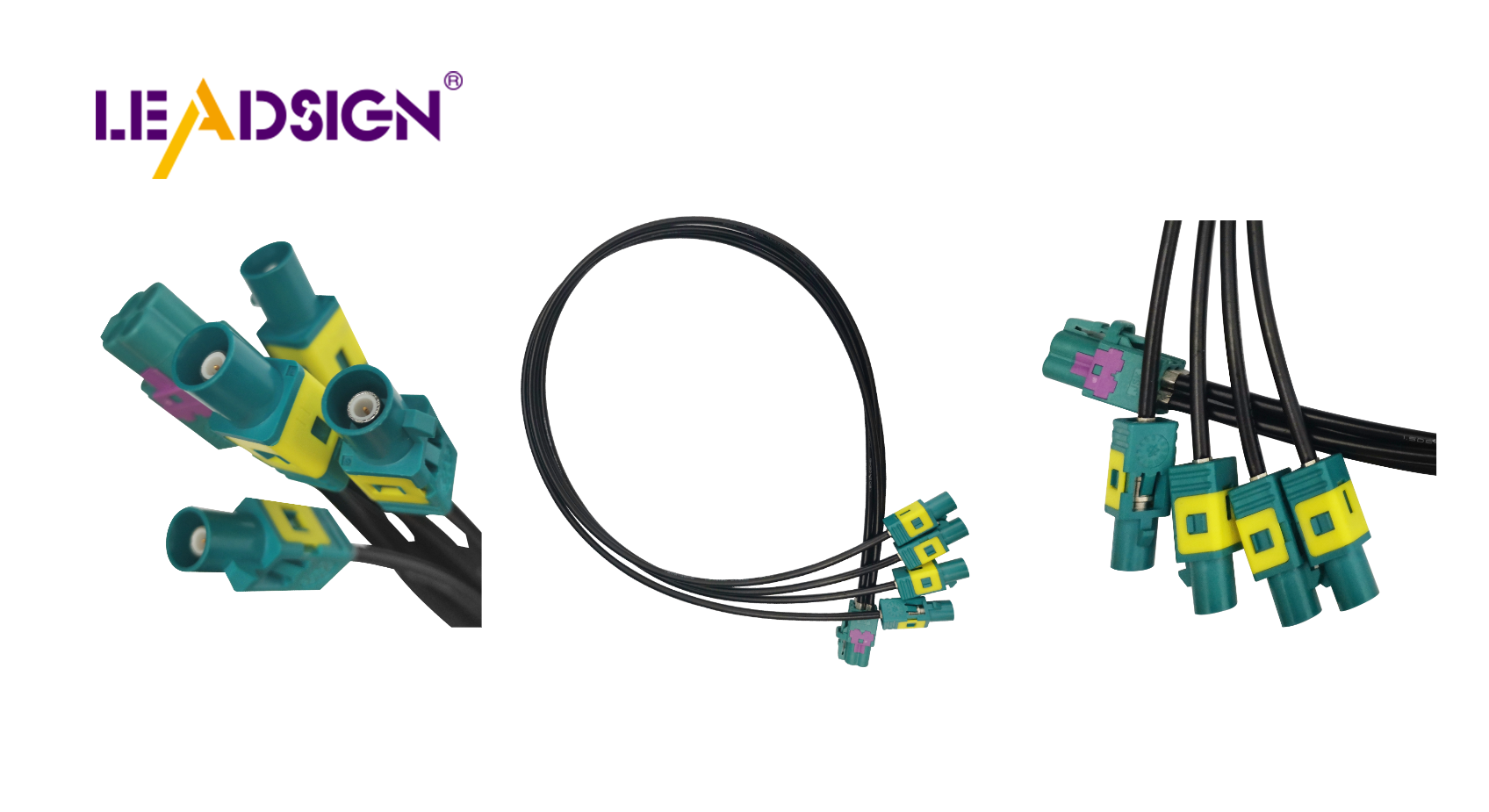
Terminal connectors are the fundamental building blocks of electrical systems – from power distribution and sensor connections to high‑speed data links. Choosing the wrong connector can lead to voltage drop, overheating, signal loss, or even fire. This guide covers the key selection criteria: electrical parameters (voltage, current, resistance), safety (insulation, fire resistance), mechanical features (strength, mating force), environmental factors (temperature, moisture), and termination methods (solder, crimp, screw). For high‑speed data applications (GPS, cameras, USB‑C), we also highlight why LEADSIGN pre‑terminated FAKRA/HSD cables are the professional choice.
1. Electrical Parameters – Voltage, Current, and Resistance
Parameter | What to check | Why it matters |
|---|---|---|
Voltage rating | Must exceed maximum system voltage (e.g., 12V/24V automotive, 48V industrial) | Prevents arcing and dielectric breakdown. |
Voltage tolerance | Ability to withstand spikes (e.g., alternator load dump up to 40V) | Protects against transient over‑voltage. |
Current capacity (ampacity) | Derate for temperature (e.g., 20A connector used at 15A in engine bay) | Prevents overheating and insulation melt. |
Resistance | Low contact resistance (<10 mΩ for power, <5 mΩ for signal) | Minimises voltage drop and power loss. |
Conductivity (material) | Copper (highest), brass (good), aluminium (lower, needs larger gauge) | Affects efficiency and heat generation. |
Rule of thumb: Always oversize current rating by 20‑30% for engine bay or high‑temperature environments.
2. Safety – Insulation and Fire Resistance
Safety factor | What to look for | Example |
|---|---|---|
Insulation quality | High dielectric strength, resistant to heat and moisture | PVC (interior), XLPE (engine bay), PTFE (high‑temp) |
Flammability rating | UL94 V‑0 or V‑2 (self‑extinguishing) | Prevents fire propagation in case of overload. |
Certification | UL, CSA, TUV, IEC (depending on region) | Ensures compliance with safety standards. |
Pro tip: For engine bay or underbody connections, use connectors with flame‑retardant housings (UL94 V‑0).
3. Mechanical Features – Strength, Fit, and Mating Force
Mechanical factor | What to evaluate | Why it matters |
|---|---|---|
Material strength | Copper alloy for terminals; high‑temp plastic or metal housing | Withstands vibration, thermal cycling, and mechanical stress. |
Connector life (mating cycles) | ≥25 for automotive (serviceable), ≥500 for test connectors | Frequent connect/disconnect requires higher cycle rating. |
Fit and retention | Secondary lock / CPA, positive latch | Prevents vibration loosening. |
Ease of installation | Tool‑less (lever), pre‑terminated, or colour‑coded | Reduces labour time and error. |
For data connectors (FAKRA, HSD): Use pre‑terminated cables – no field crimping, guaranteed retention.
4. Environmental Factors – Temperature, Humidity, and Corrosion
Environmental condition | Required feature | Example |
|---|---|---|
High temperature (engine bay, industrial ovens) | Rated -40°C to +125°C+; XLPE or silicone insulation | Deutsch DT, TE MCON |
Low temperature (cold climates) | No embrittlement; flexible insulation | PVC (interior), silicone |
Humidity / water | Sealed (IP67/IP69K), corrosion‑resistant plating | Weather Pack, sealed FAKRA |
Chemicals (oil, fuel, coolant) | Chemically resistant housing (e.g., polyamide) | Deutsch DT, TE Superseal |
Pro tip: For outdoor or underbody applications, always use sealed connectors with silicone grommets and apply dielectric grease to the seals.
5. Termination Methods – Solder, Crimp, Screw
Termination method | Best for | Pros | Cons |
|---|---|---|---|
Solder | Low‑vibration interior, permanent signal connections | Very low resistance, permanent | Slow, heat can damage insulation, brittle |
Crimp | Most automotive power and ground | Fast, gas‑tight, vibration‑resistant | Requires proper tool; poor crimp leads to failure |
Screw | Industrial control panels, battery terminals | Secure, field‑serviceable | Can loosen under vibration; requires torque control |
Recommendation for automotive: Use crimp terminals with a ratcheting crimper for power and ground. For data lines (FAKRA, HSD), use pre‑terminated cables – never field‑crimp.
6. Data Connectors – A Special Case (FAKRA, HSD)
Traditional terminal selection criteria also apply to data connectors, but additional parameters are critical:
Parameter | FAKRA (coaxial) | HSD (differential) |
|---|---|---|
Impedance | 50Ω | 100Ω |
Frequency | Up to 6 GHz (standard), 20 GHz (Mini) | Up to 6 GHz |
Shielding | Double (foil + braid) | Double (foil + braid) |
Termination | Pre‑terminated only (LEADSIGN) | Pre‑terminated only |
Why pre‑terminated? Field crimping FAKRA or HSD connectors almost always results in impedance mismatch, causing signal loss or complete failure. LEADSIGN pre‑terminated cables eliminate this risk.
7. Why LEADSIGN – Your Source for Pre‑Terminated Data Cables
For power and basic terminal connectors, many brands (TE, Molex, Deutsch) offer excellent products. For high‑speed data (FAKRA, HSD), LEADSIGN provides pre‑terminated, colour‑coded cables that meet automotive standards.
What LEADSIGN offers:
✅ FAKRA (standard & Mini) – all 14 colours, 50Ω, up to 20 GHz, IP67 optional
✅ HSD (USB‑C, Ethernet, LVDS) – 100Ω, locking, up to 5 Gbps
✅ Pre‑terminated cables – any length 0.3m – 20m, no field crimping
✅ Low‑loss, double‑shielded coax – for long runs and EV environments
✅ Bulk pricing – for shops, fleets, and distributors
For your business: When you need a terminal connector for GPS, camera, or USB‑C, choose LEADSIGN pre‑terminated cables – plug‑and‑play, perfect signal integrity, no callbacks.
Final Recommendations – Terminal Connector Selection Checklist
Step | Action |
|---|---|
1 | Determine voltage and current (oversize by 20‑30% for safety). |
2 | Choose insulation material (PVC for interior, XLPE for engine bay). |
3 | Select termination method (crimp for power, pre‑terminated for data). |
4 | Verify environmental rating (IP67 for underbody/exterior). |
5 | For data (camera, GPS, USB‑C, Ethernet), use pre‑terminated FAKRA/HSD from LEADSIGN. |
Remember: A terminal connector is only as reliable as its specification and installation. Invest in quality, and your systems will last.
Ready to simplify your data connector selection with pre‑terminated solutions?
[Request a free LEADSIGN FAKRA/HSD sample kit] | [Get bulk pricing]
See Also
Essential Insights on Fakra Connectors: Benefits and Usage
In-Depth Overview of HSD Connectors and Their Uses
Detailed Exploration of Fakra Female Connectors and Features
Enhancing Automotive Performance Using HFM Connectors Effectively
Understanding the Significance and Flexibility of FAKRA Connectors