50Ω Coax Cable for Cameras & GPS 2026: Stop Killing Your Signal with the Wrong Cable

Intro: 33% Loss in 100 Feet – Is Your Camera Suffering?
You’ve installed a high-quality reverse camera, a premium GPS antenna, or a 4G telematics module. But the image flickers. The GPS takes minutes to lock. The data connection drops. The culprit is often not the device – it’s the 50Ω coaxial cable.
Choosing the wrong 50Ω coax is the #3 cause of aftermarket camera and GPS failures (after connectors and power). A 100-foot length of poor-quality coax can lose 33% or more of your signal. For a 4K camera running at 6 GHz, the loss is even worse.
In this guide, you’ll learn:
How signal loss (attenuation) kills camera video and GPS reception
Which 50Ω coax types work for short vs. long runs in vehicles
How to match cable to your specific application (camera, GPS, radio)
The three most expensive mistakes – and how to avoid them
1. Why 50Ω Coax? The Automotive Standard
In automotive RF systems (reverse cameras, GPS antennas, SDARS, 4G/5G telematics), 50Ω impedance is the standard. This is different from 75Ω used for TV antennas.
Why 50Ω? It’s the engineering compromise between best power handling (30Ω) and lowest signal loss (77Ω). 50Ω gives you good balance for both – critical in vehicles where cables can be 5‑15 metres long.
Key takeaway for your business: Every reverse camera using AHD or CVBS, every GPS antenna, every 4G/5G antenna expects a 50Ω cable. Using a 75Ω cable (e.g., standard TV coax) will cause impedance mismatch → signal reflections → poor image or weak GPS.
2. Signal Loss (Attenuation) – The Silent Killer
Attenuation is measured in dB per 100 feet (or per metre). The higher the frequency, the higher the loss. Here’s what real numbers mean for your installations:
Cable Type | Loss @ 1 GHz (per 100ft) | Max Recommended Length for Camera (1080p) | Max Recommended Length for GPS (1.5 GHz) |
|---|---|---|---|
RG‑58 | ~10 dB | < 50 ft (15m) – marginal | < 30 ft (9m) |
RG‑174 (thin) | ~20 dB | < 25 ft (7.5m) | < 15 ft (4.5m) |
RG‑214 (thick) | ~5 dB | < 150 ft (45m) | < 100 ft (30m) |
Low‑loss automotive coax (e.g., LEADSIGN FAKRA) | ~4‑6 dB @ 1 GHz | < 60 ft (18m) – typical for vans/trucks | < 50 ft (15m) |
What does 3 dB loss mean? It means half your signal power is lost. 6 dB = 75% loss. For a camera, this translates to darker image, rolling bars, or “no signal”. For GPS, it means longer time to first fix (TTFF) or complete loss of lock.
Pro tip: For a van or truck with a 10m (33 ft) cable run from rear camera to front screen, use low‑loss coax (RG‑214 or equivalent) – not RG‑174. The difference is visible.
3. Cable Length vs. Performance – Real Numbers for Vehicles
Vehicle Type | Typical Camera Cable Length | Recommended 50Ω Coax Type |
|---|---|---|
Passenger car (sedan/hatchback) | 3‑5 m (10‑16 ft) | RG‑174 or standard FAKRA coax – acceptable |
SUV / Crossover | 5‑8 m (16‑26 ft) | RG‑58 or low‑loss |
Van / Minibus | 8‑15 m (26‑50 ft) | Low‑loss (e.g., RG‑214 or LEADSIGN low‑loss) |
Truck / Bus / RV | 15‑25 m (50‑80 ft) | Low‑loss + possibly amplifier |
Rule of thumb: Keep cable as short as practically possible. Every extra metre adds loss. Don’t coil excess cable – it acts as an inductor and creates signal reflections.
4. Matching Cable to Application – Camera vs. GPS vs. Radio
Application | Frequency | Critical Spec | Recommended Coax Type |
|---|---|---|---|
1080p AHD camera | ~1.5 GHz | Low attenuation @ 1.5 GHz | RG‑58 or low‑loss (RG‑214) for >5m |
4K / AHD camera | ~6 GHz | Very low loss @ 6 GHz | Low‑loss coax (Mini FAKRA rated) |
GPS antenna (L1, L2) | 1.575 GHz | Low loss, stable impedance | RG‑174 (short), RG‑58 (medium), low‑loss (long) |
SDARS (satellite radio) | 2.3 GHz | Low loss, good shielding | RG‑58 or better |
4G/5G telematics | 700 MHz – 6 GHz | Broadband low loss | Low‑loss coax or Mini FAKRA for 5G |
AM/FM radio | 0.5‑108 MHz | Not critical – any 50Ω works | RG‑174 fine |
Critical reminder: For GPS, loss is especially important because the signal from satellites is already extremely weak (-130 dBm). A 3 dB loss is catastrophic. Always use the best 50Ω coax you can afford for GPS extensions.
5. Three Costly 50Ω Coax Mistakes – And How to Avoid
Mistake | Consequence | Prevention |
|---|---|---|
Using 75Ω TV coax for a camera or GPS | Impedance mismatch → signal reflections → image ghosting or no GPS lock | Always verify cable marking: “50Ω” not “75Ω”. When in doubt, buy from a trusted automotive source (LEADSIGN). |
Using RG‑174 for a 10m camera run | High attenuation → dark or flickering image | Calculate loss before installation. For >5m, use RG‑58 or low-loss. |
Coiling excess cable | Coil acts as an inductor → increases loss, may cause impedance mismatch | Order custom length cables (LEADSIGN offers any length). If you must coil, make loose figure‑8 loops. |
Pro tip: Before final installation, test the camera with the actual cable length. Use a known good monitor. If the image is acceptable, proceed. If not, upgrade to lower-loss coax or shorten the run.
6. 2026 Trends – Why 50Ω Coax Choice Is More Critical Than Ever
Trend | Impact on Coax Selection |
|---|---|
4K backup cameras | 4K requires >6 GHz bandwidth. Standard RG‑174 may not be specified above 2 GHz. Use low‑loss coax or Mini FAKRA. |
EV and hybrid EMI | More electrical noise. Use double‑shielded 50Ω coax (foil + braid) to prevent interference. |
5G telematics | 5G operates up to 6 GHz, similar to 4K cameras. Low-loss cable is mandatory. |
Longer vehicle lengths (vans, campers) | Fleet retrofits often need 10‑15m runs. Standard thin coax will fail. Specify RG‑214 or equivalent. |
7. Technical Specs – How to Read a Coax Data Sheet
When choosing a 50Ω coax for automotive use, look for these parameters:
Parameter | What to Look For | Why |
|---|---|---|
Impedance | 50Ω ± 2Ω | Mismatch causes reflections |
Attenuation | < 10 dB per 100ft @ 1 GHz (for >5m runs) | Lower is better |
Shielding | Double (foil + braid) | Blocks EMI from alternators, wipers, EV motors |
Temperature range | -40°C to +105°C | For underbody or engine bay runs |
Dielectric | Low-loss foam or solid PE | Lower loss than solid polypropylene |
Data sheet example: For a camera cable, find the attenuation at 1.5 GHz (AHD) or 6 GHz (4K). Multiply by your length in 100ft units. If total loss is >6 dB, consider a better cable or shorter run.
8. Recommended 50Ω Coax Types for Automotive (2026)
Cable Type | Pros | Cons | Best Use |
|---|---|---|---|
RG‑174 | Thin, flexible, cheap | High loss (>20 dB/100ft @ 1 GHz) | Short (<3m) interior runs |
RG‑58 | Good balance of loss and flexibility | Moderate loss (~10 dB/100ft @ 1 GHz) | Most passenger cars (3‑6m) |
RG‑214 | Low loss, double shielding, rugged | Thick, stiff | Long runs (>6m), heavy‑duty |
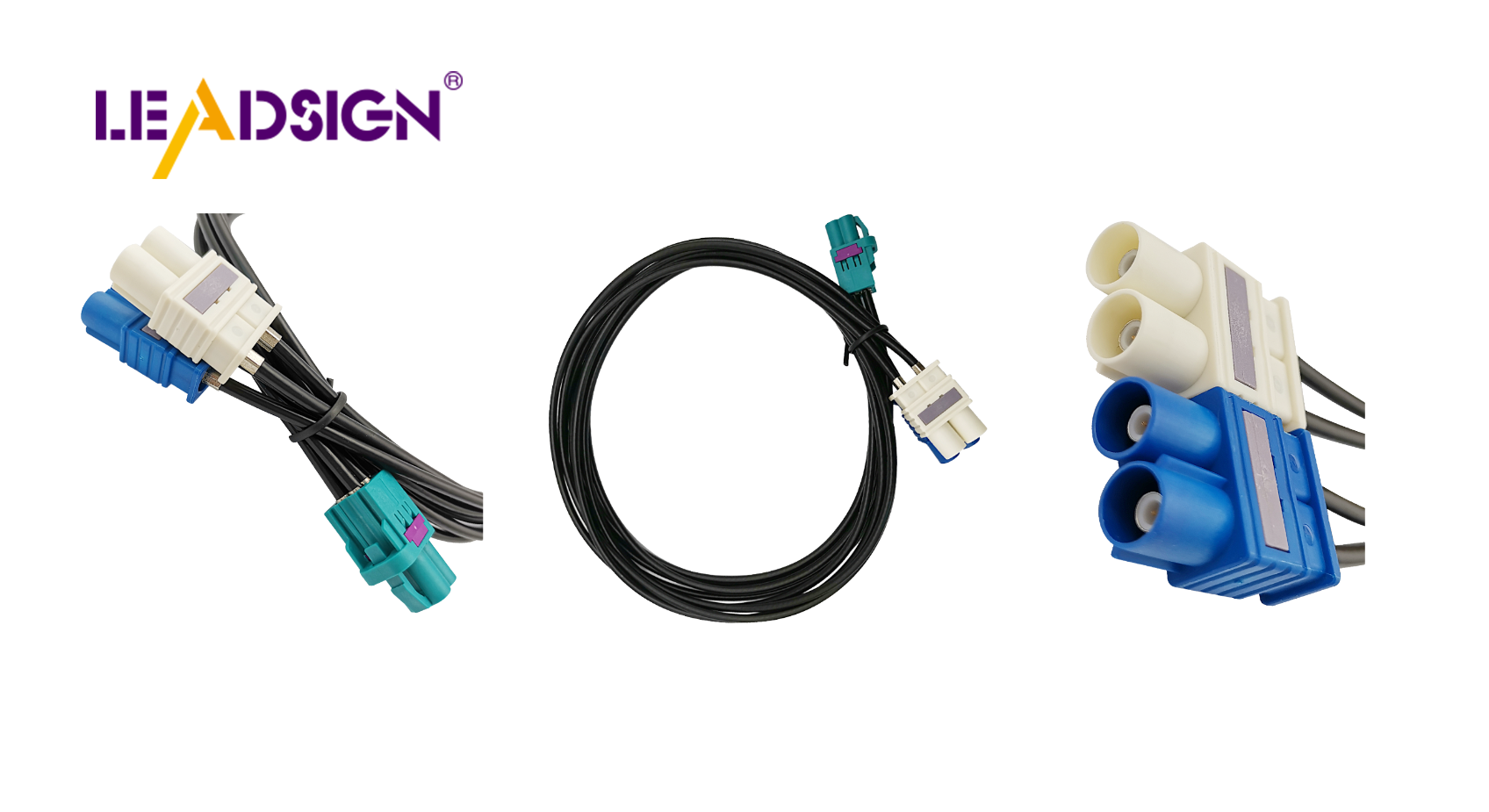
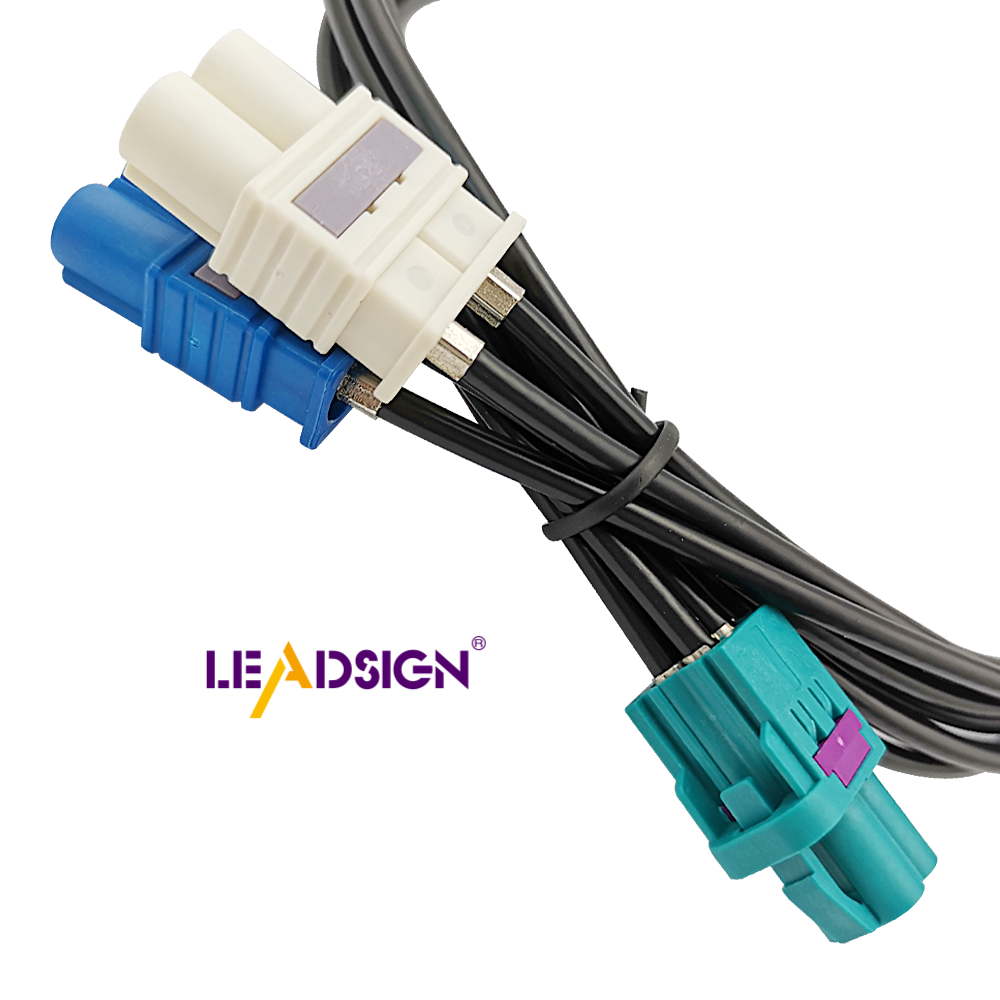
LEADSIGN low‑loss FAKRA | Pre‑terminated, 50Ω, custom length, double shielding | Slightly higher cost than bulk RG‑174 | Recommended for most camera & GPS installs |
Why LEADSIGN? We supply pre‑terminated 50Ω FAKRA cables in any length, with low-loss dielectric and double shielding. You get exactly the length you need – no coiling, no guessing, no signal loss. Save labour and eliminate callbacks.
Final Recommendations – By Vehicle Type & Cable Length
Vehicle Type | Camera Run Length | Recommended 50Ω Coax | Source |
|---|---|---|---|
Sedan / Hatchback | 3‑4 m | RG‑58 or LEADSIGN low‑loss FAKRA | LEADSIGN (pre‑terminated) |
SUV / Crossover | 5‑7 m | Low‑loss (RG‑214 or equivalent) | LEADSIGN |
Van / Minibus | 8‑12 m | Low‑loss + verify loss budget | LEADSIGN (custom length) |
Truck / Bus / RV | 12‑20 m | Low‑loss + possible amplifier | LEADSIGN (custom length + technical support) |
Always use pre‑terminated FAKRA cables from LEADSIGN:
✅ Exact length – no coiling, no excess loss
✅ 50Ω impedance – correct for cameras and GPS
✅ Double shielding – blocks EMI in EVs
✅ Bulk pricing for shops and fleets
See Also
Harnessing FAKRA Coaxial Cable's Full Potential
Maximizing the Benefits of FAKRA Cable Connectors
Exploring the Versatility of FAKRA Cable Connectors