50 Ohm Coax Cable Types: A Guide to Making the Right Choice – Professional B2B Guide for Automotive & RF Applications (2026)

Intro: One Wrong Coax Can Kill Your GPS, Camera, or Radio Signal
Choosing the correct 50Ω coaxial cable is critical – especially in automotive applications where long cable runs (5‑20 metres) and high frequencies (GPS at 1.5 GHz, 4K cameras at 6+ GHz, 5G at 6 GHz) demand low loss and stable impedance. The wrong cable can cause excessive attenuation, leading to flickering camera images, slow GPS lock, or poor radio reception. This guide explains the key components of 50Ω coax, compares popular types (RG‑58, RG‑213, LMR‑400, RG‑214), and provides selection criteria for automotive RF systems.
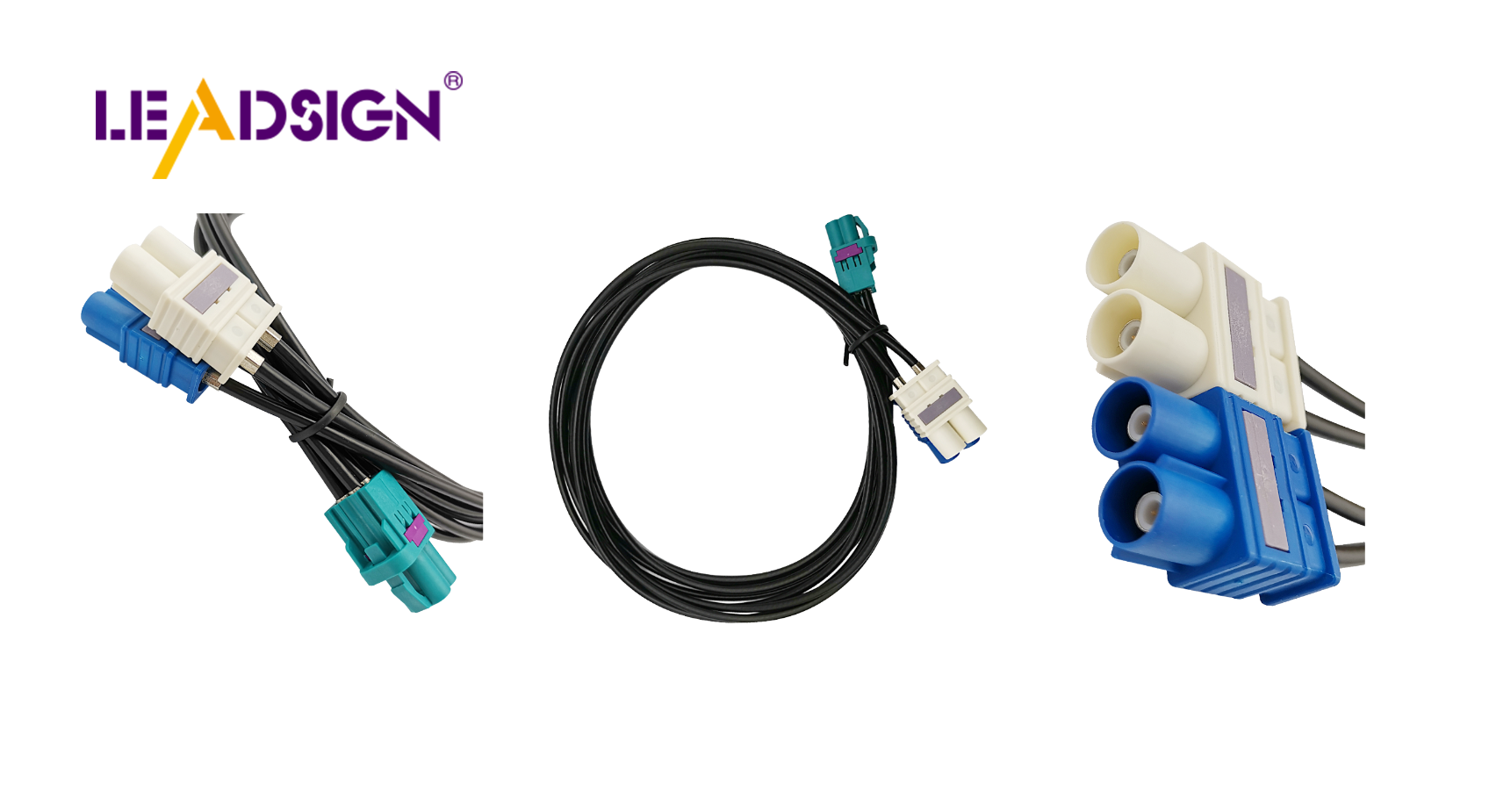
1. Anatomy of a 50Ω Coaxial Cable – Why Each Layer Matters
Component | Material / Construction | Impact on performance |
|---|---|---|
Centre conductor | Solid or stranded copper (or copper‑clad steel) | Lower resistance = less loss; solid is better for long fixed runs, stranded for flexibility. |
Dielectric (insulation) | Solid PE or low‑loss foam (e.g., cellular PE) | Foam dielectric reduces attenuation – critical for high frequencies (≥1 GHz). |
Shielding | Single / double braid, foil, or combination | Double shielding (braid + foil) rejects EMI from alternators, wipers, EV inverters. |
Outer jacket | PVC, PE, or UV‑resistant materials | Protects against moisture, chemicals, abrasion, and UV (for roof‑mounted antennas). |
Key takeaway for automotive: Use double‑shielded, low‑loss foam dielectric cable for camera and GPS extensions – especially in electric vehicles where EMI is high.
2. Common 50Ω Coax Types – Comparison Table
Cable type | Centre conductor | Shielding | Outer jacket | Attenuation (dB/100m @ 1 GHz) | Flexibility | Typical automotive use |
|---|---|---|---|---|---|---|
RG‑58 | Stranded copper | Single braid (95%) | PVC | ≈25‑30 dB | High | Short (<3m) interior GPS or radio extensions (low loss not critical) |
RG‑213 | Solid copper | Double braid | PVC | ≈12‑15 dB | Low | Longer fixed runs (roof antenna to head unit in large vehicles) |
LMR‑400 (ultra low‑loss) | Copper‑clad aluminium (solid) | Double (foil + braid) | UV‑resistant PE | ≈6‑8 dB | Medium | Long runs (>10m) for 4K cameras, 5G antennas, base stations |
RG‑214 | Solid copper | Double braid (silver‑plated) | PVC | ≈10‑12 dB | Low | High‑power RF, extreme EMI environments (military, heavy‑duty) |
For most automotive aftermarket applications (GPS, 1080p camera, 4G antenna up to 5‑10 metres), RG‑58 or low‑loss flexible coax is sufficient. For 4K cameras or 5G telematics over 10 metres, use LMR‑400 or LEADSIGN low‑loss Mini FAKRA cables.
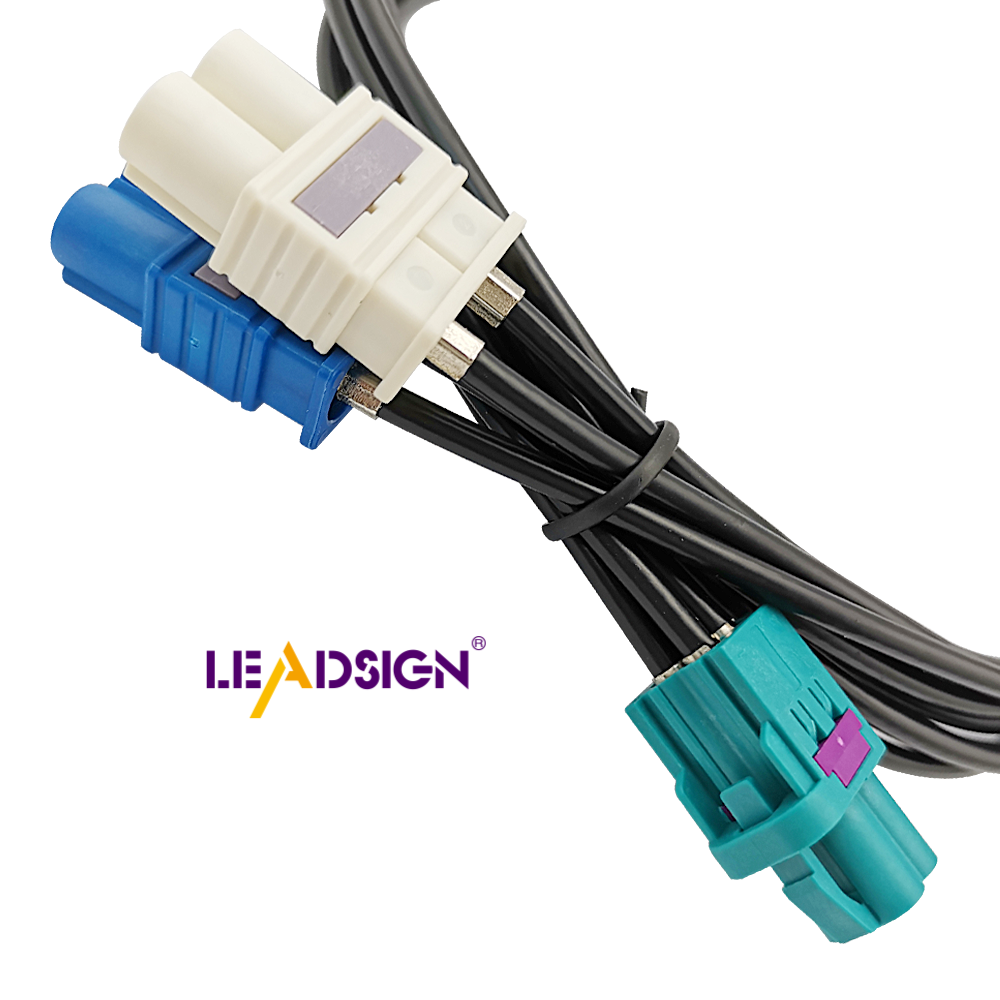
3. Key Selection Criteria – What to Check Before You Buy
Criterion | What to look for | Why it matters |
|---|---|---|
Attenuation (signal loss) | Low dB/100m at your operating frequency (e.g., 1.5 GHz for GPS) | Prevents weak signals and image degradation. |
Frequency range | Cable must support up to 6 GHz (standard FAKRA) or 20 GHz (Mini FAKRA) | 4K cameras and 5G require higher bandwidth. |
Shielding effectiveness | Double shielding (foil + braid) for high‑EMI environments (EVs, near alternators) | Avoids noise ingress that corrupts data. |
Flexibility | Stranded centre conductor and flexible jacket for tight bends | Easier routing behind dashboards, along chassis. |
Connector compatibility | Must mate with FAKRA, SMA, or other automotive connectors | Use pre‑terminated FAKRA cables (LEADSIGN) to avoid field‑crimp errors. |
Pro tip: For permanent installations (under carpet, behind trim), avoid cable that is too stiff (RG‑213, RG‑214) – use RG‑58 or low‑loss flexible equivalents.
4. Common Applications – Which Coax for Which Job?
Application | Frequency | Typical run length | Recommended cable | Notes |
|---|---|---|---|---|
GPS antenna | 1.575 GHz | 2‑5 m | RG‑58 or low‑loss FAKRA amber | Loss must be low – keep cable short. |
1080p backup camera (AHD) | ~1.5 GHz | 3‑10 m | Low‑loss flexible coax (e.g., RG‑58/U) or FAKRA blue | Acceptable loss up to 6 dB total. |
4K camera (truck/bus) | 6‑12 GHz | 10‑20 m | LMR‑400 or LEADSIGN Mini FAKRA low‑loss | Standard RG‑58 loss too high. |
4G/5G telematics antenna | 0.7‑6 GHz | 3‑15 m | LMR‑400 or RG‑214 (double‑shielded) | High EMI environment requires good shielding. |
AM/FM radio antenna | 0.1‑108 MHz | Any | RG‑58 or RG‑174 | Low frequency, any quality 50Ω works. |
5. 2026 Trends – Why Coax Choice Is More Critical Than Ever
Trend | Implication |
|---|---|
4K surround cameras on commercial vehicles | Require Mini FAKRA (20 GHz, low loss). Standard RG‑58 will cause image loss over long runs. |
5G C‑V2X (cellular vehicle‑to‑everything) | 5G antennas need low‑loss, double‑shielded coax – use LMR‑400 or LEADSIGN Mini FAKRA violet. |
EV / hybrid (high EMI) | Double shielding mandatory to reject motor and inverter noise. RG‑58 single braid insufficient. |
Pre‑terminated FAKRA cables | Shops increasingly use LEADSIGN pre‑terminated cables – no field crimping, guaranteed impedance. |
6. Connector Compatibility – Matching Coax to Automotive Connectors
Connector family | Impedance | Typical cable | Use |
|---|---|---|---|
FAKRA (standard & Mini) | 50Ω | Any 50Ω coax (RG‑174, RG‑58, low‑loss) | GPS, camera, 5G antenna – colour‑coded |
SMA | 50Ω | RG‑58, RG‑174 | Test ports, external antennas (non‑automotive) |
BNC | 50Ω (or 75Ω) | RG‑58, RG‑213 | Lab equipment, older radios (not common in modern cars) |
Best practice for automotive: Use pre‑terminated FAKRA cables (LEADSIGN) – they come with the correct connector already attached, colour‑coded for the application (amber=GPS, blue=camera, violet=5G). No field crimping, no impedance mismatch.
7. Why LEADSIGN – Pre‑Terminated Low‑Loss Coaxial Cables for Automotive
LEADSIGN specialises in FAKRA (standard & Mini) pre‑terminated cables for automotive GPS, camera, and telematics applications. We offer low‑loss, double‑shielded coax in custom lengths – eliminating the need to field‑crimp connectors.
What LEADSIGN provides:
✅ FAKRA (standard & Mini) – all 14 colours, 50Ω, up to 20 GHz, IP67 optional
✅ Pre‑terminated cables – any length 0.3m – 20m, no field crimping
✅ Low‑loss, double‑shielded coax – suitable for long runs and EV environments
✅ Bulk pricing – for shops, fleets, and distributors
For your business: When you install a backup camera or GPS antenna, use a LEADSIGN pre‑terminated FAKRA cable – correct length, correct impedance, ready to install. No signal loss, no callback.
Final Recommendations – 50Ω Coax Selection for Automotive
Scenario | Recommended cable | Source |
|---|---|---|
GPS antenna (short, <3m) | RG‑58 or LEADSIGN FAKRA amber | LEADSIGN for pre‑terminated |
1080p camera (5‑10m) | Low‑loss flexible coax (e.g., RG‑58/U) | LEADSIGN FAKRA blue |
4K camera (10‑20m, truck/bus) | LMR‑400 or LEADSIGN Mini FAKRA blue low‑loss | LEADSIGN |
5G telematics (any length) | Double‑shielded low‑loss (LMR‑400 or Mini FAKRA violet) | LEADSIGN |
AM/FM radio | Any 50Ω coax (RG‑58) | Any |
Remember: A 10‑metre cable with 0.5 dB/m loss will lose 5 dB – over half your signal power. For critical systems, invest in low‑loss coax and pre‑terminated assemblies.
Ready to simplify your coaxial cable inventory with pre‑terminated FAKRA solutions?
[Request a free LEADSIGN FAKRA sample kit] | [China Shenzhen Leadsign Automotive Electronics Co,.Ltd Contact Info]
See Also
Harnessing FAKRA Coaxial Connectors For Enhanced Performance
Maximizing Efficiency With FAKRA Coaxial Cables
Exploring The Versatility And Advantages Of FAKRA Connectors