Mini-FAKRA for Multi-Camera ADAS Systems

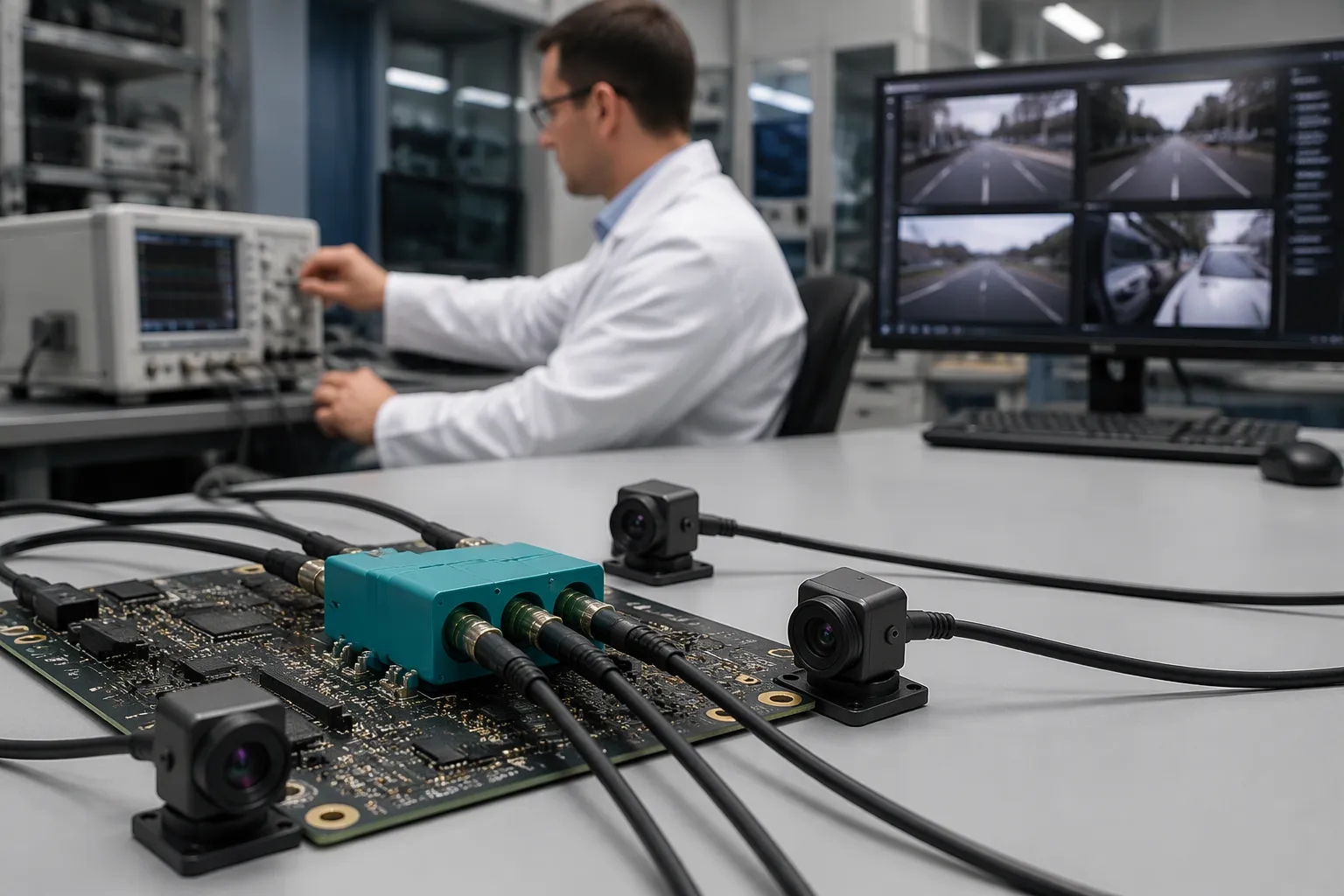
Mini-FAKRA (HFM) is a compact coaxial connector built for high-frequency automotive links. Multi-camera ADAS systems adopt it because sensor counts keep rising while space, weight, and bandwidth budgets stay extremely tight. This automotive camera connector packs high-speed capability into a small footprint, and its locking design resists vibration.
Designers and engineers, system developers, OEM/ODM buyers, and harness makers will find a fair comparison here. This post covers clear, practical selection steps, not marketing claims.
In Short: Mini-FAKRA (HFM) is a small coaxial connector for high-speed automotive links. It saves space, handles high data rates, and suits dense sensor layouts in tight installations.
Key Takeaways
Mini-FAKRA saves up to 80% space compared to standard FAKRA, allowing more cameras in tight spots.
It supports high-speed data up to 28 Gbps and frequencies up to 20 GHz for clear video.
The locking design resists vibration, keeping connections secure on rough roads.
Choose the right code and port count to avoid assembly errors and reduce costs.
Always confirm specifications and pinouts with the exact part number and drawing before ordering.
Multi-Camera ADAS Connector Demands
Bandwidth and Signal Integrity
Camera counts keep climbing. A modern vehicle may carry a front camera, a rear camera, and several side cameras for multi-camera surround-view systems. Each camera streams high-resolution video to the ADAS domain controllers. Designers add more sensors for better coverage and redundancy. That trend pushes connector density at the ECU higher with every platform.
High-resolution camera links demand wide bandwidth and clean signal integrity. Video data rates rise with resolution and frame rate. Long cable runs from the bumper to the trunk add loss and reflection. A poor connection shows up as dropped frames or image artifacts. The automotive camera connector must hold a stable 50 Ω impedance across the full link. Shielding matters just as much. It blocks interference from motors, infotainment, and camera and radar links that share the same harness.
Space, Weight, and Reliability
Space at the ECU is scarce. A single multi-way connector now carries multiple coaxial channels for surround-view and front-view cameras. Older layouts used one connector per camera. That approach no longer fits high-channel-count modules. Engineers need a smaller PCB/connector footprint and higher channel density per square millimeter.
Weight and reliability follow the same logic. Every extra connector adds mass and another failure point. Vibration, heat, and moisture attack each mated pair over the vehicle life. Multi-sensor platforms therefore favor compact, sealed designs with positive locking. A robust connector footprint protects signal quality in camera hubs and camera and radar modules. It also simplifies assembly on the line. These demands set the stage for Mini-FAKRA.
Dense layouts reward small, shielded connectors with secure locking.
Mini-FAKRA (HFM) as an Automotive Camera Connector
What HFM Is and Why It Matters
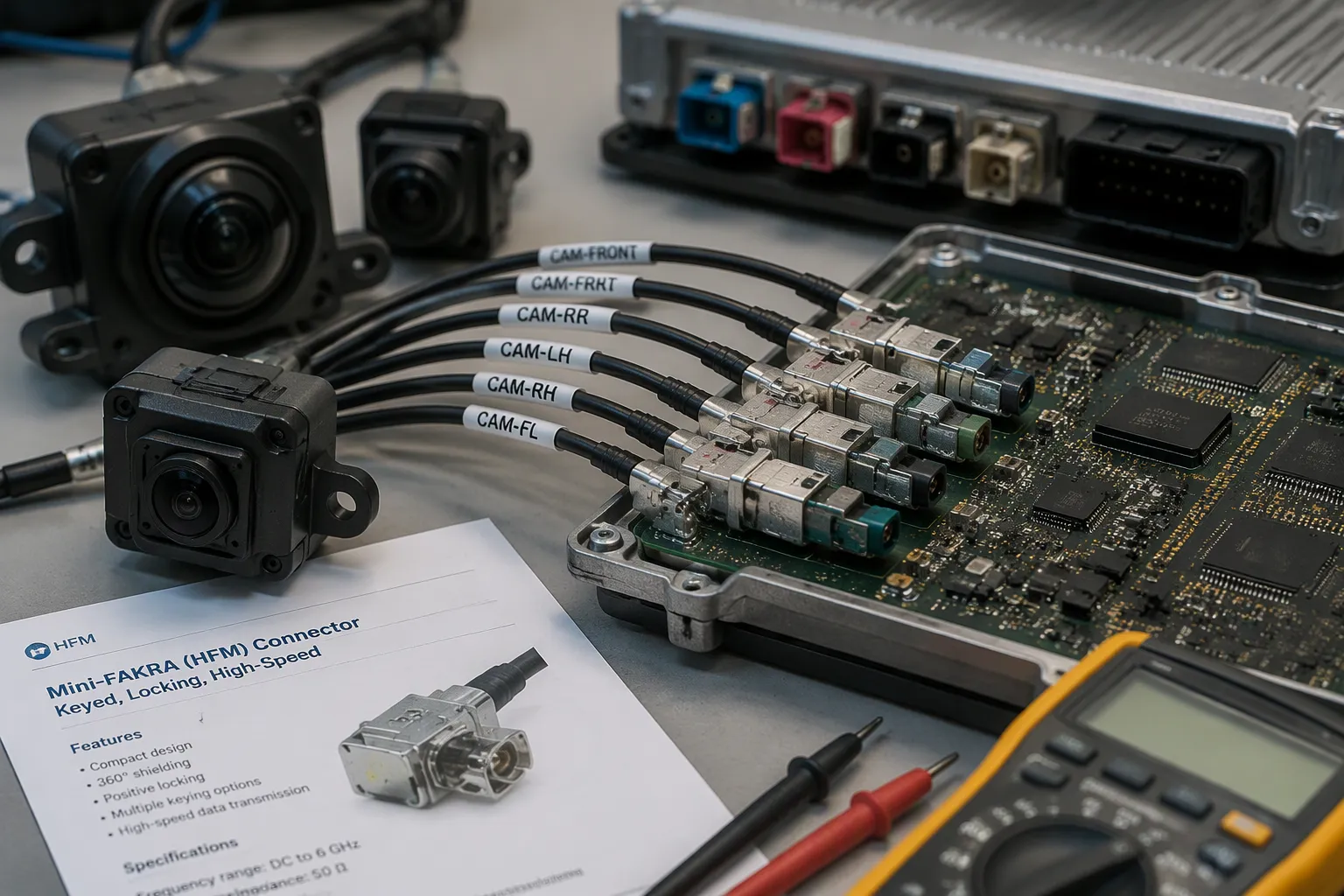
Mini-FAKRA, also called HFM (High-Speed FAKRA-Mini), is a next-generation coaxial connector for the automotive industry. It builds on the familiar FAKRA interface and shrinks the housing. The design keeps the same 50 Ω impedance and the same positive locking concept. It also raises the frequency ceiling well beyond the older standard.
This connector matters because camera links now carry more data through smaller spaces. A front camera and several surround-view cameras feed the ADAS domain controller at the same time. Each link needs a clean, shielded path. HFM delivers that path in a package that fits dense ECU layouts. The automotive camera connector therefore serves as the physical backbone of modern sensor networks.
LEADSIGN publishes the core HFM figures as follows: 50 Ω impedance, a frequency range from DC to 20 GHz, data rates up to 28 Gbps, and up to 25 mating cycles. The modular design supports cable connectors and PCB connectors in straight and right-angle versions. Specifications vary by exact part number and cable assembly. Designers should confirm the datasheet for each ordered configuration.
Key Technical Advantages for ADAS
Three themes explain why HFM suits multi-camera systems: space savings, high-speed data, and vibration resistance.
Space savings come first. HFM can save up to 80% of installation space compared with traditional FAKRA connectors. That figure varies by exact part number and cable assembly. The smaller connector footprint frees board area at the ECU. It also raises channel density on multi-way modules. Harness makers gain room for tighter routing behind trim panels and inside camera housings.
High-speed data comes second. The DC to 20 GHz range and data rates up to 28 Gbps support high-resolution camera links. Standard FAKRA reaches roughly 6 GHz, so HFM extends the usable bandwidth by a wide margin. This headroom helps automotive RF links that carry uncompressed or lightly compressed video. Strong rf performance also protects signal integrity across long cable runs from the bumper to the trunk.
Vibration resistance comes third. The positive locking mechanism holds the mated pair secure under road shock. HFM endures up to 25 mating cycles, which covers assembly, service, and rework. A secure lock protects the automotive rf connector from partial engagement. Partial engagement causes reflections and intermittent video. The compact housing also reduces leverage on the PCB solder joints during vibration.
Together, these traits make HFM a practical choice for surround-view and front-view camera systems. The connector supports the adas architecture without adding bulk. It also keeps rf performance stable across the vehicle life.
Confirm every figure against the exact part number and cable assembly before finalizing a design.
Mini-FAKRA vs. Standard FAKRA and HSD
Performance and Application Fit
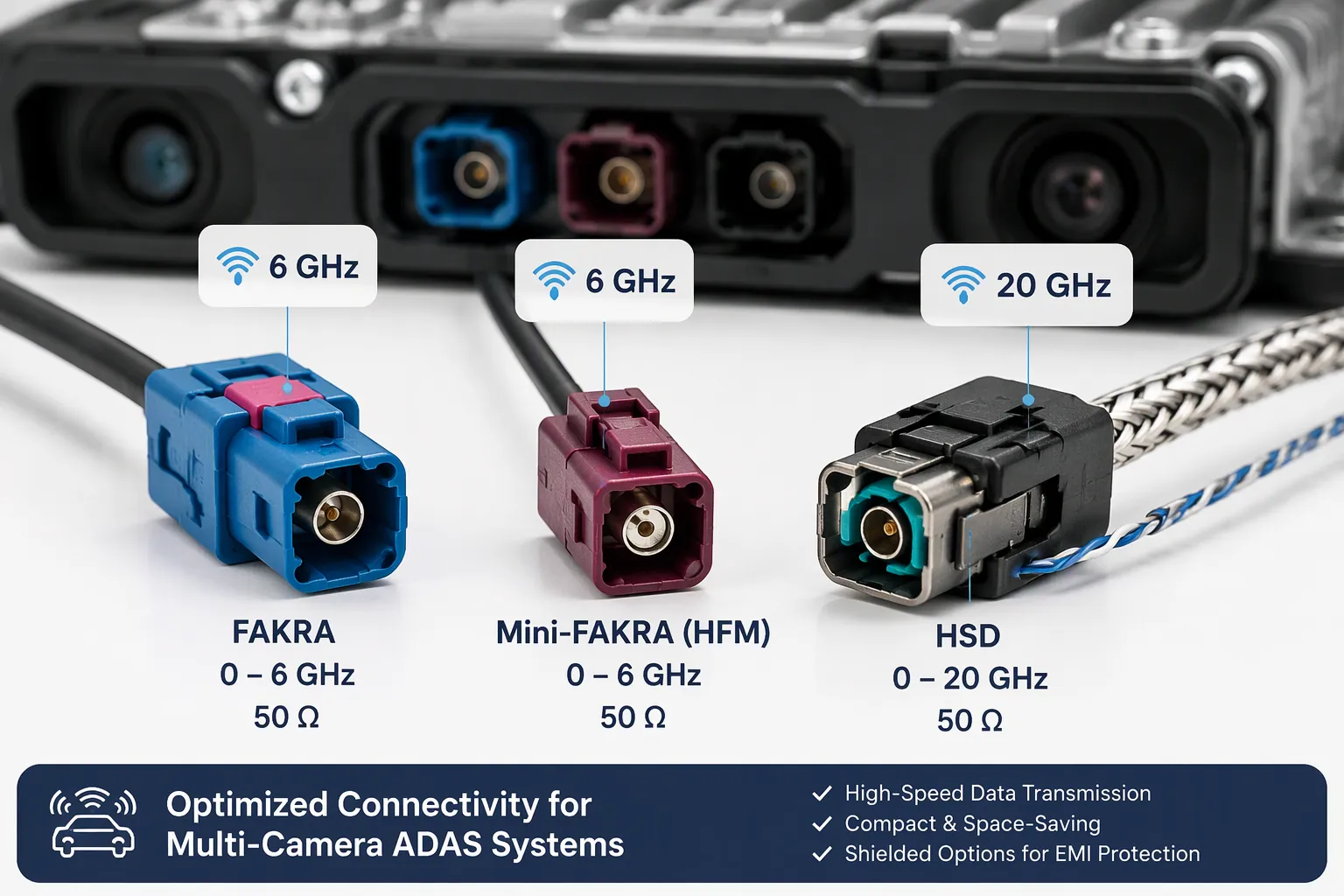
Standard FAKRA has served sensor and antenna links for years. It supports frequencies up to roughly 6 GHz. Mini-FAKRA (HFM) extends that ceiling to 20 GHz. The wider range gives designers headroom for high-resolution video and future sensor upgrades. That gap matters for adas designs that plan for higher sensor resolution over the platform life. Both interfaces share a 50 Ω impedance and a positive locking concept. HFM simply shrinks the housing and raises the bandwidth.
HSD (High-Speed Data) takes a different path. It carries differential signals over shielded twisted pairs. HSD fits best where a link needs multi-pair data rather than a single coaxial channel. Examples include USB, Ethernet, and LVDS-style links inside the cabin. A designer who needs one clean coaxial path per camera often finds HFM the better match. A designer who needs several differential pairs in one housing often finds HSD the better match. Neither option wins everywhere. Each one fits a different job. The rf performance of each option stays strong within its own band.
The table below compares the three options on the points that matter most for multi-camera layouts.
Feature | Standard FAKRA | Mini-FAKRA (HFM) | Advantage for Multi-Camera ADAS |
|---|---|---|---|
Frequency range | Up to roughly 6 GHz | DC to 20 GHz | More headroom for high-resolution video links |
Data rate | Lower ceiling | Up to 28 Gbps | Supports dense video streams |
Impedance | 50 Ω | 50 Ω | Stable signal integrity on both |
Footprint | Larger housing | Up to 80% space savings | Higher channel density at the ECU |
Mating cycles | — | Up to 25 | Covers assembly, service, and rework |
Locking | Positive lock | Positive lock | Resists vibration in exterior mounts |
Specifications vary by exact part number and cable assembly. Buyers should confirm each row against the datasheet for the ordered configuration. Signal integrity depends on the cable assembly as much as on the interface.
Coding, Ports, and Cost
Coding prevents mismating. The interface uses color and keying codes for different functions. Z-code is the neutral, universal variant. It accepts any mating half without a function-specific key. Specific codes (A, B, C, and others) lock a connector to one function, such as video or antenna. A Z-code plug mates with any coded jack. A coded plug mates only with its matching code. Designers choose Z-code for flexibility and specific codes for error-proof assembly on the line.
Port count drives cost and layout. Single-port connectors serve one link. Dual-port and quad-port housings group several channels in one shell. A quad-port module cuts the number of separate connectors at the ECU and simplifies harness routing. LEADSIGN supplies quad-port configurations and builds custom harnesses to drawing. That support helps harness makers match a specific sensor module and ECU pinout.
Cost follows volume, port count, and assembly complexity. HFM uses cost-optimized production, so the smaller connector does not carry a premium for its size alone. A quad-port assembly often costs less than four single-port assemblies once labor and board space enter the calculation. Buyers should compare total installed cost, not unit price alone. The automotive camera connector choice then rests on link count, space, and coding needs rather than on a single number.
Match the code and port count to the harness drawing before release.
Implementing Mini-FAKRA in Camera Systems
Cable Assembly and Signal Integrity
The connector alone does not guarantee a clean link. The cable assembly carries equal weight. A controlled-impedance automotive rf interface keeps a stable 50 Ω path from the camera to the ECU. Shielding blocks interference from motors and adjacent links. Poor shielding shows up as noise in the video stream.
Bend radius deserves early attention. A tight bend behind a trim panel can crush the dielectric and shift impedance. Designers should route camera harnesses with generous curves and confirm the minimum bend radius for the chosen cable. Custom cable lengths also matter. Extra length adds loss, and short length can strain the connector. LEADSIGN supports OEM/ODM work, supplies samples, and develops automotive rf cable assemblies to drawing. That process lets a team validate the rf assembly before volume release.
Selection Mistakes and Procurement Checklist
Six mistakes recur in camera harness projects:
Assuming every camera module uses standard fakra. Many newer modules use the smaller interface.
Ignoring mechanical coding. Color and keying prevent mismating.
Choosing the wrong connector gender. A plug and a jack do different jobs.
Overlooking cable bend radius in tight spaces.
Mixing single-port and quad-port layouts.
Skipping the camera/ECU pinout check before ordering.
Buyers should send clear inputs for a quotation: camera module and ECU part numbers, required cable length, connector type and coding, port count, application environment, destination country, and a drawing or sample if available. These details speed up matching and reduce rework.
Compatibility must be confirmed per camera module, ECU, display type, connector configuration, pin assignment, and installation requirements. No single cable fits every vehicle. Harness compatibility and mating-connector compatibility depend on the exact build. A careful check of the automotive camera connector, the camera harnesses, and the adas layout protects the program.
Confirm pinout and coding against the drawing before release.
Mini-FAKRA (HFM) is a compact coaxial connector for high-frequency automotive links. Its small housing, wide bandwidth, and secure locking suit dense multi-camera ADAS layouts. Each camera link gains room at the ECU without losing signal quality.
The comparison stays fair. Mini-FAKRA fits dense high-speed camera links. Standard FAKRA fits layouts with space to spare and a legacy fit to protect. HSD fits links that need several differential pairs in one shell. Readers can contact LEADSIGN for Mini-FAKRA cable information, connector matching, samples, custom lengths, and quotations.
FAQ
What frequency range does Mini-FAKRA (HFM) support?
HFM supports a frequency range from DC up to 20 GHz. Standard FAKRA reaches roughly 6 GHz. The wider range gives designers headroom for high-resolution camera links. Specifications vary by exact part number and cable assembly, so buyers should confirm the datasheet for each ordered configuration.
How much space can HFM save at the ECU?
HFM can save up to 80% of installation space compared with traditional FAKRA connectors. That figure varies by exact part number and cable assembly. The smaller footprint raises channel density on multi-way modules. Harness makers also gain room for tighter routing behind trim panels and inside camera housings.
What does Z-code mean on a Mini-FAKRA connector?
Z-code is the neutral, universal variant. It accepts any mating half without a function-specific key. Specific codes lock a connector to one function, such as video or antenna. Designers choose Z-code for flexibility and specific codes for error-proof assembly on the production line.
How many mating cycles does HFM endure?
HFM endures up to 25 mating cycles. That count covers assembly, service, and rework. The positive locking mechanism holds the mated pair secure under road shock. A secure lock protects the link from partial engagement, which causes reflections and intermittent video.
Does one Mini-FAKRA cable fit every camera system?
No. Compatibility must be confirmed per camera module, ECU, display type, connector configuration, pin assignment, and installation requirements. Buyers should share part numbers, cable length, coding, and port count before ordering. A drawing or sample speeds up matching and reduces rework.
See Also
Discovering High-Speed FAKRA-Mini HFM Benefits For Autonomous Driving Vehicles
Why Quad Mini FAKRA Connectors Matter So Much In Automotive
Exploring Mini-FAKRA Potential For Applications With Limited Space
Revealing The Benefits Of Mini FAKRA Connectors In Automotive Systems
Harnessing Mini FAKRA Connector Advantages For Automotive Application Needs