How to Test FAKRA Connector Quality: Key Tests for Automotive Applications

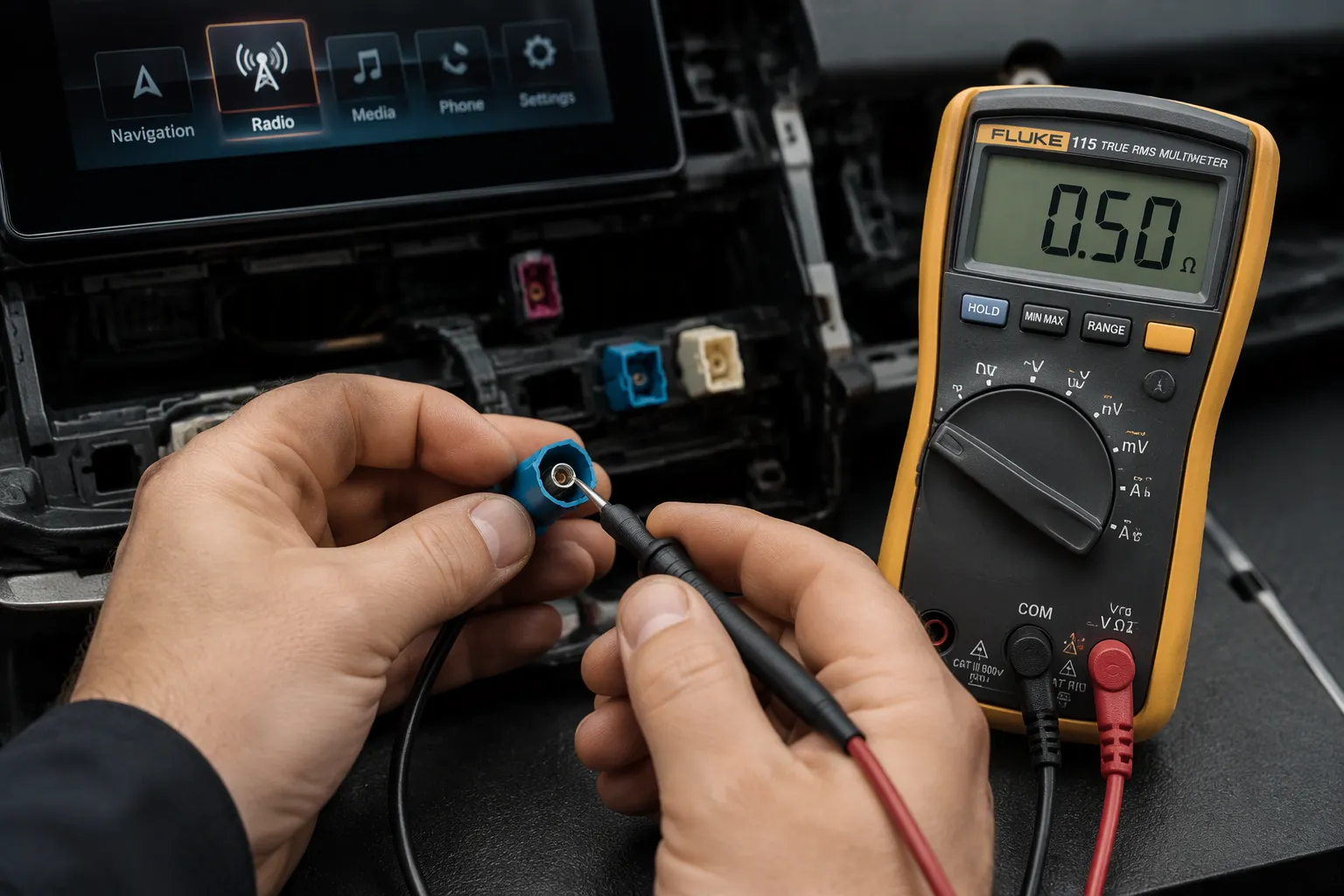
You compare two FAKRA suppliers. Both samples look identical. How do you decide which connector survives years in a vehicle?
FAKRA connector testing answers that. Quality is verified through electrical, mechanical, environmental, and production/documentation checks. These checks cover the complete connector or cable assembly, not just the plastic housing. A weak crimp can hide behind a perfect housing.
Automotive RF systems carry navigation, camera, and infotainment signals. Weak testing hides signal loss and moisture damage until vehicles reach service.
In Short: Verify FAKRA quality through electrical, mechanical, environmental, and documentation checks on the complete assembly, not the housing alone. Always confirm test conditions with your supplier before final approval.
Meta title (57 characters): How to Test FAKRA Connector Quality: Key Tests for Buyers
Meta description (157 characters): Learn how buyers verify FAKRA connector quality through electrical, mechanical, environmental, and documentation checks, plus what to request from suppliers.
Key Takeaways
Test the complete FAKRA assembly, not just the plastic housing.
Electrical tests check signal strength and interference blocking.
Mechanical tests confirm secure locking and strong cable connections.
Environmental tests simulate heat, vibration, and moisture exposure.
Always request test reports for your exact product configuration.
Why FAKRA Connector Testing Matters
Failure Modes Poor Quality Causes
A poor FAKRA connector rarely fails on day one. It fails after months of heat, vibration, and moisture. Weak quality shows up as signal loss, impedance mismatch, or an intermittent connection that appears only on rough roads. You may also see connector loosening, terminal movement, or cable separation at the crimp. Water and moisture damage lead to corrosion inside the housing and on the terminals. Each of these problems can cause installation failure or a long-term reliability issue that returns later as a warranty claim.
These failure modes rarely announce themselves during a visual check. A housing can look perfect while the terminal sits loose or the shield makes poor contact. Intermittent faults are the hardest to catch. They pass a bench test and fail in the vehicle. That is why FAKRA connector testing must measure performance under realistic conditions, not just appearance.
Test the Assembly, Not Just the Housing
The plastic housing is only one part of the system. Signal quality depends on the terminal, the crimp, the cable, the shield, and the locking features working together. A loose terminal or a weak crimp changes impedance and adds loss. Test the complete connector or cable assembly. A pull test on the cable, a continuity check through the terminal, and an RF measurement on the finished assembly reveal problems a housing inspection cannot.
Industry practice offers useful context. USCAR17 covers mechanical qualification, USCAR18 covers product design protocols, and USCAR-49 is an upcoming FAKRA RF test specification. Treat these documents as general guidance. They do not prove that a specific product passed. Always ask your supplier for test reports tied to the exact configuration you plan to buy. Confirm the test conditions, the acceptance criteria, and the product build behind every number.
Electrical Performance Tests
Electrical tests show how a connector handles RF energy. You cannot judge this by eye. You need measured data from the finished assembly.
Impedance, Return Loss, and VSWR
Impedance matching keeps RF energy flowing from the source to the antenna. A mismatch reflects part of the signal back toward the source. That reflection wastes power and distorts the signal. Many automotive RF applications use a 50-ohm design. Confirm the exact requirement for your specific system before you approve a part. Do not assume every FAKRA connector performs the same way. Design, terminal geometry, and assembly quality all shift the result.
Return loss and VSWR both describe reflected signal. Return loss tells you how much power bounces back. VSWR compares the standing wave to a perfect match. A poor crimp or a damaged terminal raises both numbers. Ask your supplier to confirm the frequency range, test method, test fixture, connector and cable configuration, test conditions, and acceptance criteria. Request the report for the exact build you plan to order. A number without its test conditions tells you very little.
Insertion Loss and Shielding Effectiveness
Insertion loss measures signal power lost as it travels through a connector, cable, adapter, or complete assembly. Every connection adds some loss. Results depend on frequency, cable length, connector design, number of connections, assembly quality, test setup, temperature, and environment. A short cable at low frequency may look excellent. The same design at higher frequency and longer length may not. Compare results only when frequency, cable length, configuration, and method match. Otherwise you compare two different tests, not two products.
Shielding effectiveness shows how well the connector and cable block unwanted energy. Vehicles carry many noise sources: motors, power electronics, and adjacent signal lines. Weak shielding lets electromagnetic interference and crosstalk reach sensitive RF paths. Connector shielding, cable shielding, grounding, termination, and cable routing all affect the outcome. A shield that terminates poorly behaves like no shield at all. Ask how the supplier verifies shielding and under what configuration. Do not accept a general claim without a test report.
LEADSIGN supplies FAKRA connectors and cable assemblies for automotive RF applications. Request electrical test data for the exact configuration you need. FAKRA connector testing only means something when the report matches your part, your cable, and your frequency range.
Mechanical Tests
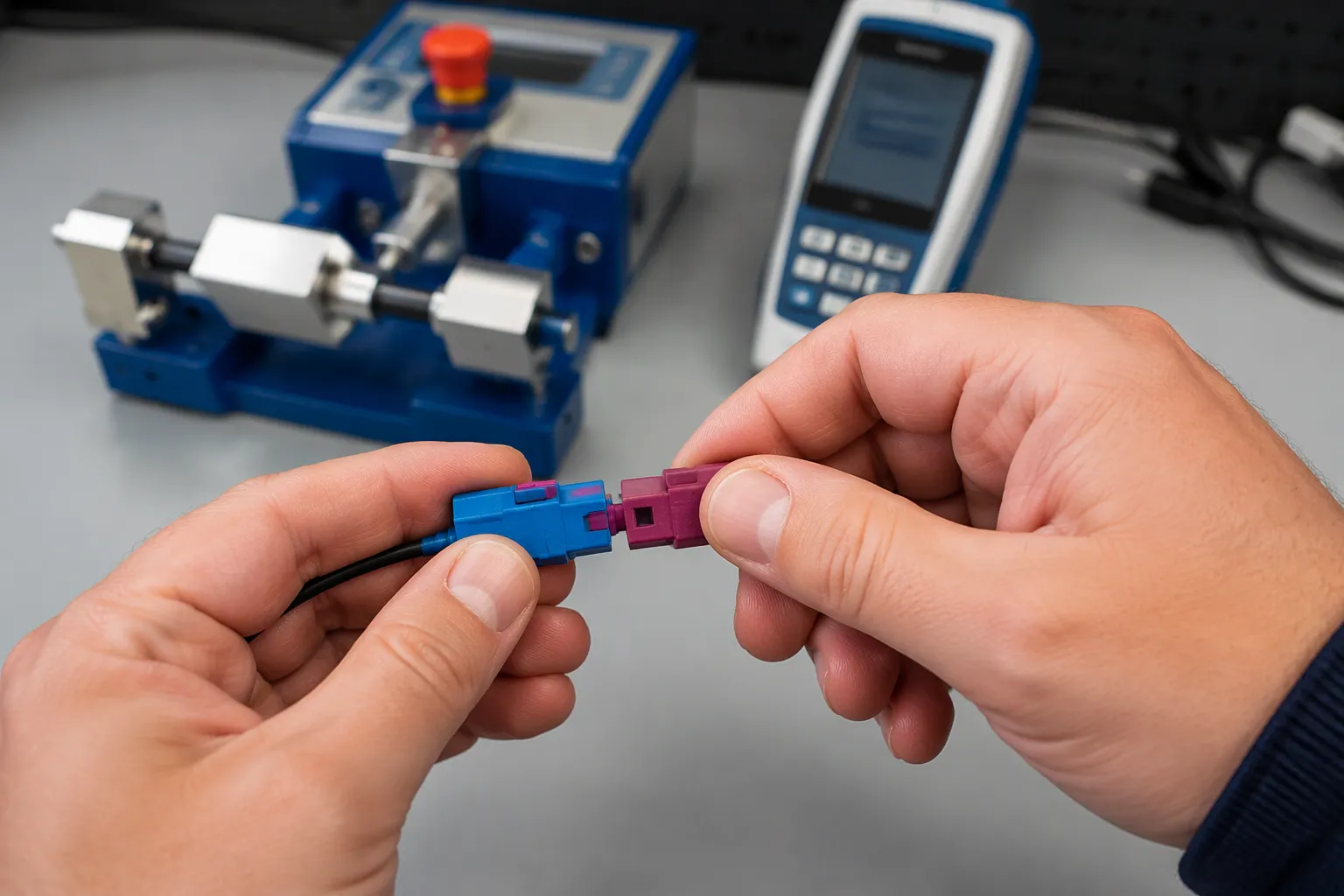
A connector that mates easily and stays locked protects the whole RF path. Mechanical tests measure how the part behaves during installation and over years of service. These checks belong in any serious FAKRA connector testing plan. Electrical data alone cannot reveal a weak lock or a loose terminal.
Mating Force and Mating Cycles
Mating and unmating force should allow secure installation without excessive force. Too much force slows the assembly line and invites damage to the housing or terminal. Too little force suggests a weak lock that may open under vibration. Ask your supplier for the test method, the initial mating force, the unmating force, the connector configuration, and the acceptance criteria. Request the report for the exact part you plan to buy. A force value from a different housing style tells you little about your part.
A simple check helps before formal testing. Mate and unmate a sample by hand. The action should feel firm and consistent, with a clear click at full engagement. Hand feel does not replace a measured test, but it catches obvious problems early.
The mating-cycle test evaluates repeated connection and disconnection. The number of cycles and the acceptance criteria depend on the product specification and the application. No universal number applies to every FAKRA part. A part used once at the factory faces different demands than a part serviced many times. Ask for the number of cycles tested, before-and-after electrical results, locking performance, terminal condition, and the full test report. A cycle count alone proves little. The electrical data after cycling shows whether the part still performs. Look for changes in contact resistance and return loss after the test.
Terminal Retention and Cable Pull
Terminal retention testing checks whether terminals remain securely positioned inside the connector housing. A terminal that shifts changes impedance and can break contact under vibration. Review the locking structure, the retention force, and any secondary locking features. Ask for post-test electrical continuity data. Do not accept a universal retention force claim. The right value depends on the terminal design and the application. A terminal that passes a static pull test may still move under vibration, so pair this test with vibration data.
A cable pull test evaluates the connection between the cable, terminal, connector housing, and strain relief. This test exposes weak crimps that pass a visual check. Check the pull direction, pull force, test duration, cable type, failure criteria, and post-test continuity. A crimp that holds mechanically may still fail electrically. Demand both results. Compare pull data only when the cable type and gauge match your order.
LEADSIGN FAKRA connectors feature primary and secondary locking systems for assembly security. The secondary lock adds a second barrier against terminal back-out. Pair this feature with documented pull and retention testing for full confidence.
When you compare two suppliers, line up the test conditions first. A report from a mated pair with a short cable does not describe a long assembly with a right-angle end. Ask each supplier to test the configuration you will order. Then compare like with like, and reject any report that hides its test conditions.
Environmental Reliability Tests
Temperature Cycling and Vibration
Vehicles heat and cool constantly. A dashboard connector may bake in summer sun and freeze overnight in winter. Temperature cycling testing simulates these repeated changes. Ask your supplier to confirm the test temperature range, the number of cycles, and the dwell time at each extreme. Request the product configuration tested. A report from a bare connector does not describe a finished cable assembly. Insist on electrical and mechanical inspection before and after the test. Look for shifts in contact resistance, return loss, or locking force. These changes reveal weaknesses that a single room-temperature check misses.
Vibration testing simulates road shock and engine stress. Confirm the test direction, duration, frequency profile, and mounting condition. Ask whether the supplier tested the part in a mated or unmated state. Electrical monitoring during the test catches intermittent faults. Post-test inspection should cover terminal position, locking function, and cable condition. Do not accept a claim of standard compliance unless the supplier confirms it for your exact product. FAKRA connector testing without vibration data leaves a major gap.
Humidity, Water Ingress, and Corrosion
Some installations face humidity, condensation, splashing, or direct water exposure. Ask whether the connector is sealed. Confirm the mated or unmated test condition, the water-ingress method, the sealing structure, and the required protection level. Request post-test electrical performance data. Do not assign an IP rating without verified documentation.
Sealed FAKRA systems may target IP69K as general industry practice, but only a product-specific test report proves it.
Salt spray and corrosion testing matters for exposed environments and metal terminals. Review the contact plating, terminal material, and housing material. Confirm the salt-spray method, duration, contact resistance after testing, and visual inspection results. Do not accept plating thickness claims without documentation.
LEADSIGN offers waterproof FAKRA versions. Its FAKRA RF connectors carry a verified temperature range of -40 °C to +105 °C. Treat these as product data for those parts, not universal test results.
Buyer Evaluation: Checklist, Supplier Questions, and Common Mistakes
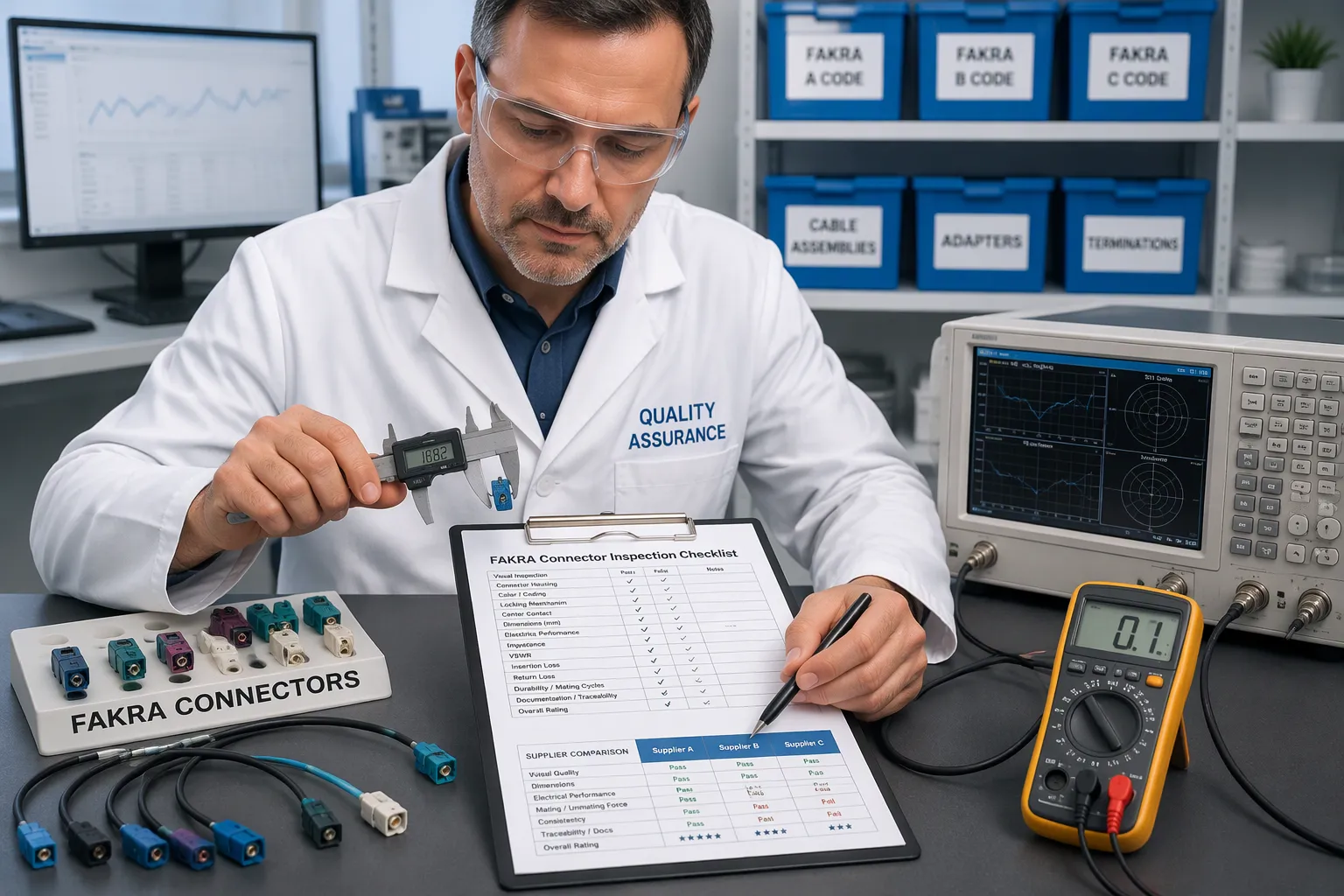
Inspection Checklist and Supplier Questions
Use a comparison table to line up test data from each supplier. The table keeps your evaluation consistent.
Test | Purpose | What you should check |
|---|---|---|
Impedance | Confirms RF match | Test frequency, fixture, and product build |
Insertion loss | Measures signal power lost | Cable length and frequency match your order |
Return loss and VSWR | Measures reflected signal | Frequency range and acceptance criteria |
Shielding | Blocks interference and crosstalk | Termination method and test setup |
Mating cycle | Checks repeated connect/disconnect | Cycle count and post-test electrical data |
Mating and unmating force | Confirms secure installation | Test method and connector configuration |
Terminal retention | Keeps terminals in place | Locking structure and continuity results |
Cable pull | Tests crimp and strain relief | Pull direction, force, and cable type |
Temperature cycling | Simulates heat and cold | Range, cycles, and dwell time |
Vibration | Simulates road and engine stress | Direction, duration, and mated state |
Humidity or water ingress | Checks sealing | Sealed condition and post-test performance |
Salt spray | Checks corrosion resistance | Plating, duration, and contact resistance |
Build a practical inspection checklist for every order. Cover the connector model, family, coding and keying, gender, housing condition, locking function, terminal position, cable termination, shielding, cable jacket, and cable length. Add the electrical results: impedance, insertion loss, return loss, and VSWR. Add the mechanical results: mating and unmating force, terminal retention, and cable pull strength. Add the environmental results: temperature, vibration, humidity or water ingress, and corrosion testing. Finish with technical drawings, material information, test reports, samples, and traceability or batch information.
Ask each supplier a fixed set of questions. Request the product drawing, the connector code and mating interface, and the available cable types and lengths. Ask which electrical, mechanical, and environmental tests they run. Request sample units and test reports for your exact configuration. Confirm custom cable assembly support, production batch inspection, quotation details, and application compatibility.
Standard vs. Custom Assemblies and Common Mistakes
A standard assembly fits a standard connector combination, a known cable length, a known application, repeated purchasing, and a stable installation. A custom assembly fits a special cable length, different connectors at each end, a straight-to-right-angle design, special coding, limited installation space, custom routing, prototypes, low-volume projects, OEM integration, and special test documentation.
Avoid common mistakes during evaluation. Do not compare suppliers by price alone. Do not check only appearance. Do not ignore the cable assembly. Do not accept test data without conditions, and never compare results from different frequencies. Confirm coding, request a drawing, and test samples before approval. Treat general standards as guidance, not product-specific proof. Review post-test electrical results and confirm batch traceability. FAKRA connector testing only protects you when the report matches your part.
LEADSIGN supplies FAKRA connectors and cable assemblies, including FAKRA HSD connectors, FAKRA PCB connectors, Mini FAKRA connectors, FAKRA coaxial cables, FAKRA cable assemblies, FAKRA extension cables, HSD connectors, and HSD cable assemblies. Send your application, vehicle system, connector type, coding, cable length and configuration, frequency or signal requirement, environmental conditions, quantity, sample needs, drawings, and test-documentation requirements. Review our quality control process, then contact us or request a quote.
Quality approval rests on four test categories: electrical, mechanical, environmental, and production/documentation checks. Each category answers a different question. Electrical tests reveal signal behavior. Mechanical tests reveal lock and crimp strength. Environmental tests reveal durability over time. Documentation proves the build matches your order. No single test is sufficient. A part that passes one check can still fail another.
Always request test conditions, acceptance criteria, and product-specific documentation. Treat general standards as guidance, not proof. FAKRA connector testing protects you only when the report matches your exact configuration.
Contact LEADSIGN for FAKRA connector information, FAKRA cable assemblies, Mini FAKRA connectors, FAKRA PCB connectors, coaxial cable assemblies, technical drawings, sample evaluation, quality documentation, custom configurations, and quotations. Reach us at info@leadsignauto.com, 86-755-23323415, or https://www.fakraconnectors.com.
FAQ
What should you request first from a new FAKRA supplier?
Start with the product drawing and the test report for your exact configuration. Confirm the connector code, mating interface, cable type, and cable length. Ask for the test conditions and acceptance criteria behind every number. A report that hides its setup tells you little about your part.
Does a visual housing inspection prove connector quality?
No. A housing can look perfect while the terminal sits loose or the shield makes poor contact. Signal quality depends on the terminal, crimp, cable, and shield working together. Test the complete assembly. Pull tests, continuity checks, and RF measurements reveal problems your eyes cannot catch.
How do you compare test reports from two suppliers fairly?
Line up the test conditions first. Match the frequency, cable length, connector configuration, and test method. A short cable at low frequency does not describe a long assembly with a right-angle end. Compare like with like, and reject any report that hides its setup.
Do general standards like USCAR17 or USCAR-49 prove a product passed?
No. These documents offer general guidance on mechanical qualification and RF testing. They do not certify a specific part. Ask your supplier for test reports tied to the exact build you plan to order. Treat standards as a framework, not as product-specific proof.
What information should you send LEADSIGN for a FAKRA quotation?
Send your application, vehicle system, connector type and coding, cable length and configuration, frequency or signal requirement, environmental conditions, quantity, sample needs, drawings, and test-documentation requirements. LEADSIGN reviews these details to match the right FAKRA connector or cable assembly to your project.
See Also
Why Fakra Connectors Play a Crucial Role in Automotive Manufacturing
Understanding the Critical Role of FAKRA Connectors in Vehicle Systems
A Closer Look at the Advantages of Fakra Connectors for Cars
Why Fakra Automotive Connectors Are Essential for Today's Advanced Vehicles
The Vital Role of FAKRA Z Connectors in Modern Automotive Technology