What Is an HSD Z Code Cable for Automotive LVDS Displays

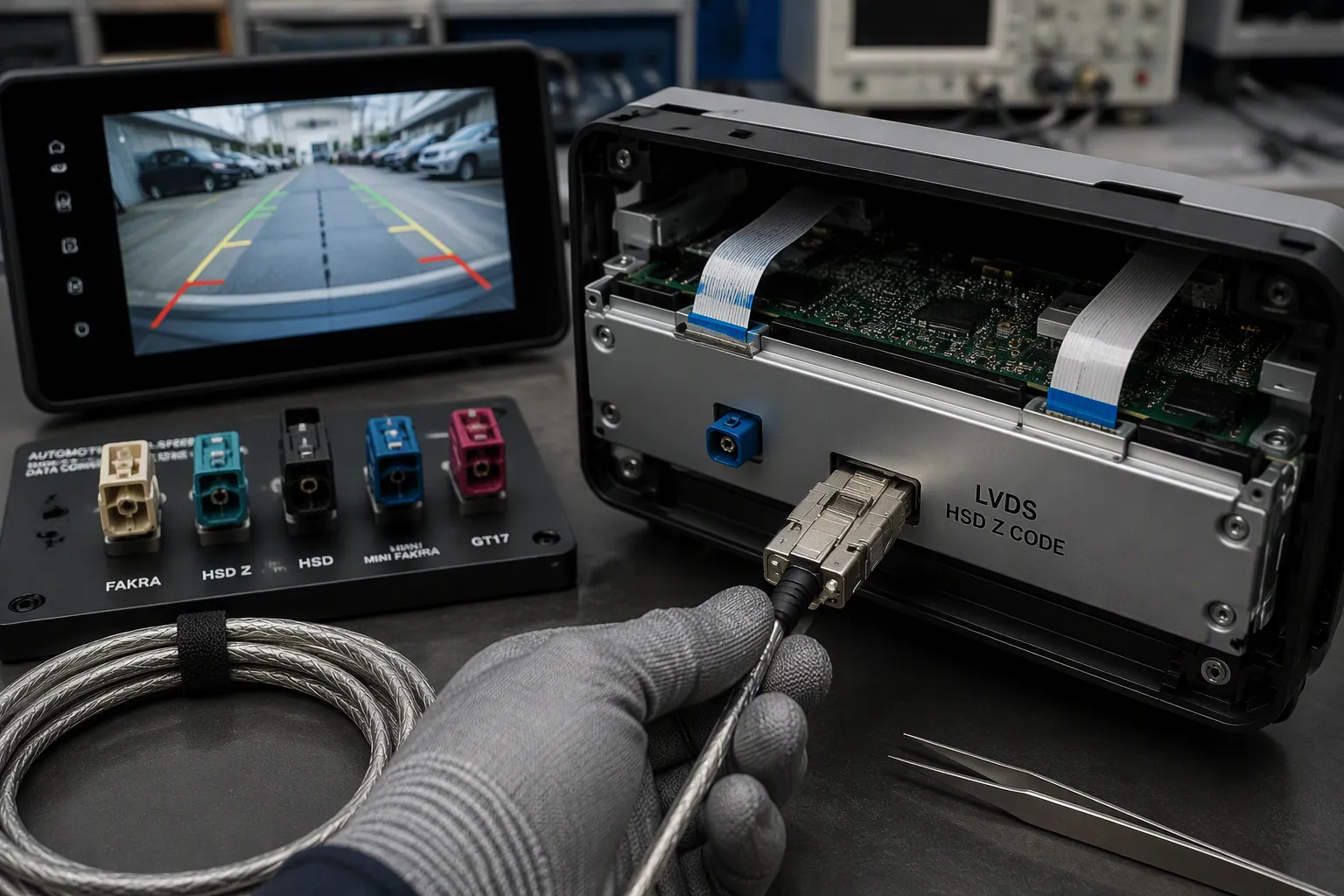
The HSD Z code cable solves this high-speed differential data link challenge. This HSD cable assembly carries video signals between displays and head units with reliable performance.
This article serves as a selection guide. It covers specifications, compatibility checks, and ordering requirements. Engineers and buyers will learn how to confirm HSD coding, connector gender, orientation, and cable length before purchase.
Key Takeaways
HSD Z code cables carry high-speed video signals for automotive LVDS displays.
Z code provides a neutral keying option for diagnostics and aftermarket use.
Always verify the HSD code, connector gender, and orientation before purchase.
Check cable length, impedance, and shielding to maintain signal integrity.
HSD cables differ from FAKRA cables in impedance and signal type.
What Is an HSD Z Code Cable?
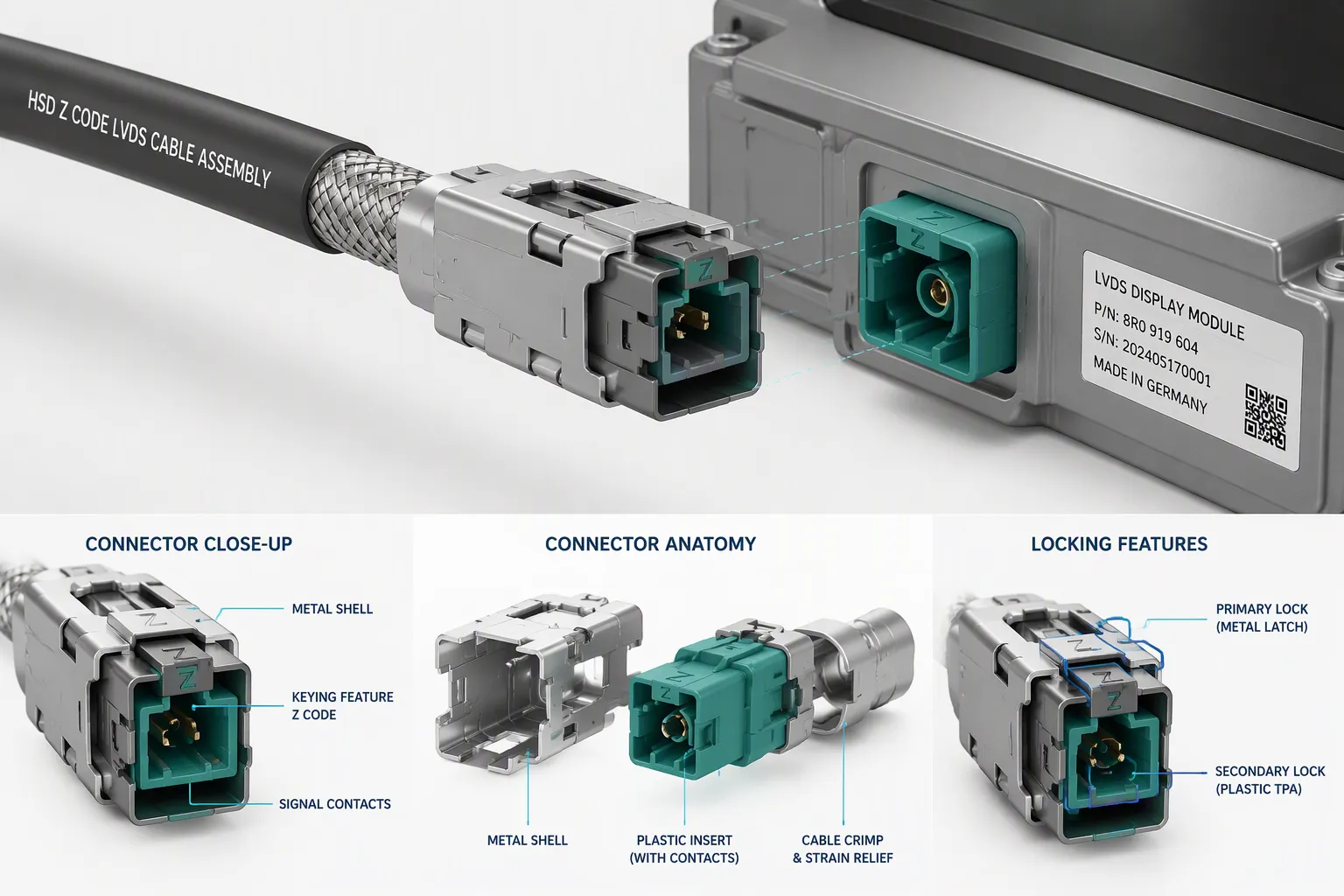
An HSD Z code cable is a specialized assembly built around the High-Speed Data connector system. This system carries 100-ohm differential signals for automotive applications. The Z code refers to a specific mechanical keying on the connector housing. Engineers use this coding to prevent mismating between similar-looking interfaces.
Defining the HSD Connector System
The High-Speed Data connector system, commonly called HSD, is a high-speed differential connector system. It handles 100-ohm differential signals for digital data links. Automotive electronics rely on HSD connectors for LVDS displays, camera links, USB, Ethernet, and APIX connections.
An HSD connector uses a compact metal housing with a plastic insert. The insert holds the signal contacts and provides shielding. The physical connector design supports high bit-rate data streams. Primary and secondary locks secure the mating interface. Crimp connections and high cable retention force keep the assembly stable during vibration.
LEADSIGN supplies HSD connectors and cable assemblies for these applications. Their product line includes HSD cable assemblies, FAKRA HSD cables, and custom harness solutions. Each HSD connector and cable assembly must match the mating device, the protocol, and the routing path.
The Function of Z Coding
The mechanical coding system on HSD connectors prevents mismating. HSD connector housings include a mechanical and visual keying system. This coding ensures the correct plug-to-jack pairing. Without it, similar-looking HSD interfaces can be mismatched.
Z code is one specific keying option within the HSD coding family. Other codes, such as Code A, B, or C, serve different applications. Selecting the exact mechanical coding prevents production misplugging. A neutral Code Z keying is intentionally designed to fit any socket. This makes Z code useful for research and development, diagnostics, and aftermarket maintenance.
However, Code Z lacks the specific error-proofing required to prevent mismating during fast-paced factory assembly. Standard mechanical coding is meant to prevent mismating. Z code is often a neutral or universal option. Buyers must confirm compatibility by drawing or sample. Full part-number and hsd pinout verification adds another layer of correct connector selection.
Key points about HSD coding:
HSD connector housings include a mechanical and visual keying system.
The primary purpose of this coding is to prevent mismating and ensure the correct plug-to-jack pairing.
Similar-looking HSD interfaces can be mismatched.
Mechanical keying such as Z Code reduces incorrect mating.
Full part-number and pinout verification adds another layer of correct connector selection.
Selecting the exact mechanical coding, such as Code A, B, or C, prevents production misplugging.
A neutral Code Z keying is intentionally designed to fit any socket for R&D, diagnostics, and aftermarket maintenance.
Code Z lacks the specific error-proofing required to prevent mismating during fast-paced factory assembly.
LEADSIGN offers HSD connectors and cable assemblies for these applications. Their team can review drawings, samples, or photos to confirm the correct HSD coding. This support helps buyers avoid mismating and signal failure.
The Role of HSD Coding in Automotive LVDS Displays
Why LVDS Displays Require High-Speed Data Connectors
LVDS links require stable differential impedance, shielding, low skew, and reliable connector mating. A standard LVDS setup uses a 350 mV swing across a 100-ohm termination resistor. The common-mode offset sits at 1.2 V. These small signals demand consistent performance from every link component. High-speed data transmission depends on these characteristics.
Modern automotive LVDS displays carry high-bandwidth video. Per-lane data rates can reach up to 3.125 Gbps. An HSD connector must support this throughput. It must offer heavy EMI shielding, vibration-proof construction, controlled impedance, and low signal skew.
Parameter | Typical value / practice | Why it matters |
|---|---|---|
Output swing | 350 mV across 100 Ω termination | Sets receiver threshold; must be detected above noise |
DC offset | 1.2 V common-mode voltage | Gives receiver a stable bias reference |
Data rate | Up to 3.125 Gbps per lane | Supports infotainment video throughput |
Shielding | Heavy EMI shielding required | Protects low swing in automotive EMI |
How HSD Coding Prevents Mismating
HSD connectors solve these challenges. They provide a compact, shielded interface for 100-ohm differential signals. HSD coding prevents mismating. The mechanical keying system ensures the correct plug-to-jack pairing. Each HSD connector carries a specific code shape. Only the matching plug fits. For infotainment and ADAS systems, this feature eliminates misconnections.
The display link carries low-voltage differential links from the head unit to the screen. A wrong connection can drop the signal completely. Specific codes like A, B, or C prevent production misplugging. Z code serves as a neutral option for diagnostic work. The HSD connector at each end must align correctly. Buyers should confirm the exact code by drawing or sample.
HSD connectors support many protocols. LVDS links, camera links, USB, Ethernet, and APIX all use HSD connectors. LEADSIGN's product line covers these needs. Custom cable assemblies match routing and length. Engineers select HSD connectors for consistent performance. HSD connectors provide the shielded path needed for clear video. The cable must maintain controlled impedance. Reliable automotive data transmission depends on correct coding and orientation.
Why Choose an HSD High-Speed Data Connector?
Technical Characteristics: Impedance and Shielding
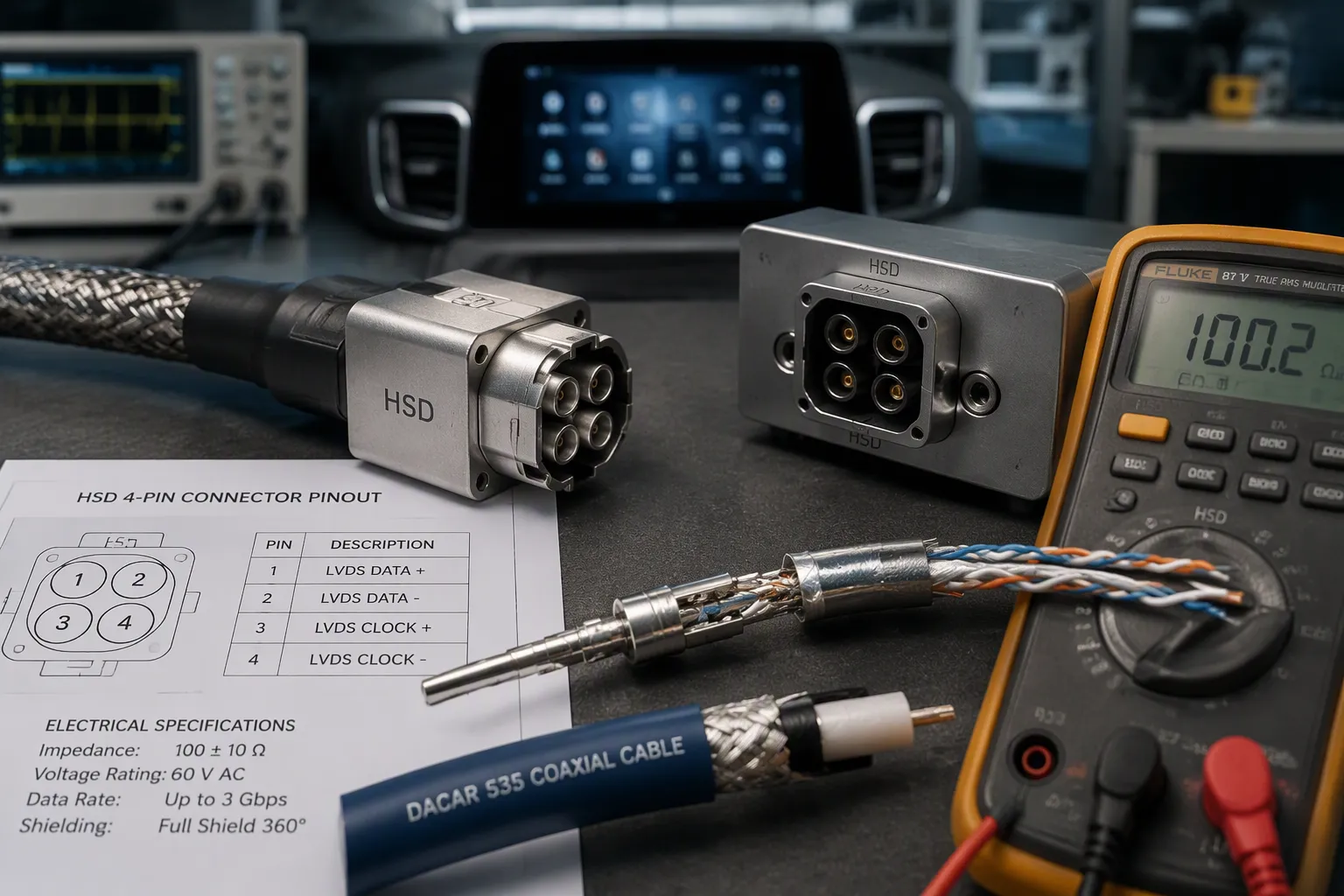
The HSD high-speed data connector system provides a controlled 100-ohm differential impedance path. This impedance match is critical for LVDS signal integrity. Any deviation causes signal reflection and data errors. The connector housing uses a metal shell for EMI protection. This shielding blocks interference from other vehicle systems.
Cable construction also affects performance. A shielded twisted quad cable design maintains consistent impedance along the link. Dacar 535 coaxial cable construction is common for these assemblies. The cable uses a specific conductor arrangement and dielectric material. These features keep the differential impedance stable.
HSD connectors come in 4 pin HSD connectors and 6-pin configurations. The 4-pin version carries one differential pair plus power or control lines. The 6-pin version supports additional signal paths. Engineers select the pin count based on the protocol and power needs.
Low skew is another key factor. Skew is the timing difference between the positive and negative signals in a differential pair. High skew reduces the signal eye opening. This leads to data errors at the receiver. Termination quality also matters. A poor crimp or solder joint creates impedance discontinuities. These discontinuities degrade the shielded differential data path.
The hsd pinout must match the mating device. A wrong pinout can short power to signal lines. This damages the display or head unit. Engineers verify the pinout against the module drawing before building the cable.
HSD Connector Selection Criteria
Selecting the right HSD connector requires more than matching the application name. Two display links can use different hsd coding, cable structures, orientations, or sealing methods. Their module interfaces and installation conditions differ. Buyers must confirm each specification against the actual mating hardware.
The following table lists the key items to verify before ordering an HSD connector and cable assembly.
Specification Item | What to Confirm | Why It Matters | Example |
|---|---|---|---|
HSD code | Code letter (A, B, C, Z) | Prevents mismating with other codes | Z code for neutral fit |
Connector gender | Plug or jack, male or female | Ensures physical mating | Jack on head unit side |
Straight/right-angle orientation | Cable exit direction | Fits routing space behind dash | Right-angle for tight bends |
Cable length | Measured routing path | Affects signal loss and impedance | 300 mm for short runs |
100-ohm differential impedance | Cable and connector rating | Maintains LVDS signal integrity | 100 Ω ±5% per TDR |
Shielding | Foil, braid, or combo | Blocks EMI from vehicle systems | 360° backshell termination |
Skew control | Pair matching specification | Keeps eye diagram open | Low skew within pair |
Protocol/application | LVDS, APIX, USB, Ethernet | Determines pinout and data rate | FPD-Link III for display |
Mating device | Module port or mating drawing | Confirms connector interface | Head unit model number |
Screen model | Display part number | Verifies display-side connector | Specific LVDS panel |
Routing path | Physical cable route | Sets length and bend radius | Behind instrument cluster |
Testing requirement | TDR, continuity, hi-pot | Validates electrical performance | TDR impedance documentation |
The final HSD connection still needs to be verified as a complete channel that includes the connector, cable, termination, routing length, and system requirements.
FPD-Link III and FPD-Link IV from Texas Instruments use HSD or FAKRA Z-key connectors in automotive applications. These assemblies must withstand vibration, humidity, and temperature cycling per AEC-Q200 and equivalent automotive specs. The 100 Ω electrical specification is identical across these protocols. The same raw cable can serve both. Differences appear in connectorization, pinout assignment, and environmental requirements.
LEADSIGN offers custom HSD cable assemblies to meet specific routing and length requirements. Their team reviews drawings, samples, or photos to confirm the correct hsd connector and cable assembly for each project.
HSD (High-Speed Data) Connector Applications and Comparisons
Common Use Cases in Vehicle Systems
The HSD (High-Speed Data) connector serves many vehicle systems that need fast, reliable data transfer. In-vehicle infotainment systems use HSD connectors to link head units to displays, USB ports, and speakers. A dashboard USB-C port for CarPlay sends data through an HSD cable to the infotainment module. Rear-seat entertainment systems use these connectors to share video and audio across multiple screens.
Advanced driver-assistance systems rely on HSD connectors for camera and radar links. A front camera sends video to the ADAS processor through an HSD Ethernet connection. Backup cameras transmit 1080p video at roughly 1.5 Gbps. Surround-view systems with 4K cameras push 6 to 12 Gbps through Mini HSD or HSD LVDS links. Autonomous driving platforms use these connectors to move massive sensor data to a central computer.
Vehicle System | Function | HSD Role / Example |
|---|---|---|
In-Vehicle Infotainment | Connects head unit to displays, USB, speakers | Carries USB-C, LVDS video, audio |
ADAS | Connects cameras, radar, LiDAR to ECU | Automotive Ethernet over HSD |
Backup Camera | Rearview video transmission | ~1.5 Gbps through HSD |
4K Surround Camera | High-resolution surround view | ~6–12 Gbps through Mini HSD |
HSD Z Code Cable vs Other Display Cable Options
Buyers often confuse HSD with FAKRA. These are different systems. FAKRA is a 50-ohm coaxial connector for RF signals like GPS, radio, and keyless entry. HSD is a 100-ohm differential system for high-speed data. An HSD Z code cable carries LVDS video, USB, and Ethernet. A FAKRA cable cannot become an HSD differential cable through a passive housing change.
Feature | 100-ohm HSD (Z code) | 50-ohm FAKRA |
|---|---|---|
Impedance | 100-ohm differential | 50-ohm coaxial |
Signal type | Shielded differential pairs | Single coaxial contact |
Data capability | High-speed data, LVDS-friendly | RF signals, limited data speed |
Coding | Z-coding prevents mis-mating | 13 color codes plus neutral |
Other options exist for custom LVDS boards. Micro-Fit 3.0 connectors save space but lack standardized shielding. USB-C Alternate Mode works with newer aftermarket head units but does not support factory LVDS sources. For automotive use, HSD connectors remain the standard for high-speed differential links.
An HSD Z code cable serves as a specialized data link for automotive LVDS displays. It carries lvds video reliably through a controlled 100-ohm differential channel. Engineers select the HSD connector, cable length, shielding, and orientation carefully. The cable must match the HSD coding on both sides.
Unverified parts introduce impedance discontinuities and differential pair skew. These defects cause horizontal stripes, intermittent errors, or total signal loss. Buyers must confirm the HSD connector gender, straight or right-angle orientation, and routing path.
A drawing, sample photo, or part number provides the verification route. LEADSIGN engineers review these details for every custom HSD cable assembly. Contact them with project requirements for custom HSD cable assembly support.
FAQ
What is an HSD Z code cable used for?
An HSD Z code cable carries high-speed differential data in vehicles. Engineers use these cables for LVDS display links, camera systems, USB connections, and Ethernet networks. The Z code provides a neutral keying option. Buyers confirm compatibility by drawing or sample before ordering.
Is HSD the same as FAKRA?
No. HSD connectors carry 100-ohm differential signals for high-speed data. FAKRA connectors handle 50-ohm RF signals for radio, GPS, and keyless entry. These systems serve different purposes. An HSD connector cannot replace a FAKRA connector through a simple housing change.
Can HSD cables be used for LVDS displays?
Yes. Automotive LVDS displays commonly use HSD connectors for video links. These cables maintain stable 100-ohm differential impedance. They provide shielding against electromagnetic interference. The hsd pinout must match the display and head unit. Engineers verify the connector code and orientation before installation.
What information is needed to order a custom HSD LVDS cable?
Buyers should provide the HSD code, connector gender, and orientation. Cable length, impedance, and shielding requirements matter. Head unit model, display model, and routing path help too. A drawing, sample photo, or part number speeds the process. Testing requirements complete the order.
See Also
Boosting Vehicle Data Links Using High Speed HSD LVDS Cables
Why LVDS And GVIF Cables Matter For Modern Vehicle Displays
Key Benefits Of LVDS Data Links Within Automotive Electronic Systems
Explaining The Fakra HSD LVDS Four Pin Connector Design
Benefits Of Using HSD Connectors For Car Infotainment Networks