Understanding HSD Connectors in Modern Automotive Systems – Professional B2B Guide (2026)

Intro: 5 TB per Hour – The Data Explosion Demands HSD
Self‑driving vehicles can generate up to 5 terabytes of data per hour – from cameras, radar, LiDAR, and ultrasonics. This massive data flow requires high‑speed, low‑latency, and error‑free transmission. Traditional automotive connectors (Deutsch, Molex power, blade terminals) were never designed for this. Enter HSD (High‑Speed Data) connectors, introduced by Rosenberger in 2007, now a standard for infotainment, ADAS, and autonomous driving.
In this guide, you will learn:
Why HSD connectors are essential for modern vehicles
Key specifications (speed, impedance, shielding)
How HSD compares to traditional connectors
Applications (infotainment, ADAS, autonomous driving)
Future trends (higher speed, miniaturisation, sealing)
Why LEADSIGN HSD cables are a cost‑effective, pre‑terminated solution
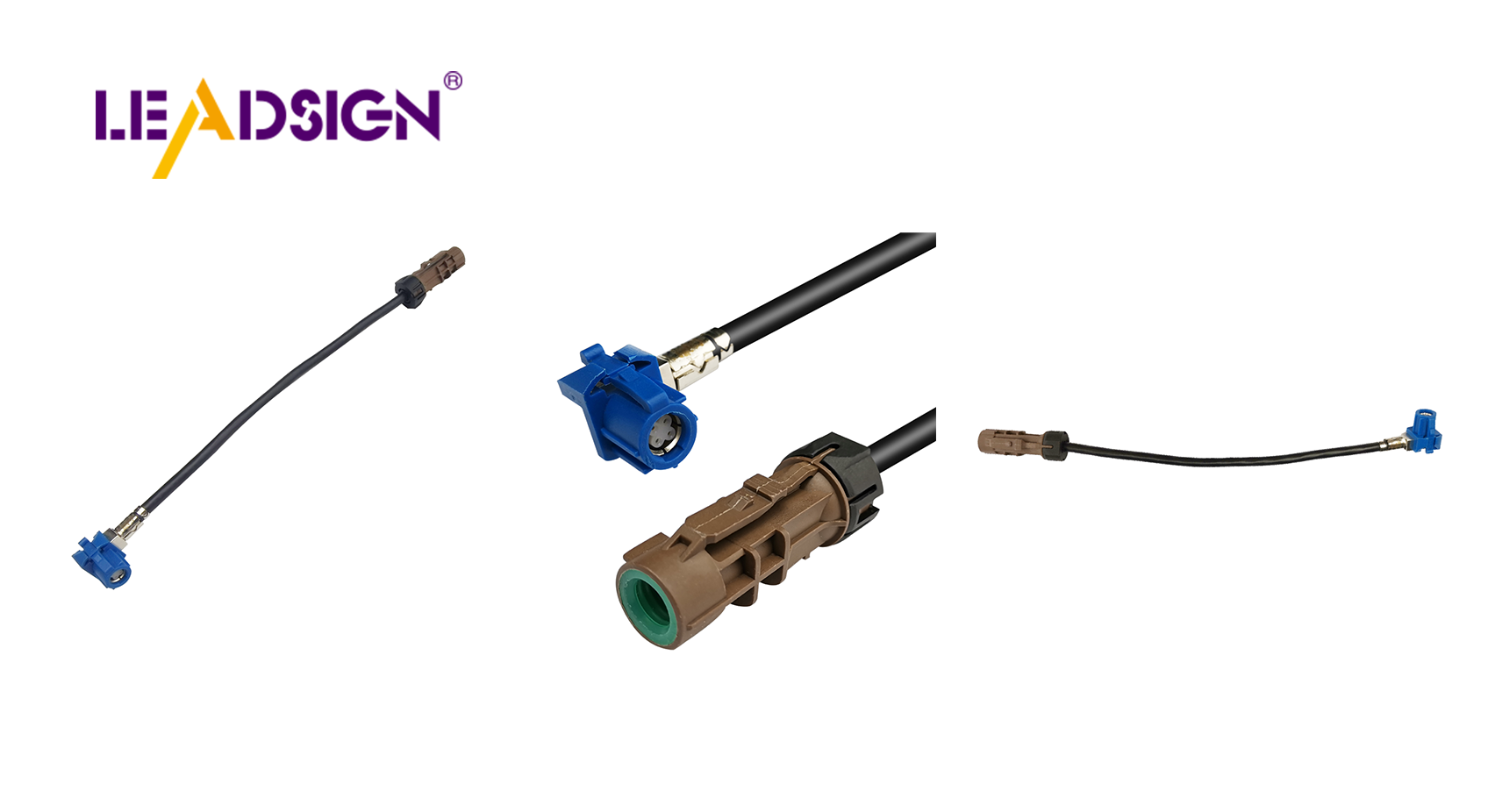
1. The Role of HSD Connectors – Meeting Current Data Demands
Vehicle system | Data rate required | HSD solution |
|---|---|---|
Backup camera (1080p) | ~1.5 Gbps | FAKRA / HSD (50Ω coax) |
4K surround camera | ~6‑12 Gbps | Mini HSD / HSD LVDS |
USB‑C CarPlay | 5 Gbps | HSD USB‑C (100Ω) |
ADAS radar / camera | 100 Mbps – 1 Gbps | HSD Ethernet (100Ω) |
Autonomous driving (raw sensor data) | 10+ Gbps | Multiple HSD lanes, fibre (future) |
Limitations of traditional connectors:
No impedance control → signal reflections, data corruption
No shielding → EMI susceptibility from wipers, alternators, EV motors
Low bandwidth → cannot carry video or high‑speed data
HSD solves these problems with controlled impedance (50Ω or 100Ω), double shielding, and high‑frequency performance.
2. HSD Connectors – Key Specifications & Features
Parameter | HSD (generic) | FAKRA (coaxial variant) | HSD differential |
|---|---|---|---|
Impedance | 100Ω (differential) / 50Ω (coax) | 50Ω | 100Ω |
Data rate | Up to 5 Gbps (USB 3.0), 1 Gbps (Ethernet) | Up to 8 Gbps (standard), 28 Gbps (Mini) | 5 Gbps |
Frequency | DC – 6 GHz | DC – 6 GHz (standard), 20 GHz (Mini) | DC – 6 GHz |
Shielding | Double (foil + braid) | Double (foil + braid) | Double |
Locking | Secondary lock / CPA | Secondary lock + colour coding | Secondary lock |
Sealing | IP67 optional | IP67 optional | IP67 optional |
Mating cycles | ≥ 25 | ≥ 25 | ≥ 25 |
Mechanical structure:
Robust connector body (high‑temp thermoplastic)
Gold‑plated contacts for low resistance, corrosion resistance
Dust cover / sealing mechanisms for environmental protection
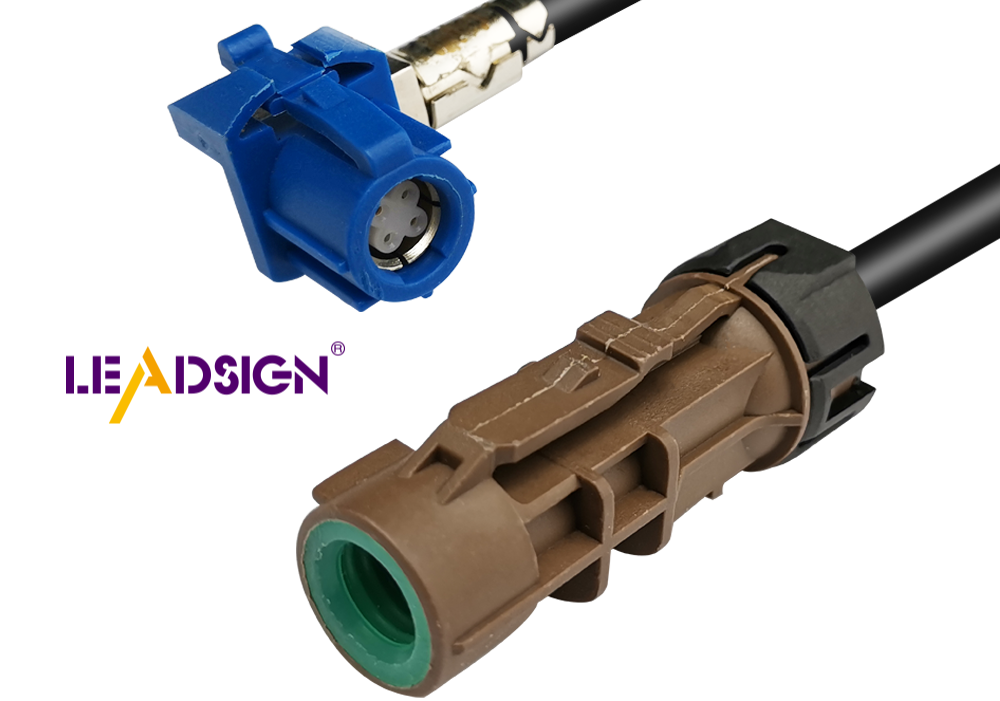
3. How HSD Compares to Traditional Connectors
Feature | Traditional power connector (Deutsch, Molex) | HSD connector |
|---|---|---|
Signal type | Power, low‑frequency analog | High‑speed data (video, USB, Ethernet) |
Impedance | Not specified | 50Ω or 100Ω |
Shielding | None | Double shielding |
Max data rate | < 10 Mbps | 5 Gbps – 28 Gbps |
Vibration rating | Good (secondary lock) | Good (secondary lock) |
Cost | Low to moderate | Moderate |
Key takeaway: You cannot replace an HSD connector with a traditional power connector – the signal will be corrupted or lost. Use each for its intended purpose.
4. Applications of HSD Connectors
🔹 Automotive – In‑Vehicle Infotainment (IVI)
Function: Connects head unit to displays, USB ports, speakers.
HSD role: Carries USB‑C (CarPlay), LVDS video, and audio signals.
Example: HSD USB‑C cable from dashboard USB port to infotainment module.
🔹 Advanced Driver‑Assistance Systems (ADAS)
Function: Connects cameras, radar, and LiDAR to ADAS ECU.
HSD role: Automotive Ethernet (100BASE‑T1, 1000BASE‑T1) over HSD.
Example: Front camera to ADAS processor – HSD Ethernet cable.
🔹 Autonomous Driving
Function: Massive data from multiple sensors to central computer.
HSD role: High‑bandwidth LVDS or Ethernet links.
Example: 4K surround cameras use Mini HSD (20 GHz).
🔹 Beyond Automotive – Telecom, Smart Home, Medical, Industrial
Telecom: High‑speed data in base stations.
Smart home: Connecting IoT gateways.
Medical: Imaging equipment (high data rate, reliability).
Factory automation: Real‑time machine control.
5. Future Development Trends (2026‑2030)
Trend | Implication for HSD |
|---|---|
Faster data speeds | HSD evolving to 10 Gbps, 28 Gbps (Mini HSD) – supports 8K video. |
Miniaturisation | Smaller connectors (80% space saving) for compact modules. |
Stronger build | Higher vibration rating, more robust lock mechanisms. |
Better water/dust protection | IP69K sealed HSD for underbody and exterior cameras. |
Integration with 3D printing & VR | HSD used for high‑speed data in VR headsets and 3D printers. |
What this means for your shop: Stocking HSD (FAKRA, HSD differential) cables is no longer optional – even basic camera retrofits require them.
6. Why LEADSIGN – Your HSD Connector Partner
You don’t need to pay Rosenberger or TE premium prices. LEADSIGN offers OEM‑grade HSD and FAKRA connectors at 30‑50% lower cost, with pre‑terminated cables in custom lengths.
What LEADSIGN provides:
✅ FAKRA (standard & Mini) – all 14 colours, 50Ω, up to 20 GHz, IP67 optional
✅ HSD (USB‑C, Ethernet, LVDS) – 100Ω, locking, up to 5 Gbps
✅ Pre‑terminated cables – any length 0.3m – 20m, no field crimping
✅ Low‑loss, double‑shielded coax – for long runs and EV environments
✅ Bulk pricing – for shops, fleets, and distributors
For your business: When you install a backup camera, USB‑C CarPlay, or ADAS sensor, use LEADSIGN pre‑terminated HSD cables – plug‑and‑play, perfect signal integrity, no callbacks.
Final Recommendations – HSD Connector Selection
Application | HSD connector | Key feature | Source |
|---|---|---|---|
GPS antenna | FAKRA amber (50Ω) | Low loss, colour‑coded | LEADSIGN |
Backup camera (1080p) | FAKRA blue (50Ω) | 6 GHz, reliable | LEADSIGN |
4K camera (truck/bus) | Mini FAKRA blue (low‑loss) | 20 GHz, long reach | LEADSIGN |
5G telematics | Mini FAKRA violet | Double‑shielded | LEADSIGN |
USB‑C CarPlay | HSD USB‑C (100Ω) | Locking, 5 Gbps | LEADSIGN |
ADAS Ethernet | HSD 100Ω (4‑pin) | 100/1000BASE‑T1 | LEADSIGN |
Remember: HSD connectors are the key to high‑speed data in modern vehicles. Choose the right type, and your systems will perform.
Ready to upgrade to pre‑terminated HSD cables?
See Also
Exploring HSD Connectors in Automotive Technology
Benefits of HSD Connectors for Automotive Applications
Significance of HSD Connectors in Automotive Sector