Automotive Electrical Connector Types: A Complete Selection Guide

Intro:
Explore the main automotive electrical connector types by function, structure, protection level, and application. Learn how to select waterproof, FAKRA, and HSD connectors for your automotive project.
Modern vehicles depend on hundreds of electrical connections to power lights, sensors, control units, cameras, antennas, infotainment systems, and safety equipment. Choosing the right automotive electrical connectors is therefore more than a packaging decision. A connector must carry the required current or signal while surviving vibration, temperature changes, moisture, dust, chemicals, and repeated mating cycles.
An unsuitable connector can cause intermittent signals, voltage drops, corrosion, water ingress, electromagnetic interference, or complete system failure. For engineers and purchasing teams, understanding the major connector categories makes it easier to balance electrical performance, reliability, installation space, cost, and supply availability.
This guide explains the most common automotive electrical connector types, how they are classified, and which factors matter when selecting connectors for a new vehicle, replacement harness, or custom automotive electronics project.
一、How Automotive Electrical Connectors Are Classified by Function
Automotive connectors can first be classified according to the type of power or signal they carry. Although some connector families can serve more than one function, most are designed around specific electrical, mechanical, and environmental requirements.
Power connectors
Power connectors transfer electrical energy from the vehicle battery, power distribution unit, or electronic control unit to downstream devices. Typical applications include:
Lighting systems
Electric motors and pumps
Heating elements
Cooling fans
Seat adjustment systems
Battery management equipment
Auxiliary power modules
The main selection factors are rated current, working voltage, terminal resistance, wire size, temperature rise, and protection against accidental disconnection.
A low-current sensor circuit may only need small terminals and thin wires. A motor or heating circuit, however, requires larger contact surfaces, lower resistance, and stronger terminal retention. The connector housing should also prevent the wrong circuits from being mated.
For high-current applications, engineers must evaluate the complete connection system rather than only the nominal terminal rating. Wire gauge, crimp quality, ambient temperature, number of loaded circuits, and airflow can all affect actual performance.
Signal connectors
Signal connectors carry low-voltage information between sensors, switches, actuators, electronic control units, and diagnostic systems. Examples include connections for:
Temperature and pressure sensors
Wheel-speed sensors
Position sensors
Parking sensors
Door and seat switches
Lighting control modules
Engine and transmission sensors
These automotive wire connectors often use compact terminals because the current is low. Nevertheless, they require stable contact resistance and reliable secondary locking. Even a brief interruption can generate a fault code or cause incorrect sensor readings.
For circuits exposed to vibration, a secure terminal retention system is essential. Many automotive connector designs therefore combine a primary terminal lock with a secondary lock or terminal position assurance mechanism.
Data and communication connectors
As vehicles become more connected, connectors must handle increasing amounts of digital information. Cameras, displays, telematics units, driver-assistance systems, and infotainment modules require interfaces that maintain controlled impedance and protect signals from electromagnetic interference.
Common automotive communication technologies include:
CAN and LIN networks
Automotive Ethernet
LVDS video links
USB connections
Camera interfaces
High-speed infotainment links
A conventional low-speed automotive electrical connector may be sufficient for CAN or simple control circuits, but high-resolution cameras and multimedia systems require connectors engineered specifically for high-speed transmission.
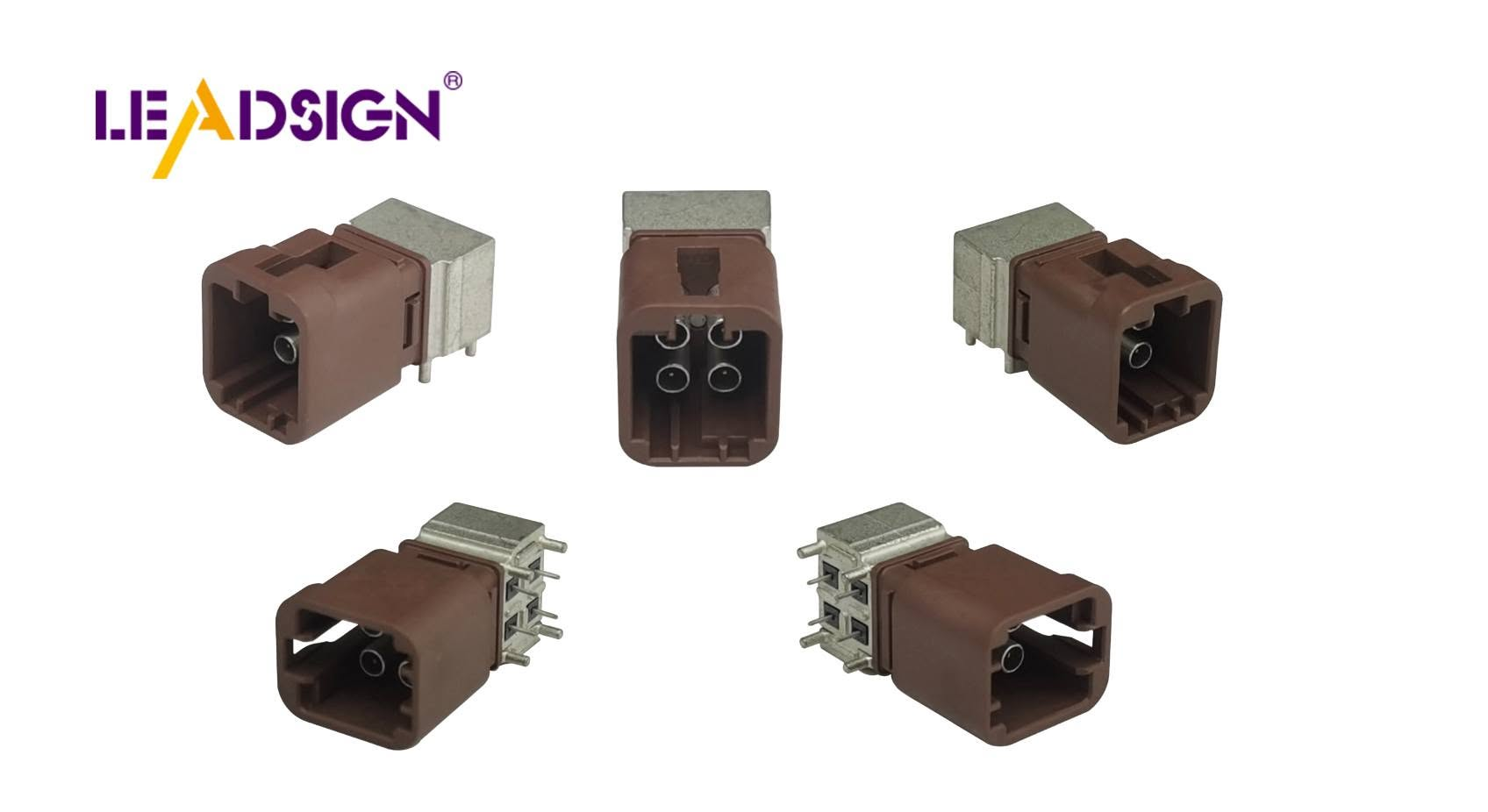
HSD connectors are widely used for differential data connections in automotive electronics. Their shielded multi-contact design supports applications such as displays, cameras, USB, LVDS, Ethernet, telematics, and navigation equipment. For cable-based applications, view our HSD cable assembly range.
RF and antenna connectors
Radio-frequency connections require a different design approach from ordinary power and signal circuits. They must maintain the specified impedance and minimize insertion loss, reflections, and interference.
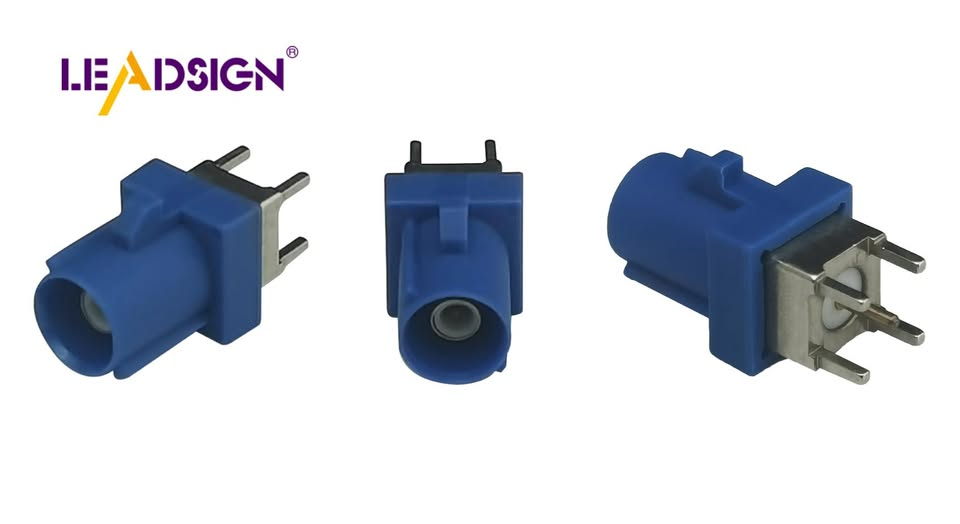
FAKRA connectors are commonly used in automotive RF applications such as:
AM/FM radio
GPS and GNSS navigation
Cellular and telematics equipment
Satellite radio
Wi-Fi and Bluetooth antennas
Remote keyless entry
Vehicle cameras in applicable designs
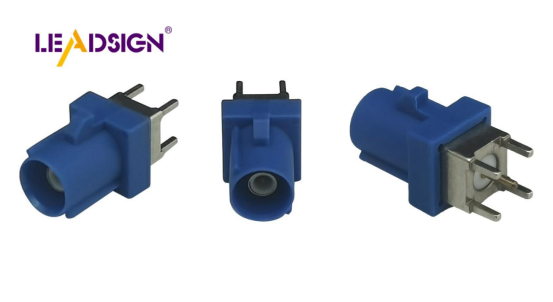
A FAKRA connector combines an RF interface with a robust automotive housing. Color and mechanical coding help prevent incorrect mating during vehicle assembly.
FAKRA systems may be supplied as PCB connectors, cable connectors, complete FAKRA cable assemblies, or a FAKRA antenna adapter connecting different RF interfaces. You can explore our FAKRA and HSD connector products and FAKRA antenna adapters.
Diagnostic and service connectors
Diagnostic connectors provide access to vehicle networks and control units for testing, programming, maintenance, and fault diagnosis. They may be standardized interfaces or application-specific service connections located within an electronic module or wiring harness.
Service connectors should be easy for technicians to identify and mate, but they must also resist incorrect insertion. If frequent connection cycles are expected, mating durability becomes more important than it would be for a connector installed only once during vehicle assembly.
二、Automotive Electrical Connector Types by Structure
Connectors can also be classified by how wires and circuit boards are connected. The three main structural categories are wire-to-wire, wire-to-board, and board-to-board.
Wire-to-wire connectors
Wire-to-wire connectors join two sections of a wiring harness. They are widely used when a harness must be divided into manageable modules or when a component includes a short pigtail.
Typical applications include:
Lighting harnesses
Door and seat wiring
Sensor pigtails
Engine-bay harnesses
Camera extension cables
Replacement and repair harnesses
Wire-to-wire designs can range from simple two-pin plugs to large multi-pin housings. A complete connection normally includes male and female housings, terminals, seals when required, and secondary locking components.
An automotive connector kit may package these components together, allowing the installer to terminate wires for a specific application. Buyers should confirm whether a kit includes both mating halves, terminals, wire seals, cavity plugs, and any required locking parts.
Wire-to-board connectors
Wire-to-board connectors connect a wiring harness directly to a printed circuit board. They are common in electronic control units, displays, infotainment devices, cameras, antennas, sensors, and communication modules.
The board side may use through-hole or surface-mount termination. Depending on the available space, the connector can be straight or right-angle.
Important design considerations include:
PCB layout
Mounting orientation
Available height above the board
Mechanical support
Pin count
Current or signal requirements
Shielding and impedance
Assembly and soldering process
For high-speed or RF applications, the transition from the cable to the PCB must be carefully controlled. A suitable connector should maintain signal integrity while providing adequate mechanical retention.
Board-to-board connectors
Board-to-board connectors link two printed circuit boards inside an electronic assembly. They can help create modular designs and reduce internal wiring, particularly in compact control units and display systems.
These connectors may be arranged as parallel, perpendicular, or stacked connections. Selection depends on contact pitch, board spacing, current rating, signal speed, vibration performance, and assembly tolerances.
Although board-to-board connectors are protected inside an enclosure, they still need to withstand the vehicle’s temperature and vibration conditions. An automotive-qualified electronic module should be evaluated as a complete system rather than assuming that its enclosure eliminates all connector-related risks.
三、Automotive Connectors by Environmental Protection Level
The installation environment strongly affects connector construction. A protected passenger-compartment connection does not face the same conditions as a connector mounted near the engine, wheel well, vehicle exterior, or battery system.
Non-waterproof connectors
Non-waterproof connectors are suitable for dry, protected locations where direct exposure to water, dust, or aggressive chemicals is unlikely. They are often used inside:
Instrument panels
Sealed electronic modules
Interior trim
Infotainment systems
Climate-control panels
Protected passenger-compartment harnesses
Their advantages can include smaller size, fewer parts, easier assembly, and lower cost. However, they should not be used in exposed areas simply because the electrical ratings are suitable.
Engineers should still consider condensation, accidental liquid exposure, temperature cycling, and contamination during assembly or service.
Waterproof automotive connectors
A waterproof automotive connector uses housing seals, wire seals, interface seals, and correctly matched terminals to reduce the risk of water and dust entering the connection.
IP67 typically indicates that an enclosure is protected against dust and temporary immersion under defined test conditions. IP69K is associated with resistance to close-range, high-pressure, high-temperature water spray under defined conditions. The required protection level should be determined by the actual mounting location and vehicle validation plan.
Waterproof connectors are commonly used in:
Engine compartments
Exterior lighting
Chassis-mounted sensors
Cameras
Agricultural and construction vehicles
Heavy trucks
Electric vehicle systems
Off-road equipment
The connector label alone does not guarantee a waterproof installation. Seal compatibility, wire insulation diameter, terminal crimping, unused-cavity plugs, mating condition, harness routing, and strain relief all affect final performance.
A sealed connector assembled with the wrong wire seal or damaged during crimping may fail even if its housing was designed for a high protection level.
四、How to Select the Right Automotive Electrical Connector
A reliable selection process begins with system requirements, not with housing appearance or price. The following factors should be defined before requesting samples or quotations.
1. Identify the signal or power type
Start by determining what the connector will carry:
High-current power
Low-current sensor signal
CAN or LIN communication
Differential high-speed data
RF antenna signal
Video or camera data
Mixed power and signal circuits
For basic power and sensor circuits, conventional sealed or unsealed automotive connectors may be suitable. For RF antenna signals, a 50-ohm FAKRA connector is usually more appropriate than a general-purpose electrical connector.
For high-speed differential data, an HSD connector or corresponding cable assembly may be required. HSD products are designed for shielded automotive data links, while FAKRA products are primarily associated with coaxial RF transmission.
Do not select FAKRA and HSD only by connector size or external appearance. Their electrical structures and intended applications are different.
2. Evaluate the operating environment
Define the full environmental profile:
Minimum and maximum temperature
Water and dust exposure
Vibration and mechanical shock
Contact with oil, fuel, cleaners, or road salt
UV exposure
Installation inside or outside a sealed enclosure
Expected mating cycles
If the connector will be exposed to moisture or installed outside the passenger compartment, use an appropriately validated waterproof series. Also confirm that seals match the selected wire diameter.
3. Confirm electrical requirements
For power circuits, specify:
Working voltage
Continuous and peak current
Wire gauge
Number of simultaneously loaded circuits
Maximum acceptable contact resistance
Permitted temperature rise
For signal circuits, specify:
Signal type
Frequency or data rate
Required impedance
Shielding
Crosstalk limits
Insertion and return-loss requirements
These parameters are especially important for FAKRA cables, HSD cables, cameras, antennas, and infotainment links.
4. Consider installation space
Automotive electronic assemblies often have limited space. Check:
Connector width and height
Cable exit direction
Straight or right-angle orientation
Required mating clearance
Minimum cable bend radius
Latch access
PCB mounting method
Harness routing and strain relief
A connector may fit in a CAD model but still be difficult to assemble or disconnect inside the actual vehicle.
5. Choose the correct terminal and wire
The housing, terminal, seal, and wire must work as one system. Confirm terminal compatibility with:
Conductor size
Insulation diameter
Copper construction
Plating requirements
Crimping equipment
Current load
Environmental exposure
A correct crimp should provide both electrical contact and mechanical retention. Pull-force inspection, crimp-height control, and cross-section analysis may be required during validation or production quality control.
6. Check coding and mistake-proofing
Mechanical keys and color coding help prevent assembly errors. This is particularly important when several similar connectors are placed close together.
FAKRA connector families use standardized mechanical and color coding to distinguish different RF connections. HSD systems also use coding options to prevent incompatible interfaces from being mated.
Coding should be selected early because it affects housings, PCB connectors, cable ends, purchasing documentation, and service parts.
7. Review applicable compliance requirements
Depending on the project, connector materials and performance may need to comply with customer specifications or standards such as:
RoHS material restrictions
REACH-related material requirements
USCAR performance requirements
OEM-specific connector specifications
Flammability requirements
Electrical and environmental validation plans
RoHS compliance concerns restricted substances; it does not by itself prove that a connector will survive automotive vibration, water exposure, temperature cycling, or electrical loads.
Likewise, “USCAR” should not be treated as a generic label. The purchasing specification should define the applicable test standard, revision, class, environment, and acceptance criteria. Always request the relevant test reports and compliance documents for the exact product configuration.
8. Plan for production and service
A technically suitable connector must also be practical to source, assemble, inspect, and service. Purchasing and manufacturing teams should consider:
Minimum order quantity
Sample availability
Tooling and crimp applicators
Lead time
Replacement parts
Packaging
Traceability
Custom cable and harness support
When requesting a quotation, provide drawings, mating-part information, coding, wire specifications, cable length, quantity, operating conditions, and validation requirements. Complete information significantly reduces the risk of receiving an unsuitable proposal.
五、Why Work With a Specialized FAKRA and HSD Connector Manufacturer?
Shenzhen Leadsign Automotive Electronics focuses on automotive FAKRA, HSD, Mini FAKRA, coaxial adapters, cable assemblies, antennas, and custom harness solutions. Our team has more than seven years of automotive connector industry experience and supports OEM and ODM requirements.
Our capabilities include:
FAKRA and HSD connector supply
PCB and cable-mount connector options
FAKRA cable assemblies
HSD and LVDS cable assemblies
FAKRA antenna adapters
Custom connector coding and cable length
Automotive wiring-harness assembly
Sample development
RoHS-compliant product options and supporting documentation
Application-based product selection support
Rather than selecting a connector only from a catalog image, customers can provide electrical requirements, installation space, cable details, environmental conditions, drawings, or existing samples. Our team can then help evaluate a suitable connector or cable-assembly configuration.
六、Conclusion: Select Automotive Connectors as a Complete System
Choosing among different automotive electrical connector types requires more than matching the number of pins. Engineers and buyers must consider function, structure, current, data rate, impedance, sealing, temperature, vibration, coding, installation space, and compliance requirements.
Conventional automotive connectors are suitable for many power and sensor circuits, while waterproof families protect connections in demanding environments. FAKRA products support automotive RF and antenna systems, and HSD products serve high-speed differential data applications.
Not sure which connector, adapter, or cable assembly fits your project? Contact our automotive connector team for selection support, samples, custom development, or a detailed quotation. Please include your application, connector type, coding, cable length, quantity, drawing, and environmental requirements so we can recommend the right solution.

See also
Understanding Automotive Electrical Connectors Types
Comprehensive Review of Waterproof Automotive Electrical Connector Plugs
Which Automotive Electrical Connectors Types Are Most Reliable? – Professional B2B Guide (2026)