Understanding Automotive Electrical Connectors Types

Intro: The Backbone of Modern Vehicle Electronics
Automotive electrical connectors are the critical links between every electronic component in a vehicle – from engine controls and sensors to infotainment and safety systems. With the rise of electric vehicles, ADAS, and connected cars, the demand for reliable, high‑performance connectors is growing rapidly. The global automotive connector market was valued at USD 7.9 billion in 2022 and is projected to grow at 7% annually through 2032. Understanding the different connector types is essential for any repair shop, fleet manager, or custom harness builder to ensure reliability, safety, and long‑term performance.
In this guide, you will learn:
The most common automotive connector types (blade, pin, butt, ring)
Their features, applications, advantages, and disadvantages
Key selection criteria (environment, power, physical needs)
Common problems and maintenance practices
Why LEADSIGN FAKRA/HSD connectors are essential for high‑speed data
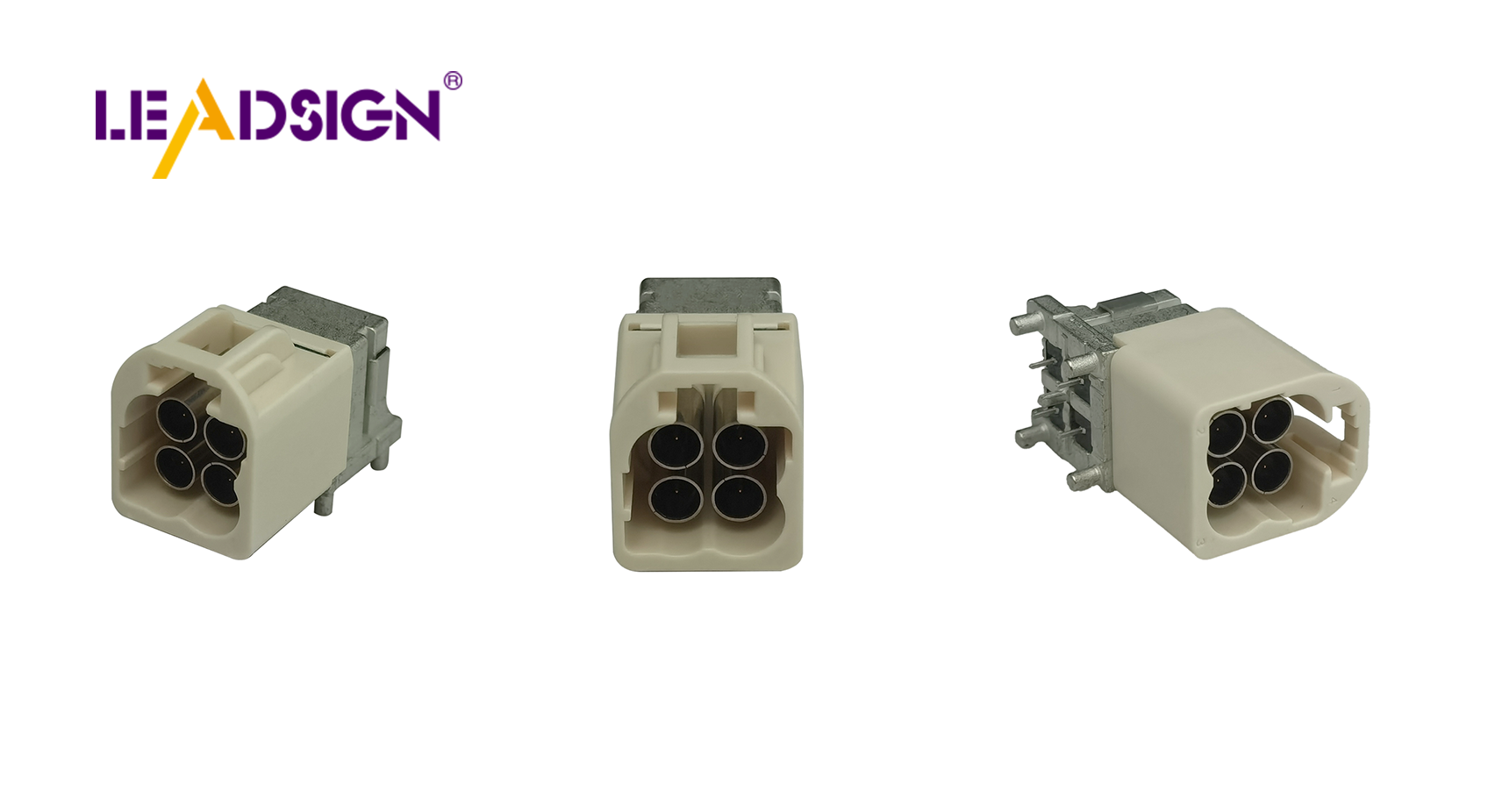
1. Overview of Common Automotive Electrical Connectors
🔹 Blade Connectors (Spade Connectors)
Description: Flat male terminal (blade) that inserts into a female receptacle. Often unsealed.
Applications: Switches, fuse boxes, relays, interior lighting, basic power circuits.
Advantages: Simple, low cost, easy to disconnect.
Disadvantages: Low current rating (typically <20A); not sealed – interior use only; can loosen under vibration.
🔹 Pin Connectors
Description: Round male pins and female sockets in a plastic housing. Can be sealed or unsealed.
Applications: ECU, transmission, sensors, multi‑pin harness connections.
Advantages: High density, can be sealed (IP67), good vibration resistance, reliable in harsh environments.
Disadvantages: Requires precise alignment and proper crimp tool; more complex installation; higher cost.
🔹 Butt Connectors
Description: Cylindrical splice connector that joins two wires end‑to‑end. Available unsealed or with heat‑shrink (sealed).
Applications: Wire repair, extending circuits, general splicing in harnesses.
Advantages: Simple permanent splice; heat‑shrink versions are waterproof and corrosion‑resistant.
Disadvantages: Not reusable; requires proper crimp tool; may not handle very high currents without proper sizing.
🔹 Ring Connectors (Ring Terminals)
Description: Circular terminal that fits over a bolt or stud. Provides a very secure, vibration‑proof connection.
Applications: Battery terminals, chassis ground points, alternator connections, power distribution.
Advantages: Extremely secure – cannot vibrate off; excellent current capacity; simple design.
Disadvantages: Requires disassembly of bolt/stud for removal; slower to disconnect; careful installation needed to ensure proper contact.
2. Key Selection Criteria for Automotive Connectors
When choosing the right connector, consider the following factors:
Criterion | What to evaluate | Why it matters |
|---|---|---|
Environment (heat, moisture, chemicals) | IP rating (IP67/IP69K for exterior/underbody), temperature range (-40°C to +125°C), chemical resistance | Prevents corrosion, melting, and premature failure. |
Power requirements (current, voltage) | Current rating (amps), voltage rating | Ensures connector can handle the load without overheating. |
Signal integrity | Impedance (50Ω for RF, 100Ω for differential), shielding | Prevents signal loss and interference in data lines. |
Physical needs (vibration, strength) | Secondary lock / CPA, USCAR‑2 vibration rating | Prevents loosening under vibration. |
Ease of installation | Crimp vs. solder vs. pre‑terminated; tool requirements | Reduces labour time and installation errors. |
Pro tip: For exterior or underbody connections, always use sealed (IP67) connectors – unsealed connectors will corrode within months.
3. Data Connectors – The Special Case (FAKRA, HSD)
Traditional blade, pin, butt, and ring connectors are designed for power and low‑frequency signals. They cannot carry high‑speed data (video, USB, Ethernet). For that, you need:
Connector type | Impedance | Data rate | Typical use |
|---|---|---|---|
FAKRA (standard) | 50Ω | Up to 8 Gbps / 6 GHz | GPS antenna, SDARS, backup camera (1080p) |
Mini FAKRA | 50Ω | Up to 28 Gbps / 20 GHz | 4K camera, 5G telematics |
HSD (differential) | 100Ω | Up to 5 Gbps | USB‑C CarPlay, LVDS, Ethernet (ADAS) |
LEADSIGN specialises in pre‑terminated FAKRA and HSD cables – colour‑coded (amber=GPS, blue=camera, violet=5G), custom lengths, and factory‑tested for impedance and loss.
4. Common Problems & Maintenance
Problem | Cause | Prevention / Fix |
|---|---|---|
Corrosion (green/white powder) | Water ingress, unsealed connector | Use sealed (IP67) connectors; apply dielectric grease to seals. |
Loose connection | Vibration, no secondary lock, poor crimp | Use connectors with CPA; perform pull test after crimping. |
Overheating / melting | Undersized connector, high resistance | Match current rating; clean corrosion; replace damaged parts. |
Intermittent signal (data lines) | Impedance mismatch, poor shield contact | Use pre‑terminated FAKRA/HSD cables (LEADSIGN). |
Maintenance tips:
Inspect connectors every 6 months – look for corrosion, cracks, loose locks.
Clean with electrical contact cleaner – not water, not WD‑40.
Replace any connector with bent pins, broken lock, or deep corrosion.
5. Why LEADSIGN – Your High‑Speed Data Connector Partner
For power and basic signal connectors (blade, pin, butt, ring), many quality brands exist. However, for high‑speed data, LEADSIGN offers pre‑terminated, colour‑coded FAKRA and HSD cables that eliminate field‑crimp errors.
What LEADSIGN provides:
✅ FAKRA (standard & Mini) – all 14 colours, 50Ω, up to 20 GHz, IP67 optional
✅ HSD (USB‑C, Ethernet, LVDS) – 100Ω, locking, up to 5 Gbps
✅ Pre‑terminated cables – custom lengths 0.3m – 20m, no field crimping
✅ Low‑loss, double‑shielded coax – for long runs and EV environments
✅ Bulk pricing – for shops, fleets, and distributors
For your business: When you install a backup camera, GPS antenna, or USB‑C port, use LEADSIGN pre‑terminated FAKRA/HSD cables – plug‑and‑play, perfect signal integrity, no callbacks.
Final Recommendations – Connector Selection by Application
Application | Recommended connector type | Sealed? | Source |
|---|---|---|---|
Interior lights / switches | Blade or spade | No | Any |
Battery terminal / ground | Ring terminal (heat‑shrink) | Optional | Any quality brand |
Engine bay sensor (temp, pressure) | Pin connector (sealed) | Yes (IP67) | Deutsch / TE |
GPS antenna | FAKRA amber | Optional | LEADSIGN pre‑terminated |
Backup camera (1080p) | FAKRA blue | Optional | LEADSIGN |
4K camera (truck/bus) | Mini FAKRA blue (low‑loss) | IP67 optional | LEADSIGN |
5G telematics antenna | Mini FAKRA violet | IP67 optional | LEADSIGN |
USB‑C CarPlay | HSD USB‑C (100Ω) | No (interior) | LEADSIGN |
Remember: Understanding the different automotive electrical connector types is the first step to reliable repairs, lower callbacks, and vehicle safety.
Ready to optimise your connector inventory with pre‑terminated data cables?
See Also
Exploring HSD Connectors in Automotive Sector
Navigating Ford Fakra Connectors
Significance of Fakra Connectors in Modern Cars