Vehicle Connectors Explained: A Guide to Automotive Electrical Systems – Professional B2B Guide (2026)

Intro: Reliable Connectors Are the Backbone of Vehicle Safety and Performance
Vehicle connectors are small components with a massive responsibility – they carry power to lights, signals to sensors, and data to cameras. A single loose or corroded connector can cause intermittent failures, flickering lights, or even safety system malfunctions. Understanding the types, selection criteria, and maintenance of automotive connectors is essential for repair shops, fleet managers, and DIY enthusiasts alike.
In this guide, you will learn:
The role and importance of connectors in modern vehicles
Common connector types (blade, ring/spade, weatherproof, high‑speed data)
Key selection factors (electrical needs, environment, material)
Installation and maintenance best practices
Why LEADSIGN FAKRA/HSD connectors are the professional choice for high‑speed data
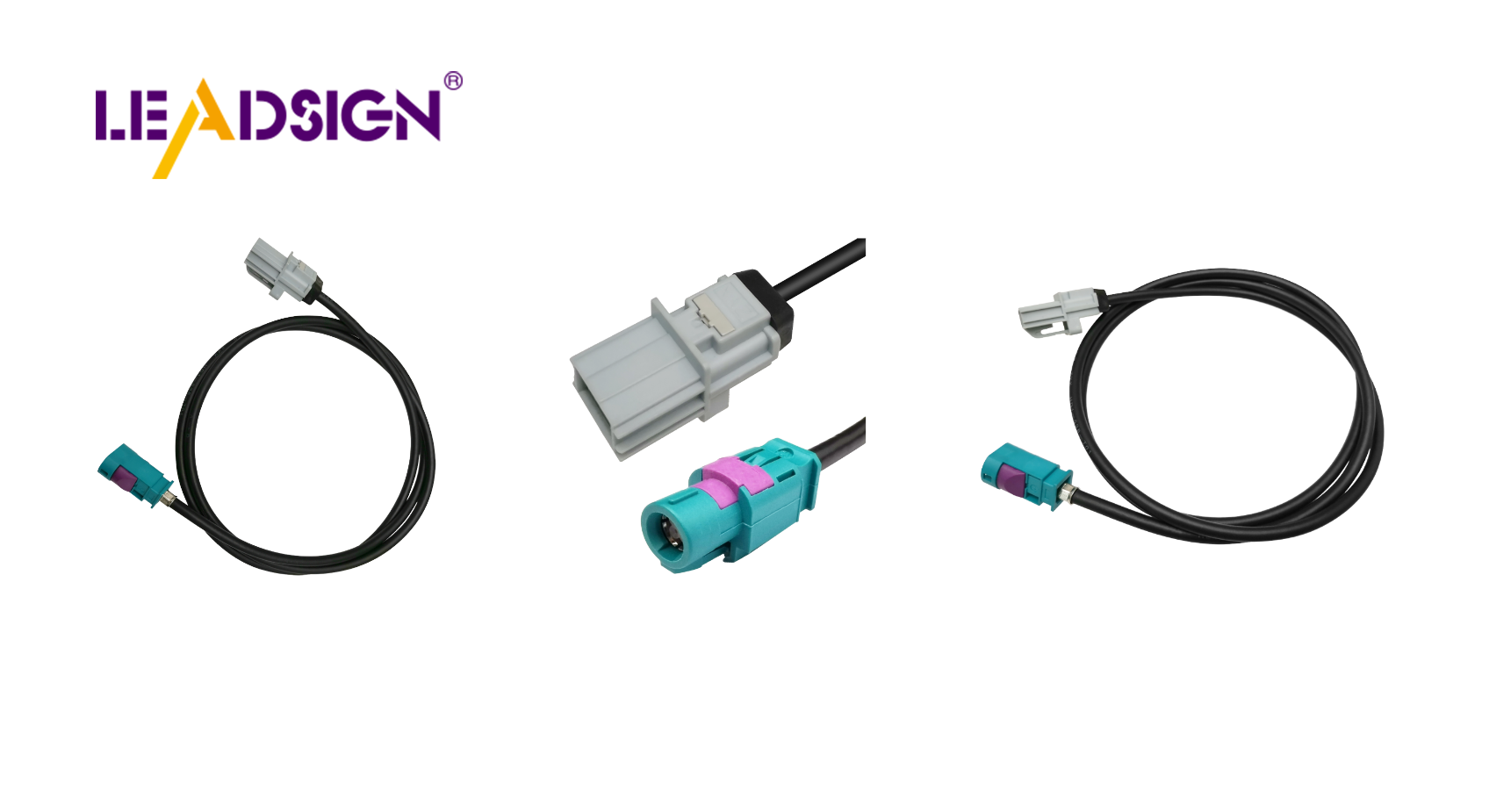
1. The Role of Vehicle Connectors in Automotive Electrical Systems
Connectors are the links between every electrical component – from the engine control unit (ECU) to the headlights, from the infotainment screen to the backup camera. They ensure:
Power delivery: Battery voltage reaches ECUs, lights, motors, and sensors.
Signal transmission: Low‑current signals travel between switches, sensors, and controllers.
Data communication: High‑speed data (video, GPS, USB‑C, Ethernet) moves without corruption.
Why they matter: A poor connection can cause voltage drops, intermittent failures, and even electrical fires. Investing in quality connectors and proper installation directly improves vehicle reliability and safety.
2. Common Types of Automotive Connectors
Connector Type | Description | Typical Use | Sealed? | Data Capable? |
|---|---|---|---|---|
Blade connector | Flat male terminal, female receptacle | Headlights, tail lights, fuse boxes | No | ❌ |
Ring terminal | Circular hole, fits over a stud | Battery connections, grounding points | No (add heat‑shrink) | ❌ |
Spade terminal | Fork‑shaped, slides under screw | Relays, switches, easy‑disconnect applications | No | ❌ |
Weatherproof connector | Sealed housing with rubber grommets | Engine bay sensors, underbody lights, exterior | Yes (IP67/IP69K) | ❌ (power/signal) |
FAKRA (coaxial) | Colour‑coded plastic housing, 50Ω | GPS antenna, backup camera (1080p/4K), 5G antenna | IP67 optional | ✅ Up to 20 GHz |
HSD (High‑Speed Data) | 4‑pin or 6‑pin, locking, 100Ω | USB‑C CarPlay, automotive Ethernet, LVDS | Optional | ✅ Up to 5 Gbps |
🔹 Blade Connectors
Uses: Lighting, fuse boxes, low‑current circuits.
Pros: Simple, low cost, easy to disconnect.
Cons: Not sealed; moderate vibration resistance.
🔹 Ring & Spade Terminals
Uses: Battery terminals (ring), relays/switches (spade).
Pros: Very secure (ring), easy to remove (spade).
Installation tip: Crimp properly, match wire gauge, and use heat‑shrink for corrosion protection.
🔹 Weatherproof Connectors
Uses: Engine bay sensors, underbody lights, exterior mirrors, off‑road vehicles.
Why needed: Prevent water, dust, and salt from corroding terminals.
Examples: Deutsch DT, Weather Pack, sealed FAKRA.
🔹 High‑Speed Data (HSD) Connectors
Uses: USB‑C (CarPlay), automotive Ethernet (ADAS), LVDS cameras.
Benefits:
Fast data transfer (up to 5 Gbps / 20 GHz for Mini FAKRA)
Impedance‑controlled (50Ω or 100Ω)
Locking mechanism prevents vibration loosening
Where found: Infotainment systems, telematics gateways, surround view cameras.
Quote: “In the exciting world of electronics, a small change can mean success or failure. Choosing the right connectors makes a system work well.”
3. Key Factors When Choosing Vehicle Connectors
Factor | What to check | Why |
|---|---|---|
Current & voltage rating | Match circuit load (e.g., 10A for lights) | Prevents overheating, voltage drop. |
Compatibility with vehicle systems | Pin count, keying, colour coding | Ensures proper fit and function. |
Environmental conditions | Temperature (-40°C to +125°C), IP rating | Survives engine bay, underbody, or exterior. |
Vibration resistance | Secondary lock / CPA, USCAR‑2 rated | No loosening on rough roads. |
Material | Copper alloy terminals, tin/gold plating | Corrosion resistance, low resistance. |
Durability | Mating cycles (≥25 for serviceable) | Long‑term reliability. |
Pro tip: For any exterior or underbody connection, always use sealed (IP67) connectors – unsealed connectors will corrode within months.
4. Installation & Maintenance Best Practices
✅ Installation Tips
Use the right tools: Ratcheting crimper, wire strippers, heat gun.
Strip wires correctly: 5‑8 mm, no nicked strands.
Crimp or solder properly: Pull test (5‑10 lbs) – wire must not move.
Seal exterior splices: Use adhesive‑lined heat‑shrink tubing.
For FAKRA/HSD cables: Use pre‑terminated cables (LEADSIGN) – no field crimping.
✅ Maintenance Checklist
Task | Frequency |
|---|---|
Visual inspection (corrosion, cracks, loose locks) | Every 6 months / 20,000 km |
Clean with contact cleaner; apply dielectric grease to seals | Annually or after water exposure |
Perform tug test on critical connectors | Every service |
Replace any connector with bent pins, broken lock, or deep corrosion | Immediately |
Common mistakes to avoid:
Using the wrong size connector (loose fit or forced).
Poor crimping (loose connection, overheating).
Over‑tightening screws (cracks housing).
Ignoring corrosion – clean and replace early.
5. Why LEADSIGN – Your Partner for High‑Speed Data Connectors
For power and basic signal connectors, many brands (TE, Molex, Deutsch) offer excellent products. However, for high‑speed data (FAKRA, HSD), field termination is difficult and error‑prone. LEADSIGN provides pre‑terminated, colour‑coded cables that eliminate guesswork.
What LEADSIGN offers:
✅ FAKRA (standard & Mini) – all 14 colours, 50Ω, up to 20 GHz, IP67 optional
✅ HSD (USB‑C, Ethernet, LVDS) – 100Ω, locking, up to 5 Gbps
✅ Pre‑terminated cables – custom lengths 0.3m – 20m, no field crimping
✅ Low‑loss, double‑shielded coax – for long runs and EV environments
✅ Bulk pricing – for shops, fleets, and distributors
For your business: When you install a backup camera, GPS antenna, or USB‑C port, use LEADSIGN pre‑terminated FAKRA/HSD cables – plug‑and‑play, perfect signal integrity, no callbacks.
Final Recommendations – Connector Selection Summary
Application | Recommended Connector | Source |
|---|---|---|
Interior lights / switches | Blade or spade (unsealed) | Any |
Battery terminal / ground | Ring terminal (copper, heat‑shrink) | Any quality brand |
Engine bay sensor (temp, pressure) | Deutsch DT or Weather Pack (sealed) | TE / Deutsch |
Underbody camera power | Sealed butt (IP67) | Any |
GPS antenna | FAKRA amber (50Ω) | LEADSIGN pre‑terminated |
Backup camera (1080p) | FAKRA blue | LEADSIGN |
4K camera (truck/bus) | Mini FAKRA blue (low‑loss) | LEADSIGN |
5G telematics antenna | Mini FAKRA violet | LEADSIGN |
USB‑C CarPlay | HSD USB‑C (locking) | LEADSIGN |
Remember: A connector that fits mechanically is not enough – it must match the electrical requirements (current, impedance, shielding, environment). Choose wisely, and your repairs will last.
Ready to simplify your connector inventory with pre‑terminated data cables?
See Also
Understanding Ford Fakra Connectors: A Comprehensive Overview
Fundamentals of HSD Connectors for Automotive Applications
Enhancing Automotive Data Flow with Advanced Connectors