Most Used Electrical Connectors in Car Systems: A Professional Guide for Shops & Fleets (2026)

Intro: Connectors Are the Nervous System of Every Vehicle
Modern vehicles contain hundreds of connectors – from simple 2‑pin power plugs to high‑speed data links for cameras and sensors. Understanding the most used electrical connector types is essential for any repair shop or fleet technician. Misidentifying or mishandling a connector can lead to intermittent failures, comebacks, and even safety hazards.
In this guide you will learn:
The most common connectors (OBD‑II, USB, sensor, JST, Dupont, Molex, FAKRA, HSD) and their roles
Where to find them and how to diagnose faults
Proper maintenance and repair techniques
2026 trends affecting connector reliability
Why LEADSIGN is your partner for high‑quality FAKRA & HSD connectors
1. Connectors Every Technician Must Know
🔹 OBD‑II Connector (J1962)
Purpose: Diagnostic access to vehicle networks (CAN, LIN, Ethernet). Used with scan tools for trouble codes, live data, programming.
Location: Under the driver’s side dashboard, near steering column.
Pinout (16‑pin): Pins 4,5 = ground; pin 16 = battery power; pins 6,14 = CAN‑H/CAN‑L; others for manufacturer‑specific signals.
Common failures: Bent pins, corrosion from moisture, broken lock tabs.
Tip: Keep a known‑good OBD‑II breakout box for quick diagnostics.
🔹 USB Ports (A, C, Mini, Micro)
Purpose: Charging, data transfer (CarPlay, Android Auto, media playback), and firmware updates.
Locations: Center console, dashboard, rear seats.
Common failures: Loose internal solder joints, damaged connector shells from forced insertion.
2026 trend: USB‑C is replacing older types; locking HSD USB‑C connectors are appearing in commercial fleets.
🔹 Sensor Connectors
Purpose: Connect engine sensors (temp, pressure, oxygen), ABS, airbags, parking sensors, cameras.
Locations: Engine bay, bumper area, wheel wells, interior.
Common types: Weather Pack (GM), Deutsch DT (heavy‑duty), TE MCON, and FAKRA (for cameras and radar).
Failure signs: Flickering signals, warning lights, sensor dropouts.
🔹 JST Connectors
Purpose: Small, compact connectors for interior electronics (HVAC controls, window switches, infotainment modules).
Locations: Behind dashboard, door panels.
Features: Locking latch, low profile.
Repair: Often requires micro‑crimp tool; better to replace the harness section.
🔹 Dupont Connectors
Purpose: Prototyping, test points, low‑current signal connections (e.g., aftermarket alarms, lighting controllers).
Caution: Not sealed; not for engine bay or underbody. Found mostly in DIY and non‑critical circuits.
🔹 Molex Connectors (MX150, Mini‑Fit, etc.)
Purpose: Power distribution (lights, fans, pumps) and some signal applications. Sealed (MX150L) and unsealed versions.
Locations: Engine bay, interior fuse box, body control module.
Strengths: High current capacity (up to 40A), multiple pin counts.
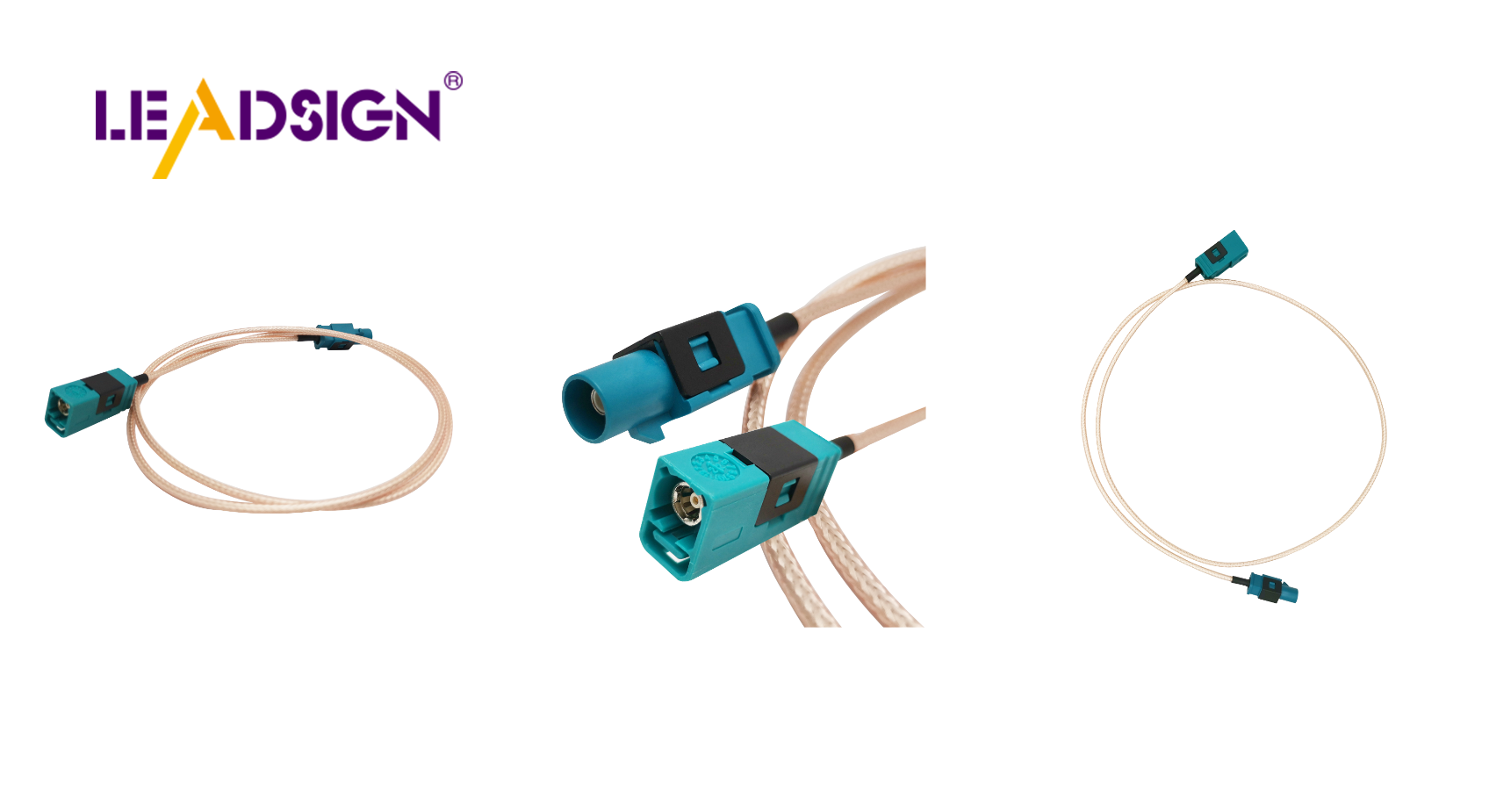
🔹 FAKRA & HSD Connectors (Critical for Data)
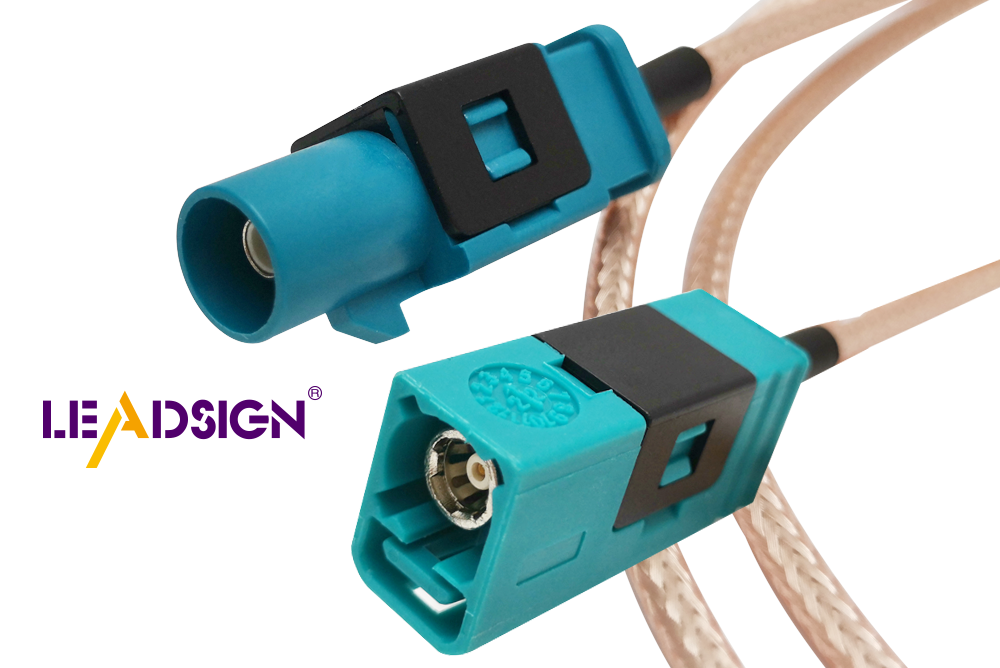
Purpose: High‑speed data – backup cameras (FAKRA blue), GPS (FAKRA amber), 4G/5G antennas (FAKRA violet), USB‑C (HSD), Ethernet (HSD).
Appearance: Colour‑coded plastic housing (FAKRA) or small locking plastic (HSD).
Why they matter: Traditional power connectors cannot transmit video or high‑speed data. Mistaking FAKRA for a power connector is a common and costly error.
Source: LEADSIGN offers pre‑terminated FAKRA and HSD cables in any length.
2. Connector Roles in Vehicle Diagnostics & Performance
Connector Type | Diagnostic role | Performance impact |
|---|---|---|
OBD‑II | Reads fault codes, live data, actuator tests | Direct access to all ECUs |
USB | Software updates, data logging | Enables infotainment features |
Sensor | Carries sensor signals to ECU | Affects engine efficiency, emissions, safety |
FAKRA/HSD | Camera video, radar, Ethernet | ADAS, backup visibility, connectivity |
Pro tip: A failing sensor connector can mimic a faulty sensor. Always check connector continuity and pin fit before replacing expensive components.
3. Maintenance & Troubleshooting – Professional Practices
✅ Regular Inspection Checklist (Every 12 months or 20,000 km)
Visual – cracks, corrosion (green/white powder), melted plastic
Mechanical – lock clicks; no excessive play
Electrical – continuity, voltage drop (<0.2V), resistance (<5Ω for power)
✅ Tools You Need
Contact cleaner (non‑conductive)
Soft brush (toothbrush size)
Dielectric grease (for sealing, not for dirty contacts)
Multimeter / breakout box
Magnifying glass (for small pins)
✅ Cleaning Procedure
Disconnect battery (negative first).
Remove connector, inspect both sides.
Spray contact cleaner, brush gently.
Dry with compressed air or allow to evaporate.
Apply dielectric grease to seals (not to electrical contacts).
Reconnect – listen for click.
✅ Signs of a Faulty Connector
Symptom | Likely cause |
|---|---|
Intermittent light / sensor | Loose terminal or corrosion |
Burnt smell / melted housing | High resistance from poor crimp |
No communication (scan tool) | Bent pin or broken lock |
Camera image flickers | Poor FAKRA shield contact |
✅ Repair Options
Clean and retension pins – use a pick tool to close female terminals carefully.
Replace terminal – if corroded or loose.
Replace entire connector – if housing is cracked. Use pigtail repair kits.
For FAKRA/HSD: Pre‑terminated cable replacement is more reliable than field crimping.
4. 2026 Trends – Connectors in New Vehicles
Trend | Implication |
|---|---|
4K cameras | Mini FAKRA required; standard FAKRA insufficient. |
5G telematics | Mini FAKRA (violet) with low‑loss coax. |
EV / hybrid | High‑voltage connectors (orange) separate; low‑voltage FAKRA/HSD must be double‑shielded for EMI. |
Software‑defined vehicles | Ethernet backbone (1000BASE‑T1) – HSD connectors. |
Pre‑terminated cables | Shops moving to plug‑and‑play to reduce labour and errors. |
What this means for your inventory: You must stock FAKRA (blue, amber, violet) and HSD (USB‑C, Ethernet) alongside traditional power connectors.
5. Why LEADSIGN – Your Partner for FAKRA & HSD Connectors
For OBD‑II, USB, JST, Dupont, and Molex, many reliable brands exist (TE, Molex, Amphenol). But for FAKRA and HSD, LEADSIGN offers the best combination of quality, cost, and customisation.
What LEADSIGN provides:
✅ FAKRA (standard & Mini) – all 14 colours, 50Ω, up to 20 GHz, IP67 optional
✅ HSD USB‑C – locking, 5 Gbps, for CarPlay / Android Auto
✅ HSD Ethernet – 100Ω, for ADAS and telematics
✅ Pre‑terminated cables – any length from 0.3m to 20m, no field crimping
✅ Double‑shielded, low‑loss options – for long runs and EV environments
✅ Bulk pricing – for shops, fleets, and distributors
Why choose LEADSIGN?
Lower cost than TE/Rosenberger, same automotive‑grade reliability, fast turnaround, and technical support.
Final Recommendations – Connector Selection by Application
Application | Recommended Connector | Key Feature |
|---|---|---|
Diagnostics | OBD‑II (J1962) | Standardised |
Phone charging / CarPlay | USB‑C, HSD USB‑C (locking) | 5 Gbps, reliable retention |
Engine sensor | Weather Pack, Deutsch DT | Sealed, high temp |
Backup camera (1080p) | FAKRA blue (50Ω coax) | Colour‑coded, secondary lock |
Backup camera (4K) | Mini FAKRA blue (low‑loss) | 20 GHz, low attenuation |
GPS antenna | FAKRA amber | Correct impedance |
5G telematics | Mini FAKRA violet | Future‑proof, double‑shielded |
Interior low‑current | JST, Dupont | Compact, easy |
Power distribution | Molex MX150L (sealed) | High current, IP67 |
Ready to upgrade your connector knowledge and inventory?
[Request a free LEADSIGN FAKRA/HSD sample kit] | [Get custom length quote] | [Download 2026 automotive connector guide]
Summary of Changes
Original Problem | Revision Strategy |
|---|---|
Consumer‑oriented overview | Rewritten for professional B2B (shops, fleets, technicians). |
No depth on data connectors (FAKRA/HSD) | Added dedicated section; explained why they are different from power connectors. |
No maintenance or troubleshooting | Added inspection, cleaning, repair procedures, symptom table. |
No 2026 trends | Added 4K, 5G, EV, software‑defined, pre‑terminated. |
No commercial CTA | Added LEADSIGN sample kit, quote, guide download. |
Basic list of connectors | Expanded with locations, failure modes, and professional tips. |
If you would like a shorter LinkedIn post version or a printable “Common Connector ID” poster, please let me know. You can also send me other low‑click articles for the same treatment.
See Also
Understanding HSD Connectors Within Automotive Engineering
Why Fakra Connectors Matter in Automotive Technology
Significance of FAKRA Connectors for Automotive Uses