Understanding HSL Connectors for Automotive Applications – Professional B2B Guide (2026)

Intro: The Next Generation of High‑Speed Data Connectors
Automotive connectors have evolved dramatically – from simple power terminals to sophisticated high‑speed data interfaces. As vehicles become more connected, the demand for rapid data transmission and enhanced reliability is accelerating. The automotive wire and connector market is projected to grow from 7.01billionin2024to7.01billionin2024to8.76 billion by 2029. Among the innovations driving this growth are HSL connectors (High‑Speed Link) and HSL USB cables, which enable faster data transfer, greater reliability, and future‑ready integration.
In this guide, you will learn:
Key features of HSL connectors (fast data transfer, durability, compatibility)
How HSL compares to traditional connectors
The role of HSL USB cables in automotive systems
Cost‑effectiveness and long‑term benefits
Why proper automotive wire selection complements HSL connectors
Future trends and market adoption
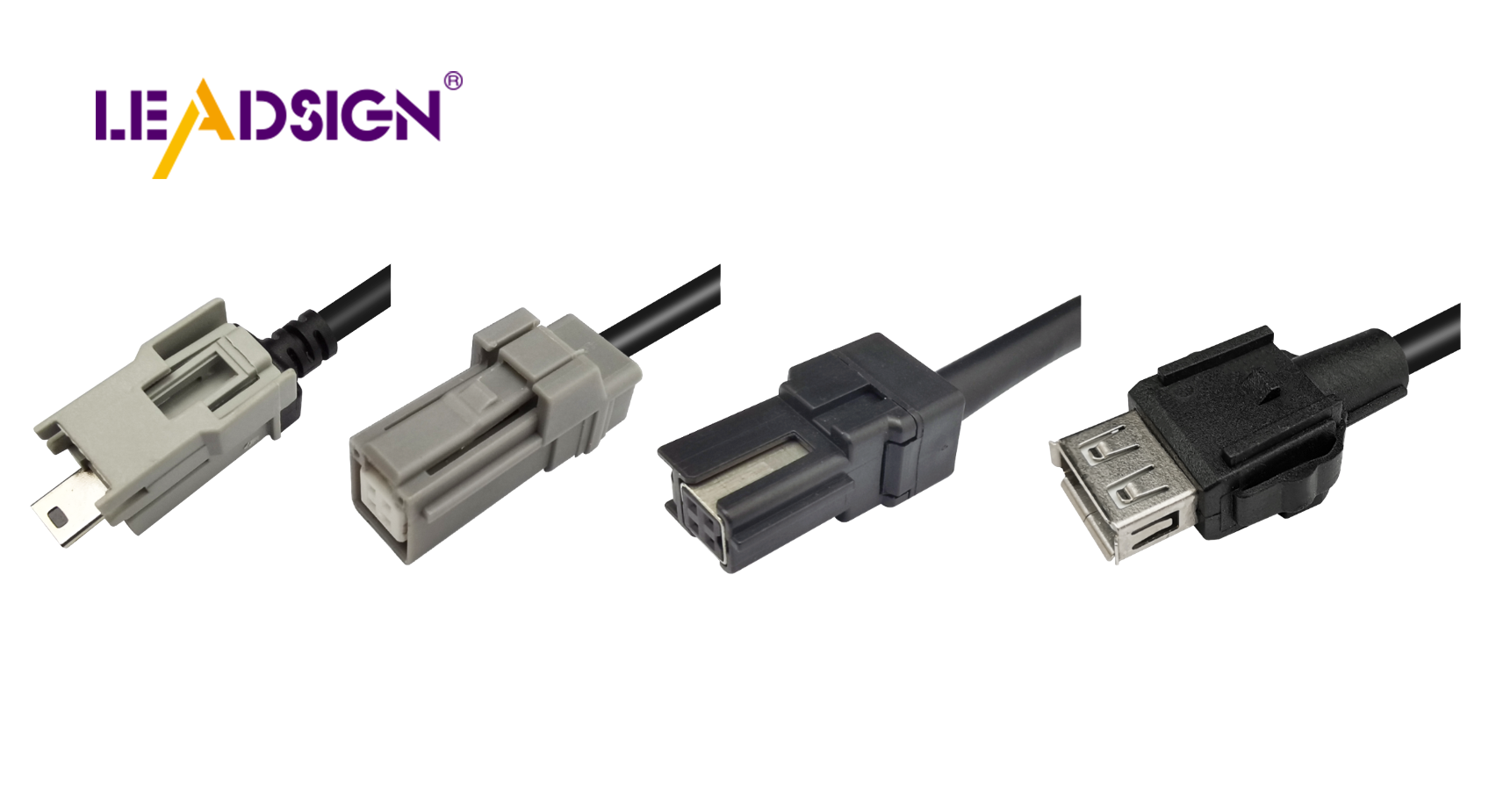
1. Key Features of HSL Connectors
🔹 Fast Data Transfer – Critical for Modern Vehicles
Today’s vehicles rely on real‑time data for navigation, infotainment, ADAS, and telematics. HSL connectors are designed to handle high‑bandwidth signals with low latency.
Feature | HSL Connector | Traditional Connector |
|---|---|---|
Data rate | Up to 28 Gbps (depending on variant) | < 1 Gbps (power/signal only) |
Signal type | High‑speed differential or coax | Low‑frequency analog |
Shielding | Double shielding (foil + braid) | Minimal or none |
Application | USB, Ethernet, LVDS, camera video | Lights, sensors, power |
Why it matters: With features like live traffic updates, 4K backup cameras, and over‑the‑air updates, vehicles need HSL‑grade speed and integrity.
🔹 Durability & Reliability – Built for Automotive Conditions
Materials: High‑grade thermoplastics, copper alloys with gold or tin plating.
Testing standards: USCAR‑2, ISO 19642, LV214 – vibration, temperature cycling, corrosion resistance.
Locking mechanism: Secondary lock / CPA prevents vibration loosening.
Sealing: IP67 optional for underbody and exterior applications.
🔹 Compatibility & Future‑Ready Design
Backward compatible: HSL connectors work with existing vehicle architectures (USB 2.0/3.0, LVDS, GVIF).
Future‑proof: Supports emerging protocols – automotive Ethernet, 5G V2X, 4K/8K video.
Easy integration: Upgrade without wholesale harness replacement.
2. HSL vs. Traditional Connectors – A Quick Comparison
Parameter | HSL Connector | Traditional (e.g., Deutsch, Molex power) |
|---|---|---|
Primary function | High‑speed data | Power / low‑frequency signal |
Impedance | 50Ω (coax) or 100Ω (differential) | Not specified |
Max frequency | Up to 20 GHz (Mini HSL) | < 1 MHz |
Weight | Lightweight (small form factor) | Heavier (larger terminals) |
Installation | Pre‑terminated cables available | Field crimp common |
Cost | Moderate (higher than basic, lower than custom) | Low to moderate |
Key takeaway: HSL connectors are not a replacement for power connectors – they are a specialised family for high‑speed data. In a modern vehicle, you will use both types.
3. The Role of HSL USB Cables in Automotive Systems
HSL USB cables are a specific implementation of HSL technology for USB protocols (USB 2.0, USB 3.0, USB‑C). They are used in:
Application | HSL USB Benefit |
|---|---|
Smartphone mirroring (CarPlay / Android Auto) | High speed (5 Gbps), low latency, reliable connection |
Infotainment data transfer | Fast media playback, firmware updates |
Telematics / diagnostics | Quick data logging and ECU flashing |
Rear‑seat entertainment | Simultaneous video and power over USB‑C |
Handling multiple protocols: HSL USB cables support USB, LVDS, and GVIF – allowing a single cable to carry different data types.
4. Cost‑Effectiveness – Long‑Term Benefits vs. Initial Investment
Cost factor | HSL Connector | Traditional / Low‑speed |
|---|---|---|
Upfront cost | Moderate (higher than basic) | Low |
Installation labour | Low (pre‑terminated cables) | Moderate (field crimping) |
Failure rate | Very low (impedance‑controlled) | Moderate (field errors) |
Long‑term value | Excellent – supports future upgrades | Poor – cannot handle high‑speed data |
Conclusion: Investing in HSL connectors (e.g., pre‑terminated FAKRA/HSD style) saves money over the life of the vehicle by eliminating data‑related callbacks and enabling future tech.
5. Choosing the Right Automotive Wire – Complementing HSL Connectors
High‑speed data requires proper wire selection:
Wire type | Use with HSL connector | Why |
|---|---|---|
50Ω coaxial (RG‑174, RG‑58, low‑loss) | FAKRA HSL (video, GPS, 5G) | Maintains impedance, low attenuation |
100Ω shielded twisted pair | HSD HSL (USB‑C, Ethernet) | Differential signalling, noise immunity |
Standard primary wire (SXL, TXL) | Power supply only (not data) | Cannot carry high‑frequency signals |
Effect on vehicle performance: Good wire reduces energy loss and signal noise, ensuring GPS, infotainment, and ADAS work flawlessly.
6. The Future of HSL Connectors – Trends & Market Adoption
🔹 New Technologies & Design Changes
Miniaturisation: Smaller connectors for tight dashboards and camera modules.
Higher speed: 28 Gbps and beyond for 8K video and autonomous driving data.
Modular designs: One connector family for USB, Ethernet, and LVDS.
🔹 Market Demand & Usage
Industry push: Automakers require HSL connectors for ADAS, 4K/8K cameras, and 5G telematics.
Increasing volumes: Adoption rising across passenger cars, commercial trucks, and EVs.
Aftermarket growth: Repair shops now stocking pre‑terminated HSL cables.
What this means for you: If you are not already using HSL‑grade connectors (FAKRA, HSD), you will be soon. Stocking LEADSIGN pre‑terminated cables prepares your shop for the future.
7. Why LEADSIGN – Your HSL Connector Partner
LEADSIGN specialises in FAKRA (standard & Mini) and HSD connectors – the automotive industry’s HSL‑grade solutions.
What LEADSIGN offers:
✅ FAKRA (standard & Mini) – all 14 colours, 50Ω, up to 20 GHz, IP67 optional
✅ HSD (USB‑C, Ethernet, LVDS) – 100Ω, locking, up to 5 Gbps
✅ Pre‑terminated cables – custom lengths 0.3m – 20m, no field crimping
✅ Low‑loss, double‑shielded coax – for long runs and EV environments
✅ Bulk pricing – for shops, fleets, and distributors
For your business: When you install a backup camera, GPS, or USB‑C port, use LEADSIGN pre‑terminated HSL cables – plug‑and‑play, perfect signal integrity, and no callbacks.
Final Recommendations – HSL Connector Selection Summary
Application | HSL Connector (LEADSIGN) | Key Feature |
|---|---|---|
GPS antenna | FAKRA amber (50Ω) | Low loss, colour‑coded |
1080p backup camera | FAKRA blue | 6 GHz, reliable |
4K camera (truck/bus) | Mini FAKRA blue (low‑loss) | 20 GHz, long reach |
5G telematics | Mini FAKRA violet | High frequency, double‑shielded |
USB‑C CarPlay | HSD USB‑C | 100Ω, locking, 5 Gbps |
ADAS Ethernet | HSD 100Ω | 100/1000BASE‑T1 |
Remember: HSL connectors are the key to unlocking high‑speed data in modern vehicles. Choose wisely, and your systems will perform.
Ready to upgrade to HSL‑grade data cables?
See Also
Essential HSD Connector Knowledge for Automotive Professionals
Significance of HSD Connectors in Automotive Applications
Benefits of HSD Connectors in Vehicle Technology