Understanding Automotive Wires for Two Pin Automotive Connectors

Intro: The Right Wire Makes the Difference Between Reliable Power and Costly Failures
Selecting the correct automotive wire for two‑pin connectors is critical for vehicle safety and performance. Two‑pin connectors are commonly used for power and ground circuits – lights, sensors, horns, fans, and auxiliary devices. Using an unsuitable wire can lead to voltage drop, overheating, insulation meltdown, or even electrical fires. Understanding wire types (GPT, SXL, GXL, TXL), their temperature ratings, insulation properties, and compliance with industry standards (SAE J‑1128, etc.) ensures that your two‑pin connections remain reliable for the life of the vehicle.
In this guide, you will learn:
Common automotive wire types (GPT, SXL, GXL, TXL) and their characteristics
How to choose the right wire for two‑pin connectors based on environment and current
The importance of wire gauges (AWG) for two‑pin circuits
Why insulation type and temperature rating matter
2026 trends (EVs, high‑temperature engine bays, lightweight materials)
Why LEADSIGN pre‑terminated FAKRA/HSD cables are not for power – but essential for data
1. Common Automotive Wire Types – GPT, SXL, GXL, TXL
Wire type | Insulation material | Temperature range | Insulation thickness | Typical applications |
|---|---|---|---|---|
GPT (General Purpose Thermoplastic) | PVC | -40°C to +80°C (up to 105°C for some) | Thick | Interior lighting, dashboards, general purpose |
SXL (Cross‑linked Polyethylene) | XLPE | -51°C to +125°C | Thickest | Engine bay, high‑heat areas, sensors |
GXL (Cross‑linked, thin wall) | XLPE | -40°C to +125°C | Medium | Battery cables, trailers, limited space / underhood |
TXL (Cross‑linked, extra thin wall) | XLPE | -40°C to +125°C | Thinnest | Tight spaces (dashboard, door harnesses), weight‑sensitive |
Key takeaway: All XLPE wires (SXL, GXL, TXL) offer superior heat and chemical resistance compared to PVC (GPT). For two‑pin connectors in engine bays or underbody, use SXL or GXL. For interior, GPT or TXL is acceptable.
2. Two‑Pin Connectors – Typical Power and Ground Circuits
Two‑pin connectors are widely used for:
Power and ground for lights (LED, halogen), horns, fans, pumps.
Sensor power (e.g., coolant temperature, oil pressure).
Accessory connections (cigarette lighter sockets, USB chargers, aftermarket lights).
What wire to use for each application:
Application | Recommended wire type | Recommended gauge (AWG) | Reason |
|---|---|---|---|
Interior light (low current, <5A) | GPT or TXL | 18‑20 AWG | Flexible, easy to route, low cost |
Engine bay fan (10‑15A) | SXL or GXL | 16‑14 AWG | High temperature resistance, durable insulation |
Underbody light (exterior, wet) | SXL or GXL (sealed connectors) | 16‑18 AWG | Chemical and moisture resistance |
Battery / alternator sense wire | GXL or TXL | 18 AWG | Thin insulation saves space, heat resistant |
Aftermarket winch control (low current) | SXL | 18 AWG | Vibration and heat resistance in engine bay |
Critical reminder: For a two‑pin power circuit, both wires (positive and ground) should be the same gauge and type. Never oversize one and undersize the other.
3. Choosing the Right Wire Gauge for Two‑Pin Circuits
Wire gauge (AWG) determines current‑carrying capacity. For two‑pin connectors carrying power:
AWG | Ampacity (chassis wiring) | Typical two‑pin use |
|---|---|---|
22‑20 | 5‑8A | Low‑power sensors, LED indicators |
18 | 10‑15A | Lights, small fans, relays |
16 | 15‑20A | Headlights, medium fans, pumps |
14 | 20‑30A | High‑power lamps, auxiliary circuits |
12 | 30‑40A | Battery main feeds, heavy‑duty accessories |
Rule of thumb: For two‑pin connectors carrying more than 10A, use at least 18 AWG SXL or GXL. For engine bay, never use GPT – the PVC insulation will harden and crack.
4. Insulation and Environmental Resistance – Why It Matters for Two‑Pin Connectors
Environmental factor | Recommended wire insulation | Why |
|---|---|---|
High heat (engine bay, exhaust) | XLPE (SXL, GXL, TXL) | Resists melting, maintains flexibility |
Moisture, road salt (underbody) | XLPE with sealed connectors | Prevents corrosion wicking |
Chemical exposure (oil, coolant, fuel) | XLPE (SXL or GXL) | Chemically resistant |
Tight bends, limited space | TXL (thin wall) | Enables compact routing |
General interior (dry) | GPT or TXL | Cost‑effective, sufficient |
Pro tip for two‑pin connectors in harsh environments: Use sealed two‑pin connectors (Deutsch DT, Weather Pack) with SXL or GXL wire. The combination prevents water ingress and protects the wire insulation.
5. Industry Standards – Safety and Compliance
Always verify that the automotive wire you use meets relevant standards:
Standard | Scope | Wire types covered |
|---|---|---|
SAE J‑1128 | Low voltage primary cable | GPT, SXL, GXL, TXL |
SAE J‑1560 | Thin wall XLPE | TXL |
Chrysler MS‑8288 | OEM specification | TXL |
Ford M1L‑123A | OEM specification | TXL |
ISO 6722 | International standard | All types |
Why this matters: Certified wires have been tested for heat, cold, abrasion, and chemical resistance. Using non‑certified wire voids warranties and increases failure risk.
6. 2026 Trends – Two‑Pin Wiring in Modern Vehicles
Trend | Implication for two‑pin wire selection |
|---|---|
More auxiliary electronics (LED lighting, USB chargers, dash cams) | Increased use of two‑pin connectors; need proper gauge to avoid voltage drop. |
EV / hybrid adoption | Engine bays are still hot (inverters, motors) – use SXL or GXL. Low‑voltage data lines are separate. |
Weight reduction | TXL (thin wall) preferred over SXL where heat is not extreme. |
Pre‑terminated pigtails | Shops prefer ready‑made two‑pin pigtails with bonded wire – eliminates field stripping and crimping. |
What this means for your inventory: Stock GPT for interior, SXL for engine bay, and TXL for tight spaces. For high‑current circuits, use GXL.
7. Why LEADSIGN – For Two‑Pin Data? (Not power, but important for integrated systems)
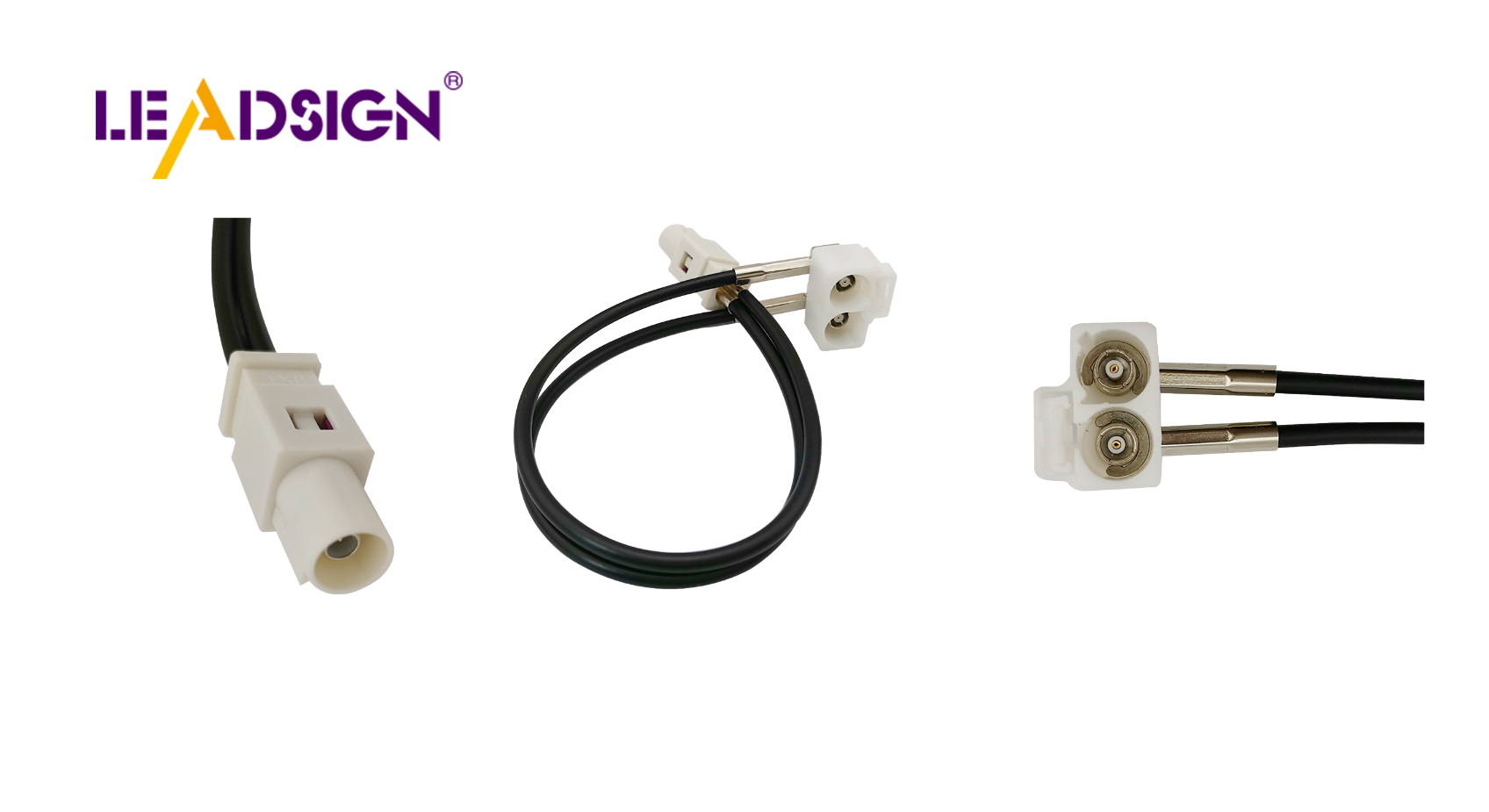
While two‑pin connectors are typically for power, some modern systems use two‑pin FAKRA coaxial connectors for data (e.g., some GPS antennas, sensor lines). For those applications, standard automotive wire is not suitable – you need 50Ω coax.
LEADSIGN offers pre‑terminated FAKRA two‑pin (coaxial) cables for data:
✅ FAKRA amber (GPS) and blue (camera)
✅ 50Ω impedance, low‑loss, double‑shielded
✅ Pre‑terminated – no field crimping
✅ Any length 0.3m – 20m
For power two‑pin connectors, LEADSIGN can supply sealed pigtails with SXL or GXL wire – contact us for custom assemblies.
Final Recommendations – Selecting Wire for Two‑Pin Connectors
Application | Recommended wire | Gauge | Connector type |
|---|---|---|---|
Interior light (dry) | GPT or TXL | 18‑20 AWG | Unsealed two‑pin |
Engine bay fan (hot) | SXL | 16‑14 AWG | Sealed two‑pin (Deutsch) |
Underbody light (wet) | SXL (sealed) | 18 AWG | Sealed two‑pin (Weather Pack) |
Trailer wiring (exterior) | GXL | 16 AWG | Sealed two‑pin |
Battery sense wire (engine bay) | TXL (thin wall) | 18 AWG | Unsealed or sealed |
GPS antenna (data, not power) | FAKRA amber 50Ω coax | N/A | FAKRA two‑pin (coaxial) |
Remember: Two‑pin connectors are only as reliable as the wire attached to them. Use the correct type, gauge, and insulation for the environment.
Ready to source high‑quality automotive wire or pre‑terminated pigtails for your two‑pin applications?
[Request a free LEADSIGN FAKRA sample kit] | [Get bulk pricing for custom two‑pin pigtails]
See Also
Understanding HSD Connectors Essential for Automotive Systems
Significance of FAKRA Connectors for Automotive Solutions
Enhancing Automotive Data Transfer with Advanced Connectors