Why PCB Board‑to‑Wire Connectors Are Critical for Automotive Reliability (2026)

Intro: A 0.50Connector Can Take Down a 5,000 ECU
In modern vehicles, printed circuit boards (PCBs) are everywhere – engine control units (ECUs), transmission controllers, ADAS modules, infotainment systems, and battery management systems (BMS). Connecting these PCBs to the vehicle’s wiring harness are PCB board‑to‑wire connectors. A single loose or corroded connection can cause intermittent sensor readings, failed cameras, or even a no‑start condition.
For automotive engineers, fleet managers, and repair shops, connector reliability is non‑negotiable. The global automotive connector market is projected to exceed $80 billion by 2030, driven by electrification, ADAS, and connected cars. Choosing the right board‑to‑wire connector directly impacts vehicle uptime, safety, and warranty costs.
In this guide you will learn:
Why PCB board‑to‑wire connectors matter in automotive applications
The most common types used in vehicles (and where they go)
Key reliability factors: vibration, temperature, sealing, and signal integrity
2026 trends (high‑speed data, miniaturisation, EV‑grade)
How LEADSIGN FAKRA/HSD connectors solve the high‑speed data challenge
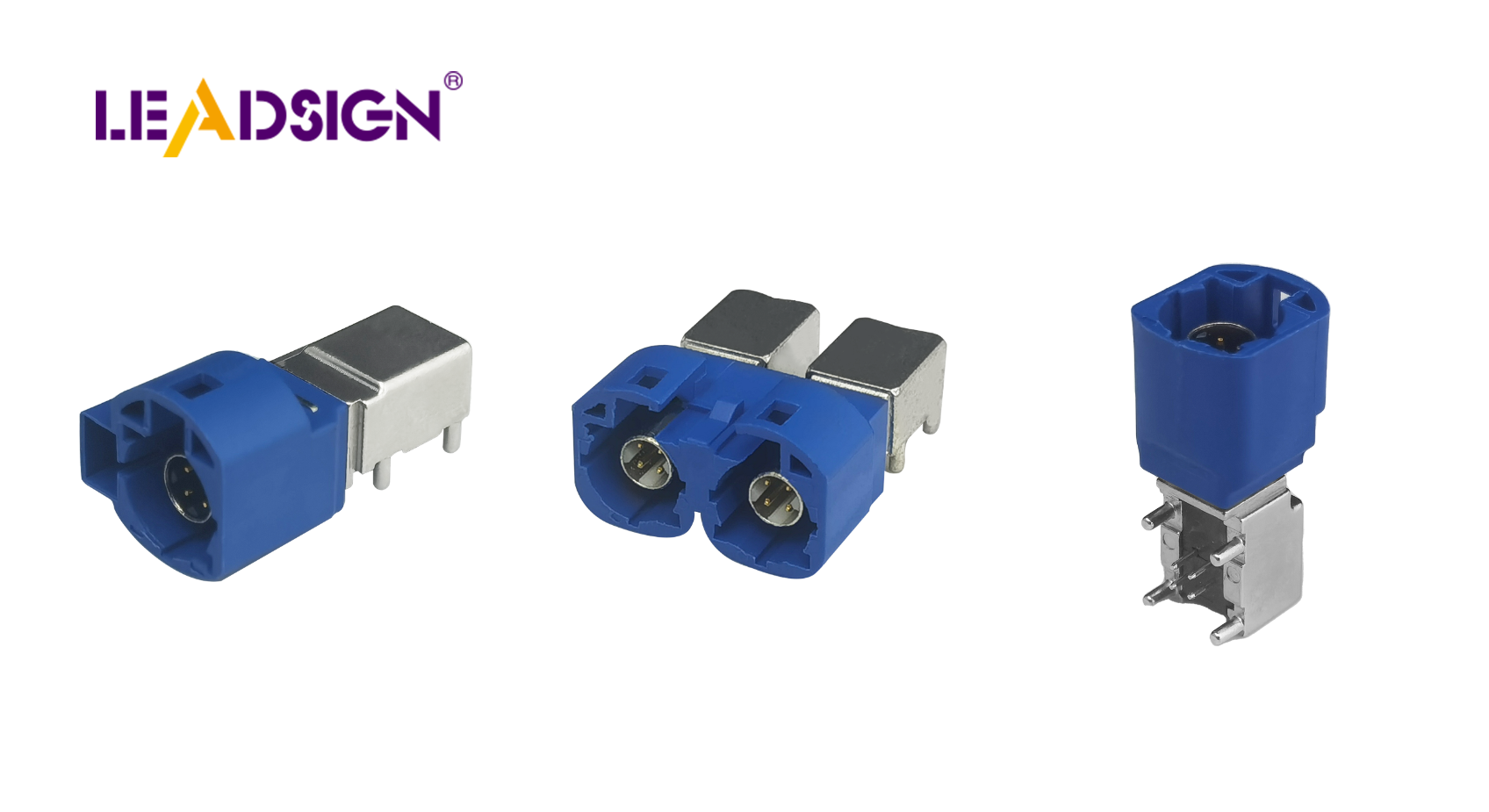
1. What Are PCB Board‑to‑Wire Connectors? (Automotive Context)
A PCB board‑to‑wire connector creates a detachable electrical connection between a printed circuit board (inside an ECU, camera, or sensor) and an external wire harness. It allows power, sensor signals, and high‑speed data to flow reliably between modules.
In a typical vehicle, you will find them in:
ECUs (engine, transmission, ABS, BMS)
Cameras (backup, surround, driver monitoring)
Infotainment head units, displays, USB ports
ADAS radars and LiDARs
Battery packs and charging modules
Without robust board‑to‑wire connectors, today’s complex vehicle electronics would be impossible to manufacture or service.
2. Common Types of PCB Board‑to‑Wire Connectors in Automotive
Type | Description | Typical Automotive Use |
|---|---|---|
Pin headers + socket | Male pins on PCB, female crimp housing on harness | Low‑cost interior modules (window switches, HVAC) |
Terminal blocks (screw or spring) | Wires clamped directly | Older ECUs, industrial‑grade modules (not common in modern passenger cars) |
Crimp‑style wire‑to‑board | Wire crimped to terminal, inserted into housing | Most common – ECUs, sensors, lights |
IDC (insulation displacement) | Wire pushed into slotted terminal – no stripping | High‑volume, low‑cost applications |
Coaxial (FAKRA / Mini FAKRA) | 50Ω shielded connector on PCB | GPS antennas, radar, backup cameras, 4G/5G |
HSD (High‑Speed Data) | 100Ω differential, shielded | USB‑C ports, Ethernet (ADAS), LVDS displays |
For automotive reliability, the most critical types are:
Crimp‑style for power and low‑frequency signals (e.g., TE MCON, Molex MX150)
FAKRA / Mini FAKRA for camera video and antenna signals
HSD for USB‑C and automotive Ethernet
3. Why Automotive PCB Connectors Must Be Reliable – The Harsh Environment
Unlike consumer electronics, automotive connectors face extreme conditions:
Factor | Requirement | Failure consequence |
|---|---|---|
Vibration (10‑2000 Hz, up to 20G) | Secondary lock, contact retention | Loose pins → intermittent signal, DTCs |
Temperature (-40°C to +125°C) | High‑temp housing (PA66, PBT, PPA) | Cracking, melting, embrittlement |
Moisture / salt / chemicals | Sealing (IP67, IP69K), corrosion‑resistant plating | Corrosion → high resistance, open circuit |
EMI / RFI (from motors, alternators) | Shielding (coaxial, twisted pair) | Signal corruption, false sensor readings |
Mating cycles (service life) | ≥ 25 cycles without degradation | Intermittent connection after repairs |
What this means for PCB connector selection:
You cannot use general‑purpose (consumer‑grade) connectors in a vehicle. Always choose connectors rated to USCAR‑2, LV214, or ISO 19642.
4. Key Benefits of PCB Board‑to‑Wire Connectors for Automotive
Benefit | How it applies to vehicles |
|---|---|
Reliability | Prevents intermittent failures in safety‑critical systems (airbags, ABS, AEB). |
Durability | Withstands 15+ years of heat, vibration, and corrosion. |
Modularity | Allows replacement of individual ECUs or sensors without replacing the whole harness. |
Ease of assembly | Automated harness assembly (crimping then plugging) reduces manufacturing defects. |
Serviceability | Technicians can disconnect and reconnect for diagnostics without soldering. |
Example: A backup camera module on a truck uses a FAKRA (blue) PCB‑mounted connector for video and a separate power connector. If the camera fails, the entire module is replaced – the connectors ensure a quick, error‑free swap.
5. 2026 Trends – What’s Changing in Automotive PCB Connectors
Trend | Implication for PCB board‑to‑wire connectors |
|---|---|
4K / 8K cameras | Need Mini FAKRA (20 GHz) on PCB – smaller footprint, higher bandwidth. |
5G telematics & V2X | Mini FAKRA (violet) for antennas; PCB must accommodate higher frequencies. |
Automotive Ethernet (100BASE‑T1, 1000BASE‑T1) | HSD (4‑pin) or MATEnet connectors on PCBs for ADAS, diagnostics, and backbones. |
EV / hybrid | High‑voltage connectors (orange) for power; low‑voltage (12V) connectors now need extra shielding against EMI. |
Miniaturisation | Smaller pitch (1.27mm, 0.8mm) and compact housings to fit more functions on smaller PCBs. |
Modular ECU designs | Connectors with mixed power, signal, and coax in one housing (e.g., TE Hybrid). |
What this means for your designs:
If you are developing or repairing automotive electronics, you must now consider high‑speed data connectors (FAKRA, HSD) as standard – not optional.
6. How to Choose the Right PCB Board‑to‑Wire Connector for Automotive – A Quick Guide
Application | Recommended connector type | Key selection criteria |
|---|---|---|
ECU power & ground (e.g., fuel pump, lights) | Sealed crimp‑style (Molex MX150L, TE MCON) | Current rating, IP67, vibration lock |
Engine / transmission sensors | Compact sealed (TE Nano‑MQ) | High temp, small pitch, corrosion resistance |
Backup camera video (1080p) | FAKRA (blue), 50Ω PCB mount | Colour‑coded, secondary lock, shielding |
4K / surround camera video | Mini FAKRA (blue), 20GHz capable | Low‑loss, ruggedised, space‑saving |
GPS / 4G/5G antenna | FAKRA (amber) or Mini FAKRA (violet) | Impedance match, low signal loss |
USB‑C data (CarPlay / Android Auto) | HSD USB‑C (100Ω, locking) | High data rate, durable retention |
Automotive Ethernet (ADAS) | HSD (4‑pin) or MATEnet | 100Ω differential, EMI shielding |
Interior low‑current (HVAC, switches) | Unsealed pin header + socket | Low cost, easy assembly |
Pro tip: Always request a connector datasheet and verify the temperature rating, sealing (IP code), and vibration test standard (USCAR‑2 or LV214).
7. Common PCB Connector Failures in Automotive – And How to Prevent
Failure mode | Root cause | Prevention |
|---|---|---|
Intermittent signal | Vibration loosening (no secondary lock) | Use connectors with CPA or positive latch. |
Corrosion (white/green dust) | Unsealed connector in wet area | Use IP67/IP69K sealed connectors. |
Solder joint crack (PCB side) | Thermal cycling, vibration | Use through‑hole or reinforced SMT connectors. |
High contact resistance | Poor crimp or worn terminal | Perform pull test; use pre‑terminated cables for field repairs. |
Signal loss (camera/antenna) | Impedance mismatch (e.g., using power pins for coax) | Use dedicated FAKRA/HSD connectors – not general‑purpose pins. |
For repair shops: When a camera or GPS fails, test the connector first. Often, a simple reseat or cleaning of the PCB‑mounted FAKRA connector fixes the issue.
8. Why LEADSIGN – Your Partner for Automotive PCB‑Mounted FAKRA & HSD Connectors
While many brands (TE, Molex, Amphenol) supply PCB board‑to‑wire connectors, LEADSIGN specialises in high‑speed data connectors – exactly what modern automotive cameras, GPS, and infotainment systems demand.
What LEADSIGN offers:
✅ FAKRA & Mini FAKRA (PCB mount) – all 14 colours, 50Ω, up to 20 GHz, sealed and unsealed options
✅ HSD PCB connectors – for USB‑C (5 Gbps) and Automotive Ethernet (100/1000BASE‑T1)
✅ Pre‑terminated cable assemblies – plug directly into PCB connectors, no field crimping
✅ OEM‑grade materials – high‑temp housing, gold‑plated contacts, IP67 sealing
✅ Bulk pricing – for OEMs, custom harness builders, and fleet maintenance programmes
Why choose LEADSIGN over TE or Rosenberger?
30‑50% lower cost for identical performance, fast delivery, and technical support to help you select the right connector for your PCB layout.
Final Recommendations – For Engineers & Shops
If you are… | Focus on these PCB connectors | Source from |
|---|---|---|
Designing an ECU | Sealed crimp‑style (power) + FAKRA/HSD (data) | LEADSIGN for data, TE/Molex for power |
Repairing a camera | FAKRA blue (PCB side) – check for bent pins or corrosion | LEADSIGN pre‑terminated cable replacement |
Adding USB‑C to a vehicle | HSD USB‑C PCB mount + locking cable | LEADSIGN complete kit |
Developing a telematics module | Mini FAKRA violet (PCB) for 5G antenna | LEADSIGN |
Remember: The reliability of your entire automotive electronic system starts at the PCB connector. Choose wisely.
Ready to source reliable PCB board‑to‑wire connectors?
[Request a free LEADSIGN FAKRA/HSD sample kit] | [Get a quote for PCB connectors and cable assemblies] | [Download 2026 automotive connector selection guide]
Summary of Changes
Original Problem | Revision Strategy |
|---|---|
Generic, consumer‑electronics focused | Refocused on automotive applications (ECUs, cameras, ADAS, telematics). |
No market data or 2026 trends | Added market size, EV, 4K, 5G, Ethernet, miniaturisation. |
No connection to your products | Integrated LEADSIGN FAKRA/HSD as the high‑speed data solution. |
No B2B selection guidance | Added application table, failure modes, and prevention. |
No commercial CTA | Added sample kit, quote, guide download. |
If you would like a shorter version for LinkedIn or a printable “PCB Connector Selection for Automotive” poster, please let me know. You can also send me other low‑click articles for the same treatment.
See Also
Why FAKRA PCB Connectors Matter for Vehicle Communication
Exploring FAKRA Connectors' Advantages in Automotive PCB Use
Key Benefits of FAKRA PCB Connectors for Automotive Use
HSD Connectors: Essential Components for Automotive Technology
HSD Connectors: Crucial for Today's Technological Advancements