Auto Harness Connectors 2026: The Unsung Heroes of Vehicle Safety

Intro: One Loose Connector Can Disable Airbags, ABS, and Cameras
Today’s vehicles are packed with safety systems: automatic emergency braking, lane‑keeping assist, blind‑spot monitoring, and multiple airbags. All of these depend on a network of sensors, ECUs, and actuators – connected by auto harness connectors.
A single corroded, poorly crimped, or unsealed connector can cause:
Airbag deployment failure (life‑threatening)
ABS / traction control loss (crash risk)
Backup camera blackout (back‑over accidents)
False ADAS alerts or no alerts at all
For a repair shop or fleet operator, every such failure means a come‑back, liability, and a damaged reputation. Choosing and maintaining the right harness connectors is not a detail – it is a safety obligation.
In this guide you will learn:
How harness connectors enable critical safety systems
Which connector types are required for ADAS, cameras, and power distribution
Common failure modes and how to prevent them
2026 trends affecting connector reliability
Why LEADSIGN pre‑terminated FAKRA/HSD cables reduce safety risks
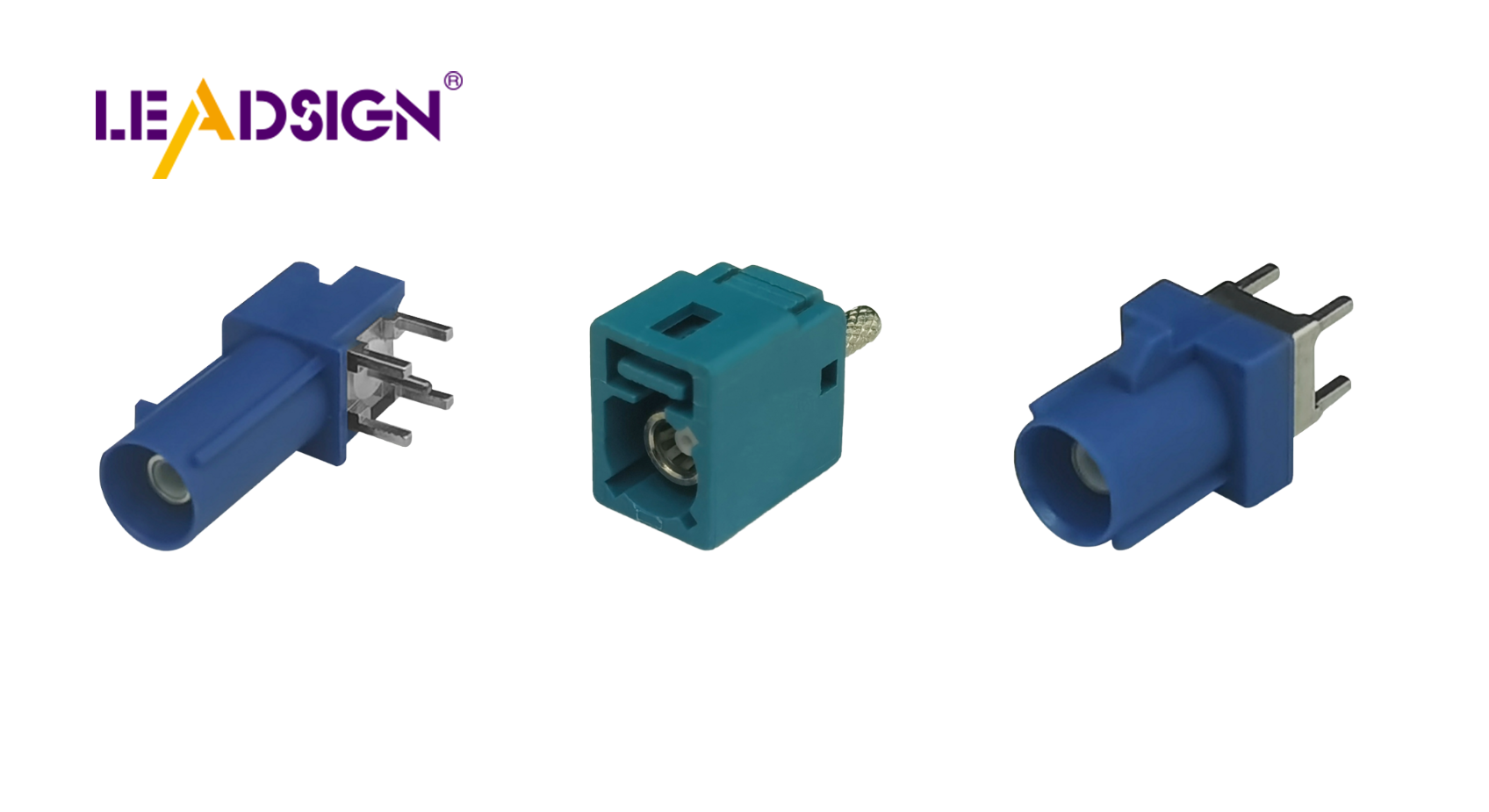
1. What Are Auto Harness Connectors? (Safety‑Critical Definition)
A harness connector is the interface that joins wires, sensors, ECUs, or power sources inside a vehicle. It must maintain electrical continuity under extreme vibration, temperature swings, moisture, and chemical exposure.
Primary safety roles:
Role | Example |
|---|---|
Signal integrity | Camera video to ADAS processor – no corruption |
Power delivery | Airbag squib, ABS pump, brake lights |
Data communication | Radar, lidar, ultrasonic sensor data |
System redundancy | Dual paths for critical functions |
Without robust connectors, a 2026 vehicle’s electronic safety net collapses.
2. Key Safety Systems That Depend on Harness Connectors
System | Connector type | Failure consequence |
|---|---|---|
Airbags | Sealed multi‑pin (e.g., TE MCON) | No deployment in crash → severe injury |
ABS / ESC | Sealed power & sensor connectors | Brake lockup or loss of stability control |
Backup camera | FAKRA (50Ω coax, blue) | No rear visibility – back‑over accident |
360° surround view | FAKRA or LVDS HSD | Blind spots, parking collisions |
Forward radar / camera (AEB) | Automotive Ethernet (HSD 100Ω) | No automatic emergency braking |
Blind‑spot monitoring | Shielded twisted pair (HSD) | No lane‑change warning |
Brake lights / indicators | Sealed power (Deutsch, Weather Pack) | No visual warning to following traffic |
Pro tip for shops: When repairing a vehicle after a crash, inspect every connector in the safety system path. A half‑broken latch or tiny crack in the housing may work today but fail next week.
3. Common Connector Failure Modes (And How to Prevent)
Failure mode | Cause | Safety impact | Prevention |
|---|---|---|---|
Corrosion | Water ingress (unsealed connector under body) | Intermittent signal → ABS/airbag fault | Use IP67 / IP69K sealed connectors for exterior. |
Vibration loosening | No secondary lock or CPA | Complete loss of power to sensor | Specify connectors with positive latch / secondary lock. |
High resistance / overheating | Pure brass terminals (instead of copper alloy) | Voltage drop → camera not turning on; fire risk | Use tin‑plated copper alloy terminals (LEADSIGN). |
Crimp failure | Poor tooling or technique | Intermittent open circuit | Use pre‑terminated cables or professional crimp tool. |
Pin push‑out | Damaged terminal retention | Signal lost after assembly | Perform pull test; use known‑good connectors. |
Case example: A fleet installed reverse cameras using cheap, unsealed bullet connectors under the trucks. After one winter, 40% had corrosion and intermittent image. Re‑labour cost exceeded 10× the “saved” connector cost.
4. Connector Types That Ensure Safety – A 2026 Guide
Connector family | Safety‑critical feature | Best use |
|---|---|---|
FAKRA (standard & Mini) | Colour coding prevents mismating; secondary lock survives vibration; 50Ω impedance for camera/GPS integrity | Backup camera video, GPS, 4G/5G antenna |
HSD (Ethernet, USB‑C, LVDS) | 100Ω differential signal; locking; shielding for EMI | ADAS radar/lidar, telematics, CarPlay |
Deutsch DT | Vibration rating 20 G’s; IP68; chemical resistant | Engine bay power, ABS, airbag squib (certain circuits) |
Weather Pack | IP67, low cost, good sealing | Exterior lighting, trailer wiring |
Molex MX150L | IP67, up to 40A | High‑current safety loads (fans, pumps) |
TE MCON | Compact sealed | Airbag, ABS sensor connectors |
Critical rule: Never substitute a power connector (Deutsch, Weather Pack) for a video or data connector (FAKRA, HSD). The signal will be corrupted, and safety systems that rely on that data (e.g., automatic braking from a camera) may fail.
5. How FAKRA & HSD Connectors Enable ADAS Safety
Modern ADAS (automatic emergency braking, adaptive cruise control, lane‑keep) uses multiple cameras and radars. Each sensor must send high‑bandwidth, low‑latency data to the central processor.
FAKRA (50Ω coax) carries analog or AHD camera video. The blue colour code is specifically for cameras. Using any other connector type will cause image loss or corruption – which means the car may not “see” a pedestrian.
HSD Ethernet (100Ω) carries radar and raw camera streams at 100 Mbps – 1 Gbps. A loose connector here can cause a false brake event or no brake event at all.
For repair shops: When you replace a damaged bumper camera, you must also inspect the FAKRA connector. A bent centre pin or corroded shield will degrade the image – and the ADAS system’s confidence. Replace the cable if any doubt.
6. 2026 Trends – Safety Demands Higher Reliability
Trend | Connector implication |
|---|---|
4K backup cameras on commercial vehicles | Need Mini FAKRA (20 GHz). Standard FAKRA may have high attenuation over longer runs. |
EV and hybrid proliferation | High EMI environment requires double‑shielded FAKRA/HSD cables – otherwise safety sensors may get false signals. |
5G telematics for emergency call (eCall) | 5G antenna needs Mini FAKRA (violet) with low loss. A poor connection could delay emergency response. |
Autonomous driving (level 3+) | Redundant sensor connections required – twin FAKRA or HSD lines. |
Longer vehicle lengths (buses, trucks) | Camera runs 10‑20m – low‑loss coax mandatory. High attenuation could cause missed obstacle detection. |
What this means for you: Safety margins are shrinking. Using the cheapest connector is no longer an option – it directly affects whether a vehicle can stop for a pedestrian.
7. Preventive Maintenance – Safety Checklist for Shops & Fleets
Every time you service a vehicle with ADAS or camera systems, include a connector inspection:
Visual check – cracks, corrosion (green/white powder), bent pins.
Seal condition – rubber grommets and seals not torn or hardened.
Locking mechanism – click felt when mating; secondary lock engaged.
Pull test (for crimped pins) – wire does not pull out with light force (5‑10 lbs).
For FAKRA – colour code matches function (blue = camera, amber = GPS, etc.).
Test – activate system (e.g., reverse camera) and verify stable image.
Pro tip: A simple continuity test on a FAKRA or HSD cable may not detect impedance mismatch. For safety‑critical systems, use known‑good pre‑terminated cables from a trusted source like LEADSIGN.
8. Why LEADSIGN – Your Safety‑Focused Connector Partner
LEADSIGN specialises in FAKRA, Mini FAKRA, and HSD connectors – the exact parts that modern safety systems depend on. All products meet or exceed ISO 19642, USCAR‑2, and LV214.
What LEADSIGN provides for safety:
✅ Colour‑coded (14 colours) – prevents mismating (blue = camera, amber = GPS).
✅ Secondary lock / CPA – prevents vibration loosening.
✅ IP67 sealed options – for underbody camera connections.
✅ Pre‑terminated cables – any length from 0.3m to 20m – eliminates field‑crimp errors.
✅ Low‑loss and double‑shielded – for long runs and EV/EMI environments.
✅ Bulk pricing – for shops, fleets, and distributors.
Why this matters for your business: When you install a camera or repair an ADAS sensor, using a LEADSIGN pre‑terminated FAKRA cable means you deliver a provably reliable connection – no callbacks, no safety liability.
Final Recommendations – Safety by Application
Installation | Recommended Connector (LEADSIGN) | Safety note |
|---|---|---|
Backup camera (1080p, car) | FAKRA blue, standard coax, pre‑terminated | Colour coding ensures correct video path. |
Backup camera (4K, truck/bus) | Mini FAKRA blue, low‑loss coax, pre‑terminated | Long‑run attenuation could hide obstacles. |
GPS antenna | FAKRA amber | Wrong colour = no signal to navigation. |
5G telematics (eCall) | Mini FAKRA violet | Emergency call failure. |
ADAS radar / front camera | HSD Ethernet (100Ω) | Use pre‑terminated for impedance integrity. |
Airbag / ABS sensor | Sealed multi‑pin (Deutsch, TE MCON) – we can source | Do not substitute – life‑critical. |
Ready to prioritise safety and eliminate connector‑related callbacks?
[Request a free LEADSIGN safety sample kit (FAKRA blue + amber, HSD Ethernet)] | [Get custom length quote] | [Download 2026 automotive safety connector guide]
Summary of Changes
Original Problem | Revision Strategy |
|---|---|
General discussion of harness connectors | Focused on specific safety systems (airbags, ABS, ADAS, cameras). |
No direct tie to your products | Explicitly linked FAKRA/HSD to camera video, ADAS, GPS, telematics. |
No 2026 trends or failure modes | Added corrosion, vibration, impedance mismatch, long cable runs, EV EMI. |
No preventive maintenance | Added inspection checklist. |
No commercial CTA | Added LEADSIGN sample kit, quote, guide download. |
Language basic / consumer | Rewritten for professional B2B (shops, fleets, distributors). |
If you need a shorter LinkedIn post version or a printable “Safety Connector Inspection Poster”, please let me know. You can also send me other low‑click articles for the same treatment.🚗
See Also
Why HSD Connectors Are Crucial for Automotive Systems
Significance of Fakra Connectors in Today's Vehicles
Fakra Connectors: Essential Components for Automotive Innovation