A Guide to Automotive Wiring Connector Types and Their Uses

Intro: The Right Connector Keeps Every System Running
Automotive wiring connectors are the links between every electrical component in a vehicle – from headlights and sensors to ECUs and cameras. Choosing the correct type ensures reliable power delivery, clean signal transmission, and long‑term safety. With the rise of EVs, ADAS, and high‑speed data, understanding connector types is more critical than ever for repair shops and fleet managers.
In this guide, you will learn:
Common connector types (blade, ring, butt, weatherproof, specialty)
Their specific uses and limitations
How to select based on power needs, environment, and system compatibility
Installation and maintenance best practices
Why FAKRA/HSD connectors are essential for high‑speed data
Why LEADSIGN pre‑terminated cables simplify installation and reduce callbacks
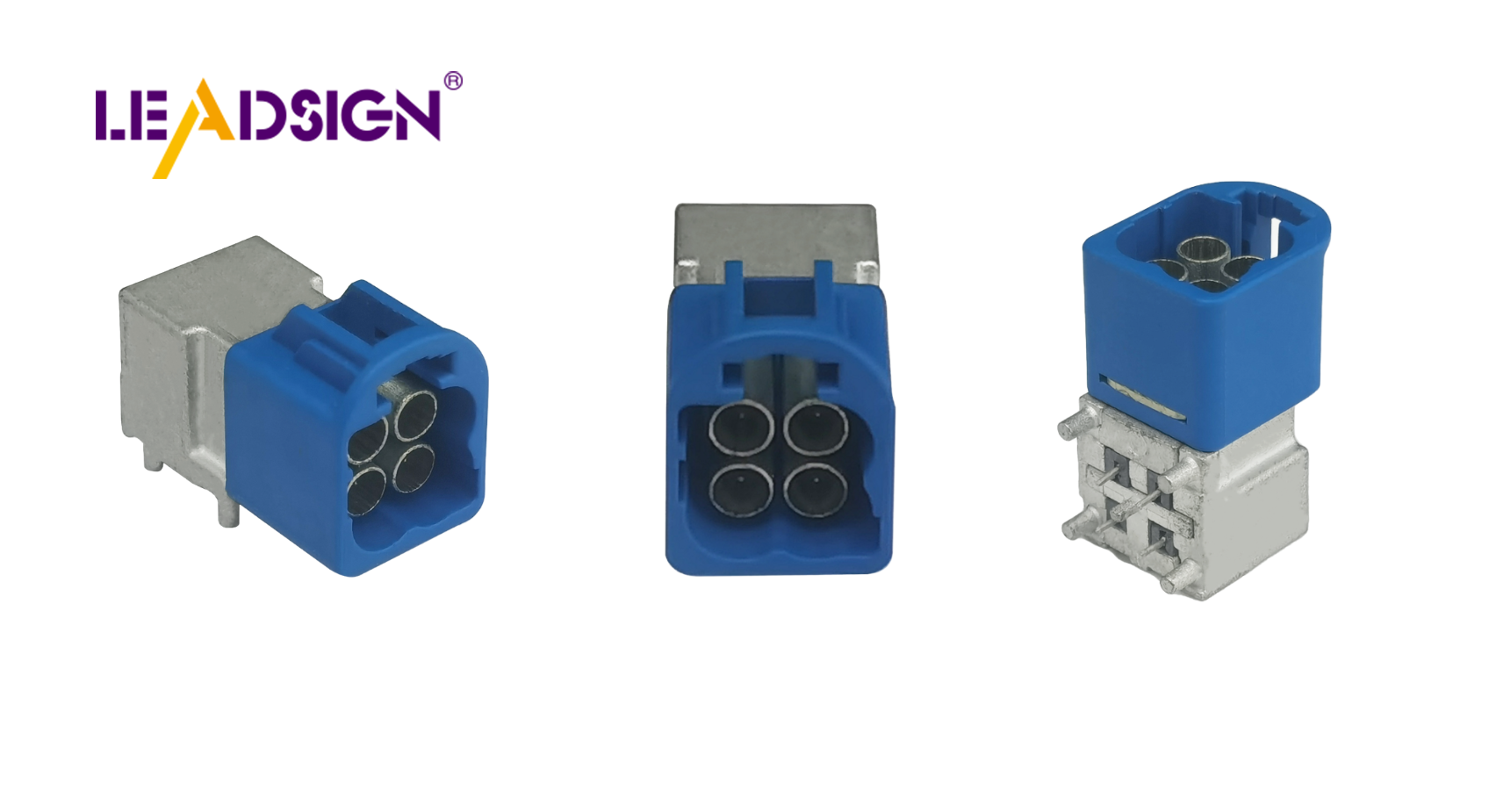
1. Common Types of Automotive Connectors
Connector Type | Description | Typical Use | Sealed? | Data Capable? |
|---|---|---|---|---|
Blade connector | Flat male terminal, female receptacle | Headlights, tail lights, interior lights, fuse boxes | No (unsealed) | ❌ |
Ring terminal | Circular, fits over a stud | Battery connection, grounding points | No (add heat‑shrink) | ❌ |
Butt connector | Cylindrical, joins two wires | Wire repair, extending harnesses | Optional (heat‑shrink) | ❌ |
Weatherproof connector | Sealed housing with rubber grommets | Engine bay sensors, underbody lights, exterior | Yes (IP67/IP69K) | ❌ (power/signal only) |
Specialty connector (FAKRA) | Colour‑coded plastic housing, 50Ω coaxial | GPS antenna, backup camera (1080p/4K), 5G antenna | IP67 optional | ✅ Up to 20 GHz |
Specialty connector (HSD) | 4‑pin or 6‑pin, locking, 100Ω differential | USB‑C CarPlay, Ethernet, LVDS display | Optional | ✅ Up to 5 Gbps |
Key insight: For power and low‑speed signals, blade, ring, butt, and weatherproof connectors are suitable. For high‑speed data (video, GPS, USB‑C), you must use FAKRA or HSD.
2. Detailed Overview of Each Connector Type
🔹 Blade Connectors
Uses: Lighting systems (headlights, taillights, interior lights), power distribution in fuse boxes.
Pros: Simple, low cost, easy to disconnect.
Cons: Not sealed; moderate vibration resistance; prone to corrosion in wet areas.
Best for: Interior dry locations.
🔹 Ring Terminals
Uses: Battery terminals, chassis grounding, high‑current connections.
Pros: Very secure, excellent vibration resistance.
Cons: Requires bolt/screw removal; not quick‑disconnect.
Installation: Crimp or solder, then tighten to stud. Add heat‑shrink for moisture protection.
🔹 Butt Connectors
Uses: Joining two wires – repair, extension, or splicing harnesses.
Pros: Simple, permanent splice.
Cons: Not reusable; needs proper crimping.
Tip: Use adhesive‑lined heat‑shrink butt connectors for underbody or exterior repairs.
🔹 Weatherproof Connectors (Sealed)
Uses: Engine bay sensors (coolant, oxygen), underbody lights, exterior mirrors, wiper motors.
Features: Rubber wire seals, housing gasket, secondary lock.
Importance in wet areas: Prevents corrosion, short circuits, and system failure.
Best for: Any location exposed to water, salt, or dirt – IP67 minimum.
🔹 Specialty Connectors – FAKRA & HSD
FAKRA (coaxial): Colour‑coded (amber=GPS, blue=camera, violet=5G), 50Ω, up to 20 GHz (Mini).
Uses: GPS navigation, SDARS, backup camera (1080p/4K), 4G/5G antennas.
HSD (differential): 100Ω, locking, up to 5 Gbps.
Uses: USB‑C CarPlay, automotive Ethernet (ADAS), LVDS displays.
Why they are different: Impedance control, shielding, and locking – power connectors cannot carry these signals.
3. How to Select the Right Connector – Decision Matrix
Selection Factor | What to check | Example |
|---|---|---|
Power requirements | Voltage (12V/24V/HV), current (amps) | Ring terminal for battery; butt for tail light. |
Environment | Dry interior, engine bay, underbody | Engine bay → sealed (Deutsch, Weather Pack). |
Vibration | High vibration needs secondary lock | Engine sensors → Deutsch DT or sealed FAKRA. |
Data speed | Video, GPS, USB, Ethernet | FAKRA (50Ω) for camera/GPS; HSD (100Ω) for USB/Ethernet. |
Compatibility | Pin count, keying, colour coding | FAKRA blue only mates with blue – prevents error. |
Standards | USCAR‑2, ISO 19642, LV214 | Ensures long‑term reliability. |
Pro tip: For any exterior or underbody connection, always use IP67 sealed connectors – unsealed connectors will corrode within months.
4. Installation & Maintenance Best Practices
✅ Installation Steps
Disconnect battery (negative terminal first).
Strip wire correctly (5‑8 mm, no nicked strands).
Crimp terminal with ratcheting crimper – pull test (5‑10 lbs).
Insert terminal into housing until click; engage secondary lock.
If sealed, ensure rubber grommet is correctly seated.
Apply dielectric grease to seals – not to electrical contacts.
Test continuity and voltage drop before final assembly.
🔧 Common Installation Mistakes
Mistake | Consequence | Prevention |
|---|---|---|
Poor crimp (wrong tool) | Loose connection, overheating | Use ratcheting crimper with correct die. |
Over‑stripping wire | Exposed copper, short circuit risk | Strip only required length (5‑8 mm). |
No heat‑shrink on exterior splice | Water ingress → corrosion | Use adhesive‑lined heat‑shrink. |
Forcing mismatched FAKRA colour | Bent centre pin, housing damage | Check colour (blue=camera, amber=GPS). |
Field‑crimping FAKRA/HSD | Impedance mismatch, signal loss | Use pre‑terminated LEADSIGN cables. |
✅ Maintenance Tips
Inspect every 6 months or 20,000 km – look for corrosion, cracks, loose locks.
Clean with electrical contact cleaner – not water, not WD‑40.
Replace damaged connectors immediately – cracked housing or bent pins.
Signs of wear: Rust, loose fit, melted plastic, intermittent operation.
5. 2026 Trends – What’s Changing
Trend | Implication |
|---|---|
4K cameras on trucks & vans | Mini FAKRA (20 GHz) required – standard FAKRA may lose signal over long runs. |
5G telematics for fleets | 5G antennas need Mini FAKRA (violet) with low‑loss coax; field crimping impossible. |
EV / hybrid | High‑voltage (orange) connectors – do not touch. Low‑voltage data lines need double shielding. |
Pre‑terminated cables | Shops prefer plug‑and‑play FAKRA/HSD from LEADSIGN – no field errors. |
Software‑defined vehicles | Automotive Ethernet backbone uses HSD 100Ω connectors. |
6. Why LEADSIGN – Your Partner for High‑Speed Data Connectors
For power and basic signal connectors, many brands (Deutsch, TE, Molex) offer excellent products. However, for high‑speed data (FAKRA, HSD), field termination is difficult and error‑prone. LEADSIGN provides pre‑terminated, ready‑to‑install cables.
What LEADSIGN offers:
✅ FAKRA (standard & Mini) – all 14 colours, 50Ω, up to 20 GHz, IP67 optional
✅ HSD (USB‑C, Ethernet, LVDS) – 100Ω, locking, up to 5 Gbps
✅ Pre‑terminated cables – custom lengths 0.3m – 20m, no crimping
✅ Low‑loss, double‑shielded coax – for long runs and EV environments
✅ Bulk pricing – for shops, fleets, and distributors
For your business: When you install a backup camera or GPS antenna, use LEADSIGN pre‑terminated FAKRA cables – they arrive ready to connect, ensuring perfect signal integrity and no callbacks.
Final Recommendations – Connector Selection Summary
Application | Recommended Connector | Source |
|---|---|---|
Interior lighting / switches | Blade or butt (unsealed) | Any |
Battery terminal / ground | Ring terminal (copper, heat‑shrink) | Any quality brand |
Engine bay sensor (temp, pressure) | Deutsch DT or Weather Pack (sealed) | TE / Deutsch |
Underbody camera power | Sealed butt (IP67) | Any |
GPS antenna | FAKRA amber (50Ω) | LEADSIGN pre‑terminated |
1080p backup camera | FAKRA blue (50Ω) | LEADSIGN |
4K camera (truck/bus) | Mini FAKRA blue (low‑loss) | LEADSIGN |
5G telematics antenna | Mini FAKRA violet | LEADSIGN |
USB‑C CarPlay | HSD USB‑C (locking) | LEADSIGN |
Remember: A connector that fits mechanically is not enough – it must match electrical requirements (current, impedance, shielding, environment). Choose wisely, and your repairs will last.
Ready to upgrade your connector inventory with pre‑terminated data cables?
See Also
Understanding Ford Fakra Connectors for Automotive Use
An In-Depth Overview of HSD Connectors
Fundamentals of HSD Connectors in Cars