Comparing EV and Hybrid Vehicle Cables with Custom Cable Makers – Professional B2B Guide (2026)

Intro: The Hidden Backbone of Electrification
Electric and hybrid vehicles rely on a complex network of cables – from high‑voltage power transmission to low‑voltage data lines for cameras, sensors, and infotainment. Choosing the right cable type and working with custom cable makers can significantly affect vehicle safety, efficiency, and long‑term reliability.
In this guide, you will learn:
The different cable types used in EVs and hybrids (high‑voltage, charging, low‑voltage data)
Key requirements: heat resistance, flexibility, shielding, and safety standards
How custom cable makers improve performance and fit for specific vehicle models
2026 trends: 800V platforms, liquid‑cooled charging, and high‑speed data
Why LEADSIGN FAKRA/HSD cables are essential for hybrid and EV data systems
1. EV Cables – High‑Voltage & Charging
🔹 High‑Voltage Cables (Orange / Blue)
Purpose: Transmit power from the battery to the motor, inverter, and high‑voltage components.
Voltage: Typically 400V – 800V (newer EVs use 800V for faster charging and lower losses).
Key requirements: High current capacity, thermal management (up to 125°C), flame resistance, and clear colour coding (orange for safety identification).
Shielding: Required to minimise EMI that could interfere with low‑voltage data lines (e.g., camera, GPS).
Safety note: Never repair or modify high‑voltage cables without proper HV training and PPE.
🔹 Charging Cables (Type 1, Type 2, CCS, NACS)
Type 1 (SAE J1772): Single‑phase AC charging, common in older EVs and North America.
Type 2 (IEC 62196): Single‑ or three‑phase AC, standard in Europe.
CCS (Combo 1 / Combo 2): Combined AC and DC fast charging.
NACS (North American Charging Standard): Gaining adoption (Tesla style).
Key requirements: Flexibility in cold weather, high‑current contacts, temperature monitoring, and compatibility with public charging stations.
Trend 2026: Liquid‑cooled charging cables allow up to 500 kW+ for ultra‑fast charging (e.g., Tesla V4).
2. Hybrid Vehicle Cables – Dual‑Power Systems
Hybrids combine an internal combustion engine with an electric motor. Their cable needs are unique:
Function | Cable type | Requirements |
|---|---|---|
High‑voltage (traction battery to motor) | Similar to EV HV cables, but often lower voltage (48V – 400V) | Heat resistance, flexible routing around engine block. |
Low‑voltage (12V auxiliary) | Standard automotive wire (lights, ECUs, sensors) | Reliable, but must be separated from HV cables. |
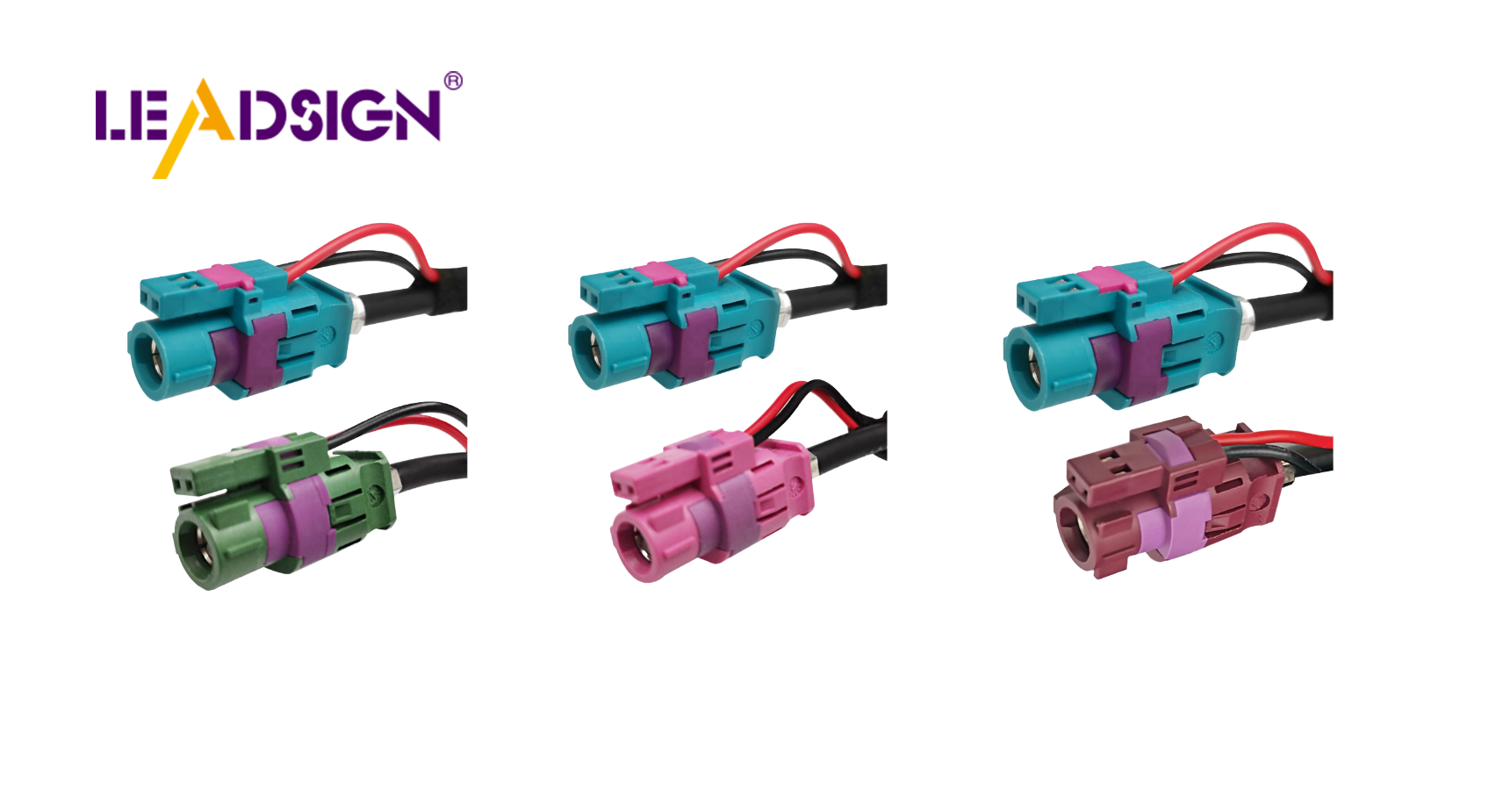
Data (cameras, sensors, HEV controller) | FAKRA (50Ω coax) or HSD (100Ω differential) | Shielding to reject EMI from HV and ignition system. |
Engine sensors (O2, knock, etc.) | Twisted or shielded signal wires | Noise immunity. |
Key insight: Hybrids often have more complex routing because both power sources share the same limited space. Cables must be flexible, abrasion‑resistant, and able to withstand engine bay heat.
3. Role of Custom Cable Makers
Off‑the‑shelf cables rarely fit the exact length, connector type, or environmental requirements of a specific EV or hybrid model. Custom cable makers provide:
🔹 Performance Optimisation
Exact length – no coiling, no excess loss.
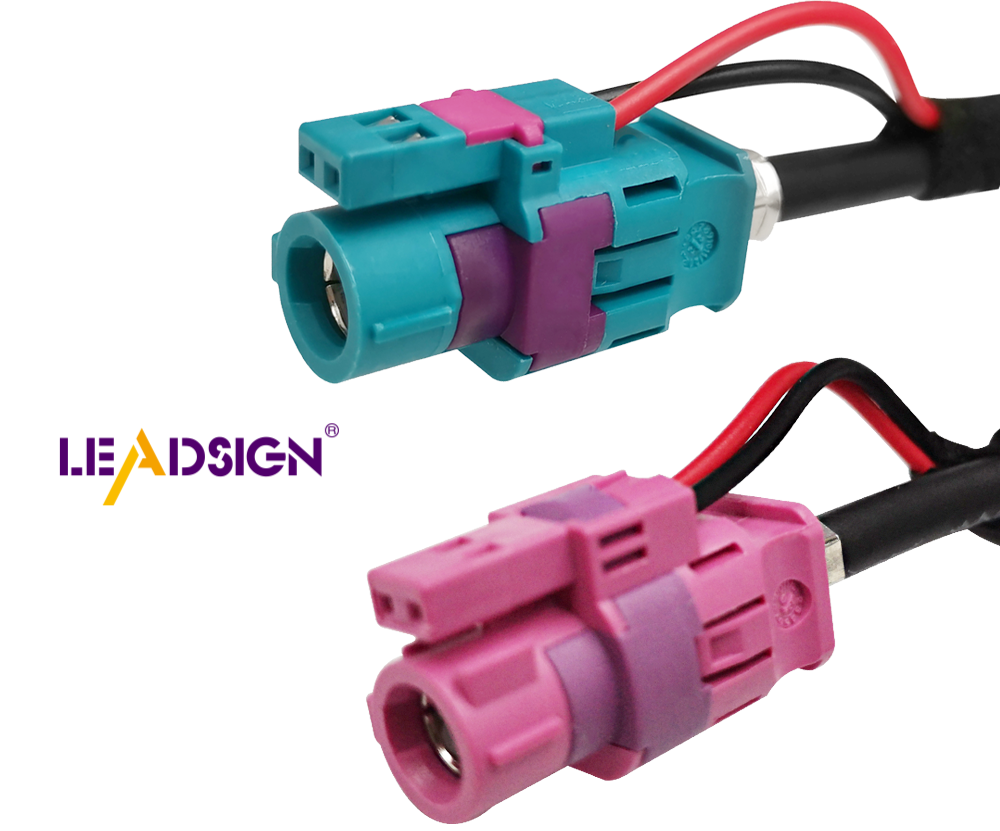
Specific connector termination – e.g., FAKRA (colour‑coded) on one end, bare wire on the other.
Mixed wire gauge – combine power and data in one harness.
Jacket material – choose high‑temp XLPE for engine bay, flexible silicone for cold weather.
🔹 Compatibility & Compliance
Fitment to various vehicle models (passenger EV, electric bus, off‑road hybrid).
Compliance with industry standards:
ISO 19642 – automotive cables.
ISO 6722 – low‑voltage cables.
IEC 62893 – EV charging cables.
LV214 / USCAR‑2 – connector performance.
Pro tip: For data lines (cameras, GPS, USB‑C), use pre‑terminated custom cables from LEADSIGN – they deliver ready‑to‑install, impedance‑matched assemblies.
4. 2026 Trends – What’s Changing in EV & Hybrid Cabling
Trend | Implication |
|---|---|
800V platforms (Porsche Taycan, Hyundai E‑GMP, Lucid) | Cables need thicker insulation, higher voltage ratings, and enhanced EMI shielding. |
Liquid‑cooled charging cables | Enables 500 kW+ charging – but requires integrated cooling channels and leak‑proof connectors. |
Wireless EV charging | Still emerging; cables still needed for on‑board systems. |
4K surround cameras on EVs | Requires Mini FAKRA (20 GHz) for video – standard FAKRA may not handle long cable runs in large vehicles. |
5G telematics | For both EV and hybrid fleets, 5G antennas need Mini FAKRA (violet) with low‑loss coax. |
Automotive Ethernet for battery management | HSD (100Ω) connectors for high‑speed data between BMS and main controller. |
5. Custom Cable Makers – What to Look For
When selecting a custom cable partner for EV or hybrid projects, verify:
Capability | Why it matters |
|---|---|
High‑voltage experience | Safety, proper insulation, colour coding, HVIL (high‑voltage interlock) circuits. |
Data cable expertise (FAKRA, HSD) | Impedance control, shielding, low attenuation. |
Material selection | Heat resistance, flexibility, chemical resistance. |
Testing | Continuity, hi‑pot, attenuation, VSWR for data lines. |
Volume flexibility | From prototypes to fleet quantities. |
LEADSIGN specialises in high‑speed data cables (FAKRA, Mini FAKRA, HSD) for EV and hybrid data systems – cameras, GPS, 5G, USB‑C, and Ethernet. We also offer custom lengths and pre‑terminated assemblies.
6. Why LEADSIGN for EV & Hybrid Data Cables
For high‑voltage power cables, multiple specialised manufacturers exist. But for low‑voltage data (cameras, GPS, telematics, USB‑C), LEADSIGN provides OEM‑grade custom solutions.
What LEADSIGN offers:
✅ FAKRA (standard & Mini) – all 14 colours, 50Ω, up to 20 GHz, IP67 optional
✅ HSD (USB‑C, Ethernet, LVDS) – 100Ω, locking, up to 5 Gbps
✅ Pre‑terminated cables – any length 0.3m – 20m, no field crimping
✅ Low‑loss, double‑shielded coax – for long runs (e.g., rear camera to front display in long EV)
✅ Bulk pricing – for fleets, repair shops, and custom harness builders
For your business: Whether you are converting a classic car to electric, repairing a hybrid, or building a custom EV, LEADSIGN can supply data cables that withstand vibration, temperature, and EMI – ready to install.
Final Recommendations – Cable Selection by Application
Vehicle type | Power cable | Data / signal cable |
|---|---|---|
Passenger EV (400V) | HV orange cable (ISO 19642) | FAKRA blue (camera), FAKRA amber (GPS), HSD USB‑C |
Passenger EV (800V) | HV cable with higher insulation rating | Same FAKRA/HSD, but additional EMI shielding |
Hybrid (petrol + electric) | HV cable + standard 12V wire | FAKRA (camera, GPS), shielded sensor wires |
Electric bus / truck | Heavy‑duty HV cable, long length | Mini FAKRA (low‑loss, 20 GHz) for 4K cameras; HSD Ethernet for telematics |
Charging station cable | Type 2 or CCS with temperature sensor and flexible jacket | Not applicable (LEADSIGN does not supply high‑power charging cables) |
Remember: A custom cable built specifically for your EV or hybrid application will outlast and outperform any off‑the‑shelf alternative.
Ready to source custom FAKRA/HSD cables for your EV or hybrid project?
See Also
Improving Automotive Data Flow With Innovative Connectors
Boosting Vehicle Efficiency Using HSD to USB 2.0
Improving Connectivity Through HSD LVDS Cable Solutions
Increasing Automotive Efficiency Using HFM Connectors
Harnessing FAKRA Coaxial Connectors For Enhanced Performance