Custom Wire Cables: A Guide to Vehicle Cable Selection – Professional B2B Guide (2026)

Intro: One Wrong Cable Can Overheat, Fail, or Cause a Fire
Choosing the right vehicle cable is not just about current rating – it directly affects safety, performance, and long‑term reliability. A cable that is undersized, poorly insulated, or mismatched to the application can overheat, melt, or cause intermittent electrical failures. For repair shops, fleet managers, and custom harness builders, understanding wire types, materials, gauge, insulation, and connectors is essential for professional results.
In this guide, you will learn:
Common automotive wire types (primary, battery, specialised)
Key selection factors (material, amperage, gauge, insulation, connectors)
Differences between similar cables (welding vs. battery, coaxial vs. fibre optic)
Practical tips including colour coding and application matching
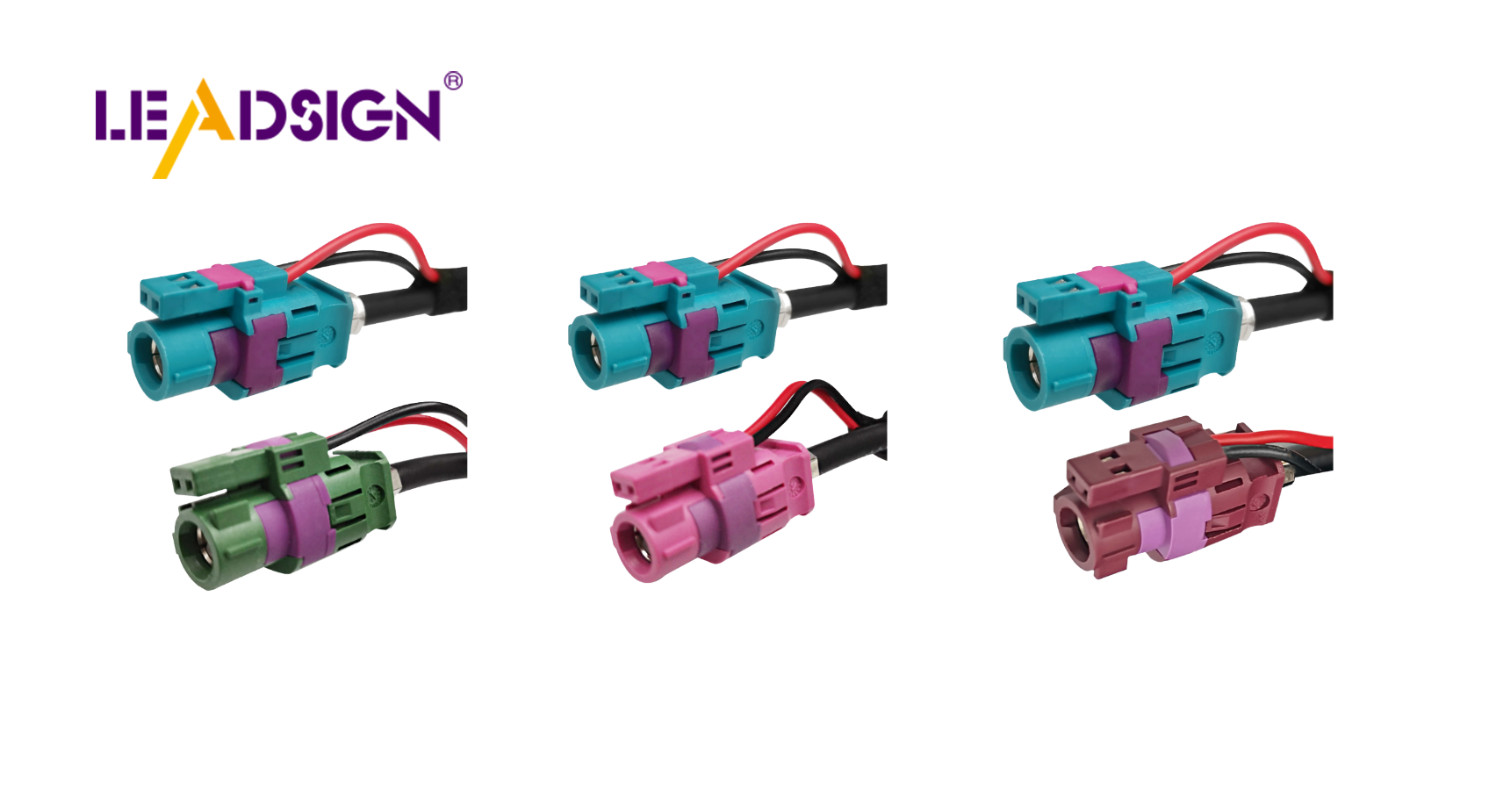
Why LEADSIGN FAKRA/HSD cables are the right choice for high‑speed data
1. Overview of Automotive Wire Types
Wire Type | Description | Key Features | Typical Applications |
|---|---|---|---|
Primary wire (GPT, SXL, TXL) | General purpose, low‑voltage circuits | GPT (economy), SXL (heat‑resistant), TXL (thin, compact) | Lights, sensors, switches, interior electronics |
Battery cable (GXL, welding‑type) | Heavy‑duty, high‑current | Thick insulation, stranded copper, low flexibility | Battery to starter, alternator, ground straps |
Specialised wire (cross‑link, shielded) | High‑temperature or EMI‑sensitive | XLPE insulation, foil/braid shielding | Engine bay, oxygen sensors, data lines (FAKRA, HSD) |
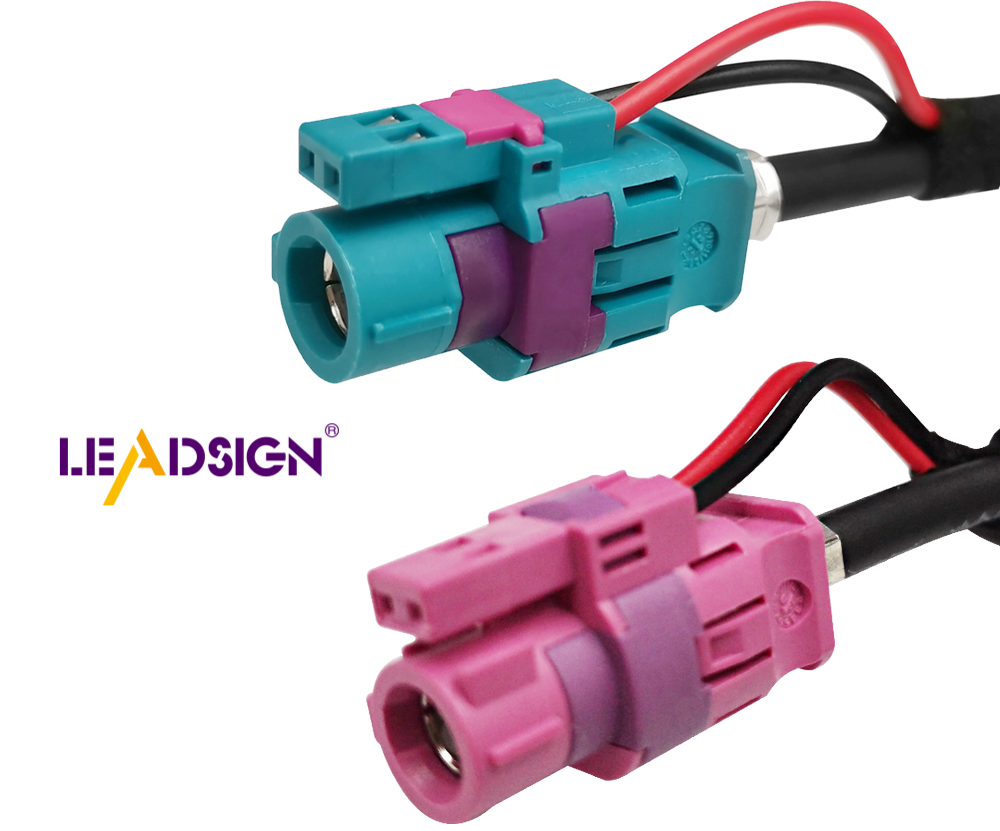
Key insight: For most interior circuits, primary wire (SXL or TXL) is sufficient. For high‑current engine bay applications, use battery cable or cross‑linked wire. For high‑speed data (cameras, GPS, USB‑C), use FAKRA (50Ω coax) or HSD (100Ω differential) cables – not standard primary wire.
2. Key Factors When Choosing Vehicle Cables
🔹 Wire Material – Copper vs. Aluminium
Material | Conductivity | Weight | Cost | Corrosion resistance | Best use |
|---|---|---|---|---|---|
Copper | Excellent (100% IACS) | Heavy | Higher | Good (with tin plating) | Most automotive, high‑current, data |
Aluminium | Lower (≈61% IACS) | Light | Lower | Moderate (requires special terminals) | Large‑gauge battery cables (cost/weight saving) |
Recommendation: For 99% of automotive repairs, use copper (tinned copper for corrosion resistance). Aluminium requires larger wire gauge and special anti‑corrosion paste – not recommended for general shop use.
🔹 Insulation Types
Insulation material | Temperature range | Properties | Typical use |
|---|---|---|---|
PVC (GPT) | -40°C to +80°C | Low cost, flexible | Interior, non‑engine bay |
XLPE (SXL, GXL) | -40°C to +125°C | Heat resistant, durable | Engine bay, underhood |
TXL | -40°C to +125°C | Thin wall, lightweight | Tight spaces, weight‑sensitive |
Silicone | -50°C to +150°C | Very flexible, high temp | Battery cables, high‑flex applications |
Pro tip: For any wire passing through the engine bay, use XLPE (SXL or GXL) – PVC will harden and crack over time.
🔹 Amperage & Wire Gauge (AWG)
AWG | Copper ampacity (chassis wiring) | Typical automotive use |
|---|---|---|
22‑20 | 5‑10A | Sensors, small signals |
18‑16 | 10‑20A | Lighting, relays, fans |
14‑12 | 20‑35A | Power distribution, ECUs |
10‑8 | 35‑55A | Alternator, starter (short runs) |
6‑4 | 55‑100A+ | Battery leads, winches |
Rule of thumb: Use thicker wire (lower AWG number) for longer runs to avoid voltage drop. For example, a 10m run to a rear winch requires 4 AWG, not 8 AWG.
🔹 Connectors – Matching the Cable to the End
Connector type | Best for | Sealed? | Data capable? |
|---|---|---|---|
Crimp (butt, ring, spade) | Power, ground, speakers (interior) | Optional (heat‑shrink) | ❌ |
Deutsch DT | Engine bay sensors, power | Yes (IP67) | ❌ |
Weather Pack | Exterior lights, moderate vibration | Yes (IP67) | ❌ |
FAKRA (coaxial) | Camera video, GPS, 5G | IP67 optional | ✅ 50Ω |
HSD (differential) | USB‑C, Ethernet, LVDS | Optional | ✅ 100Ω |
Ensure secure connections:
Use a ratcheting crimper – not pliers.
Perform a pull test (5‑10 lbs) – wire must not come out.
For exterior/underbody, use adhesive‑lined heat‑shrink or sealed connectors.
3. Differences Between Similar Products
🔹 Welding Cable vs. Battery Cable
Feature | Welding Cable | Battery Cable |
|---|---|---|
Flexibility | Very high (fine strands) | Low (coarse strands) |
Insulation | EPDM or neoprene (flexible, oil resistant) | PVC or XLPE (durable, less flexible) |
Voltage rating | 600V | 60V (automotive) |
Best use | Portable equipment, jumpers, winch extensions | Fixed battery to starter, ground |
Advice: Do not use welding cable for permanent battery installations – its fine strands can wick corrosion and its voltage rating is overkill but its flexibility is unnecessary.
🔹 Coaxial Cable vs. Fibre Optic Cable
Feature | Coaxial (e.g., RG‑174, RG‑58, low‑loss FAKRA) | Fibre Optic |
|---|---|---|
Signal medium | Copper centre conductor with shield | Light (glass or plastic fibre) |
Bandwidth | Up to 6 GHz (standard), 20 GHz (Mini) | Very high (GHz to THz) |
EMI immunity | Good (shielded) | Excellent (no electrical interference) |
Automotive use | GPS, SDARS, backup camera (AHD, CVBS), 4G/5G antenna | MOST bus, high‑end infotainment |
Connector | FAKRA, Mini FAKRA | HSD fibre (special) |
Application tip: For backup cameras and GPS, use FAKRA 50Ω coax. For fibre optic (MOST), use dedicated fibre cables – do not substitute with coax.
4. Practical Tips for Picking the Right Wire
🔹 Colour Coding – Why It Matters
Colour | Typical function |
|---|---|
Black | Ground (chassis/negative) |
Red / Orange | Battery positive (constant) |
Yellow | Switched ignition (accessory) |
Blue | Lighting or remote turn‑on |
Green / White | Sensor signals (manufacturer specific) |
Pro tip: When adding aftermarket circuits, follow the same colour scheme – red for +12V constant, black for ground, yellow for ignition‑switched.
🔹 Matching Wire Type to Application
Application | Recommended wire | Comments |
|---|---|---|
Interior lights / switches | SXL or TXL (18‑16 AWG) | Flexible, easy to route |
Engine bay sensor (temp, pressure) | SXL or cross‑link (20‑18 AWG) | Heat resistant |
Battery to starter | Battery cable (4‑2 AWG) | High current, short run |
Backup camera video | FAKRA 50Ω coax (pre‑terminated) | Do not use primary wire |
GPS antenna | FAKRA 50Ω coax (amber) | Low loss, colour‑coded |
USB‑C CarPlay | HSD USB‑C (100Ω) | Differential pair, shielded |
🔹 Common Mistakes to Avoid
Using primary wire for camera video → no image or severe noise → use FAKRA.
Undersized wire for winch → voltage drop, overheating → calculate load and length.
No strain relief at connector → wire pulls out → zip‑tie within 5 cm.
Unsealed wire in underbody → corrosion → use heat‑shrink or sealed cables.
5. Why LEADSIGN – Pre‑Terminated Data Cables Simplify Selection
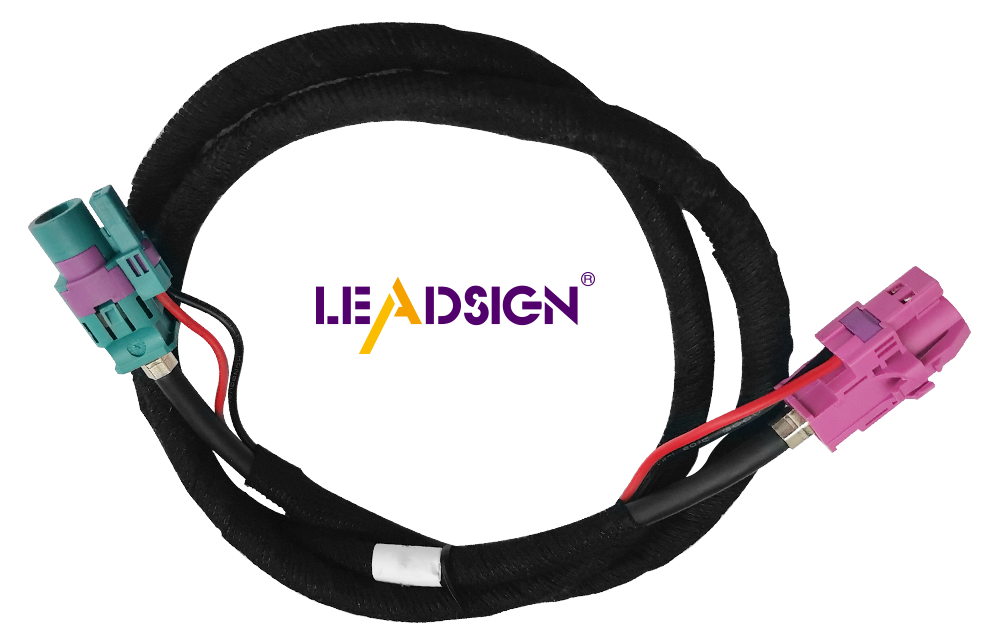
For power wiring, many quality wire brands exist. But for high‑speed data (FAKRA, HSD), field termination is difficult and error‑prone. LEADSIGN provides pre‑terminated, tested cables that eliminate guesswork.
What LEADSIGN offers:
✅ FAKRA (standard & Mini) – all 14 colours, 50Ω, up to 20 GHz, IP67 optional
✅ HSD (USB‑C, Ethernet, LVDS) – 100Ω, locking, up to 5 Gbps
✅ Pre‑terminated cables – custom lengths 0.3m – 20m, no crimping
✅ Low‑loss, double‑shielded coax – for long runs and EV environments
✅ Bulk pricing – for shops, fleets, and distributors
For your business: When you need a camera cable, GPS extension, or USB‑C lead, order a LEADSIGN pre‑terminated cable – correct gauge, correct connector, correct impedance. No wire selection confusion.
Final Recommendations – Wire Selection Summary
What you need | Recommended cable | Source |
|---|---|---|
Interior power (lights, switches) | SXL or TXL primary wire (18 AWG) | Any auto wire supplier |
Engine bay sensor | SXL cross‑link (20 AWG) | Any |
Battery to starter | Battery cable (4‑2 AWG, copper) | Any |
Backup camera video | FAKRA blue 50Ω coax | LEADSIGN pre‑terminated |
GPS antenna | FAKRA amber 50Ω coax | LEADSIGN |
5G telematics antenna | Mini FAKRA violet low‑loss coax | LEADSIGN |
USB‑C CarPlay | HSD USB‑C 100Ω | LEADSIGN |
Winch / high‑current auxiliary | Welding cable (fine strand, flexible) | Any industrial supplier |
Remember: The right cable starts with the right selection. When in doubt, oversize the wire, use copper, and choose sealed connectors for exposed locations.
Ready to simplify your custom cable sourcing?
See Also
Maximizing Automotive Data Flow With Superior Connectors And Cables
Boosting Data Transfer: Significance of Fast Automotive Connectors
Improving Automotive Data Flow Using FAKRA PCB Connectors
Significance of FAKRA Connectors in Today's Automotive Industry