Copper vs Aluminum Car Wiring Wire for Automotive Applications

Intro: Conductivity, Weight, Cost – The Three-Way Trade‑Off
Choosing between copper and aluminum automotive wire is a fundamental decision for vehicle manufacturers, custom harness builders, and repair shops. Copper offers superior electrical conductivity, strength, and corrosion resistance. Aluminum is lighter and less expensive. Understanding the technical differences – conductivity, tensile strength, thermal expansion, and long‑term reliability – is essential for selecting the right material for each application.
In this guide, you will learn:
Key property comparisons (conductivity, strength, corrosion resistance, thermal expansion)
Cost analysis (initial vs. long‑term)
Application suitability (high‑current, low‑current, weight‑sensitive)
Safety and reliability considerations (fire risk, durability, maintenance)
Why copper remains the preferred choice for most automotive wiring
1. Key Property Comparison – Copper vs. Aluminum
Property | Copper | Aluminum | Impact |
|---|---|---|---|
Electrical conductivity | 100% IACS (International Annealed Copper Standard) | ≈61% IACS | Copper carries more current for the same cross‑sectional area. |
Density (weight) | 8.96 g/cm³ | 2.70 g/cm³ | Aluminum is 70% lighter – significant for weight‑sensitive applications. |
Tensile strength | ~220 MPa (annealed) | ~90 MPa (annealed) | Copper is stronger, more resistant to breakage under vibration. |
Corrosion resistance | Excellent (forms protective patina) | Prone to oxidation (white rust) | Copper requires less protection; aluminum needs special coatings. |
Coefficient of thermal expansion | 17 × 10⁻⁶ /°C | 23 × 10⁻⁶ /°C | Aluminum expands more, can loosen connections over time. |
Cost per kg | Higher | Lower (≈30‑50% less) | Aluminum offers initial cost savings. |
Key takeaway: Copper is the superior conductor and more durable. Aluminum wins on weight and raw material cost.
2. Conductivity – Why Copper Carries More Current
For the same wire gauge (AWG), copper can carry about 60% more current than aluminum without overheating. This means:
A 10 AWG copper wire can handle the same current as a 8 AWG aluminium wire (one size larger).
Copper wires are smaller and easier to route in tight spaces.
Voltage drop is lower with copper for the same length and load.
Example: A 10 AWG copper wire may carry 30A safely; an aluminium wire of the same gauge might be limited to 18‑20A.
For automotive high‑current circuits (starter, alternator, winch): Copper is strongly preferred.
3. Strength and Durability – Handling Vibration and Flexing
Vehicles experience constant vibration, bending, and thermal cycling. Copper has higher tensile strength and better fatigue resistance than aluminum.
Copper withstands repeated bending without cracking. It is less likely to break at crimp points.
Aluminum is more brittle. Under vibration, it can work‑harden and crack, especially at terminals.
Result: Copper connections remain reliable for the life of the vehicle. Aluminum may require periodic retorquing and inspection.
4. Corrosion Resistance – Long‑Term Reliability
Copper naturally forms a protective oxide layer that stops further corrosion. It resists moisture, road salt, and chemicals.
Aluminium oxidises rapidly when exposed to air and moisture. Aluminium oxide is an insulator, increasing connection resistance. This can cause overheating.
Mitigation for aluminium: Use tin‑plated or copper‑clad aluminium (CCA) terminals and apply anti‑oxidation paste. Even then, copper is more “fit and forget”.
5. Thermal Expansion – Connection Loosening over Time
Both metals expand and contract with temperature changes. However, aluminium expands about 35% more than copper.
Effect | Copper | Aluminium |
|---|---|---|
Terminal loosening | Low – stays tight | Higher – may require periodic retorquing |
Risk of arcing / fire | Low | Higher if connection loosens |
Practical implication: Aluminium connections (especially in engine bays) need regular inspection. Copper connections are more stable.
6. Cost Analysis – Initial vs. Long‑Term
Cost factor | Copper | Aluminium |
|---|---|---|
Raw material cost | High | Low (30‑50% less) |
Installation labour | Similar (but easier because smaller gauge) | Similar (but may need larger gauge = more weight) |
Maintenance | Low – virtually none | Higher – periodic inspection, anti‑corrosion treatment |
Long‑term reliability | Excellent | Moderate – requires careful design |
For OEMs: Aluminium is attractive for weight‑sensitive EVs and hybrids. For aftermarket repairs and high‑reliability applications, copper is the safer, longer‑lasting choice.
7. Application Suitability – Where to Use Each
🔹 High‑Current / Power Circuits (battery, alternator, starter, winch)
Recommended: Copper
Why: High conductivity, low voltage drop, heat resistance, reliable crimps.
🔹 Low‑Current / Signal Circuits (sensors, switches, lights)
Recommended: Copper (or CCA for non‑critical, interior, low‑vibration)
Why: Smaller gauge saves space; copper ensures signal integrity.
🔹 Weight‑Sensitive Applications (EVs, hybrid, weight‑optimised race cars)
Aluminium can be used for non‑critical, low‑current, or carefully designed high‑current circuits.
Typical use: Battery cables, heavy‑gauge power distribution where weight savings outweigh long‑term concerns.
🔹 High‑Vibration / Engine Bay
Copper only – aluminium is more likely to crack or loosen.
8. Safety and Reliability – Fire Risk
Risk | Copper | Aluminium |
|---|---|---|
Overheating due to undersizing | Low if properly selected | Higher (needs larger gauge for same current) |
Connection loosening | Very low | Moderate – requires periodic checking |
Corrosion leading to high resistance | Low | High (unless properly sealed and plated) |
For safety‑critical systems (airbags, ABS, engine control): Always use copper.
9. Maintenance – Long‑Term Care
Copper: Minimal – inspect for physical damage, but corrosion is rarely an issue. Terminals remain tight.
Aluminium: Requires periodic inspection for oxidation, loose terminals, and signs of overheating. Use anti‑oxidation paste at connections.
10. Why Copper Dominates Automotive Wiring – Summary
Criterion | Winner |
|---|---|
Conductivity | ✅ Copper |
Strength & durability | ✅ Copper |
Corrosion resistance | ✅ Copper |
Thermal stability | ✅ Copper |
Weight | ✅ Aluminium |
Initial cost | ✅ Aluminium |
Long‑term reliability | ✅ Copper |
Conclusion: For most automotive applications – especially power, safety, and high‑vibration environments – copper is the superior choice. Aluminium may be used in weight‑sensitive, low‑current, or cost‑driven applications, but only with proper design, sealing, and maintenance.
For data cables (FAKRA, HSD, USB‑C, Ethernet): Copper is mandatory – aluminium cannot meet the impedance, attenuation, and flexibility requirements.
Why LEADSIGN for Automotive Data Cables
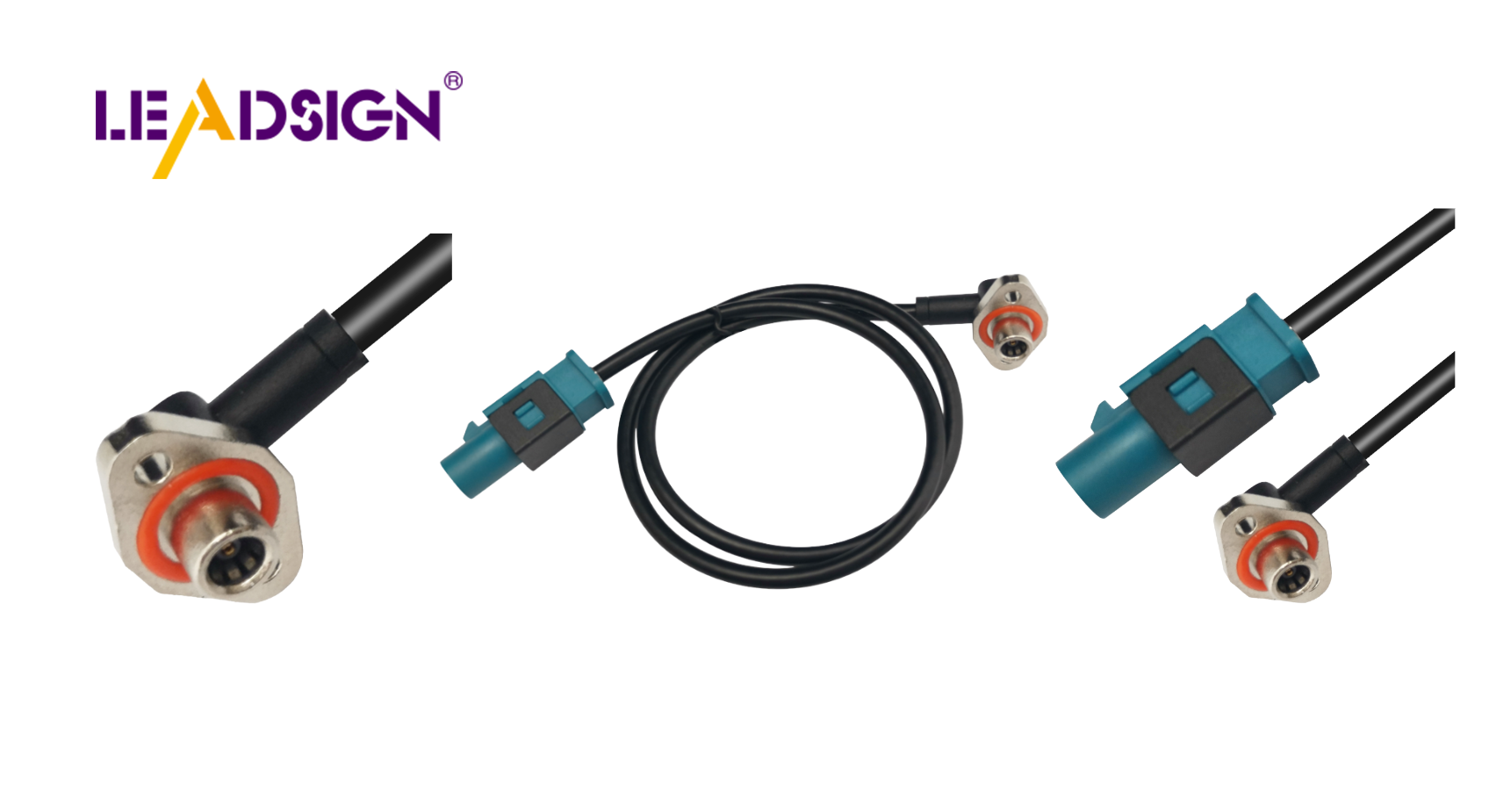
LEADSIGN specialises in pre‑terminated FAKRA and HSD cables – all using high‑quality copper conductors for optimal signal integrity.
What LEADSIGN offers:
✅ FAKRA (standard & Mini) – all 14 colours, 50Ω, up to 20 GHz, IP67 optional
✅ HSD (USB‑C, Ethernet, LVDS) – 100Ω, locking, up to 5 Gbps
✅ Pre‑terminated cables – custom lengths 0.3m – 20m, no field crimping
✅ Low‑loss, double‑shielded coax – for long runs and EV environments
✅ Bulk pricing – for shops, fleets, and distributors
For your business: When you need a reliable camera, GPS, or USB‑C connection, choose LEADSIGN copper‑based pre‑terminated cables – they deliver the conductivity and durability that aluminium cannot match.
Final Recommendations – Copper vs Aluminium Selection Table
Application | Recommended material | Reason |
|---|---|---|
Starter / battery cable (high current) | Copper | Conductivity, heat resistance |
Engine bay sensor (vibration) | Copper | Strength, corrosion resistance |
EV high‑voltage (orange) | Aluminium (special) or copper | Weight savings possible, but requires HV certification |
Interior lighting / low current | Copper (or CCA for non‑critical) | Signal integrity |
Winch / heavy accessory | Copper | High current, reliability |
Camera video / GPS / data | Copper | Impedance, shielding, flexibility |
Remember: The extra upfront cost of copper wire buys decades of reliable service. Aluminium may save a few dollars now but can cost more in maintenance and callbacks later.
Ready to source high‑quality copper‑based data cables?
See Also
Enhancing Data Transfer in Vehicles: Innovative Connectors and Wires
Benefits of HFM Connectors for Automotive Applications
Benefits of HFM RF Connectors in Vehicle Technology