Surprising Benefits of Rigid Coaxial Cable in Cars – Professional B2B Guide (2026)

Intro: The Unsung Hero of Reliable Vehicle Electronics
When you think of automotive technology, cables rarely come to mind. Yet rigid coaxial cables play a critical role in ensuring clear signal transmission for GPS, radio, satellite communication, and even backup cameras. Unlike standard flexible cables, rigid coax offers superior shielding, lower signal loss, and exceptional durability in harsh environments. For repair shops, fleet managers, and custom harness builders, understanding the advantages of rigid coaxial cable can lead to more reliable repairs and fewer callbacks.
In this guide, you will learn:
Technical advantages (signal integrity, low attenuation, EMI rejection)
Practical benefits (durability, temperature resistance, moisture protection)
Cost considerations (upfront vs. long‑term savings, resale value)
2026 trends (4K cameras, 5G telematics, EV EMI)
When to use rigid coax vs. standard flexible coax
Why LEADSIGN FAKRA pre‑terminated cables offer a practical alternative for many automotive RF applications
1. Technical Advantages of Rigid Coaxial Cables
Parameter | Rigid coaxial cable | Standard flexible coax (e.g., RG‑174) |
|---|---|---|
Signal attenuation (loss) | Very low (≈0.2‑0.4 dB/m @ 1 GHz) | Moderate (≈0.6‑1.2 dB/m @ 1 GHz) |
Shielding effectiveness | Excellent (solid outer conductor) | Good (braided or foil) |
EMI / RFI rejection | Superior | Moderate |
Impedance stability | Very stable (50Ω or 75Ω) | Good, but can vary with bending |
Flexibility | Low (bends require special tooling) | High |
Typical use | Fixed installations, test equipment, base stations | Mobile, aftermarket, interior |
Key takeaway: Rigid coaxial cable provides the best possible signal integrity and isolation from interference – essential for high‑frequency applications (GPS L1/L2, 5G, satellite radio). However, its lack of flexibility means it is best suited for fixed runs within the vehicle chassis or engine bay, not for movable doors or hatches.
2. Practical Benefits in Automotive Applications
🔹 Durability & Long Life
Mechanical strength: Rigid coax resists crushing, vibration, and mechanical stress better than flexible coax. It maintains its shape and impedance even in high‑vibration areas (engine bay, underbody).
Fewer replacements: Less prone to internal conductor fatigue – reduces maintenance costs over the vehicle’s life.
🔹 Temperature & Environmental Resistance
Wide operating range: Typically -55°C to +125°C – suitable for engine bays and exterior applications.
Moisture & corrosion resistance: Solid outer conductor and robust jacket prevent water ingress – ideal for underbody camera and antenna cables.
🔹 Ideal for Harsh Conditions
Off‑road and heavy‑duty: Performance in rough terrain (construction, agricultural, military vehicles) where flexible cables may chafe or break.
EMI‑rich environments (EVs, hybrids): Excellent shielding protects sensitive GPS and radio signals from inverter and motor noise.
Pro tip for 2026: With the proliferation of 4K cameras and 5G telematics, signal integrity is more critical than ever. For long, straight runs under the vehicle chassis, rigid coax can outperform flexible alternatives.
3. Cost Considerations – Upfront vs. Long‑Term
Cost factor | Rigid coax | Standard flexible coax |
|---|---|---|
Initial purchase price | Higher (specialised construction) | Lower |
Installation labour | Higher (requires careful bending, specialised connectors) | Lower (easy to route) |
Maintenance & replacement | Lower (longer life, fewer failures) | Higher (subject to fatigue) |
Vehicle resale value impact | Positive (perceived quality) | Neutral |
Advice for shops: Use rigid coax for fixed, hard‑to‑access runs (e.g., from roof‑mounted antenna to head unit) where replacement labour would be expensive. For short, flexible runs (door hinges, seats), standard coax is sufficient.
4. 2026 Trends Affecting Coaxial Cable Choice
Trend | Implication for coaxial cable |
|---|---|
4K surround cameras (up to 20 GHz) | Requires low‑loss, high‑shielding coax – rigid coax offers superior performance, but Mini FAKRA flexible options are also available. |
5G telematics (C‑V2X) | Antenna cables must have very low attenuation – rigid coax can be used for the primary fixed run with a flexible pigtail at the connector. |
EV / hybrid adoption | High EMI environment demands double‑shielded coax – rigid coax’s solid outer conductor provides excellent shielding. |
Longer vehicle lengths (trucks, buses) | Camera and antenna runs of 10‑20m – low‑loss rigid coax minimises signal degradation. |
Pre‑terminated cable assemblies | Shops prefer ready‑to‑install cables (LEADSIGN FAKRA) – available in flexible low‑loss coax that often meets or exceeds rigid coax performance for most applications. |
Key insight: For most automotive aftermarket installations (up to 6 GHz, 10‑15m runs), high‑quality flexible low‑loss coax (e.g., LEADSIGN FAKRA cables) offers a practical balance between performance, flexibility, and ease of installation. Rigid coax is best reserved for fixed, high‑vibration, or extreme EMI environments.
5. When to Use Rigid Coaxial Cable – A Decision Guide
Application | Recommend rigid coax? | Reason |
|---|---|---|
Roof‑mounted GPS antenna to head unit (fixed route) | ✅ Yes | Fixed path, long run, low loss benefits |
Backup camera in a passenger car (flexible door/tailgate) | ❌ No (use flexible low‑loss) | Requires flexibility |
Engine bay sensor (high heat, vibration) | ✅ Yes | Superior temperature and vibration resistance |
Underbody camera on a truck (long, fixed run) | ✅ Yes | Low loss, moisture resistance |
5G antenna cable within a bus (fixed chassis route) | ✅ Yes | Excellent shielding for high frequency |
Aftermarket USB‑C CarPlay (short, interior) | ❌ No | Overkill; standard HSD sufficient |
Pro tip: For most aftermarket repairs, a high‑quality flexible low‑loss FAKRA cable from LEADSIGN provides excellent performance without the installation difficulty of rigid coax.
6. Why LEADSIGN – Your Source for High‑Quality FAKRA Coaxial Cables
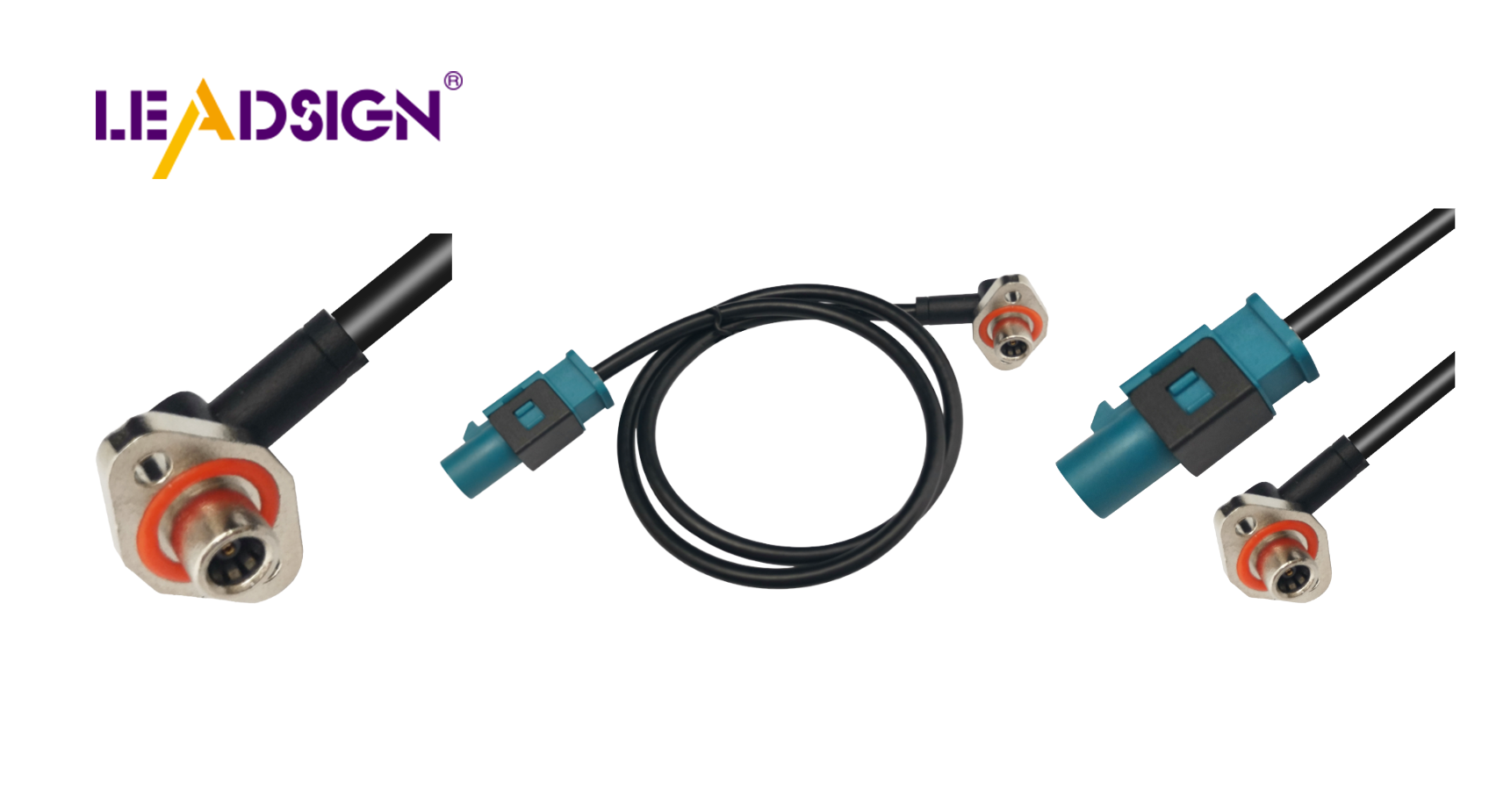
While rigid coax has its place, the majority of automotive RF applications (GPS, camera, telematics) use flexible, pre‑terminated FAKRA cables. LEADSIGN offers low‑loss, double‑shielded FAKRA cables that deliver near‑rigid performance with the flexibility needed for easy installation.
What LEADSIGN offers:
✅ FAKRA (standard & Mini) – all 14 colours, 50Ω, up to 20 GHz, IP67 optional
✅ Pre‑terminated cables – any length 0.3m – 20m, no field crimping
✅ Low‑loss, double‑shielded coax – suitable for long runs and EV environments
✅ Flexible yet durable – easier to route than rigid coax
✅ Bulk pricing – for shops, fleets, and distributors
For your business: When you need a reliable camera, GPS, or 5G antenna connection, LEADSIGN FAKRA cables offer the best balance of signal integrity, durability, and installation ease – without the handling challenges of rigid coax.
Final Recommendations – Coaxial Cable Selection for 2026
Use case | Recommended cable | Source |
|---|---|---|
Fixed, long, high‑vibration run (engine bay, underbody) | Rigid coaxial or LEADSIGN low‑loss flexible | LEADSIGN (flexible) |
Flexible, short run (door, tailgate) | LEADSIGN FAKRA flexible (standard or low‑loss) | LEADSIGN |
4K camera (high bandwidth, >5m) | LEADSIGN Mini FAKRA low‑loss coax | LEADSIGN |
5G telematics (high frequency, critical shielding) | LEADSIGN Mini FAKRA violet double‑shielded | LEADSIGN |
Standard GPS / radio (legacy) | LEADSIGN FAKRA standard coax | LEADSIGN |
Remember: Rigid coaxial cable offers exceptional performance, but its lack of flexibility limits its use in modern vehicles. For most automotive repairs and upgrades, high‑quality flexible low‑loss FAKRA cables (LEADSIGN) provide the best combination of performance, ease of installation, and long‑term reliability.
Ready to upgrade your coaxial cable inventory for 2026?
See Also
Why FAKRA Coaxial Cables Matter in Automotive Use
Harnessing the Potential of FAKRA Coaxial Cables
Maximizing the Benefits of FAKRA Coaxial Connectors
Exploring the Flexibility and Advantages of FAKRA Connectors