What Are Automotive Ethernet Cables in Vehicle Cable Systems? – Professional B2B Guide (2026)

Intro: The Backbone of Next‑Generation Vehicle Connectivity
Automotive Ethernet is not the same as the Ethernet in your office or home. It is a specialised, ruggedised version designed to withstand extreme vibration, temperature swings, and electromagnetic interference (EMI) found in vehicles. With the in‑car Ethernet market projected to reach USD 2.52 billion by 2023 and continue growing, this technology is rapidly replacing traditional CAN, LIN, and MOST networks. It enables high‑speed data transfer for advanced driver‑assistance systems (ADAS), infotainment, over‑the‑air (OTA) updates, and autonomous driving.
In this guide, you will learn:
What automotive Ethernet is and why it differs from traditional networks
Key technical specifications (standards, cabling, data rates)
Advantages over legacy networks (cost, weight, performance)
How it integrates with modern vehicle systems (ADAS, infotainment, diagnostics)
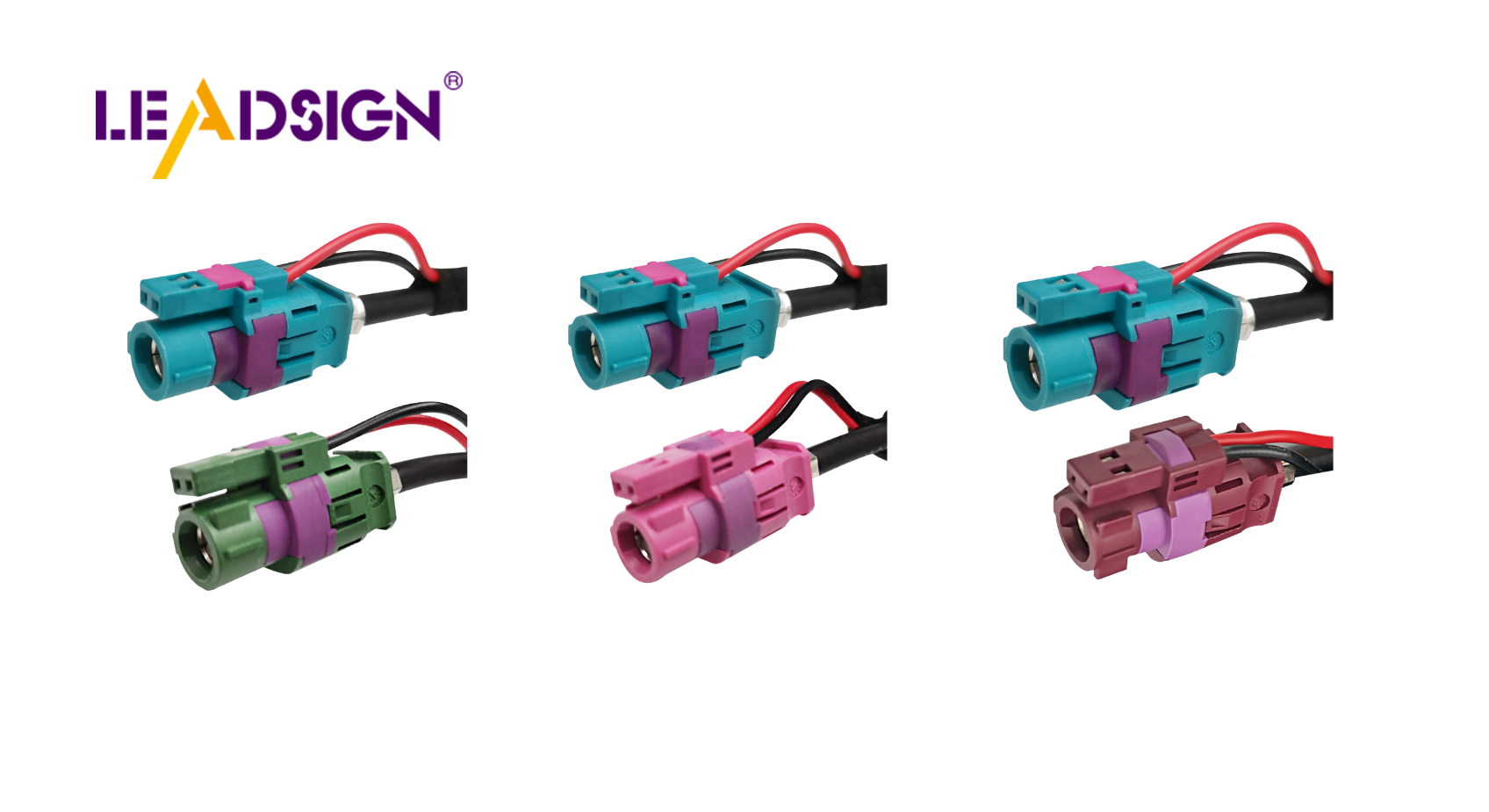
The role of connectors (HSD, MATEnet) in automotive Ethernet
Why LEADSIGN HSD cables are a reliable choice for Ethernet connectivity
1. Understanding Automotive Ethernet – Definition & Purpose
Automotive Ethernet is a physical network standard (based on IEEE 802.3) adapted for vehicle use. Unlike consumer Ethernet, it uses single twisted pair (100BASE‑T1, 1000BASE‑T1) instead of four pairs, saving weight and space. It is designed to meet automotive EMC/EMI requirements and operate from -40°C to +105°C.
Feature | Automotive Ethernet | Traditional Ethernet (office) |
|---|---|---|
Physical medium | Single twisted pair (UTP/STP) | 4‑pair UTP or fibre |
Data rate | 100 Mbps – 10 Gbps | 10 Mbps – 100 Gbps |
Temperature range | -40°C to +105°C | 0°C to +70°C |
EMI/EMC compliance | Strict automotive standards | Less stringent |
Connectors | HSD, MATEnet, H‑MT | RJ45 |
Purpose: Enable high‑bandwidth, low‑latency communication between ECUs, cameras, radar, lidar, and infotainment modules – all while reducing wiring weight and cost.
2. Comparison with Traditional Automotive Networks (CAN, LIN, MOST)
Network | Max data rate | Typical use | Limitations |
|---|---|---|---|
CAN (Controller Area Network) | 1 Mbps | Engine, transmission, body control | Too slow for video, high‑bandwidth sensors |
LIN (Local Interconnect Network) | 20 kbps | Window lifts, seats, switches | Very low speed |
MOST (Media Oriented Systems Transport) | 25‑150 Mbps | Audio, video (older infotainment) | Expensive, proprietary, less flexible |
Automotive Ethernet | 100 Mbps – 10 Gbps | ADAS, cameras, infotainment, backbone | Requires new connectors (HSD) |
Advantages of Ethernet over legacy networks:
Higher bandwidth: 100 Mbps (100BASE‑T1) to 1 Gbps (1000BASE‑T1) supports 4K cameras and raw radar data.
Lower weight: Single twisted pair reduces harness weight by up to 50% compared to multiple CAN/LIN wires.
Lower cost: Uses standard IP software stack, reducing development and integration cost.
Scalability: Easily add new nodes, higher speeds, and future protocols.
3. Key Features & Specifications
🔹 Network Standards (IEEE 802.3)
Standard | Data rate | Cable length | Typical automotive use |
|---|---|---|---|
100BASE‑T1 (802.3bw) | 100 Mbps | 15 m | Sensors, audio, low‑res cameras |
1000BASE‑T1 (802.3bp) | 1 Gbps | 15 m | 4K cameras, radar, lidar, backbone |
10BASE‑T1S (802.3cg) | 10 Mbps | 25 m | Low‑speed sensors, actuators (replacing CAN) |
🔹 Cabling – Single Twisted Pair
Unshielded twisted pair (UTP) for standard EMC environments.
Shielded twisted pair (STP) for high‑noise areas (EV motor compartments).
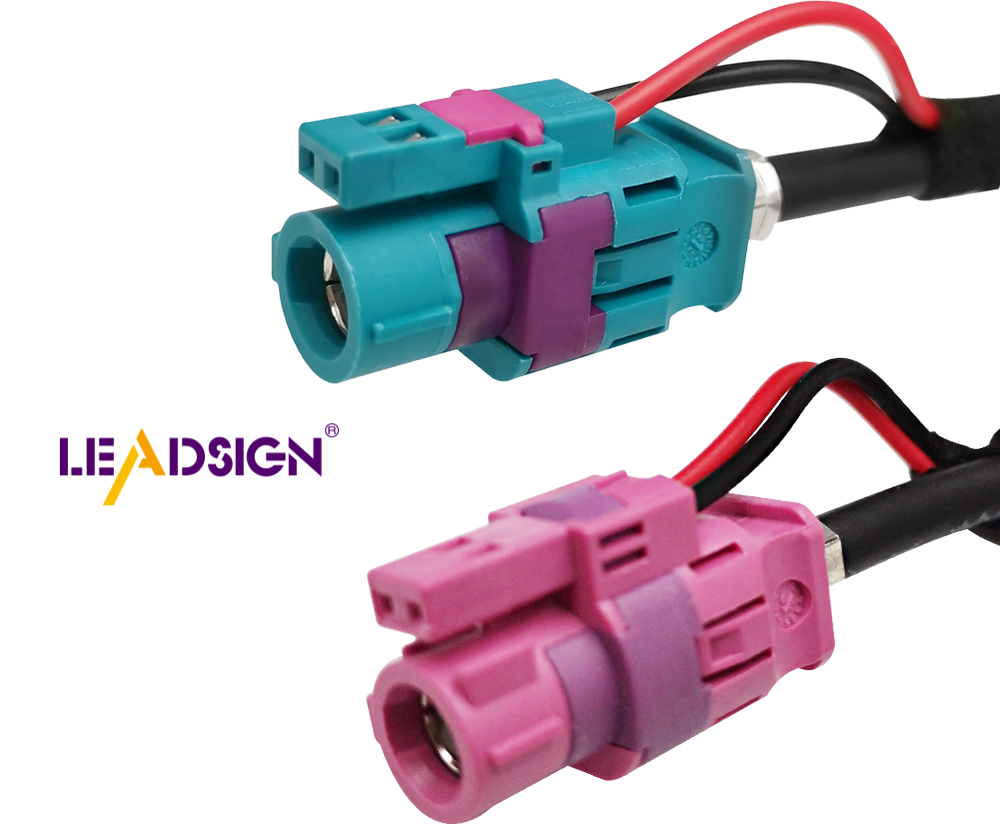
Connectors: HSD (High‑Speed Data) or MATEnet (TE) – both 100Ω differential, locking.
🔹 Electrical and Environmental Robustness
Temperature: -40°C to +105°C (engine bay capable).
Vibration: USCAR‑2 Class 4 (20 G’s).
EMI: Passes automotive EMC requirements (e.g., CISPR 25).
4. Role of Automotive Ethernet in Modern Vehicle Systems
System | How Ethernet helps |
|---|---|
ADAS (cameras, radar, lidar) | High bandwidth for raw sensor data, low latency for real‑time processing. |
Infotainment | Stream video, audio, navigation data between head unit and displays. |
Telematics / OTA updates | Fast download of firmware and software updates. |
Diagnostics | High‑speed reprogramming of ECUs over Ethernet. |
Autonomous driving | Merging multiple sensor streams (4K cameras, lidar) into central computer. |
Impact on wiring harness: Fewer, lighter cables – a single Ethernet pair can replace multiple CAN buses and dedicated video links.
5. Connectors for Automotive Ethernet – HSD & MATEnet
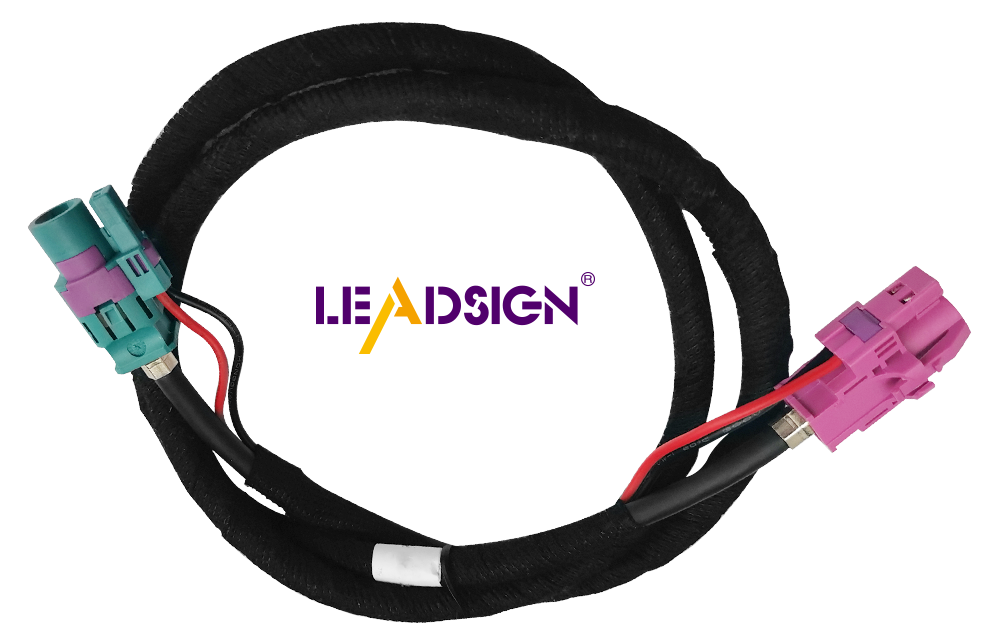
Traditional RJ45 connectors are too large and not vibration‑proof. Automotive Ethernet uses specialised connectors:
Connector family | Data rate | Locking | Sealed | Typical use |
|---|---|---|---|---|
HSD (High‑Speed Data) | 100 Mbps – 1 Gbps | Secondary lock | IP67 optional | Camera, radar, Ethernet backbone |
MATEnet (TE) | 100 Mbps – 1 Gbps | Secondary lock | IP67 optional | Smaller, higher density |
H‑MT (Rosenberger) | 100 Mbps – 1 Gbps | Secondary lock | IP67 | Similar to HSD |
For aftermarket and repair shops: HSD connectors are the most common. LEADSIGN offers pre‑terminated HSD Ethernet cables in custom lengths – no field crimping, guaranteed impedance.
6. Why LEADSIGN – Your Automotive Ethernet Cable Partner
LEADSIGN specialises in HSD (High‑Speed Data) cables for automotive Ethernet, USB‑C, and LVDS applications. We provide pre‑terminated, tested cables that eliminate field‑termination errors.
What LEADSIGN offers for Ethernet:
✅ HSD 100Ω (4‑pin) – compatible with 100BASE‑T1 and 1000BASE‑T1.
✅ Pre‑terminated cables – any length 0.3m – 20m, no field crimping.
✅ Double‑shielded (foil + braid) – for EV/EMI heavy environments.
✅ IP67 optional – for underbody or exterior Ethernet connections.
✅ Bulk pricing – for shops, fleets, and distributors.
For your business: When you repair or install an ADAS camera, radar, or telematics module that uses Ethernet, use LEADSIGN pre‑terminated HSD cables – plug‑and‑play, perfect signal integrity, no callbacks.
Final Recommendations – Automotive Ethernet Cable Selection
Application | Ethernet standard | Recommended connector | Source |
|---|---|---|---|
Backup camera (low resolution) | 100BASE‑T1 | HSD 100Ω | LEADSIGN |
4K surround view camera | 1000BASE‑T1 | HSD 100Ω | LEADSIGN |
Radar / LiDAR sensor | 1000BASE‑T1 | HSD 100Ω (shielded) | LEADSIGN |
Infotainment backbone | 1000BASE‑T1 | HSD or MATEnet | LEADSIGN |
Diagnostic / reprogramming | 100BASE‑T1 | HSD to RJ45 adapter | LEADSIGN (upon request) |
Remember: Automotive Ethernet is the future of in‑vehicle networking. Choosing high‑quality, pre‑terminated HSD cables ensures your repairs and upgrades will perform reliably for years.
Ready to upgrade your Ethernet cable inventory?
See Also
Improving Automotive Data Flow With Innovative Connectors And Cables
Boosting Data Transfer: Significance of Fast Automotive Connectors
Upgrading Automotive HSD Systems Through USB Integration
Improving Automotive Data Transfer Using FAKRA PCB Connectors