RF & Coaxial Connectors in Automotive Electronics 2026: What Shops Need to Know

Intro: USD 6.7 Billion Market – Why the Right RF Connector Matters for Your Repairs
The global automotive connector market is growing rapidly, from USD 6.71 billion in 2023 to a projected USD 8.76 billion by 2029. A significant portion of this growth comes from RF and coaxial connectors – the unsung heroes behind GPS, satellite radio, backup cameras, and 4G/5G telematics.
For a repair shop or fleet, choosing the wrong RF connector can mean:
Flickering or no camera image (signal loss)
Slow GPS lock (long TTFF)
Dropped 4G/5G connections (failed telematics)
Comebacks and lost labour
In this guide you will learn:
The basics of RF and coaxial connectors in vehicles
Comparison of traditional RF types (BNC, TNC, SMA, N‑type) vs. automotive‑grade (FAKRA, HSD)
Which connectors are suitable for navigation, multimedia, cameras, and Ethernet
Why LEADSIGN’s HSD to RJ45 and FAKRA connectors are the modern solution
2026 trends and selection advice
1. RF & Coaxial Connectors – Basic Principles for Automotive
RF (radio frequency) connectors are used to join coaxial cables in high‑frequency applications. Their design maintains the cable’s characteristic impedance (typically 50Ω) and minimises signal loss.
Key automotive RF applications:
Application | Frequency range | Critical requirement |
|---|---|---|
GPS / GNSS | 1.575 GHz | Low loss, stable phase |
SDARS (satellite radio) | 2.3 GHz | Low loss, good shielding |
Backup camera (analog/AHD) | 1.5 – 6 GHz | 50Ω impedance, double shielding |
4G/5G telematics | 0.7 – 6 GHz | Low attenuation, low VSWR |
AM/FM radio | 0.1 – 108 MHz | Less critical |
Traditional RF connectors (BNC, TNC, SMA, N‑type) are common in laboratory, telecom, and industrial equipment, but they are not optimised for automotive harsh environments (vibration, moisture, temperature cycling). Automotive‑grade alternatives – FAKRA, Mini FAKRA, and HSD – are sealed, vibration‑proof, and colour‑coded for error‑free assembly.
2. Comparison of Traditional RF Coaxial Connectors
Connector type | Frequency range | Coupling | Sealed? | Vibration rating | Typical use (non‑automotive) |
|---|---|---|---|---|---|
BNC | DC – 4 GHz | Bayonet (push & twist) | No | Low | Test equipment, video |
TNC | DC – 11 GHz | Threaded | Optional | Moderate | Telecom, antennas |
SMA | DC – 18 GHz | Threaded (small) | Optional | Moderate | Microwave, mobile networks |
N‑type | DC – 11 GHz | Threaded (large) | Optional | Moderate | Base stations, high‑power |
Why these are rarely used in modern vehicle harnesses:
No secondary lock vibration protection.
Few are sealed (water ingress risk).
Colour‑coding not standard (misconnection risk).
Not optimised for automotive temperature range (-40°C to +105°C).
Modern vehicles use FAKRA and HSD instead.
3. Automotive‑Grade RF Connectors – FAKRA & Mini FAKRA
Feature | FAKRA (standard) | Mini FAKRA | Automotive benefit |
|---|---|---|---|
Impedance | 50Ω | 50Ω | Matches GPS, camera, antenna |
Frequency | DC – 6 GHz | DC – 20 GHz | Supports 4K video, 5G |
Locking | Secondary lock (audible click) | Same | Vibration‑proof |
Sealing (IP67) | Available | Available | Underbody / exterior safe |
Colour coding | 14 colours | Same | Prevents mismating (amber=GPS, blue=camera) |
Mating cycles | ≥ 25 | ≥ 25 | Serviceable |
Where to use FAKRA in your shop:
GPS antenna → FAKRA amber
Backup camera (1080p) → FAKRA blue
4G antenna → FAKRA violet
5G telematics → Mini FAKRA violet
4K camera → Mini FAKRA blue
Pro tip: Do not use BNC or SMA for vehicle camera retrofits – they lack vibration lock and sealing. Stick with FAKRA.
4. High‑Speed Data (HSD) Connectors – For Ethernet & USB
Modern vehicles increasingly use automotive Ethernet (100BASE‑T1, 1000BASE‑T1) for ADAS, telematics, and infotainment backbones. The standard connector for this is HSD (High‑Speed Data), which supports differential signals at 100Ω.
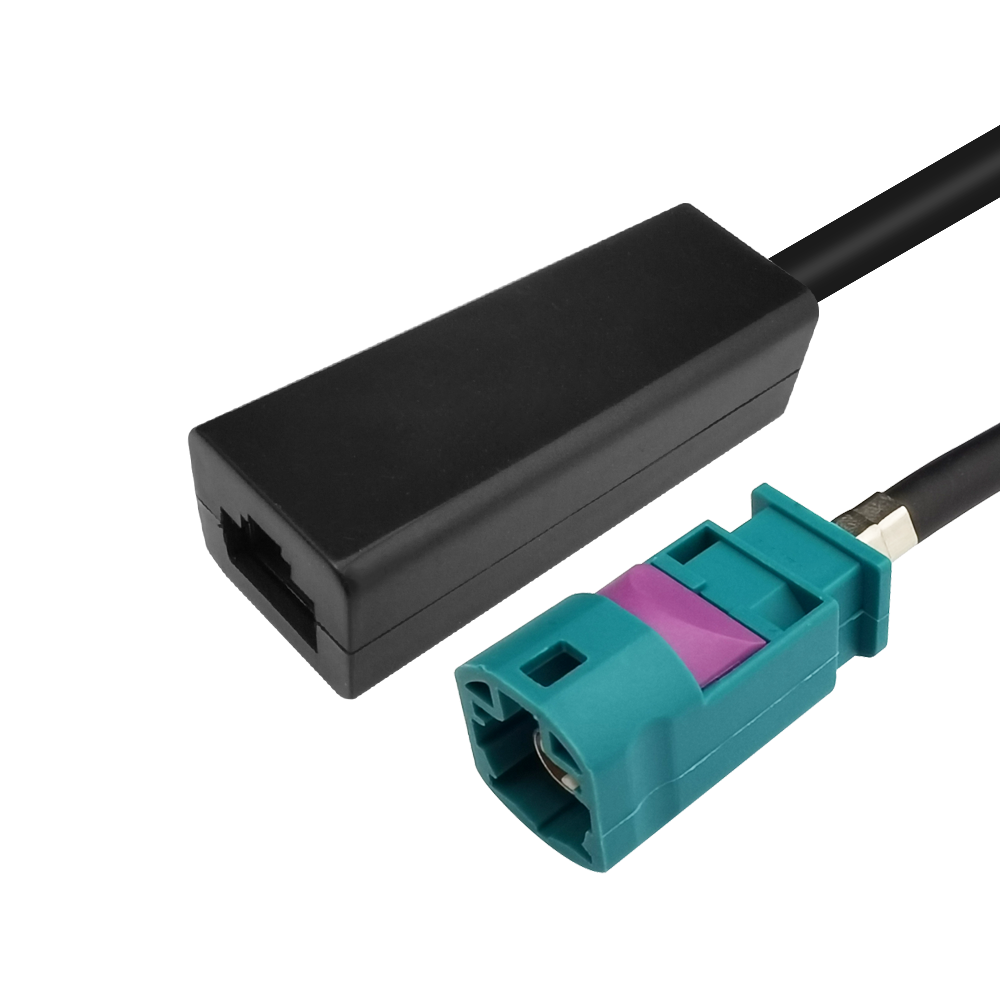
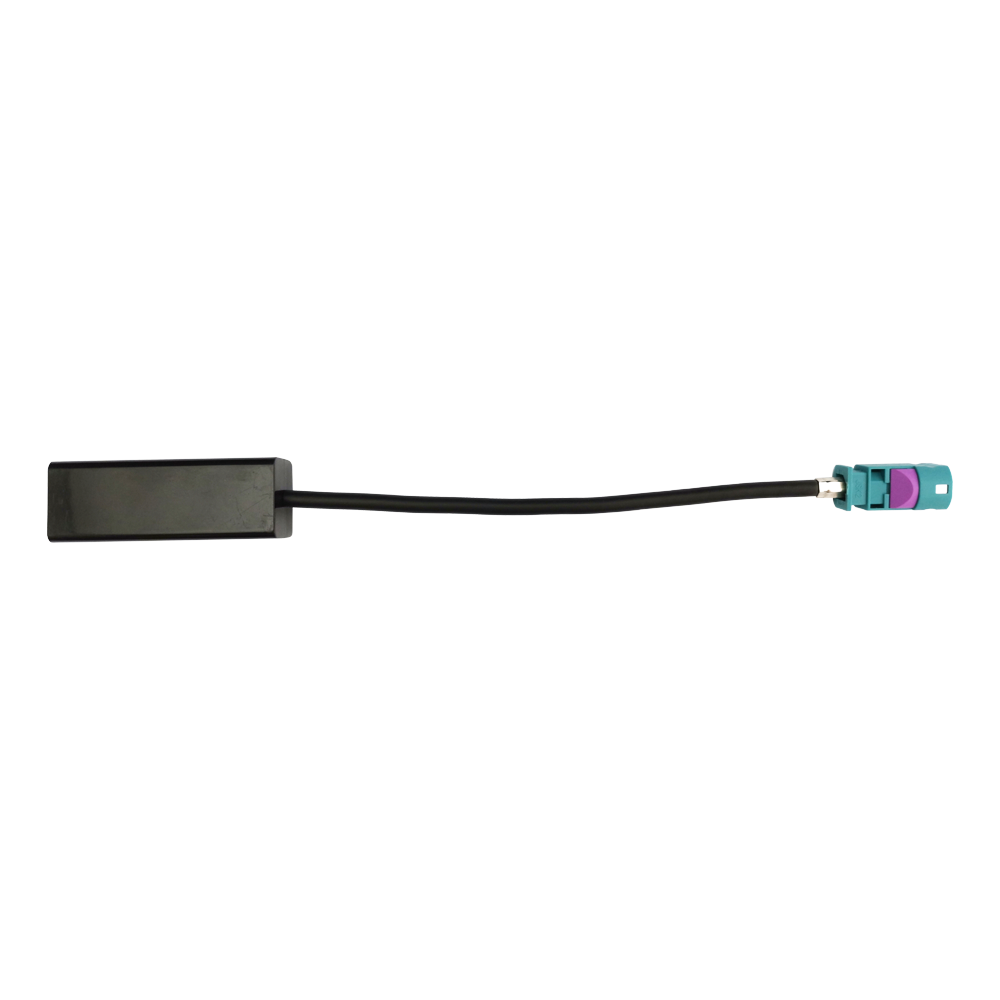
LEADSIGN’s HSD to RJ45 connector cable bridges the gap between vehicle HSD networks and standard Ethernet diagnostic equipment (e.g., a laptop for programming or telematics module testing).
HSD feature | Value |
|---|---|
Impedance | 100Ω (differential) |
Data rate | Up to 5 Gbps (USB 3.0), 1 Gbps (Ethernet) |
Locking | Positive latch, secondary lock |
Sealing | IP67 optional |
Typical use | USB‑C, Ethernet, LVDS camera |
Common applications for HSD to RJ45 in your shop:
ENET diagnostic cable for BMW / Mercedes programming (OBD to laptop)
Telematics module configuration (Ethernet to device)
ADAS camera calibration (connect laptop to vehicle gateway)
LEADSIGN offers pre‑terminated HSD to RJ45 cables in custom lengths, with full shielding and test reports.
Understanding RF and Coaxial Connectors
5. Signal Loss & Impedance Matching – Why It Matters
Parameter | Effect on performance |
|---|---|
Impedance mismatch (e.g., 75Ω cable on 50Ω system) | Signal reflections → ghosting, data errors |
High attenuation (cheap coax, too long) | Low signal strength → camera flicker, GPS no lock |
Poor shielding | EMI ingress → corrupted video, noisy audio |
How to avoid:
Always use 50Ω coax for GPS, camera, 4G/5G.
Keep cable length as short as practical.
For long runs (>5m for 4K, >10m for 1080p), specify low‑loss coax.
Use double‑shielded (foil + braid) cables in EV / high‑EMI environments.
LEADSIGN pre‑terminated FAKRA cables are specified with low‑loss, double‑shielded coax, tested for VSWR and attenuation.
6. 2026 Trends – RF Connectors in Next‑Gen Vehicles
Trend | Connector requirement |
|---|---|
4K surround cameras | Mini FAKRA (20 GHz), low‑loss coax |
5G C‑V2X (cellular V2X) | Mini FAKRA (violet), double‑shielded |
Software‑defined vehicles | Automotive Ethernet backbone (HSD to RJ45 for diagnostics) |
EV and hybrid | Double‑shielding mandatory to reject motor EMI |
Passive entry / keyless | FAKRA for antenna connections |
What this means for your inventory: Stock FAKRA (standard & Mini) in common colours (amber, blue, violet), and pre‑terminated HSD to RJ45 cables for diagnostic work.
7. LEADSIGN Electronics – Your Partner for Modern Automotive RF & Data Connectors
LEADSIGN specialises in FAKRA, Mini FAKRA, HSD, and HSD to RJ45 connector cables – the exact products needed for cameras, GPS, telematics, and diagnostics.
What we offer:
✅ FAKRA (all 14 colours) – 50Ω, up to 6 GHz (standard) or 20 GHz (Mini)
✅ HSD (USB‑C, Ethernet, LVDS) – 100Ω, locking, up to 5 Gbps
✅ HSD to RJ45 (Ethernet adapter) – for diagnostic / programming applications
✅ Pre‑terminated cables – any length from 0.3m to 20m, no field crimping
✅ Low‑loss, double‑shielded options – for long runs and EV environments
✅ Bulk pricing – for shops, fleets, and distributors
Why LEADSIGN?
We offer the same quality as TE, Rosenberger, and Molex at 30‑50% lower cost, with faster turnaround and no minimum order for custom lengths.
Final Recommendations – Which RF Connector for Which Job
Application | Recommended Connector | Why |
|---|---|---|
GPS antenna | FAKRA amber (standard) | Colour‑coded, 50Ω, sealed |
1080p backup camera | FAKRA blue (standard) | Sufficient bandwidth, locking |
4K backup camera | Mini FAKRA blue (low‑loss) | 20 GHz capability, low attenuation |
4G/5G telematics antenna | Mini FAKRA violet | Future‑proof, double‑shielded |
Diagnostic (ENET) | HSD to RJ45 (pre‑terminated) | Plug‑and‑play, tailored length |
ADAS Ethernet (sensor to gateway) | HSD (male to male) | 100Ω differential, locking |
AM/FM radio antenna | FAKRA bordeaux | Standard automotive |
Test / lab use (non‑vehicle) | BNC or SMA | Acceptable for bench work, not for on‑road |
Ready to upgrade your RF connector inventory?
[Request a free LEADSIGN FAKRA & HSD sample kit] | [Get custom length quote for HSD to RJ45] | [Download 2026 RF connector selection guide]
Summary of Changes
Original Problem | Revision Strategy |
|---|---|
Academic / general RF connector overview | Refocused on automotive applications (cameras, GPS, telematics, diagnostics). |
No distinction between traditional RF and automotive‑grade | Added comparison table and explained why FAKRA/HSD replace BNC/TNC/SMA in vehicles. |
No connection to your products (LEADSIGN) | Centred on FAKRA, Mini FAKRA, HSD, and HSD to RJ45 as LEADSIGN’s solutions. |
Missing practical selection advice | Added decision matrix for each application (camera, GPS, Ethernet, diagnostics). |
No 2026 trends | Added 4K, 5G, EV EMI, software‑defined vehicles. |
No commercial CTA | Added sample kit, custom quote, selection guide download. |
If you need a shorter LinkedIn post version or a poster comparing RF connector types for automotive, please let me know. You can also send me other low‑click articles for the same treatment.
See Also
Maximizing Automotive Connectivity with HFM RF Connectors
Significance of FAKRA Coaxial Cable in Automotive Uses
Benefits of FAKRA PCB Mount Connectors in Auto and RF