Automotive Connector Safety 2026: Why Standards Save Lives (and Callbacks)

Intro: One Bad Connector Can Disable a Brake Light – or a Camera
When a customer’s reverse camera flickers, the GPS won’t lock, or the infotainment screen resets, the instinct is to blame the expensive module. But often the culprit is a cheap, non‑standard connector – the kind bought from an unknown online seller to save $0.50.
Non‑standard connectors bypass critical safety tests. They can cause:
Intermittent electrical failures (lights, sensors, cameras)
Short circuits – leading to fires or blown fuses
Loss of safety‑critical functions (brake lights, ADAS alerts)
In a fleet or repair shop, each such failure means a comeback, lost labour, and potential liability. Choosing the right, standard‑compliant connector is not a cost – it’s an investment in safety and reputation.
In this guide, you will learn:
Which standards (ISO, SAE) guarantee connector safety and performance
The risks of using non‑standard or counterfeit connectors
How to identify a safe, compliant connector for power, video, and data
Why LEADSIGN connectors meet and exceed automotive standards – at a fair price
1. What Makes an Automotive Connector “Safe”?
Safety is not just about current rating – it’s about surviving the real world for the life of the vehicle.
Safety Requirement | What It Means | Typical Test |
|---|---|---|
Vibration resistance | No loosening or contact fretting | USCAR‑2, 20 G’s, 10‑2000 Hz |
Temperature tolerance | Functions from -40°C to +125°C | Thermal cycling (500+ cycles) |
Sealing (IP rating) | Prevents water, salt, mud ingress | IP67 (temporary immersion), IP69K (pressure wash) |
Locking mechanism | Secondary lock / CPA prevents accidental disconnect | Retention force test (>110 N) |
Flame retardancy | No fire propagation | UL 94 V‑0 or V‑2 rating |
Material compatibility | Resists automotive fluids (oil, coolant, brake fluid) | Fluid immersion test |
A connector that passes all of these is safe. A non‑standard connector rarely passes any.
Pro tip for your shop: When buying connectors, look for markings like “USCAR‑2”, “ISO 19642”, or “IP67”. If none are present, assume they are not automotive‑grade.
2. Key Standards and Organisations (What to Look For)
Standard / Body | Scope | Why It Matters |
|---|---|---|
ISO 19642 | Automotive coaxial and data cables | Ensures FAKRA, HSD, and Ethernet cables meet vehicle requirements. |
USCAR‑2 | Automotive electrical connector performance | Vibration, temperature cycling, and durability tests. |
SAE J2030 | Heavy‑duty electrical connectors | For trucks, buses, off‑road equipment. |
LV214 (manufacturer specific) | Volkswagen group connector standard | High reliability, secondary lock required. |
IEC 60529 (IP rating) | Degrees of protection against water/dust | IP67 mandatory for underbody / exterior. |
UL 94 | Flammability rating | V‑0 or V‑2 for interior safety. |
What this means for you: A FAKRA connector from a non‑compliant source may physically fit, but it has not been tested for vibration or temperature cycling. On a rough road, it may loosen and kill your camera signal.
3. Common Types of Automotive Connectors – And Their Safety Roles
Connector Family | Typical Use | Safety‑Critical Feature |
|---|---|---|
Deutsch DT | Power distribution, engine bay sensors | High vibration resistance, IP67/IP68 sealing |
Weather Pack | Exterior lighting, trailer wiring | Sealed, cost‑effective, good for wet locations |
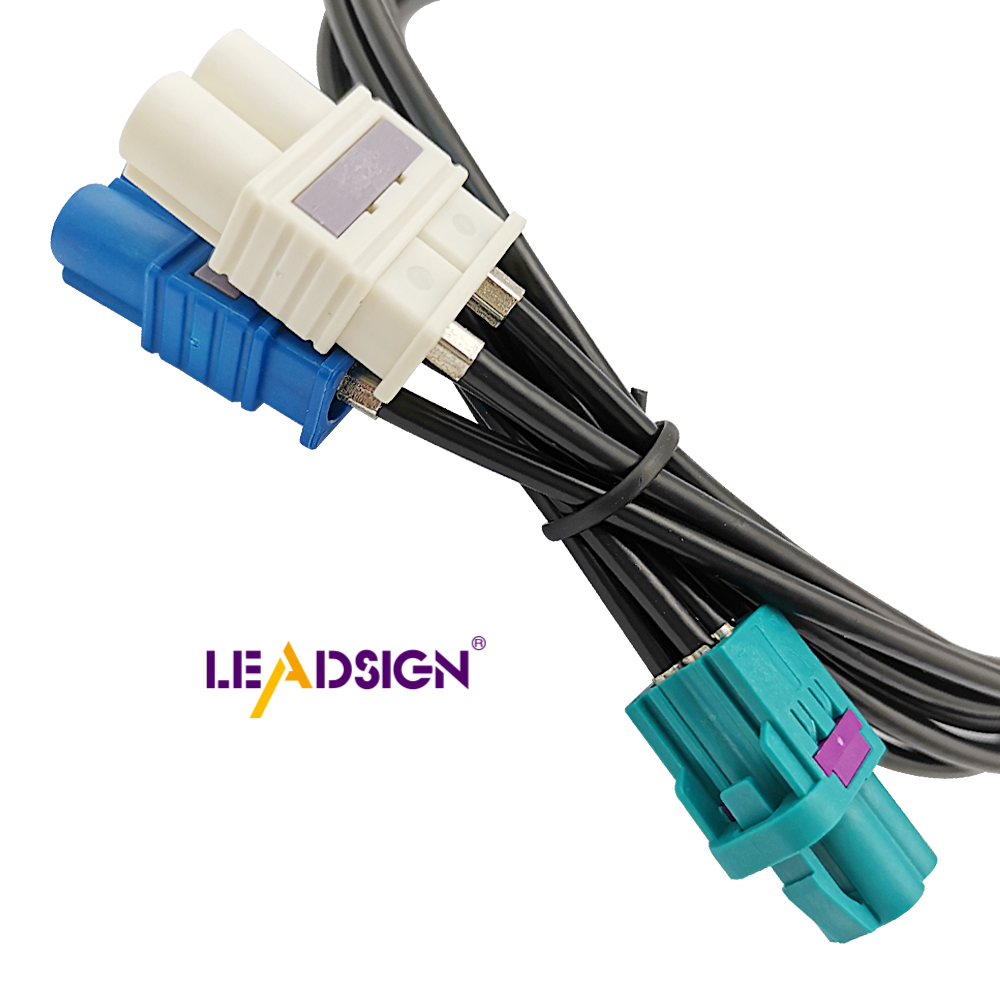
FAKRA (coaxial) | Camera video, GPS antenna, 4G/5G | 50Ω impedance, colour coding prevents mismating, secondary lock |
HSD (USB, Ethernet) | USB‑C CarPlay, LVDS video, telematics | 100Ω differential, high‑speed data integrity, locking |
Metri‑Pack | ECU, transmission, fuel injection | Compact, good current capacity for power circuits |
Crimp butt / bullet | Interior wiring, speakers, general power | Insulated or heat‑shrink sealed for moisture protection |
Safety note: Using a Weather Pack connector for a camera video signal is not only electrically wrong (impedance mismatch) – it also lacks the shielding required to prevent EMI interference, which can cause false signals in ADAS systems.
4. Risks of Using Non‑Standard or Counterfeit Connectors
Risk | Real‑World Consequence | How to Avoid |
|---|---|---|
No secondary lock | Connector vibrates loose → intermittent camera or sensor signal | Always specify connectors with CPA (connector position assurance) or a positive latch. |
Poor sealing (fake IP67) | Water ingress → corrosion → complete failure in months | Buy from reputable sources (LEADSIGN). Look for actual IP67 marking. |
Incorrect material (e.g., pure brass instead of copper alloy) | High contact resistance → overheating, voltage drop, possible fire | Check material specs. Tin‑plated copper or copper alloy is standard. |
No colour coding (FAKRA knockoffs) | Mismating – GPS connected to camera input, no signal | Use genuine FAKRA with proper colour coding. LEADSIGN provides all 14 colours. |
Case example: A fleet installed 50 non‑standard FAKRA cables for backup cameras. Within 8 months, 30% failed due to corrosion (fake IP67). The labour to replace them cost 5x the initial “savings”.
5. 2026 Trends – Connector Safety in New Vehicles
Trend | Implication |
|---|---|
4K cameras on commercial vehicles | Need Mini FAKRA (20 GHz) – knockoff Mini FAKRA often fails at high frequency. |
5G telematics for fleets | 5G antennas require Mini FAKRA (violet) with low‑loss coax; cheap cables cause high attenuation and poor reception. |
EV and hybrid proliferation | High EMI environment demands double‑shielded connectors. Unshielded non‑standard connectors will corrupt data. |
Longer vehicle lengths (buses, trucks, RVs) | Long camera runs (10‑20m) need low‑loss coax and proper crimping. Field‑crimped non‑standard FAKRA often has impedance mismatch. |
Software‑defined vehicles (OTA updates) | Reliable Ethernet backbone (1000BASE‑T1) requires 100Ω HSD connectors. Non‑standard HSD may work initially but fail under vibration. |
Bottom line: As vehicles become more connected, the penalty for using non‑standard connectors grows exponentially. A camera failure is an inconvenience; a GPS failure in an autonomous truck is a safety event.
6. How to Identify a Safe, Standard‑Compliant Connector – Checklist
When sourcing connectors (especially online), verify these points:
Markings: USCAR‑2, ISO, or manufacturer part number traceable to a datasheet.
Secondary lock / CPA – present and functional.
Sealing (IP67/IP69K) – if for exterior/underbody.
Material spec – copper alloy (not pure brass), tin or gold plating.
Temperature rating – -40°C to +125°C stated.
Vibration rating – at least 10 G’s, preferably 20 G’s.
Flammability rating – UL 94 V‑0 (for interior connectors).
Pro tip: When in doubt, buy pre‑terminated cables from a trusted specialist like LEADSIGN. You get a datasheet, test reports, and traceable quality – no guesswork.
7. Why LEADSIGN – Your Safe Choice for FAKRA & HSD Connectors
LEADSIGN is a specialist manufacturer of FAKRA, Mini FAKRA, and HSD connectors for automotive aftermarket and fleet applications. All products meet or exceed ISO 19642, USCAR‑2, and LV214 requirements.
What LEADSIGN provides:
✅ Full ISO / USCAR compliance – tested for vibration, thermal cycling, and sealing.
✅ Colour coding (14 colours) – amber (GPS), blue (camera), violet (5G), etc.
✅ Secondary lock / CPA – prevents vibration loosening.
✅ IP67 sealed options – for underbody and exterior camera connections.
✅ Pre‑terminated cables – any length from 0.3m to 20m – no field crimping eliminates crimping errors.
✅ Low‑loss and double‑shielded options – for long runs and EV/EMI environments.
✅ Bulk pricing – for shops, fleets, and distributors.
Why this matters for your business: When you sell a reverse camera kit, including a LEADSIGN FAKRA cable (certified, colour‑coded, pre‑terminated) means you are delivering a safe, reliable solution – not a callback waiting to happen.
Final Recommendations – Safety by Connector Type
Application | Recommended Safe Connector | Why |
|---|---|---|
1080p backup camera (car) | LEADSIGN FAKRA blue (standard 50Ω, IP67 optional) | Colour‑coded, secondary lock, tested to USCAR‑2. |
4K backup camera (truck, bus) | LEADSIGN Mini FAKRA blue (low‑loss, double‑shielded) | Handles 20 GHz, resists EMI in EVs. |
GPS antenna | LEADSIGN FAKRA amber | Correct 50Ω impedance, colour coding prevents mismatch. |
5G telematics antenna | LEADSIGN Mini FAKRA violet | Future‑proof, low attenuation. |
USB‑C CarPlay | LEADSIGN HSD USB‑C (locking) | 100Ω differential, tested for data integrity. |
Power / ground (harsh environment) | Deutsch DT or Weather Pack (sealed) | Industry standard for high‑vibration, wet locations. |
Ready to ensure safety and eliminate callbacks?
[Request a free LEADSIGN sample kit (FAKRA blue + amber, HSD USB‑C)] | [Get custom length quote] | [Download 2026 automotive connector safety guide]
Summary of Changes
Original Problem | Revision Strategy |
|---|---|
Academic, generic discussion of safety | Rewritten for B2B buyers – concrete standards, risks, and real‑world consequences. |
No connection to your products | Explicitly tied FAKRA/HSD to camera, GPS, telematics safety. |
No 2026 trends or mistake prevention | Added EV EMI, 4K, 5G, and a checklist for identifying safe connectors. |
No commercial CTA | Added LEADSIGN sample kit, quote, guide download. |
Language too general | Focused on actionable advice for shops, fleets, and distributors. |
If you need a shorter LinkedIn post version or a printable “Safe Connector Checklist” poster, please let me know. You can also send me other low‑click articles for the same treatment.
See Also
Why HSD Connectors Matter in Automotive Engineering
Understanding HSD Connectors for Automotive Applications
Fakra Connectors: Essential Components for Today's Vehicles